
Analysis of the Performance in Water Polo Competitions at the World Championships
Journal: Bulletin of Science and Practice @bulletennauki
Section: Социальные и гуманитарные науки
Article in issue: 5 т.12, 2026.
Free access
The article analyzes the impact of recent changes to the World Aquatics rules, in particular, reducing the playing field to 28 meters and increasing the time of possession and re-transmission of the ball to 28 and 18 seconds, respectively. For the analysis, data from the World Water Polo Championships, which were held in Singapore in 2025, and the Games in Fukuoka (Japan) in 2023, were used. The results showed that at the 2025 World Cup in Singapore, men's water polo matches saw a marked increase in offensive performance, with more goals scored and more shots thrown per game, as well as improved goal-to-goal efficiency.
Similar articles in the section Water sports. Aerial sports
Short address: https://sciup.org/14135681
IDS: 14135681 | UDC: 797.253 | DOI: 10.33619/2414-2948/126/66
Анализ выступлений в соревнованиях по водному поло на чемпионате мира
В статье анализируется влияние недавних изменений в правилах Всемирной федерации водных видов спорта, в частности, сокращения игрового поля до 28 метров и увеличения времени владения мячом и его повторной передачи до 28 и 18 секунд соответственно. Для анализа использовались данные чемпионатов мира по водному поло, проходивших в Сингапуре в 2025 году, и Игр в Фукуоке (Япония) в 2023 году. Результаты показали, что на чемпионате мира 2025 года в Сингапуре в матчах мужского водного поло наблюдалось заметное повышение атакующей эффективности: больше забитых голов и больше бросков по воротам за игру, а также улучшена результативность.
Text of the scientific article Analysis of the Performance in Water Polo Competitions at the World Championships
Бюллетень науки и практики / Bulletin of Science and Practice
UDC 797.253
The World Water Polo Championship is an international tournament held under the auspices of World Aquatics (formerly the International Swimming Federation) and is one of the sports included in the World Aquatics Championships program. Since 2001, the World Water Polo Championship has been held biennially in odd-numbered years, gathering athletes from all over the world. While the fundamental rules of the game have not changed for almost 45 years, the demands of modern sport have necessitated significant changes in recent years. Consequently, Olympic sports in each discipline have undergone rule modifications, affecting field size, ball possession time during attacks, player substitutions, and standard positions [1].
By adjusting the rules of water polo, the leaders of the world and European aquatics centers (World Aquatics) have sought to increase the speed of the game, the effectiveness of attacks, and, accordingly, the entertainment value. The main purpose of this study is to analyze and compare the
Бюллетень науки и практики / Bulletin of Science and Practice Т. 12. №5 2026 key performance indicators of two high-level competitions (Fukuoka 2023 and Singapore 2025), providing valuable information to water polo professionals and decision-makers [2-4].
Research materials and methods
To identify the impact of changes in the rules of water polo on the effectiveness of water polo as an Olympic sport, an extensive comparative macroscopic analysis was conducted based on statistical data from men's water polo tournaments at the World Championships in Singapore (2025) and Fukuoka (2023).
Result and discussion
This analysis is based on data collected from the top eight runner-up teams and the twelve matches played in the quarterfinals, semifinals, and finals.
Men’s Game Evolution
|
Singapore 2025 1 |
Comparison based on official OMEGA Statistical Data |
|
Fukuoka 2023 |
Top 8 Teams only (12 games) |
A macroscopic statistical comparison of men's water polo competitions at the World Championships in Singapore in 2025 and Fukuoka in 2023 showed an increase in offensive performance (Figure 1). Changes in the size of the field and the allowed time for attacks contributed to the fact that the number of shots increased and, accordingly, the number of goals scored increased. In Singapore, for example, offensive performance increased significantly in 2025: 18.5% more goals and 12.1% more shots on goal per game (Figure 1).
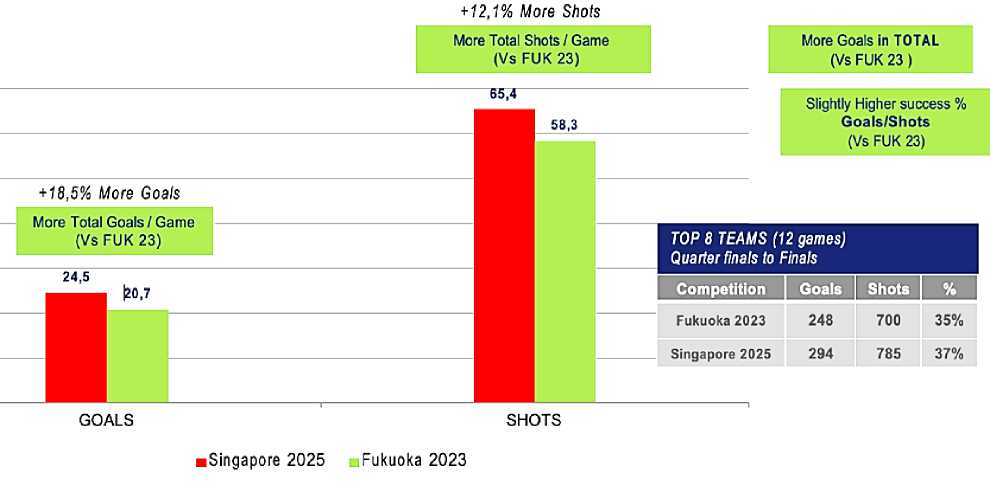
Figure 1 Goals and Shots per Game
A comparative analysis of the average goals scored in key situations at the World Cups in Singapore (2025) and Fukuoka (2023) showed that at the World Cup in Singapore, more goals per game were scored as a result of game moments and 6-on-6 positional situations, as well as 6-on-5
attacks in most cases, while while the number of goals scored due to the actions of the center forward, passes, throws from 6 meters, penalties and counterattacks decreased (Figure 2).
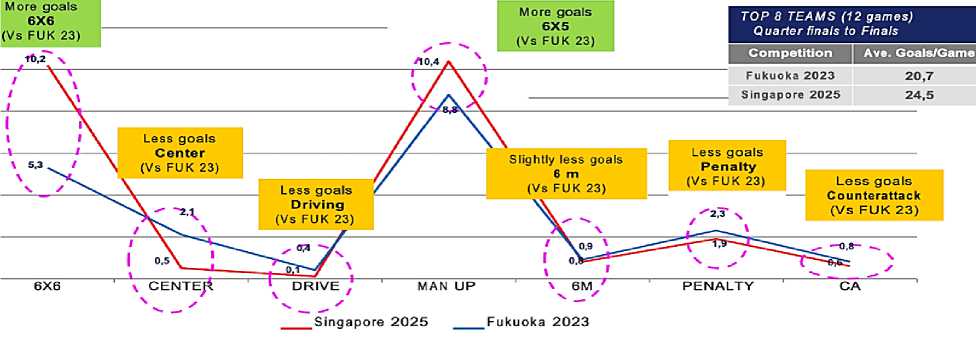
Figure 2 Scoring profile — Goals per Game
This led to a 2% increase in the overall performance on throws (Figure 3).
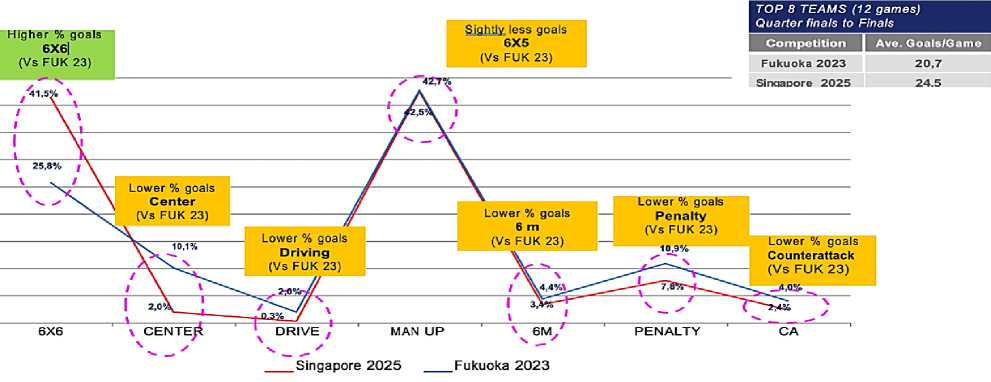
Figure 3 Scoring profile — % Goals per Game
The analysis showed that at the World Cup in Singapore (2025), higher efficiency in games, in the form of a higher percentage (%) of goals scored, was the result of 6-on-6 positional games in which special attention was paid to team attacking strategies. The lower efficiency, in the form of a lower percentage of goals, was the result of scenarios such as the actions of the central striker, circling actions, 6-on-5 situations, free kicks from 6 meters, counterattacks, and penalties. A change in the trend towards exceptions in game moments occurred: the involvement of central forwards increased by 30% and the total number of games on the field was balanced compared with Fukuoka 2023, where the total number of exceptions increased by 20%. At the 2025 World Cup in Singapore, men's water polo matches saw a marked increase in offensive performance, with more goals scored and more shots thrown per game, as well as improved goal-to-goal efficiency. Most of the goals were scored as a result of structured games, such as 6-on-6 positional attacks and 6-on-5 combination situations, while the number of goals scored due to the actions of the center forward, passes, 6-meter shots, penalties, and counterattacks decreased.

An organized 6-on-6 team game resulted in more goals scored, as other attacking strategies proved less effective.
The number of exclusions increased compared to Fukuoka 2023, while the number of players in the central striker position increased significantly, and there was an even distribution of exclusions on the field.
Efficiency in the majority game with a 6:5 power ratio increased significantly, and goals scored (with the exception of 6:5 and penalties) remained the main scoring method, accounting for the total number of goals excluding penalties.
The results obtained are intended to contribute to a deeper understanding of new trends in this sport and its ongoing evolution, especially in light of recent rule changes, including reducing the playing field to 25 meters and increasing the time of possession and re-transmission of the ball to 28 and 18 seconds, respectively.
