
Application of the Six sigma method for quality management of concrete works in construction
Journal: Nanotechnologies in Construction: A Scientific Internet-Journal @nanobuild-en
Section: System solutions for technological problems
Article in issue: 3 Vol.18, 2026.
Free access
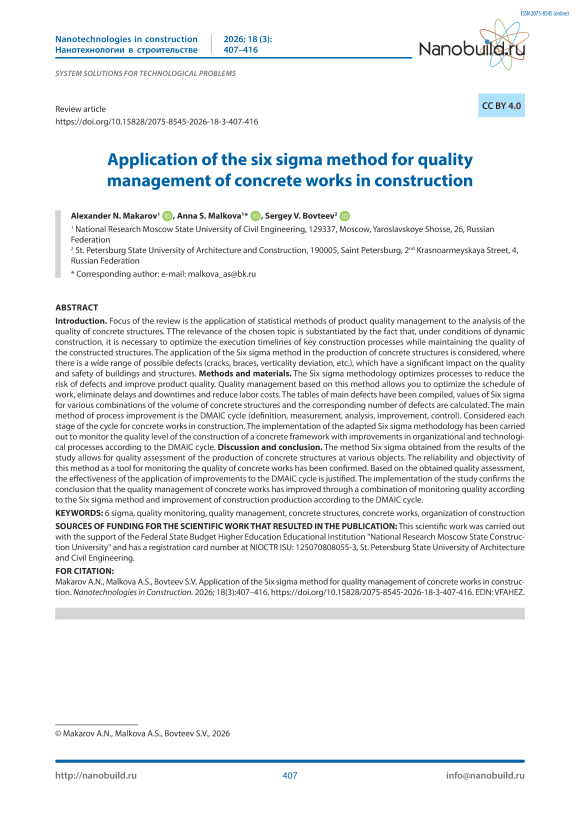
Introduction. Focus of the review is the application of statistical methods of product quality management to the analysis of the quality of concrete structures. TThe relevance of the chosen topic is substantiated by the fact that, under conditions of dynamic construction, it is necessary to optimize the execution timelines of key construction processes while maintaining the quality of the constructed structures. The application of the Six sigma method in the production of concrete structures is considered, where there is a wide range of possible defects (cracks, braces, verticality deviation, etc.), which have a significant impact on the quality and safety of buildings and structures. Methods and materials. The Six sigma methodology optimizes processes to reduce the risk of defects and improve product quality. Quality management based on this method allows you to optimize the schedule of work, eliminate delays and downtimes and reduce labor costs. The tables of main defects have been compiled, values of Six sigma for various combinations of the volume of concrete structures and the corresponding number of defects are calculated. The main method of process improvement is the DMAIC cycle (definition, measurement, analysis, improvement, control). Considered each stage of the cycle for concrete works in construction. The implementation of the adapted Six sigma methodology has been carried out to monitor the quality level of the construction of a concrete framework with improvements in organizational and technological processes according to the DMAIC cycle. Discussion and conclusion. The method Six sigma obtained from the results of the study allows for quality assessment of the production of concrete structures at various objects. The reliability and objectivity of this method as a tool for monitoring the quality of concrete works has been confirmed. Based on the obtained quality assessment, the effectiveness of the application of improvements to the DMAIC cycle is justified. The implementation of the study confirms the conclusion that the quality management of concrete works has improved through a combination of monitoring quality according to the Six sigma method and improvement of construction production according to the DMAIC cycle.
Similar articles in the section Business management, administration. Commercial organization

Short address: https://sciup.org/142248073
IDS: 142248073 | DOI: 10.15828/2075-8545-2026-18-3-407-416
Text of the scientific article Application of the Six sigma method for quality management of concrete works in construction
Review article
Макаров А.Н., Малькова А.С., Бовтеев С.В. Применение метода «6 сигм» для управления качеством бетонных работ в строительстве. Нанотехнологии в строительстве. 2026;18(3):407–416. EDN: VFAHEZ.
To manage product quality, companies in various areas are implementing the global Six sigma quality management methodology to improve organizational performance, identify errors and minimize them [1–3]. This approach is based on the static measurement of a process in the number of defects [4]. The aim of the methodology is to reduce variation in production and business processes to a level corresponding to six standard deviations from the mean [5]. The main tool of the Six sigma methodology is the DMAIC improvement cycle consisting of five steps: determination, measurement, analysis, improvement, control [6–8]. If it is not possible to completely eliminate errors in the process, statistical monitoring will help. It involves the use of control schedules to monitor and analyze deviations within the limits allowed [9]. In construction, the Six sigma method can be used effectively to improve processes such as materials and works quality management, time management and budget [10]. By minimizing deviations from the project, high economic performance and labor costs can be achieved [11]. The methodology has been applied in practice in the fields of production and services – with a view to improving
Nanotechnologies in construction
Нанотехнологии в строительстве
2026; 18 (3): 407–416
Nanob
SYSTEM SOLUTIONS FOR TECHNOLOGICAL PROBLEMS
the quality of products and services, reducing production costs, reducing waiting times [12, 13]. The method was successfully applied in production to improve the quality of galvanized iron treatment: the introduction of an automated zinc layer thickness control system using ultrasonic sensors allowed to reduce coating defects, Increase adhesion and increase line speed. This approach has not only made products more competitive in the market, but also ensured that they meet standards while minimizing corrosion in construction and engineering. The targeted optimization of key parameters in the towelling process has led to a significant increase in output performance -the material removal rate, which is a direct indication of the effectiveness of the approach used [14]. The DMAIC cycle was applied in the foundry industry at the plant to minimize defects and improve market competitiveness: analysis of six-month data revealed critical points, which reduced manufacturing marriage [15]. In Europe and South America, a leading private electricity distribution operator has been using the Six sigma methodology to identify electrical grid stability factors. It helped to distinguish resilience events from reliability events by helping to classify events (high impact, low probability) that threaten the energy system [16]. The DMAIC cycle is closely integrated with lean construction, reinforcing it through data and statistics. Lean Six Sigma’s comprehensive approach is based on the Six sigma methodology and focuses on loss elimination (overproduction, downtime, re-engineering). Low-cost construction tools have already been applied to coal mining. Optimizes processes, eliminates waste and improves product quality by reducing unnecessary operations, resource efficiency and productivity [17, 18]. The Russian construction industry faces development problems due to specificities – seasonality, dependence on weather, multiple subcontractors and difficulties in implementing new management methods – resistance to change, low digitalization, shortage of qualified specialists. The construction organization requires improvements, as domestic companies are losing out to foreign companies in terms of efficiency. Implementation of these approaches in the construction sector is limited so far (unlike mechanical engineering), but experience of domestic practice shows their effectiveness [19]. It is necessary to increase the competitiveness of construction companies through instruments of economical production: elimination of losses, growth of margin without compromising quality; identification of weak points and unnecessary processes. The main shortcoming of new management technologies is a lack of ready-made implementation [20]. The absence of a ready-made DMAIC implementation method is overcome with a step-by-step approach. The DMAIC standard cycle needs to be adapted as a basis for the construction sector. The implementation should start with a pilot project in one process (for example, concrete pouring), assemble a team consisting of the project manager, the project manager and construction control engineers, and allocate resources for implementation. Engineers analyze key problems of the construction industry – high downtimes, overconsumption of materials and low productivity, and propose a set of measures to optimize concrete works based on principles of economical construction [21].
Concrete works make up a significant share of the volume of typical construction projects. At the same time, they have a wide and diverse range of possible defects that have a significant impact on the reliability and safety of buildings and structures. The appearance of defects in concrete construction increases its cost by 15–25% and contributes to a delay in the completion of projects. Therefore, the introduction of modern methods for monitoring and managing the quality of concrete works should increase their efficiency and contribute to sustainable development by minimizing costs and increasing productivity.
METHODS AND MATERIALS
The authors of the study propose the introduction of the Six sigma concept into the construction industry. The aim of the study is to improve the quality of production of concrete structures. Let’s identify the main defects that arise in concrete construction. Consider the main process of construction – concrete work. We will carry out static data collection on the basis of defective statements from a housing construction facility in Moscow.
Number of possible significant and critical defects (non-conformities) per unit for concrete work nCTQC = 20. The following defects are critical – D2, D4, D5, D7, D16, D20, in which case an increasing factor is introduced to calculate by the Six sigma method γb ,1 =3. For the remaining significant defects, the coefficient γb ,2 =1.0.
As part of this study, an analysis was carried out of defective statements obtained during the author and technical supervision of concrete works on three large residential complexes at different stages of construction in Moscow. The aim of the analysis was to statistically identify and quantify the most common defects shown in Fig. 1.
Apply the method 6 sigma, which will allow to systematically analyze the variability of processes through statistical tools, establish strict control criteria, Identify root causes of discrepancies and implement targeted improvements to achieve the level of defects of the respective 5–6 sigma.
Number of defects (non-conformities) per million possible defects [22]. The value YDPMO is calculated by formula (1):
YDPM0 =--—-- 1000000, (1)
nunits*nCTQC where nunits – number of units of products checked (grab of concrete structures);
Nanotechnologies in construction
Нанотехнологии в строительстве
2026; 18 (3): 407–416
SYSTEM SOLUTIONS FOR TECHNOLOGICAL PROBLEMS
Nanob
Nd – number of defects (discrepancies) detected;
nCTQC – number of possible defects (non-conformities) per seizure.
The boundary values are defined in accordance with Annex A [22] and are given in Table 2.
Table 3 is based on the Six sigma methodology, where the number of sigmas reflects the variability of defects in concrete works.
Adapted the DMAIC cycle algorithm (definition, measurement, analysis, improvement, control) for the quality management process of concrete works as shown in Fig. 2.
Stage 1 (Define) involves identifying problem areas that prevent the construction of concrete structures. To improve the quality of manufactured structures, we propose to first identify defects in the packing – 30 concrete mixture. At the next stage, we conduct a defect analysis and perform calculations for the first floor of concrete structures, with subsequent scaling to tiers and the entire building. When
constructing a residential complex, scaling can be extended to all objects carried out by the general contractor within the framework of the complex construction.
Stage 2 (Measure) – measurement of deviations and counting of detected defects for each 30 m3 concrete structure.
Stage 3 (Analyze) – analysis of surveyed structures – determine the values “σ” by the number of detected defects. If, after pouring the first batch of concrete mixture, a significant number of damages was found, and the result is within the range 2–3, 1–2 sims make it necessary to change the production technology for the remaining attachments, applying crucial organizational and technological solutions (OR) to improve quality. If, according to the results of the analysis of sigma in boundaries 3–4, 4–5, then the use of point TRO is required, repair work. If the result is 5–6 sigma, the effect of defects is negligible, and the remaining structures can be constructed using the same technology.
Table 1. Table of defects in concrete works
|
№ |
Name of defects |
|
Concrete work |
|
|
1 |
Discrepancy between the frost resistance, strength, and water permeability parameters of the concrete and the project specifications |
|
2 |
The minimum strength of concrete during the removal of formwork for unloaded structures is less than the specified normative value |
|
3 |
Violation of project requirements and standards regarding the location and design of construction joints during concreting |
|
4 |
Deviations in the thickness of the protective layer exceed the specified norms |
|
5 |
Deviations from the design marks of supporting surfaces in concrete structures exceed the specified values |
|
6 |
Concrete surfaces have voids, pores, and exposed reinforcement |
|
7 |
Delamination of concrete on the surface of the structure |
|
8 |
Bulges and chips on the concrete surface |
|
9 |
Deviation of structural openings from the design position |
|
10 |
Shift of column and support axes relative to layout axes in the support section exceeds the specified values |
|
11 |
Deviation of column axes from vertical in the upper section, depending on the column length, exceeds the specified values |
|
12 |
Discrepancy between the design of openings and holes in concrete structures and the working documentation |
|
13 |
Deviation from straightness and flatness of the surface over a length of 1–3 m, and local unevenness of the concrete surface in concrete structures |
|
14 |
Deviation of horizontal planes across the entire inspected area of the structure |
|
15 |
Deviation of lengths or spans of elements, dimensions in clear openings from specified values |
|
16 |
Deviation of the axes of frame building columns over the entire height of the building from the specified values |
|
17 |
Deviation of the cross-sectional size of element h from the specified value |
|
18 |
The arrangement of anchor bolts does not comply with the standards |
|
19 |
Deviation from the coaxiality of vertical structures |
|
20 |
The width of crack openings in concrete structures exceeds design and specified values |
Table 3. Quality classification of concrete works by sigma
|
Number of sigma (standard deviations of random value) Z value |
Quality of concrete work |
|
1–2 |
Defect. Complete process re-engineering |
|
2–3 |
Low quality. Global improvements needed |
|
3–4 |
Medium quality. Improvements needed |
|
4–6 |
High quality. Does not require improvement |
Table 4. Table of values Y DPMO – number of defects per million possible defects
|
Concrete works |
NUMBER OF CATCH |
|||||||
|
1 |
8 |
10 |
20 |
50 |
80 |
100 |
||
|
N U M B E R O F D E F E C T S |
1 |
5×10⁴ |
6250 |
5×10³ |
2500 |
103 |
625 |
500 |
|
2–6 |
105–3×10⁵ |
12 500–37 500 |
104–3×10⁴ |
5×10³–15×103 |
2000–6000 |
1250–3750 |
103–3×10³ |
|
|
7 |
35×104 |
5 x 10 4 |
35×103 |
17 500 |
7×10³ |
4375 |
3500 |
|
|
10 |
5×10⁵ |
68 750 |
55 555 |
25×103 |
104 |
6250 |
5×10³ |
|
|
15 |
75×103 |
93 750 |
75×103 |
37 500 |
15×103 |
9375 |
7500 |
|
|
20 |
106 |
125×103 |
105 |
5×10⁴ |
2×10⁴ |
12 500 |
104 |
|
|
25 |
125×104 |
156 250 |
125×103 |
62 500 |
25×103 |
15 625 |
12 500 |
|
|
30 |
15×105 |
187 500 |
15×104 |
75×103 |
3×10⁴ |
18 750 |
15×103 |
|
|
35 |
175×104 |
218 750 |
175×103 |
87 500 |
35×103 |
21 875 |
17 500 |
|
|
40 |
2×10⁶ |
25×104 |
2×10⁵ |
105 |
4×10⁴ |
25×103 |
2×10⁴ |
|
|
45 |
225×104 |
281 250 |
225×103 |
112 500 |
45×103 |
28 125 |
22 500 |
|
|
50 |
25×105 |
312 500 |
25×104 |
125×103 |
5×10⁴ |
31 250 |
25×103 |
|
Table 6. Defects of concrete structures, 1st stage of quality recording of completed works
|
Defect No. |
Description of the defect |
Type of defect |
|
D1 |
Concrete strength parameter mismatch |
Significant |
|
D6 |
Concrete surfaces have washbasins |
Significant |
|
D7 |
Concrete delamination on the structure surface |
Critical |
|
D11 |
Column axis deviation from vertical in upper section exceeds normative values depending on column length |
Significant |
|
D12 |
Nonconformity of the device of openings, holes in concrete work documentation structures |
Significant |
|
D19 |
Verticality deviation of structural elements |
Significant |
|
D20 |
The width of crack opening in concrete structures exceeds standard values |
Critical |
Table 7. OTR complex for eliminating defects in concrete work
|
Defect code |
Name of defect |
Organizational and technological solutions to prevent defects |
|
D1 |
Concrete strength settings are inconsistent with the project |
|
|
D6 |
Concrete surfaces have washbasins |
|
|
D11 |
Column axis deflection from vertical |
|
|
D12 |
Nonconformity of the device of openings, holes |
|
|
D20 |
Crack clearance width is higher than normal |
|
Nanotechnologies in construction
Нанотехнологии в строительстве
2026; 18 (3): 407–416
SYSTEM SOLUTIONS FOR TECHNOLOGICAL PROBLEMS
Nanob
has a borderline value. In turn, site 3’s sigma is the lowest of the table and corresponds to an average level of quality, which requires significant changes in approach to concrete work. It is worth noting that relative quality indicators Nd,z и N for this object also has the worst values.
d,100
DISCUSSION
The authors of the study first applied the Six sigma method in construction quality control on concrete works. Assessment of the quality level according to the proposed method and comparison with classical indicators, such as number of defects, number of defects per 100 m3 of concrete ( Nd,100 ) and for the hike ( Nd,z ). Classical metrics do not set limits on the range of values to translate quantitative into qualitative, which is necessary for decision-making. It is possible to establish such boundaries in an expert way. The authors have established these boundaries using the corresponding sigma boundaries. The metric comparison is shown in Table 10.
When analyzing the table, it is found that the selected ranges of the peaks correspond to the relative ranges of the indicators determined by experts. The adapted 6-sigma assessment method has several advantages over known metrics:
– takes into account the influence of significant and critical defects through the introduction of a weighting factor;
– resistant to fluctuations in indirect characteristics such as concrete volume and number of packings;
– is more sensitive to fluctuations in the number of defects and gives more representative values compared to relative quality indicators.
Thus, the Six sigma method is more sensitive to types and number of defects, depending less on indirect characteristics (volume of concrete and quantity of material), than relative quality indicators Nd,z и Nd,10 . The ranges of sigma values are mathematically formalized, limited to representative values, and explicitly translated into qualitative indicators.
Table 8. The result of calculating the value of a sigma before and after organizational and technical work
|
No. |
Indicator name |
Value of indicator before organizational and technical work |
Value of indicator after organizational and technical work |
|
1 |
Number of hikes |
10 |
20 |
|
2 |
Volume of concrete |
300 |
600 |
|
3 |
Number of defects |
7 |
2 |
|
critical |
2 |
– |
|
|
significant |
5 |
2 |
|
|
4 |
DPMO |
55 000 |
5000 |
|
5 |
Sigma |
3.1 |
4.08 |
|
6 |
Nd,100 |
2.3 |
0.3 |
|
7 |
N d,z |
0.7 |
0.1 |
Table 9. Pivot analysis of defects in concrete works on objects
|
Object |
Total area, m2 |
Volume of concrete |
Number of hikes |
Number of comments, N d |
Number of comment of hikes, N d,z |
Number of comments per 100 m3, N d,100 |
Y DPMO |
Sigma, Z value |
|
No. 1 |
92 208 |
42 680 |
711 |
90 |
0.13 |
0.21 |
6300 |
3.99 |
|
No. 2 |
112 776 |
33 009 |
550 |
37 |
0.07 |
0.11 |
3363 |
4.21 |
|
No. 3 |
31 305 |
16 177 |
270 |
84 |
0.31 |
0.52 |
15 555 |
3.66 |
Table 10. Comparison of metrics for assessing the quality of concrete works
|
Z value |
N d,100 |
N d,z |
Qualitative indicator |
|
1–2 |
20–46 |
6–14 |
Defect. A complete re–engineering of processes |
|
2–3 |
4–20 |
1–6 |
Poor quality. Global improvements required |
|
3–4 |
0.4–4 |
0.1–1 |
Medium quality. Improvements needed |
|
4–6 |
0–0.4 |
0–0.1 |
High quality. No need for improvement |
Nanotechnologies in construction
Нанотехнологии в строительстве
2026; 18 (3): 407–416
Nanob
SYSTEM SOLUTIONS FOR TECHNOLOGICAL PROBLEMS
The use of the Six sigma method within the DMAIC cycle allows for its continuity and inclusiveness, which is important in the paradigm of low-cost construction, and enables continuous improvements to be achieved until an investor achieves a level of quality of final products.
CONCLUSION
The Six sigma methodology is a systematic approach to assessing and monitoring the quality of concrete structures, which has high reliability and representativeness compared with existing methods. The article demon-
strates the effectiveness of the application of the DMAIC cycle in a complex with an adapted evaluation method Six sigma. The integration of these methods allows for improving the efficiency of quality management in concrete works during the construction of buildings made of concrete reinforced concrete, and contributes to the refinement of traditional quality control methods. This monitoring and decision-making tool contributes to the continuous improvement of construction organization, effective quality management, minimization of defects and achieving a qualitatively new level of reliability of construction objects.
