
Beyond Charon’s Obol: Coin and Coin-Like Depositions in Funerary Assemblages at Parion from the Classical to the Roman Period
Журнал: Материалы по археологии и истории античного и средневекового Причерноморья @maiask
Рубрика: Нумизматика
Статья в выпуске: 22, 2026 года.
Бесплатный доступ
This article examines funerary monetary deposition in 75 documented contexts from the South/Tavşandere Necropolis of Parion, dated from the Late Classical/Early Hellenistic to the Roman Imperial period. The dataset is analysed at context level and distinguishes ordinary struck coins, coin-like objects, and modified monetary deposits, while keeping coin issue date separate from grave/context date. The evidence is dominated by in-mouth bronze coins, but the corpus also includes multi-coin mouth and near-mouth deposits, indeterminate micro-locations, gold coin-impression foils, a dolphin-shaped cast object, and foil-gilded bronze coins. The study argues that Charon’s obol remains a useful interpretation only where object category, placement, burial mode, and archaeological association support it. Parion thus offers a well-documented corpus for examining how coins, coin images, and transformed monetary forms entered funerary practice.
Короткий адрес: https://sciup.org/14139210
IDS: 14139210 | DOI: 10.53737/2713-2021.2026.49.40.017
За пределами обола Харона: монеты и монетоподобные вложения в погребальных комплексах Париона от классической эпохи до римского периода
Погребальные монетные вложения из Южного (Тавшандере) некрополя Париона представлены 75 документированными контекстами, датируемыми от позднеклассического/раннеэллинистического времени до римского императорского периода. Материал анализируется на уровне погребального контекста; при этом разграничиваются обычные чеканные монеты, монетоподобные предметы и модифицированные денежные вложения, а дата выпуска монеты не отождествляется с датой погребения. Данные показывают выраженную концентрацию бронзовых монет, помещённых в рот умершего, но тот же корпус включает многомонетные вложения в полости рта и рядом с ней неопределённые микролокации, золотые фольги с монетными оттисками, литой предмет в форме дельфина и бронзовые монеты с позолотой. В работе обосновывается тезис о том, что интерпретация находки как «обола Харона» правомерна лишь тогда, когда она подтверждается категорией предмета, его расположением, типом погребения и археологическим контекстом. Таким образом, материалы Париона представляют собой хорошо документированную базу для изучения того, как монеты, их изображения и трансформированные денежные формы проникали в погребальную практику.
Текст научной статьи Beyond Charon’s Obol: Coin and Coin-Like Depositions in Funerary Assemblages at Parion from the Classical to the Roman Period
Coins recovered from graves have long been interpreted through the familiar framework of Charon’s obol, especially when a low-value coin is found in or near the mouth of the deceased. The literary tradition gives this model considerable force, but the archaeological record is more varied than the literary image alone can explain. Stevens remains fundamental in this respect: she distinguishes the relatively coherent literary formulation of Charon’s fare from the diversity of cemetery evidence, where coins may occur in different numbers, metals, placements, and depositional circumstances (Stevens 1991: 215—216). Her warning that funerary coins should be read case by case, rather than forced into a single explanation, provides the methodological starting point for this article (Stevens 1991: 227).
Recent work in funerary numismatics has strengthened this contextual approach. Coins in graves are not only chronological indicators or illustrations of a mythological passage; they are archaeological objects whose interpretation depends on placement, number, condition, burial mode, associated grave goods, and the quality of contextual recording. Doyen’s methodological reflections on the topology, packaging, and mise en scène of monetary deposits, Brown’s variable-based analysis of coin deposition in burials, and Van Andringa’s emphasis on depositional sequence and stratigraphic recording together show why funerary coins must be interpreted through context rather than object type alone (Doyen 2012: i—x; Brown 2008: 122; 2013: 11—13; Van Andringa 2019: 509—511).
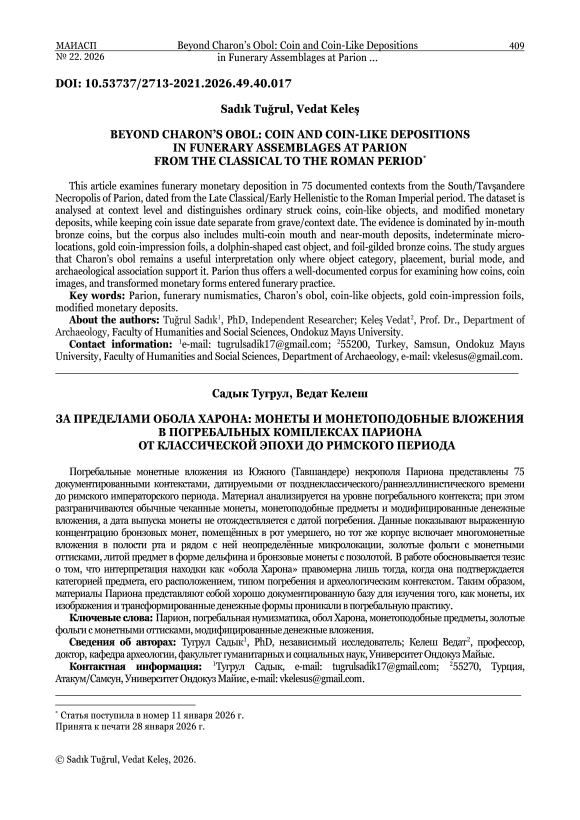
The South/Tavşandere Necropolis of Parion provides a useful case for reassessing these issues. Parion 1 lies in northwestern Anatolia, within the Troas—Propontic landscape and in close relation to the Hellespontine and northern Aegean worlds (Fig. 1). The South/Tavşandere Necropolis, located approximately 1 km south of the city centre, was first identified during the 2004 salvage excavations and has since been investigated through systematic excavation; previous work has discussed its topography, grave typology, and funerary development across the Archaic to Roman phases, while the monetary contexts are analysed here systematically for the first time (Kaba 2021: 145—146; Kasapoğlu 2022: 261—266; Tuğrul 2024: 1—5). The corpus examined here consists of 75 documented funerary contexts containing ordinary struck coins, coin-like objects, or modified monetary deposits from the Late Classical/Early Hellenistic to the Roman Imperial period. It is not intended to measure the overall frequency of coin deposition across the entire necropolis, but to analyse the internal variation of contexts in which monetary or monetary-looking objects were recorded.
The Parion material is particularly relevant here because it brings together a marked mouth-related pattern and several object categories that are not best understood as ordinary coins. Ordinary struck bronze coins form the largest part of the corpus, especially in Roman Imperial contexts. Yet the dataset also includes gold coin-impression foils, a dolphin-shaped cast object, and foil-gilded struck bronze coins. Earlier discussions associated some Parion gold objects with the Kharon tradition, but Keleş re-evaluated them through technique, function, and iconography, while Çelikbaş later argued that labels such as “impression coin” and “Kharon coin” are misleading for these appliqué-like objects (Keleş 2014: 117—118; Çelikbaş 2020: 257). The present article therefore uses the descriptive term gold coin-impression foil and treats these objects as coin-like objects rather than as ordinary struck coins. The spelling Charon is used throughout, except when referring to earlier terminology that explicitly used Kharon.
МАИАСП № 22. 2026
Beyond Charon’s Obol: Coin and Coin-Like Depositions in Funerary Assemblages at Parion ...
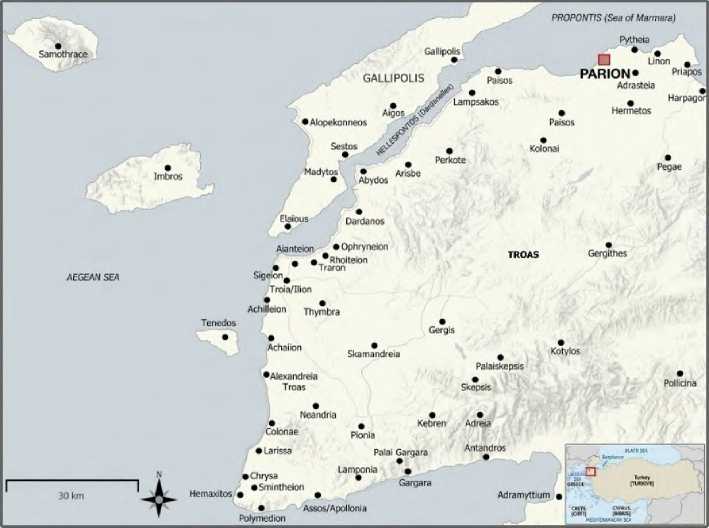
Fig. 1. Regional map showing the location of Parion in the Troas.
This article examines how far the Charon model can account for the Parion evidence, how coinlike objects and modified monetary deposits alter the interpretation of funerary monetary practice, and what this dataset contributes to wider regional discussions of coins, coin images, and transformed monetary forms in burial contexts. Its central argument is that Parion cannot be explained through a single Charon’s obol model. Secure in-mouth ordinary struck coins provide the clearest basis for such a reading, but other contexts require interpretation through object category, placement, burial mode, and contextual confidence. The article first sets out the dataset and method, then examines chronological distribution, placement, object category, and demographic visibility before turning to the limits of Charon’s obol, the role of coin-like and modified monetary forms, and Parion’s place within regional funerary numismatic practice.
Materials and methods
This study is based on an analytical dataset of 75 documented funerary contexts from the South/Tavşandere Necropolis of Parion that contain ordinary struck coins, coin-like objects, or modified monetary deposits. The dataset was compiled from the Parion excavation archive and catalogue records.
According to the Parion excavation archive, the wider assessable cemetery archive currently comprises 289 documented graves from the 2005—2025 excavation seasons, excluding heavily destroyed graves whose contexts could not be reliably evaluated. This figure reflects the excavation archive as updated through the 2025 season. The 75 contexts analysed here represent only those funerary contexts in which an ordinary struck coin, a coin-like object, or a modified monetary deposit was recorded in the excavation archive or catalogue. They constitute c. 26% of the currently assessable 289-grave archive; this ratio, however, reflects only the proportion of documented monetary or monetary-looking contexts within the excavation archive and should not be treated as the cemetery-wide frequency of coin deposition. Isolated coins recovered from the necropolis area without secure funerary-context association are therefore not included. The dataset is consequently
МАИАСП № 22. 2026
a monetary-context sample, not a proportional sample for calculating the overall frequency of coin deposition across the cemetery as a whole.
The broader Hellenistic and Roman burial contexts of the South/Tavşandere Necropolis have been discussed elsewhere, on the basis of the 2005—2023 excavation data (Tuğrul 2024). The present study isolates the monetary contexts as a distinct analytical dataset. Some Late Classical—Early Hellenistic contexts included here are incorporated on the basis of excavation archive documentation and have not yet been fully published as grave contexts. The primary unit of analysis is the funerary context rather than the individual object, since several contexts contain more than one monetary or monetary-looking item. The location of the South/Tavşandere Necropolis within the site of Parion is shown in the site plan (Fig. 2).
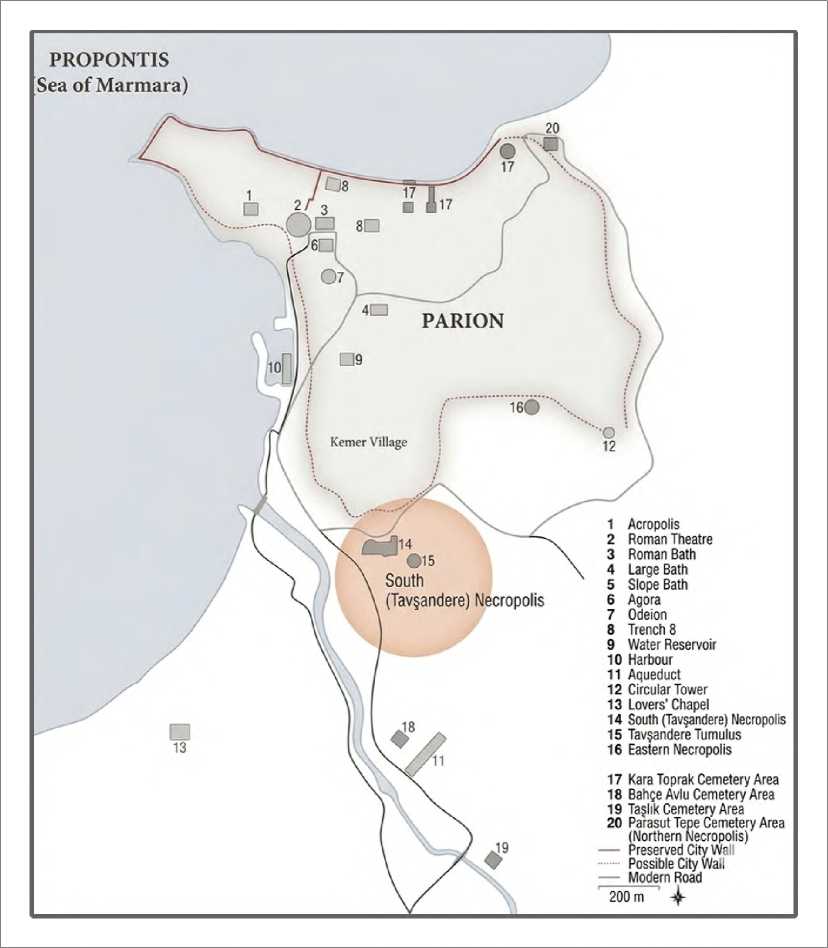
Fig. 2. Site plan of Parion showing the location of the South/Tavşandere Necropolis.
Grave and context codes follow the Parion excavation catalogue and are retained to preserve the link with the field records. The prefixes also indicate grave construction type: DSM, İSM, and İKM refer to tile graves; BTM to simple earth graves; ATM to wooden coffin or wooden bier graves;
МАИАСП № 22. 2026
Beyond Charon’s Obol: Coin and Coin-Like Depositions in Funerary Assemblages at Parion ...
TSM to stone-cist graves; THM to stone-built chamber graves; TOM to stone-built chamber tombs; AntM to monumental tombs; and UM to urn graves.
The chronological and contextual assessment of each grave is based on the excavation archive, catalogue records, grave typology, associated finds, and, where available, stratigraphic or superpositional relationships. The present article does not attempt a full stratigraphic reconstruction of the South/Tavşandere Necropolis. Stratigraphic information is used only where it affects context date, contextual security, or the interpretation of a deposit. The grave-code prefixes used in the catalogue identify construction type and archival context; they are not treated as spatial sectors or as equivalent analytical units for formal intra-site spatial analysis. No spatial clustering of monetary deposition is therefore inferred unless it is supported by secure contextual evidence independent of the code prefix.
Each context was coded according to a standardized set of variables: grave/context date, grave type, burial mode, burial grouping, age category, sex where recorded, monetary object type and count, depositional micro-location, and associated grave goods. This procedure follows contextual approaches to funerary numismatics in which coins are assessed not only as numismatic objects, but also through their archaeological association, placement, number, material, condition, and relation to the burial assemblage. Brown’s work is important in this respect because it treats coin use in burials through variables such as burial type, sex and age of the deceased, burial date, number of coins, date of issue, position in the grave, metal, denomination, obverse and reverse type, wear, piercing, and associated grave goods (Brown 2008: 122; 2013: 11—13). Doyen’s methodological framework is likewise relevant because it foregrounds the topology of monetary offerings, the packaging and mise en scène of coins, burned or unburned condition, protected coins, purses, stacking, denomination, type selection, and manipulation (Doyen 2012: vii—xv).
The dataset distinguishes three analytical categories. Ordinary struck coins are standard struck coins recorded without additional modification or coin-like transformation. In the present dataset, this category consists of bronze coins; gold occurs only as coin-impression foils or as foil applied to modified bronze coins. Coin-like objects are monetary-looking objects that are not ordinary struck coins; at Parion these include the gold coin-impression foils and the dolphin-shaped cast object. This category includes two technically distinct subgroups: image-bearing gold coin-impression foils and a non-struck dolphin-shaped cast monetary-looking object. They are grouped together only because both fall outside the category of unmodified struck coin deposition: neither is an unmodified struck coin, and both introduce monetary form, monetary imagery, or an association with value into the funerary context. The category therefore does not imply technical homogeneity; the gold foils and the dolphin-shaped cast object are treated separately wherever their material form, production, and placement require different interpretation. The terminology used for the gold foils follows the reassessment of the Parion gold objects by Keleş and Çelikbaş, who questioned earlier identifications of these objects as “Kharon coins” or ordinary funerary coins and emphasised their technical and decorative character (Keleş 2014: 117—118; Çelikbaş 2020: 257). Modified monetary deposits are struck coins whose material appearance was altered before or during funerary use; in the present dataset this category is represented by foil-gilded struck bronze coins. These categories are analytical, not hierarchical, and prevent technically different objects from being collapsed into a single undifferentiated group of “coins in graves”.
Numismatic attribution of ordinary struck coins was recorded where preservation permitted, including mint or issuing authority, obverse and reverse type, and broad issue date. Uncertain or low-condition coins are treated qualitatively rather than through a formal confidence scale. Denomination, weight, diameter, and wear could not be assessed consistently across the full dataset because preservation, corrosion, legibility, and the availability of archival measurements vary from object to object. These variables are therefore not used as independent analytical variables.
Grave/context date is treated as the primary chronological variable. Coin mint date is not used as a substitute for the archaeological date of the burial context. This distinction is necessary because a coin may have circulated, been curated, reused, or entered the grave residually before deposition;
МАИАСП № 22. 2026
Brown’s treatment of the interval between coin date and burial date provides an important methodological precedent for keeping these variables separate (Brown 2013: 102—103).
Depositional placement is recorded only at the level supported by the excavation record. In-mouth, near-mouth, hand, chest, multiple body-related, vessel-associated, exterior, and indeterminate placements are therefore kept separate. No more precise anatomical position is inferred where it was not documented. This is particularly important for cremation deposits, disturbed contexts, multiple burials, and secondary burial units contained within another funerary context, where the relationship between the monetary object and a specific body may be archaeologically less visible. Van Andringa’s emphasis on stratigraphic recording and on the position of the coin within the ritual sequence is especially relevant here, since the meaning of a coin deposit depends on when and how it entered the burial procedure, not simply on the object’s presence in a grave (Van Andringa 2019: 509—511). Duchemin similarly stresses that the interpretation of funerary coin deposition requires attention to archaeological micro-context and performed gesture rather than reliance on a generalised mythological explanation (Duchemin 2019: 31, 35).
Age and sex are used only where the relationship between the monetary object and an individual can be assessed with sufficient confidence. For this reason, pooled demographic analysis is restricted to the single-burial subset. Multiple and collective contexts, as well as secondary burial units contained within another funerary context, remain part of the full dataset and are retained for contextual interpretation, but they are excluded from pooled individual-based demographic counts. Explicit individual associations recorded within such contexts are discussed only at context level. This distinction is essential for cases such as TOM 1 and THM 1, where individual-level associations are recorded, and for UM 1, which is a secondary urn context within TSM 1. Singleburial contexts contain one recorded individual; multiple or collective contexts contain more than one individual or a group-level burial association; secondary burial units contained within another funerary context are treated separately, as in UM 1 within TSM 1.
Interpretive confidence is calibrated according to object category, placement precision, burial mode, contextual security, and attribution level. In-mouth placements, and in some cases nearmouth placements, provide the clearest positional basis for a Charon-type reading, but such an interpretation is not assigned automatically. Charon’s obol is therefore treated here as a graded interpretive possibility rather than as a default classification.
Results
Composition and Broad Chronological Distribution of the Dataset
The dataset analysed here consists of 75 documented funerary contexts from the South/Tavşandere Necropolis, each containing at least one ordinary struck coin, coin-like object, or modified monetary deposit. The counts presented in this section are context counts, not object counts, since several contexts contained more than one monetary or monetary-looking item. Table 1 distinguishes contexts with ordinary struck coins only, contexts with coin-like objects only, and contexts with ordinary struck coins and modified monetary deposits.
Table 1 shows a strongly uneven chronological distribution. Roman Imperial contexts form the largest part of the dataset, with 62 of 75 contexts, and are overwhelmingly represented by ordinary struck bronze coins. The earlier phases are numerically smaller, but they are analytically important because most coin-like objects belong to Late Classical—Early Hellenistic or Hellenistic contexts. The two contexts combining ordinary struck coins and modified monetary deposits belong to the Roman Imperial group.
МАИАСП № 22. 2026
Beyond Charon’s Obol: Coin and Coin-Like Depositions in Funerary Assemblages at Parion ...
Table 1. Composition and broad chronological distribution of the monetary dataset from the South/Tavşandere Necropolis of Parion 2 .
|
Period |
Contexts with ordinary struck coins only |
Contexts with coinlike objects only |
Contexts with ordinary struck coins and modified monetary deposits |
Total contexts |
% of dataset |
|
Late Classical—Early Hellenistic |
1 |
5 |
0 |
6 |
8.0 |
|
Hellenistic |
3 |
1 |
0 |
4 |
5.3 |
|
Late Hellenistic—Early Imperial |
3 |
0 |
0 |
3 |
4.0 |
|
Roman Imperial |
60 |
0 |
2 |
62 |
82.7 |
|
TOTAL |
67 |
6 |
2 |
75 |
100.0 |
Among the identifiable ordinary struck coins in the excavation records underlying this study, Parion civic, colonial, and secondary/countermarked bronze issues form the most visible group. These include earlier civic types, Caesarian colonial issues, and Roman colonial or secondary issues, especially coins with ploughing or colonial foundation reverse types. A single non-Parion regional attribution, represented by an Adramytteion coin, is noted here only to show that the funerary corpus was not composed exclusively of Parion issues; it is insufficient for reconstructing a regional selection pattern. Many coins remain low-condition or insufficiently legible for secure attribution. Capricorn-countermarked Parion secondary issues occur within the corpus, including mouth-related deposits, but they are not confined to that placement category and should not be treated as a funerary selection marker. The available ordinary struck coin data do not point to a narrowly selected funerary coin type. Rather, they suggest the use of available bronze coins from local circulation, with limited evidence for a wider regional component; the clearest Charon-compatible cases are defined by placement and bodily association rather than primarily by mint or iconographic type.
This distribution should not be read as a linear development from coin-like forms to ordinary struck coin deposition. The chronological groups are uneven in size, and the objects differ technically and contextually. DSM 16 is grouped here within the Hellenistic category because its grave/context date falls within the 2nd — 1st century BCE and does not extend into the Imperial period; the Late Hellenistic—Early Imperial group is reserved for contexts that cross the BCE/CE transition. What can be stated securely is that the Parion dataset is not a uniform body of “coins in graves”: ordinary struck coins dominate numerically, while coin-like objects and modified monetary deposits form distinct analytical subgroups.
Depositional Placement
Depositional placement is central to assessing how monetary and monetary-looking objects were incorporated into funerary contexts at Parion. The categories used here follow the recorded microlocation of the object where such information is available. No finer anatomical position is inferred where it was not documented. The distribution of placement categories is summarized in Table 2.
-
2 Counts refer to funerary contexts, not individual objects. Contexts are assigned by grave/context date, not by coin issue date. Percentages are calculated within the 75-context monetary dataset. Object categories follow the definitions set out in the Materials and Methods section.
МАИАСП № 22. 2026
Table 2. Recorded depositional placement categories in the monetary dataset from the South/Tavşandere Necropolis of Parion 3 .
|
Placement category |
Count |
% of total dataset |
Analytical grouping |
|
In the mouth |
48 |
64.0 |
Body-related placement |
|
Near the mouth |
1 |
1.3 |
Body-related placement |
|
In the hand |
2 |
2.7 |
Body-related placement |
|
On the chest |
1 |
1.3 |
Body-related placement |
|
Inside a vessel |
1 |
1.3 |
Container-associated placement |
|
Outside the primary burial container |
1 |
1.3 |
Grave-space / exterior placement |
|
Multiple body-related placement |
1 |
1.3 |
Body-related placement |
|
Indeterminate microlocation |
20 |
26.7 |
Funerary association without secure micro-location |
|
TOTAL |
75 |
100.0% |
A securely documented in-mouth placement is illustrated by İSM 30 (Fig. 3).
Fig. 3. Representative documentation of monetary object placement in the Parion South/Tavşandere Necropolis: a — in situ photograph of grave İSM 30; b — interpretive drawing showing the bronze coin deposited in the mouth and the associated grave goods.
-
3 Counts refer to funerary contexts, not individual objects or individuals. Percentages are calculated within the 75-context monetary dataset. Placement categories follow the recorded micro-location of the monetary or monetary-looking object; no finer anatomical position is inferred where it was not documented. Contexts with several distinct body-related placements are coded as “multiple body-related placement”. “Indeterminate micro-location” denotes contexts with secure funerary association but without secure body-level placement.
МАИАСП № 22. 2026
Beyond Charon’s Obol: Coin and Coin-Like Depositions in Funerary Assemblages at Parion ...
Table 2 shows that in-mouth placement is by far the most frequent recorded category, with 48 contexts. This count refers to funerary contexts, not to the number of coins. It therefore includes contexts with more than one coin placed in the mouth, such as BTM 7 and BTM 21, as well as multiple burials in which an individual-level mouth association was recorded. DSM 62 is kept separate as the only near-mouth context, with four bronze coins recorded close to the mouth rather than inside it (Fig. 4: a—b). İSM 49 is treated separately as multiple body-related placement because its three bronze coins were placed in distinct micro-locations: one in the mouth, one on the chest/upper torso, and one near the feet.
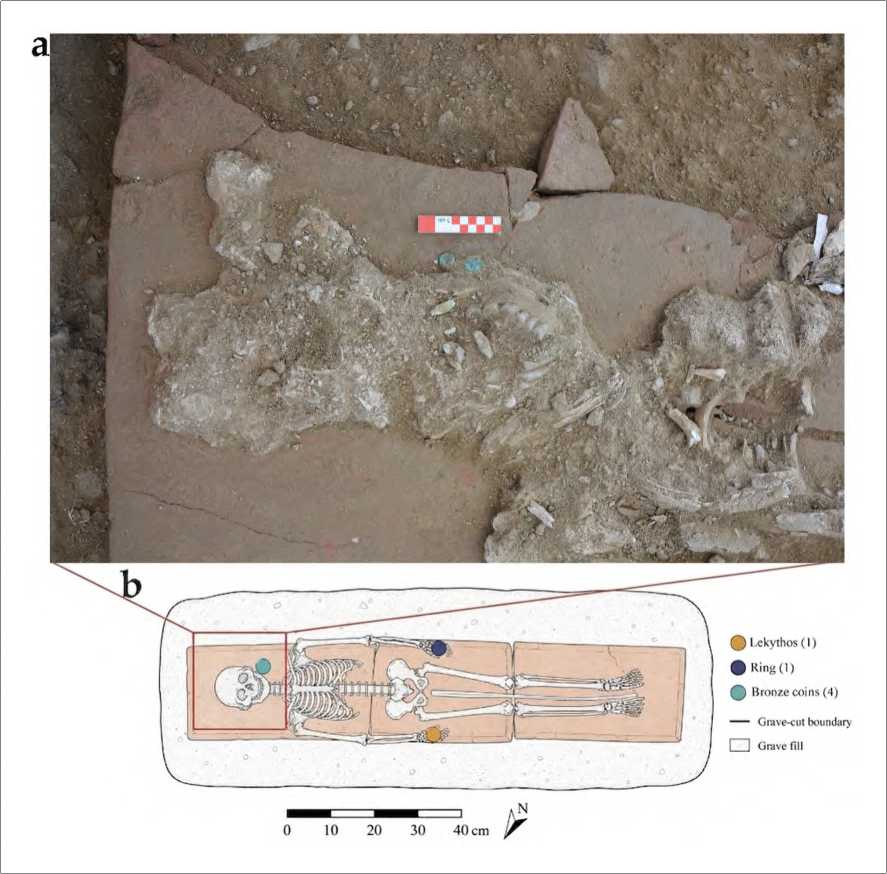
Fig. 4. Representative documentation of near-mouth monetary placement in the Parion South/Tavşandere Necropolis: a — in situ photograph of grave DSM 62; b — interpretive drawing showing the four bronze coins deposited near the mouth and the associated grave goods.
The remaining placement categories show that monetary deposition was not exclusively mouth-centred. The dataset includes hand, chest, vessel-associated, exterior, multiple body-related, and indeterminate placements. Indeterminate micro-location forms a substantial group, with 20 contexts. These cases remain part of the funerary monetary dataset, but they cannot support body-level interpretation. Their separation prevents uncertain evidence from being folded into a mouth-centred interpretation beyond what the record allows. The indeterminate category does not indicate that the monetary object lacks funerary association. Rather, it marks cases in which the
МАИАСП № 22. 2026
available record does not preserve a secure body-level micro-location. This may result from cremation practice, disturbance, multiple or collective burial conditions, post-depositional movement, or the limits of archival documentation. For this reason, indeterminate contexts are retained in the dataset but excluded from arguments that require precise bodily placement.
Table 3. Depositional placement by broad chronological period in the monetary dataset from the South/Tavşandere Necropolis of Parion 4 .
|
Period |
a я о g -я ■M Д hH |
о g 6 я V Й |
-я я л 6 я 1—1 |
% -5 6 О |
+- э* |
% св НН |
О |
© О +-Й НН |
+-н |
|
Late Classical—Early Hellenistic |
3 |
1 |
0 |
0 |
0 |
1 |
1 |
0 |
6 |
|
Hellenistic |
3 |
0 |
1 |
0 |
0 |
0 |
0 |
0 |
4 |
|
Late Hellenistic—Early Imperial |
2 |
0 |
0 |
0 |
0 |
0 |
0 |
1 |
3 |
|
Roman Imperial |
40 |
0 |
1 |
1 |
1 |
0 |
0 |
19 |
62 |
|
TOTAL |
48 |
1 |
2 |
1 |
1 |
1 |
1 |
20 |
75 |
Table 3 shows that in-mouth placement occurs across the broad chronological phases, but the uneven size of the period groups limits chronological interpretation. The Roman Imperial group contains most of the in-mouth placements, but also most of the indeterminate micro-locations. The earlier groups are smaller, yet they preserve a wider range of less frequent placement categories, including near-mouth, vessel-associated, exterior, and hand placements. This pattern is best read as depositional diversity rather than as a secure chronological sequence of ritual change.
Table 4. Depositional placement by burial mode in the monetary dataset from the South/Tavşandere Necropolis of Parion 5 .
|
Burial mode |
6 g ■м Д НН |
g 6 Св 4) £ |
я л 6 1—1 |
% -5 6 О |
44 4ч |
% св НН |
я h & я О |
я 5 g |
Total |
|
Inhumation |
48 |
1 |
2 |
1 |
1 |
0 |
1 |
12 |
66 |
|
Primary cremation |
0 |
0 |
0 |
0 |
0 |
0 |
0 |
8 |
8 |
|
Secondary cremation |
0 |
0 |
0 |
0 |
0 |
1 |
0 |
0 |
1 |
|
TOTAL |
48 |
1 |
2 |
1 |
1 |
1 |
1 |
20 |
75 |
Table 4 separates the placement data by burial mode. Secure body-related placements are confined to inhumation contexts, whereas all primary cremation contexts fall into the indeterminate micro-location category. The single secondary cremation context is vessel-associated. This pattern should not be interpreted simply as a difference in ritual choice; it also reflects the different archaeological visibility of bodily placement in cremation and inhumation contexts.
-
4 Counts refer to funerary contexts, not individual objects. Periods are based on grave/context dates, not coin issue dates.
-
5 Counts refer to funerary contexts, not individual objects or individuals. Burial mode follows the recorded funerary context; indeterminate micro-location denotes secure funerary association without secure body-level placement.
МАИАСП № 22. 2026
Beyond Charon’s Obol: Coin and Coin-Like Depositions in Funerary Assemblages at Parion ...
Coin-like Objects and Modified Monetary Deposits
A smaller but analytically important part of the dataset consists of objects that cannot be treated simply as ordinary struck coins. These include the dolphin-shaped cast object, gold coin-impression foils, and foil-gilded struck bronze coins. They are discussed together here not because they form a single object type, but because each requires an interpretive procedure different from that applied to ordinary struck coins. The grouping is therefore methodological rather than typological: these objects are analysed together only insofar as they fall outside the category of ordinary struck coin deposition. Their distribution is summarized in Table 5; representative examples are illustrated in Fig. 5.
Table 5. Coin-like objects and modified monetary deposits in the monetary dataset from the South/Tavşandere Necropolis of Parion 6 .
|
Context code / setting |
Grave/context date |
Object category and description |
Placement |
|
DSM 61 |
Late 4th century BCE —mid-3rd century BCE |
Coin-like object: dolphin-shaped cast object |
Outside the primary burial container |
|
TSM 1 |
Late 4th century BCE — early 3rd century BCE |
Coin-like object: gold coin-impression foil, Apollo-type |
In the mouth |
|
UM 1 (secondary urn within TSM 1) |
Late 4th century BCE — early 3rd century BCE |
Coin-like object: gold coin-impression foil, Gorgoneion-type |
Inside a vessel |
|
TSM 2 |
Late 4th century BCE — early 3rd century BCE |
Coin-like object: gold coin-impression foil, Helios-type |
In the mouth |
|
TSM 3 |
Late 4th century BCE — early 3rd century BCE |
Coin-like object: gold coin-impression foil, Persephone-type |
In the mouth |
|
DSM 16 |
2nd century BCE — 1st century BCE |
Coin-like object: gold coin-impression foil, laureate male head, probably Apollo-type; prototype not securely identified |
In the mouth |
|
AntM 2, multiple burial |
1st — 2nd century CE |
Modified monetary deposit: foil-gilded struck bronze coin, type not securely legible, broadly dated to the 1st — 2nd centuries CE; ordinary struck bronze coins also present |
Indeterminate micro-location |
|
TOM 1, multiple burial |
Second half of the 1st century CE — early 3rd century CE |
Modified monetary deposit: foil-gilded struck bronze coin, Caracalla colonial type; ordinary struck bronze coins also present |
In the mouth, individual 2, as recorded |
Table 5 shows that the coin-like objects listed here belong to earlier contexts, whereas the modified monetary deposits are recorded in Roman Imperial contexts. Among the earliest examples is the dolphin-shaped cast object from DSM 61 (Fig. 5: a), dated by grave context to the late fourth —mid-third century BCE. This object is not a struck coin and should not be conflated with the gold foils. Its inclusion in the dataset rests on its non-standard, monetary-looking, or value-bearing character within a funerary context.
The gold coin-impression foils are treated as coin-like objects. This term is used descriptively and analytically, not as a claim that they functioned as ordinary currency. The examples include Apollo-, Gorgoneion-, Helios-, and Persephone-type images (Fig. 5: b—e). The later DSM 16 foil, shown on both sides, bears a laureate male head, probably of Apollo type, although no secure
-
6 The table lists only contexts containing coin-like objects or modified monetary deposits. Grave/context dates are based on archaeological context, not coin issue date. “Modified monetary deposit” refers here to foil-gilded struck bronze coins. In contexts involving more than one individual, or in secondary burial units contained within another funerary context, placement is recorded only at the level supported by the excavation record.
МАИАСП № 22. 2026
prototype can yet be identified (Fig. 5: f). Their iconography is relevant, but it is not treated here as evidence for a single unified ritual programme. On the present evidence, the foils are best understood as selective uses of coin-like imagery on thin precious-metal objects rather than as direct reproductions of a single identifiable coin type.
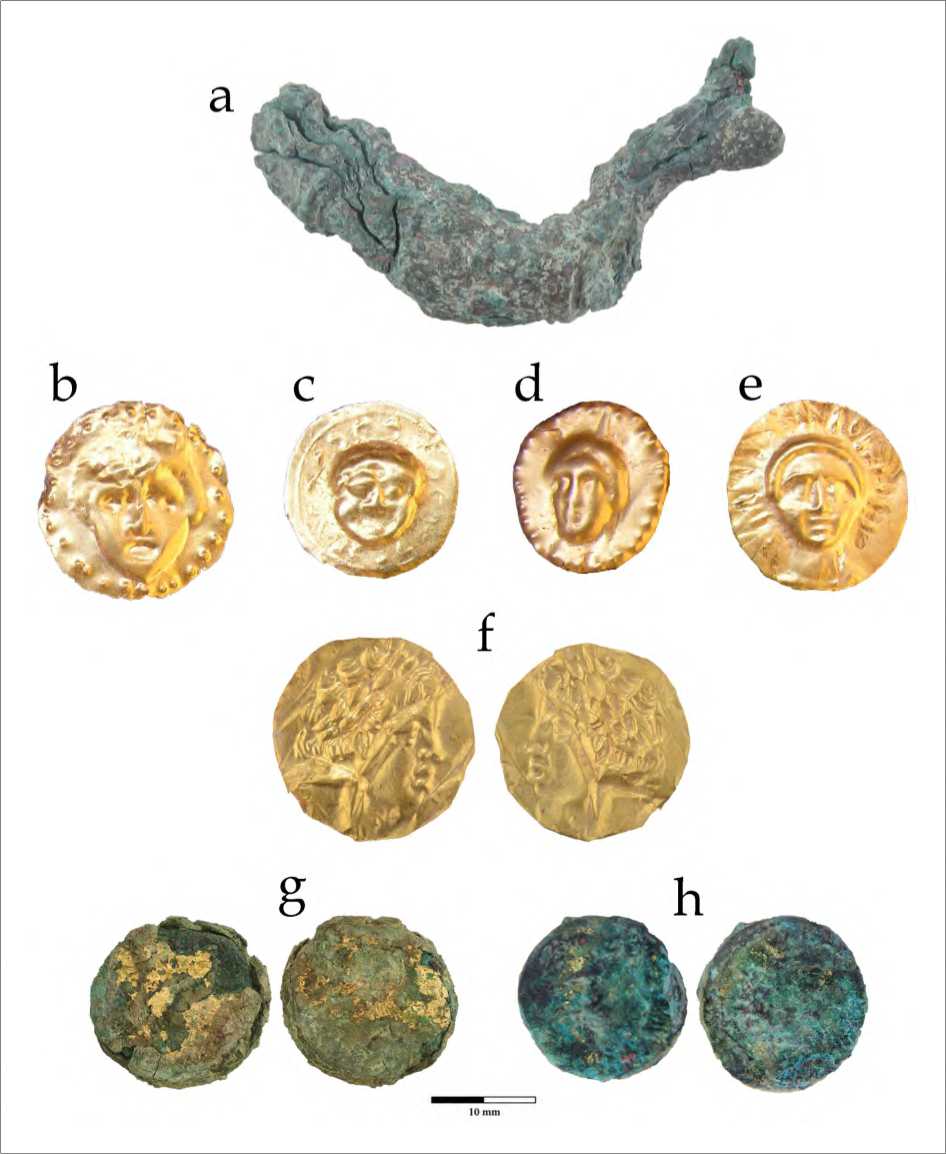
Fig. 5. Coin-like objects and modified monetary deposits from the South/Tavşandere Necropolis of Parion: a — dolphin-shaped cast object from DSM 61; b — Apollo-type gold coin-impression foil from TSM 1; c — Gorgoneion-type gold coin-impression foil from UM 1; d —Helios-type gold coin-impression foil from TSM 2; e — Persephone-type gold coin-impression foil from TSM 3; f — gold coin-impression foil from DSM 16, shown on both sides; g—h — foil-gilded struck bronze coins shown in obverse and reverse views.
МАИАСП № 22. 2026
Beyond Charon’s Obol: Coin and Coin-Like Depositions in Funerary Assemblages at Parion ...
The foil-gilded struck bronze coins (Fig. 5: g—h) form a separate category: modified monetary deposits. Unlike the gold foils and the dolphin-shaped cast object, these are actual struck coins whose material appearance was transformed through the application of gold foil. In AntM 2 and TOM 1, the foil-gilded coins occur together with ordinary struck bronze coins, showing that modified and unmodified monetary objects could be incorporated within the same funerary context. These cases should therefore not be reduced to a simple coin count.
Demographic Visibility and Association Limits
The relationship between monetary deposition and demographic variables can be assessed only within single-burial contexts where the association between object and individual is secure. Multiple and collective contexts, as well as secondary burial units contained within another funerary context, are excluded from pooled demographic counts because the association between a monetary object and a specific individual cannot always be established securely. Table 6 therefore represents a restricted analytical subset of the dataset rather than the full corpus of monetary contexts. The table includes 70 single-burial contexts; THM 1, TOM 1, AntM 2, BTM 11, and UM 1 are excluded from this pooled count because they either contain more than one individual or represent a secondary burial unit within another funerary context.
Table 6. Age category and grouped depositional placement in the single-burial subset of monetary funerary contexts from the South/Tavşandere Necropolis of Parion 7 .
|
Age category |
Mouth-related placement (in-mouth and nearmouth) |
Other body-related placement |
Multiple body-related placement |
Container/ exterior placement |
Indeterminate micro-location |
Total |
|
Infant |
4 |
0 |
0 |
0 |
0 |
4 |
|
Child |
9 |
0 |
0 |
0 |
1 |
10 |
|
Adolescent |
1 |
0 |
0 |
0 |
0 |
1 |
|
Young adult |
5 |
0 |
0 |
0 |
2 |
7 |
|
Middle adult |
6 |
1 |
1 |
0 |
0 |
8 |
|
Older adult |
7 |
0 |
0 |
1 |
1 |
9 |
|
Adult |
12 |
2 |
0 |
0 |
8 |
22 |
|
Unknown |
3 |
0 |
0 |
0 |
6 |
9 |
|
TOTAL |
47 |
3 |
1 |
1 |
18 |
70 |
Within the single-burial subset, mouth-related placement is the most frequent grouped category and occurs across several age categories, including infants, children, adolescents, adults, and individuals whose age could not be determined more precisely. This distribution indicates that mouth-related monetary deposition was not restricted to adults. At the same time, the table does not support a distinct age-specific rule. The smaller numbers in the other categories, namely hand or chest placement, multiple body-related placement, container/exterior placement, and indeterminate micro-location, should therefore be read as limits on demographic interpretation rather than as evidence for age-based depositional patterns.
-
7 Counts refer to funerary contexts, not individual objects. The table includes only contexts treated as single-burial contexts for pooled demographic analysis. THM 1, TOM 1, AntM 2, and BTM 11 are excluded because they contain more than one individual or represent collective burial contexts; UM 1 is excluded because it is a secondary urn context within TSM 1. “Mouth-related placement” combines in-mouth and near-mouth placements. “Adult” refers to adults whose age could not be assigned more precisely to young, middle, or older adult categories. THM 1 and TOM 1 preserve recorded individual-level mouth associations and may be discussed at context level, but they are not included in the pooled single-burial subset.
МАИАСП № 22. 2026
The demographic evidence has a primarily constraining function. It shows that monetary deposition crossed age categories within the single-burial subset, but age cannot be isolated as the decisive variable behind depositional placement. Age, burial form, object category, and microlocation must instead be assessed together within each funerary context.
Mouth-related placement in infant and child graves is analytically important, but it should not be converted into an age-specific rule. The single-burial subset shows that mouth-related monetary deposition was used for non-adults as well as adults, yet the archaeological record does not preserve the precise meaning attached to the gesture in any individual case. For this reason, infant and child examples are best treated as evidence that the practice crossed age categories, not as proof that the Charon myth was applied to children in a uniform or literal way. They also do not show whether mourners understood infant and child deaths through the same eschatological framework as adult deaths; they only show that the same depositional gesture could be applied across age categories. This is consistent with the broader caution in funerary numismatics that coin deposits should be read case by case rather than reduced to a single mythological explanation (Stevens 1991: 215—216, 226—227; Brown 2008: 122).
Associated grave goods provide an additional contextual variable, but the present dataset does not support a consistent correlation between coin deposition and any single class of grave good. The inventories in Appendix A show that monetary and monetary-looking objects occur in graves with very different assemblage compositions, ranging from relatively sparse deposits to contexts with vessels, lamps, figurines, jewellery, mirrors, tools, shells, or chest fittings. More elaborate or materially distinctive assemblages are important for interpreting particular cases, especially the gold coin-impression foils and the foil-gilded bronze coins, but the range or quantity of associated grave goods alone does not explain monetary deposition. Following Brown’s emphasis on associated grave goods as one variable among several, these inventories are used here to assess contextual association, not to establish a deterministic link between coins and specific object types (Brown 2008: 122; 2013: 11—13). The available evidence therefore suggests that grave inventory, like age, is a constraining contextual factor rather than an independent predictor of coin placement or object category.
Discussion
Charon’s obol and the limits of a single explanatory model
The Parion evidence requires a distinction between the cultural recognisability of Charon’s obol and its archaeological applicability. The literary model is familiar: a low-value coin is placed in the mouth of the deceased as payment for Charon’s fare. Yet cemetery evidence rarely conforms to this model in a uniform way. Stevens has shown that funerary coin deposits include different numbers, metals, placements, and depositional arrangements, and that they should be interpreted case by case rather than treated as direct reflections of a single classical rite (Stevens 1991: 215—216, 226—227). This caution is directly relevant to Parion. The Charon interpretation remains possible, but only where the archaeological context supports it.
The question, therefore, is not whether the Charon tradition was known, but whether a particular burial context provides enough archaeological evidence to support such a reading. As established in the methodology above, this depends on object category, placement precision, burial mode, contextual security, and the level at which the deposit can be associated with an individual. Duchemin’s distinction between literary allusion and archaeological practice is useful here: the written tradition and the material record operate at different levels and cannot simply be collapsed into one another (Duchemin 2019: 30—31). His emphasis on archaeological gesture and micro-context also reinforces the need to reconstruct how and when the object entered the funerary sequence (Duchemin 2019: 35, 42).
At Parion, the clearest evidence for a Charon-type reading is provided by secure in-mouth placements of ordinary struck coins. Table 2 shows that the in-mouth placement category is the
МАИАСП № 22. 2026
Beyond Charon’s Obol: Coin and Coin-Like Depositions in Funerary Assemblages at Parion ...
largest group in the dataset, and İSM 30 (Fig. 3) illustrates the kind of recorded body association on which such an interpretation can securely rest. In these contexts, object type and placement converge: the object is an ordinary coin, the location is the mouth, and the relation to the body is explicit. These contexts should therefore be taken seriously as evidence for a practice that could have been understood in relation to Charon’s fare.
Even so, mouth placement is not identical with ritual intention. Rahmani’s narrow definition of Charon’s obol is useful because it restricts the identification to tightly defined placements, while warning against generalising from a small number of cases to a community-wide custom (Rahmani 1993: 149—150). Parion confirms the need for such caution. BTM 7 and BTM 21 show that more than one coin could be placed in the mouth, while DSM 62 (Fig. 4a—b) preserves four bronze coins near the mouth rather than in it. These contexts remain highly relevant to mouth-related monetary deposition, but they already complicate the simple image of a single fare paid by a single coin.
İSM 49 makes this complexity especially clear. This context cannot be treated as a simple mouthplacement grave. Its three bronze coins were recorded in distinct body-related micro-locations: one in the mouth, one on the chest or upper torso, and one near the feet. A Charon-type element may be present, but the whole arrangement points to a more complex use of monetary objects in relation to the body. The safest interpretation is therefore not “three Charon’s obols”, but a differentiated body-related deposition in which the mouth coin forms only one part of the assemblage.
Burial mode and burial grouping further limit interpretation. In the Parion dataset, secure body-related placements belong to inhumation contexts, whereas primary cremation contexts fall into the indeterminate micro-location category. This pattern should not be turned into a simple ritual contrast between inhumation and cremation; it also reflects the weaker archaeological visibility of body-related placement after burning, collection, transfer, and deposition. Van Andringa’s emphasis on depositional sequence and stratigraphic recording is important here, because the meaning of a coin depends on when, where, and how it entered the funerary process (Van Andringa 2019: 509—511).
İSM 50 illustrates this limitation particularly clearly. It is a primary cremation context containing eleven bronze coins, the highest coin count in the dataset, but its micro-location is indeterminate. The numerical weight of the deposit is therefore significant, but it does not provide secure Charon-type evidence. In a primary cremation context, burning and subsequent disturbance can obscure the original relationship between coins and the body. İSM 50 is better understood as a multi-coin cremation deposit that demonstrates the importance of monetary objects within the funerary assemblage without providing secure evidence for mouth placement or individual bodily association.
Contexts involving more than one individual, or a secondary burial unit within another funerary context, require the same restraint. TOM 1 and THM 1 preserve recorded individual-level mouth associations and may be discussed at context level, but they should not be used for pooled demographic generalisation. UM 1, as a secondary urn context within TSM 1, also has lower evidential value for individual-level placement. AntM 2 is still less suitable for a Charon-type reading: it is a multiple burial, its micro-location is indeterminate, and its foil-gilded struck bronze coin belongs to the category of modified monetary deposits rather than ordinary unmodified coin deposition.
A useful comparison is provided by the coins from Chamber Tomb 5 in the Eastern Necropolis of Parion, which have been published collectively under the heading of “Charon coins” (Kızılyalçın Oyarçin, Meral 2023: 777—778). The same publication, however, describes Chamber Tomb 5 as a complex multiple-burial context containing 33 individuals, with disturbed deposits, repeated use, and secondary displacement of earlier bones to make room for later burials (Kızılyalçın Oyarçin, Meral 2023: 775—777; Sulan 2018: 52—54, 69). An earlier report records an Elagabalus coin on the jaw of an individual in OM5 and illustrates a coin described as lying in an adult’s mouth (Kaba et al. 2019: 494, 504, fig. 9). This documented mouth association provides a strong basis for interpreting the individual deposit as Charon’s obol, although it does not justify extending the same interpretation to all coins recovered from the tomb. In such a context, the ritual function of each coin cannot be inferred from its presence within the tomb alone. As presented, the assemblage is important for understanding the broader use of bronze coins
МАИАСП № 22. 2026
in Parion funerary contexts, but the classification of the whole group as “Charon coins” depends on an interpretive step that is not secure unless individual depositional micro-contexts, especially mouth-, jaw-, or body-related placements, are documented for each coin (Kızılyalçın Oyarçin, Meral 2023: 775—777). For this reason, the Eastern Necropolis material is not adopted here as an interpretive model for the South/Tavşandere Necropolis. It is used instead as a comparative dataset that reinforces the need to distinguish coin presence, coin placement, burial history, and contextual security.
The numismatic profile of the ordinary struck coins reinforces this point: identifiable coins do not form a single mint or type group restricted to mouth placement, so the Charon-compatible cases rest more securely on placement and bodily association than on numismatic type selection. Because denomination, weight, diameter, and wear could not be assessed consistently across the full corpus, the most secure Charon-compatible readings at Parion cannot rest on a precise low-denomination profile. They depend more securely on the convergence of ordinary bronze coin, mouth placement, and bodily association. The dominance of bronze coins is nevertheless important. It may reflect local small-change circulation, a preference for low-value media in funerary practice, or both; the limited regional evidence does not allow a more precise reconstruction. No ordinary gold or silver coin deposit is documented in the dataset. For this reason, bronze should be treated as the monetary medium through which the best-documented Charon-compatible deposits were made, not as proof of a deliberately standardised low-value selection.
The Parion evidence therefore supports a differentiated reading of funerary monetary deposition. Secure in-mouth ordinary struck coins provide the clearest basis for a Charon-type reading. Near-mouth deposits, multiple mouth coins, and individually recorded mouth associations remain relevant, but require more caution. Multiple body-related placements, hand or chest placements, cremation contexts, exterior finds, container-associated deposits, and indeterminate micro-locations have lower evidential value for Charon’s obol and must be read within their own funerary contexts. This conclusion prepares the ground for the next section: if ordinary struck coins already require contextual differentiation, coin-like objects and modified monetary deposits require an even more careful assessment of object form, material alteration, and placement.
Coin-like objects, modified monetary deposits, and the transformation of monetary form
The coin-like and modified monetary deposits from Parion are few in number, but they are central to the interpretation of the dataset. They show that funerary monetary practice did not always involve the deposition of ordinary struck coins. It could also involve coin imagery, non-struck monetary-looking forms, or the visual alteration of actual coins. The distinction is not merely typological: it determines whether a Charon-type reading can be proposed, and at what level of confidence.
The gold coin-impression foils form the clearest case of monetary imagery detached from ordinary monetary circulation. They are thin gold objects bearing figural images associated with coin-like visual conventions, but they were not struck coins and should not be counted as ordinary currency. This point is especially important for Parion because earlier interpretations connected some of these finds with the Kharon tradition. Keleş re-evaluated the four gold objects from three stone-cist graves in the southern necropolis by considering technique, function, and iconography rather than accepting the earlier funerary-coin interpretation at face value (Keleş 2014: 117—118). Çelikbaş later made the terminological problem more explicit: labels such as “impression coin” or “Kharon coin” are misleading for these appliqué-like objects, since the earlier interpretation was influenced by their reported findspots and by the coin-like character of some images, especially the Gorgoneion (Çelikbaş 2020: 257). This terminological caution is accepted here. However, the reported mouth findspots cannot be dismissed simply because some graves suffered poor skeletal preservation or possible water infiltration. Such factors may be noted as taphonomic cautions, but they do not by themselves provide positive evidence that the recorded mouth positions are secondary. The repeated documentation of mouth placement must therefore remain part of the
МАИАСП № 22. 2026
Beyond Charon’s Obol: Coin and Coin-Like Depositions in Funerary Assemblages at Parion ...
archaeological record, even though placement alone cannot determine function. For this reason, the descriptive term gold coin-impression foil is retained here. It identifies material and visual dependence on coin imagery without presuming monetary circulation or a single ritual meaning.
The iconographic variety of the Parion foils is important for this interpretation. Apollo-, Gorgoneion-, Helios-, and Persephone-type images show that the objects did not reproduce a single repeated motif. DSM 16 appears to show a laureate male head, probably of Apollo type, but the prototype cannot be securely identified on the present evidence. The available material therefore does not support the reconstruction of a unified iconographic programme or a single coin model for the group. What can be argued more securely is that coin-like visual forms were transferred into a thin precious-metal funerary medium.
The images themselves may have carried different associative values. A Gorgoneion could evoke apotropaic protection; Persephone-type imagery may suggest a funerary or chthonic horizon; Helios-type imagery may have broader associations with visibility, transition, or divine presence; and Apollo-type imagery could belong to a wider civic and numismatic visual repertoire. These possibilities, however, cannot be converted into a secure interpretive programme for Parion. The foils are few in number, their prototypes are not always securely identifiable, and their contexts do not show a repeated correlation between image type, grave type, age, sex, placement, or assemblage composition. The iconography is therefore treated here as part of the objects’ coin-like visual form, not as independent proof of a specific cultic, eschatological, or theological selection.
The closest technical comparanda are the gold danakes from Tenea. Korka and Lagos report four gold danakes from the Hellenistic cemetery at Tenea, made to replicate types of early Hellenistic bronze coins of Sikyon and to produce the appearance of real coins (Korka, Lagos 2019: 358). They further explain that a danake could be made from a thin sheet of gold into which a coin was pressed, and that in two Tenea examples two impressions were joined to create the appearance of an almost complete coin (Korka, Lagos 2019: 358—359). This comparison supports the technical plausibility of producing funerary gold foils through coin imagery, but it does not require the Parion examples to be labelled as danakes. Tenea provides a technical and contextual parallel, not a terminology to be transferred without qualification.
Peloponnesian material clarifies the interpretive range of such objects. Nikolakopoulou describes gold “pseudo-coins” as a special Hellenistic funerary category, also called ghost-coins, ghost money, or danakes, and notes that these objects were often imprints of ancient coins in circulation (Nikolakopoulou 2019: 343—344). She also links them, where findspots are known, with Charon’s obol, status display, or possible mystic identity (Nikolakopoulou 2019: 344). These possibilities are useful as a comparative frame, but they cannot be transferred directly to Parion. The Parion foils occur in different contexts and do not form a single homogeneous depositional group.
The Macedonian and Aegean Thracian evidence widens the discussion beyond pseudo-coins. Chryssanthaki-Nagle emphasises that Charon’s obol was not a generalised custom in all the necropoleis under study and that other metallic objects could also serve as guarantors of a successful passage to the world of the dead (Chryssanthaki-Nagle 2019: 387—389). Her discussion of epistomia and Orphic-Dionysiac lamellae is relevant because such thin metal objects could be placed on the mouth, chest, hand, or body and could mediate passage without being ordinary coins (Chryssanthaki-Nagle 2019: 393—395). Parion’s gold foils should not be identified as epistomia or lamellae, but they belong to the same analytical problem: funerary metalwork could use precious material, bodily placement, and image-bearing surfaces to produce meanings adjacent to, but not identical with, monetary payment.
The dolphin-shaped cast object from DSM 61 requires a different level of caution. Olbian dolphinshaped cast coins show that dolphin-shaped monetary forms existed in the ancient monetary repertoire of the northern Black Sea, where such objects functioned as small exchange media and circulated beyond Olbia and its chora (Orlyk, Kolesnichenko 2022: 140—142). Excavations at Olbia also document substantial numbers of cast dolphin-shaped coins, including 77 examples from the T-4 sector, while stressing their specific Olbian chronological and economic context (Kozlenko et al. 2021:
МАИАСП № 22. 2026
306—307). These parallels show that dolphin-shaped monetary objects were historically real, but they do not prove that the Parion object was an Olbian coin or that it carried a Charonic meaning. The comparison is therefore morphological and monetary-historical rather than evidence for direct object transfer. Its funerary significance must remain local and contextual: it is a non-struck, monetary-looking or value-bearing object recorded outside the primary burial container, not an ordinary coin and not a secure Charon’s obol. Nor does the dolphin shape alone justify a wider marine, votive, or cultic interpretation, since no associated evidence from the context identifies the object as a local emblem, offering, or cult object. Given Parion’s maritime position, a broader resonance with coastal or marine imagery cannot be excluded, but the present context does not justify linking the object specifically to Milesian colonisation, Apollonia Pontica, or direct Pontic transfer.
The foil-gilded struck bronze coins require a separate analytical category. They are not coin-like objects in the same sense as the gold foils or the dolphin-shaped cast object, because they began as actual struck coins. Their analytical importance lies in their transformation. In AntM 2 and TOM 1, bronze coins were given a gold surface through foil-gilding, altering their visual and material identity within the funerary assemblage. For the AntM 2 specimen, identified in the analytical record as CZZ-81, this interpretation is supported by ongoing archaeometric study. Stereo-microscopic observation and non-destructive p-XRF and µ-XRF analyses indicate a lead-rich Cu—Sn—Pb alloy and discontinuous gold residues. Together, these observations are consistent with leaf/foil gilding; mercury was not detected in the analyses reported to date (Keleş, Yılmaz 2025). These data confirm the transformation of surface appearance in the AntM 2 example, although the full operational sequence of preparation, application, and preservation cannot yet be reconstructed in detail. This transformation did not erase their monetary origin, but it changed the way they appeared within the burial context: a base-metal coin was made to approximate the visual register of precious metal. The result is a modified monetary object whose gold surface may have affected its appearance and perceived value in the funerary assemblage. For this reason, they are treated here as modified monetary deposits. Doyen’s attention to packaging, mise en scène, and manipulation provides the methodological frame for treating such objects as transformed ritual artefacts rather than simply as additional coins (Doyen 2012: viii—x, xiv—xv). Brown’s emphasis on modification, position, and associated grave goods also supports this separation, because altered coins may have had a biography different from that of ordinary circulating coins deposited without modification (Brown 2013: 11—13).
These distinctions have direct interpretive consequences. A gold coin-impression foil placed in the mouth may stand closer to a Charon-type reading than the dolphin-shaped cast object from outside the burial container, but neither should be treated as an ordinary struck coin. A foil-gilded bronze coin in a recorded mouth position, as in TOM 1, may preserve a clearer possible link to the Charon model than AntM 2, where the modified coin is low-condition, broadly dated, and comes from a multiple burial with indeterminate micro-location. Object category and placement must therefore be read together. At Parion, the transformation of monetary form is not a secondary detail; it is one of the main reasons why funerary monetary deposition cannot be reduced to the presence or absence of coins.
Parion in regional perspective
The Parion evidence is best understood through controlled regional comparison rather than through direct typological equivalence. The comparanda discussed here define the range of funerary monetary practices attested in neighbouring and wider Mediterranean settings, but they do not provide fixed models into which the Parion material should be fitted.
The closest available regional comparison is Antandros. Recent reassessment of the Antandros Necropolis provides the broader archaeological frame for this comparison: excavations between 2001 and 2018 revealed 519 graves, with a long sequence extending from the late Geometric period through the Hellenistic period and with both inhumation and cremation practices represented across changing grave types (Yağız 2025: 83—85). The necropolis also provides several coin-related cases that are relevant for Parion. In the Classical period, a coin was recorded north of the skull in grave no.
МАИАСП № 22. 2026
Beyond Charon’s Obol: Coin and Coin-Like Depositions in Funerary Assemblages at Parion ...
194 and interpreted as Charon’s fee; other Classical and Hellenistic examples include coins possibly placed in the mouth, coins associated with primary cremations, and Hellenistic simple earth graves where coins occur in the hand or mouth (Yağız 2025: 92, 95—97). Yıldırım’s focused study of coin-bearing graves remains important because it examines when the practice of placing coins in graves began, how long it continued, how widespread it was, and how coin-bearing graves related to burial type and associated grave goods (Yıldırım 2009: 1—2). Her synthesis indicates that coinbearing graves crossed demographic categories and represented approximately 13% of the necropolis (Yıldırım 2009: 93—98). Antandros is therefore not an identical model for Parion, but it is the closest Troad-level comparator showing that coin deposition could occur across age, sex, grave type, and burial mode without becoming a universal practice.
Western Anatolian examples are useful mainly as cautions about context quality. At Dağkızılca on Mount Nif, Lenger records coins from the necropolis area, but many came from plundered graves, surface contexts, or sondages, while securely excavated graves did not produce coin finds; this situation underlines the risk of treating cemetery-area coins as funerary deposits without secure association (Lenger 2016: 561—562). Hierapolis provides a related warning: Travaglini and Camilleri show that coins from tomb environments may be affected by long-term use, reopening, collective burial, dumping, and post-depositional mixing, which limits their interpretation as evidence for the original burial rite (Travaglini, Camilleri 2019: 468—472). These comparisons support the methodological separation maintained at Parion between secure body-related placements, container or exterior finds, and indeterminate micro-locations.
The northern Aegean and Thracian evidence provides closer interpretive parallels. At Abdera, Kallintzi and Chatziprokopiou distinguish burial coins from Charon’s obols by considering quantity, value, location, chronology, and the relationship between coin date and burial date (Kallintzi, Chatziprokopiou 2019: 423—427). Their material is especially relevant because it includes mouth/head-area deposition, uncertain placements, chest placement, hand-held hoards, pseudo-coins, ghost coins, and danakai (Kallintzi, Chatziprokopiou 2019: 427—431, 438—440). Abdera therefore supports the same interpretive distinction required at Parion: mouth-related placement may strengthen a Charon-type reading, but the wider funerary monetary assemblage cannot be reduced to that model.
Amphipolis is important for the strength of mouth placement in the northern Aegean. Kosmidou’s study of coins from the eastern cemetery records a marked preference for the mouth as a deposit location (Kosmidou 2006: 415). Kosmidou and Malamidou later situate this evidence within a 155-grave sample and stress variation by burial type, age, sex, socio-economic strata, and assemblage context (Kosmidou, Malamidou 2019: 399—401, 405). For Parion, Amphipolis confirms that mouth placement can be a clear depositional signal, but not that all funerary coins should be interpreted through a single mythological explanation.
The Macedonian and Aegean Thracian material is also important because it widens the discussion beyond ordinary struck coins. Chryssanthaki-Nagle notes that funerary coins may be placed in the mouth, hand, chest, or sometimes on the eyes, and connects obol/danake terminology with payment for Charon’s fare (Chryssanthaki-Nagle 2019: 389). At the same time, she emphasises that Charon’s obol was not a generalised custom in all the necropoleis under study and that other metallic objects could act as guarantors of passage to the world of the dead (Chryssanthaki-Nagle 2019: 387—389). This is directly relevant to Parion’s coin-like objects, but only as an analytical comparison: the Parion gold coin-impression foils should not be re-labelled as Macedonian-style danakes, epistomia, or lamellae.
The Peloponnesian and Tenea material has already been used above for the technical question of gold foils and pseudo-coin objects. In regional perspective, its value is narrower but still important: it shows that thin gold pseudo-coins formed part of a wider Hellenistic funerary repertoire, while also confirming that local terminology and ritual meaning cannot be transferred directly to Parion (Nikolakopoulou 2019: 343—344; Korka, Lagos 2019: 358—359).
Finally, the West Pontic evidence from Apollonia and Messambria illustrates the variability of local practice among coastal cities. Yordanova’s database includes 328 coins from 177 graves at Apollonia and 212 Classical and Hellenistic coins from 193 graves at Messambria; the proportion of graves with
МАИАСП № 22. 2026
coins differs sharply, approximately 7% at Apollonia and 48% at Messambria (Yordanova 2019: 449—450). Her analysis also distinguishes coin type, denomination, number, burial structure, position around the body, gender/age attribution, and burial rite (Yordanova 2019: 453—456). The value of this comparison is methodological rather than typological: the frequency of coin-bearing graves does not itself define the meaning of the practice. The contrast is not used here to explain why the two West Pontic cemeteries differed so sharply; that question belongs to their own local histories. Its value for Parion is methodological: frequency alone cannot be treated as a proxy for ritual meaning, since placement, burial form, object category, and recording quality remain decisive.
These comparisons confirm that Parion belongs within a wider funerary numismatic field, but they also clarify its distinctiveness. Its dataset combines a marked in-mouth pattern, earlier gold coin-impression foils, a dolphin-shaped cast object, Roman Imperial dominance of struck bronze coins, foil-gilded struck bronze coins as modified monetary deposits, and a substantial group of indeterminate or non-mouth placements. The regional evidence therefore supports the interpretive position developed here: Charon-type readings are most secure where ordinary coin, mouth placement, and secure individual association converge, while other deposits require explanation through material substitution, imitation, modification, and contextual placement.
Synthesis: contextual funerary monetary deposition at Parion
The Parion evidence is best understood as a graded field of funerary monetary deposition. At one end of this field are the most secure cases: in-mouth placements of ordinary struck bronze coins in individually associated inhumation contexts. These cases provide the clearest archaeological support for a Charon-type interpretation, although even here the evidence documents placement and association more securely than ritual intention.
A middle range consists of deposits that remain close to the Charon model but alter it in form, number, or context: multiple coins placed in the mouth, near-mouth placement, multiple body-related placement, and recorded individual mouth associations within multiple burials. These cases retain a relationship to the body and, in several instances, to the mouth, but they do not fit the narrow model of a single coin deposited as a single fare.
A further group extends beyond ordinary coin deposition. Gold coin-impression foils, the dolphin-shaped cast object, and foil-gilded bronze coins show that funerary monetary practice could also work through image, resemblance, substitution, and surface transformation. These objects may intersect with Charon-type ideas where their placement establishes a body-related or mouth-related association, but they require analysis through material form and funerary context rather than through coin presence alone.
The value of the Parion dataset lies in preserving this analytical range: it shows both a marked mouth-related coin practice and a wider repertoire of monetary, monetary-looking, and materially transformed funerary deposits. In this respect, Parion’s position between the Troad, the Propontic zone, and the northern Aegean is relevant not as a ready-made explanation, but as a regional setting in which different forms of monetary imagery, local bronze circulation, limited regional connections, and funerary practice could intersect.
Conclusion
This article has argued that funerary monetary deposition at Parion is best understood not as a single rite, but as a context-dependent field of practice in which coins, coin images, and transformed monetary objects could acquire different roles according to object form, placement, burial mode, and contextual security. The South/Tavşandere Necropolis dataset is important not because it invalidates the Charon’s obol model, but because it shows where that model is archaeologically supported, where it becomes less secure, and where different categories of evidence require different interpretive procedures.
МАИАСП № 22. 2026
Beyond Charon’s Obol: Coin and Coin-Like Depositions in Funerary Assemblages at Parion ...
The main contribution of the study is therefore methodological as well as regional. By separating ordinary struck coins, coin-like objects, and modified monetary deposits, the Parion evidence avoids treating all monetary or monetary-looking finds as equivalent “coins in graves”. Secure in-mouth ordinary struck bronze coins remain the clearest contexts for a Charon-type interpretation, especially where the association with an individual body is clear. Yet the same cemetery also preserves multi-coin mouth and near-mouth cases, multiple body-related placements, cremation contexts with indeterminate micro-location, gold coin-impression foils, a dolphin-shaped cast monetary-looking object, and foil-gilded bronze coins. These forms cannot all be explained through the same mechanism.
The Parion corpus also shows that numismatic type alone does not define funerary meaning. The available ordinary struck coin data indicate the use of bronze coins drawn mainly from local circulation, with limited evidence for a wider regional component, and with no narrowly selected mint, obverse type, reverse type, or countermark restricted to mouth placement. This reinforces the central point of the article: the most secure Charon-compatible cases depend more on placement and bodily association than on coin type. Conversely, coin-like and modified monetary objects require attention to image, material surface, and transformation, not simply to monetary value.
Several limits remain. The 75 contexts analysed here form a monetary-context sample rather than a proportional sample of the entire necropolis, and the study does not calculate the overall cemetery-wide frequency of coin deposition. Coin issue date has been kept separate from grave/context date, and demographic interpretation has been restricted to securely associated single-burial contexts. The grave/context code system has been retained to preserve the connection with the excavation archive; these code prefixes indicate grave construction type and archival context rather than formal spatial sectors. For this reason, no intra-site spatial clustering is inferred from the code system.
The main significance of Parion lies in the coexistence, within a single necropolis dataset, of secure mouth-related bronze coin deposits, earlier coin-impression foils, a dolphin-shaped cast object, and foil-gilded bronze coins. This combination makes it possible to move from a binary Charon/non-Charon interpretation toward a graded contextual model of funerary monetary deposition.
Within these limits, Parion offers a systematically documented case study for a broader problem in funerary numismatics: Charon’s obol should neither be rejected as irrelevant nor applied as a default explanation. It should be treated as one interpretive possibility within a wider repertoire of monetary, monetary-looking, and materially transformed funerary deposits. The tripartite distinction used here may therefore be useful for other necropoleis where ordinary coins, coin images, and altered monetary objects occur together, provided that each case is evaluated through placement, context, object category, and the security of archaeological association.
