
Changes in permeability and microstructure of sand during reinforcement with polyurethane resin
Journal: Nanotechnologies in Construction: A Scientific Internet-Journal @nanobuild-en
Section: The results of the specialists’ and scientists’ researches
Article in issue: 2 Vol.18, 2026.
Free access
Introduction. In complex geotechnical conditions during construction and operation of engineering structures, polyurethane compositions are used to strengthen loose soils. Analysis of current research has shown that the effect of polymers on sandy soil filtration properties is poorly studied. The purpose of this study is to determine the dependence of permeability and microstructure of chemically strengthened sand on the treatment method, polyurethane resin consumption and external compressive loads. Methods and Materials. Experiments are carried out with fine and medium-grained sands. Two-component highly elastic and one-component polyurethane resins are used for strengthening. Their main purposes are soil stabilization, waterproofing, and formation of cutoff curtains. The effect of the resins on rock permeability and microstructure is assessed based on the experimental results. The experiments include formation of the polymer-sand mixtures using one-solution and two-solution resin treatments with resin/rock volume ratios of 0.05–0.25, microstructure study and filtration tests under various sample loading conditions. Results and discussion. The dependence of the sand permeability on the method of strengthening with polyurethanes has been determined. In the case of one-solution treatment with highly elastic resin with composition/rock volume ratio of 0.2, the permeability of the samples is 7–13 ·10–3 μm2. A two-fold decrease of the resin content causes an increase in permeability by 1–2 orders of magnitude. Such behavior is explained by the structure in which open intergranular pores predominate and form connected pore channels. The addition of a small volume of a one-component rigid polyurethane composition reduces sand permeability by 1.5–3.2 times and improves the stability of samples under compressive loads. Conclusion. The practical significance of the results consists in the increasing efficiency of sand filtration properties reduction with polyurethane resins strengthening. The proper choice of a chemical treatment method with consider of the geotechnical problem provides both effective rock permeability reduction and decrease in the consumption of expensive polymer compositions for the construction of cutoff curtains and screens in the rock mass.
Similar articles in the section Civil and structural engineering in general
Short address: https://sciup.org/142247642
IDS: 142247642 | DOI: 10.15828/2075-8545-2026-18-2-242-253
Text of the scientific article Changes in permeability and microstructure of sand during reinforcement with polyurethane resin
Original article
Шилова Т.В., Иванова О.А., Сердюков А.С. Особенности изменения проницаемости и микроструктуры песка при укреплении полиуретановыми смолами. Нанотехнологии в строительстве. 2026; 18(2):242–253. – EDN: ZHLSAF.
An increase in the volume of construction and intensive operation of engineering objects are complicated by hazardous exogenous processes, that include flooding, soil subsidence and erosion, associated with groundwater [1, 2]. A loose structure and high permeability of sandy soils cause negative processes such as an intense fluid filtration, liquefaction and subsidence. In complex geotechnical conditions, physical and chemical methods are used to improve operational properties of soils. Loose and dis- turbed rocks are often strengthened using chemical reagents that interact with each other and/or groundwater. Among them polymer resins are common [3–6]. Unlike traditional strengthening compositions (cements, sodium silicate), polymer resins well penetrate into rocks reinforcing them for the curing process. Two-component highly elastic polyurethanes are commonly used to bind loose soils, construct cutoff curtains and impermeable screens in rock mass [7–9]. In these systems, the interaction of isocyanate (component B) and a polyester compound (component A)–a mixture of polyfunctional hydroxyl-
Nanotechnologies in construction
Нанотехнологии в строительстве
2026; 18 (2): 242–253
Nanob
THE RESULTS OF THE SPECIALISTS’ AND SCIENTISTS’ RESEARCHES
containing polyols with a foaming agent and a catalyst– leads to the formation of a foamed polyurethane and a significant composition volume increase. Loose soil particles are bound by the cured resin, resulting in low residual porosity [10–13]. The use of foaming compositions provides low filtration properties of sandy soils after chemical strengthening. According to [14], the permeability of fine-grained sands impregnated with polyurethanes is 10–4–10–3 µm2, which corresponds to low-permeability and impermeable rock types. The analysis of current research shows that the influence of consumption, method of treatment with polymer compositions, and compressive loads on the filtration properties of loose soils are poorly studied. A large number of laboratory tests on rock strengthening and determination of their properties would make possible to predict the results of a planned natural experiments. The purpose of the study is to determine the characteristics of changes in the permeability and microstructure of chemically strengthened sand, depending on the treatment method, consumption of polyurethane compositions and external compressive loads.
METHODS AND MATERIALS
Materials
Laboratory experiments are carried out with loose rocks- fine- and medium-grained sands, that were collected from the operating open mine in the Novosibirsk District of Novosibirsk Region. Preliminary preparation of experimental samples includes drying to constant weight, sieving, and determination of the rock granulometric composition. The sand fraction with grain sizes of 0.2–0.3 mm is approximately 80% by mass. This corresponds to fine- and medium-grained sand, according to the classification from GOST 25100-2020 “Soils. Classification” [15]. The content of coarse (grain size greater than 0.5 mm) and fine (grain size less than 0.2 mm) fractions are approximately 7% and 12% by mass, respectively. The selected fraction of 0.2–0.3 mm is used for further experiments. The absolute and bulk densities of sand are determined under laboratory conditions. They are 2.65 g/cm³ and 1.6 g/cm³, respectively. Then the average porosity coefficient of unconsolidated loose rock is estimated as 0.65. The experiments are carried out with low-moisture sand with water saturation of approximately 0.1 fractional units. Under laboratory conditions the samples are artificially moistened to achieve the required moisture content. To consolidate and chemically strengthen sand, a two-component highly elastic polyurethane resin (hereinafter SR compound) is used. It is designed for a consolidating and waterproofing of loose rock, forming impermeable screens in rock mass, and in construction – for repairing cracks in underground structures (passages, tunnels, foundations), forming impermeable barriers at the soil-concrete boundary. The SR compound is formed by mixing individual liquid components A and B in a 1:1 volume ratio to a uniform consistency. Component A is a mixture of castor oil, phenoxypropanol, and low-molecular-weight polypropylene glycol (a catalyst). Component B is a mixture of methylene diphenyl diisocyanate, polypropylene glycol, and propylene carbonate. The low viscosity, long reaction time (approximately 3.5 hours), and slow foaming of the SR compound provide penetration into small rock voids and pore channels. This causes a significant reduction in the permeability of the strengthened sand. The cured polyurethane resin is an elastic, impermeable material. Its main characteristics are showed in the Table 1 [16]. The one-component fast-cured polyurethane resin (hereinafter, FR compound) is also used in experiments to chemically strengthen sand. It is designed both to bind loose and fractured rocks for construction of underground structures, and to reduce soil permeability and to form impermeable screens in the rock mass behind building structures. The FR compound polymerizes reacting with water. In case of a liquid resin/water ratio from 1:1 to 9:1, the full curing time is 90–180 seconds (Table 1). A carbon dioxide, which is released during reaction of isocyanate with water and polymerization, causes intense foaming of the FR compound. A liquid resin/water ratio of 5:1 is used in the experiments. The full cured FR compound is a fine-pored foam material that is stable under significant loads. It has previously been obtained that
Table 1. Properties of two- and one-component polyurethane compositions [16]
|
Indicators |
SR compound |
FR compound |
|
Purpose |
Strengthening of loose soils, waterproofing, formation of impermeable curtains |
Strengthening loose and unstable rocks, forming anti-seepage curtains |
|
Volume ratio of components A to B |
1:1 |
– |
|
Resin : water volume ratio |
– |
1:1–9:1 |
|
Density (components A / B), g/cm3 |
1.01/1.21 at 23 ºС |
1.14 at 20 ºС |
|
Viscosity (components A / B/ mixture), MPa·s |
115/40/80 at 23 ºС |
800–1000 at 20 ºС |
|
Curing time, s |
≈10800 |
90–180 |
Nanotechnologies in construction 2026; 18 (2):
Нанотехнологии в строительстве 242–253
THE RESULTS OF THE SPECIALISTS’ AND SCIENTISTS’ RESEARCHES
Nanob

a small adding of the fast-acting, one-component polyurethane FR compound increases strength properties of sand by 1.3 to 3 times, compared to samples strengthened with only a highly elastic resin [16]. However, a sharp increase in the viscosity during polymerization of composition can reduce the penetration zone in the strengthened soil, especially in low-permeability rocks containing fine cracks. This study aims to experimentally determine the effect of adding a fast-cured, one-component resin on the filtration properties of chemically strengthened sand.
Methods
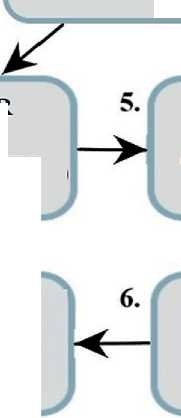
The effect of polyurethane compounds on sand permeability is determined based on laboratory studies. The experiments include: preparation of rock samples, treatment them with polymer compounds, forming strengthened sand samples (hereinafter geomaterials), studying the microstructure, and filtration tests. In the experiments two methods of the sand “binding” with resins are used: one-solution and two-solution methods. The one-solution method includes mixing the rock sample with a prepared liquid polymer compound (SR or FR). They are being mixed until the homogeneous mixture is obtained. For both polyurethane compounds, the geomaterials are formed at liquid resin/rock ratios of 0.05; 0.1; 0.2 (Fig. 1). The two-solution method includes sequentially adding and mixing prepared SR and FR compounds with sand. Geomaterials are formed using liquid composition ratios of 0.05–0.2 (SR compound/rock) and 0.05 (FR compound/rock), respectively (Fig. 2).
In both cases, the formed sand-polyurethane resin mixtures are placed in the detachable plastic cylindrical molds with a height 80 mm and a diameter 30 mm, kept until the polymers are fully cured, removed, and cut to 60 mm. The formed samples are used for subsequent filtration tests.
Permeability of various geomaterials is determined based on filtration experiments. The tests are carried out on the laboratory setup, which was developed at Chi-nakal Institute of Mining, Siberian Branch of the Russian Academy of Sciences. This laboratory setup is designed to measure permeability of rocks and porous materials under steady-state linear gas flow conditions and under axial and lateral compression pressures of cylindrical samples. The setup scheme, experimental methodology, and permeability determination are presented in [17, 18]. The tests are carried out with the geomaterials of 30 mm in diameter and 60 mm in height under uniform compression pressures equal to 400, 600, and 800 kPa (Fig. 3). Permeability coefficients are calculated using the expression [17, 18]:
2xlO4VgLPat
StAP(AP+2Pat)
where k is calculated permeability coefficient, mD (millidarcy, 1 mD = 10–3 µm2);
µ is viscosity, mPa·s;
S is the cross-sectional area of sample, sm2;
∆P is pressure difference at the ends of the sample, 10–1 MPa;
Рat is the pressure at the outlet of the sample (atmospheric), 10–1 MPa;
-
L is the sample length, sm;
-
t is the filtration time, s;
-
V is the volume of gas passed through the sample, cm3.
The microstructure of chemically strengthened sand is studied using scanning electron microscopy (SEM). SEM images are used to study the distribution of het-
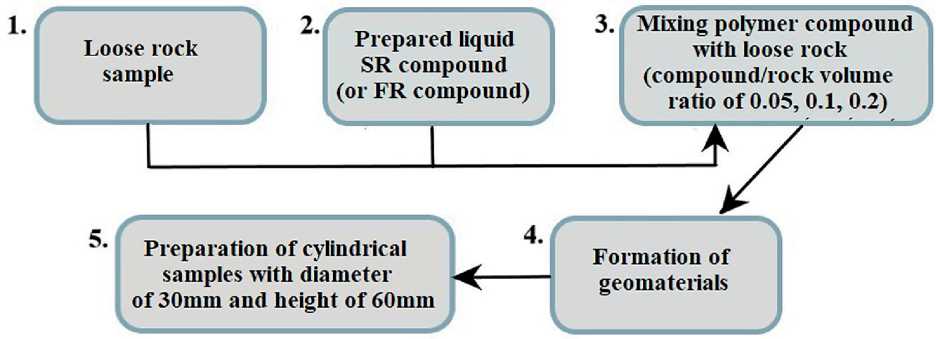
Fig. 1. One-solution method of the sand treatment with polyurethane resins: 1 – preparation of loose rock (sand) sample; 2 – preparation of SR polymer composition (or FR compound); 3 – mixing liquid solution with loose rock sample in the volume ratio of 0.05, 0.1, 0.2; 4 – placing the mixture in cylindrical molds with height 80 mm and diameter 30 mm, holding until full polymer curing, extraction of the obtained geomaterials; 5 – preparation of geomaterials for filtration tests: cutting samples to the height of 60 mm
Nanotechnologies in construction 2026; 18 (2):
Нанотехнологии в строительстве 242–253
Nanob
THE RESULTS OF THE SPECIALISTS’ AND SCIENTISTS’ RESEARCHES
Loose rock sample
Prepared liquid SR compound
Prepared liquid FR compound

Mixing of polymer SR compound with rock (compound/rock volume 1 ratio of 0.05, 0.1, 0.2)
Preparation of cylindrical samples with height 60mm and diameter 30mm
Addition of polymer FR compound (liquid compound/rock volume ratio of 0.05)
Formation of geomaterials
Fig. 2. Two-solution method of sand treatment with polyurethane resins: 1 – preparation of loose rock sample;
2 – preparation of SR compound; 3 – mixing liquid SR compound with loose rock sample in the ratio of 0.05; 0.1; 0.2; 4 – preparation of FR compound; 5 – addition of FR compound (liquid resin/rock volume ratio is 0.05) to sand/ SR compound mixture; 6 – placing the mixture in cylindrical molds with height of 80 mm and diameter of 30 mm, holding until full curing of polymers, extraction of the obtained geomaterials; 7 – preparation of geomaterials for filtration tests: cutting samples to the height of 60 mm
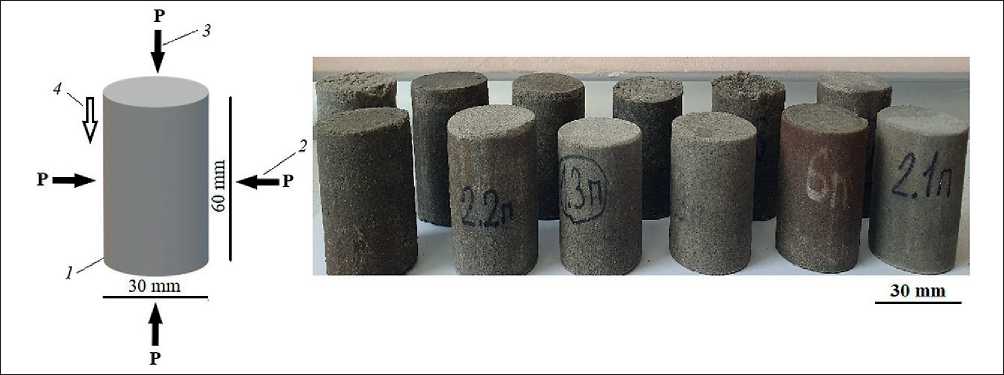
Fig. 3. Geomaterials for filtration experiments. 1 – cylindrical sample of geomaterial; 2, 3 – lateral and axial compression of samples by external pressure; 4 – direction of gas filtration
erogeneities and voids, estimate the content of the cured polymers in the geomaterials, determine the pore linear dimensions, etc. The data analysis and statistical processing are carried out using the automated microstructure analyzer “Mineral C7” (SIAMS company), specialized software: the “Porosity Study” module, “Study of Pore Structure” [19, 20].
RESULTS AND DISCUSSION
A distribution of cured polyurethane compounds in sand void space, pore filling and characteristics are assessed by studying a microstructure of geomaterials using SEM-images. In the case of one-solution method of sand treatment with the liquid SR compound/rock ratio of 0.2,
Nanotechnologies in construction
Нанотехнологии в строительстве
2026; 18 (2): 242–253
Nanob
THE RESULTS OF THE SPECIALISTS’ AND SCIENTISTS’ RESEARCHES
the strengthened sand obtains a basal structure which is characterized by a grain distribution within the bulk of a binder (cured polymer). Void space filling with cured polymer is 54–58% (Figs. 4, 5). After polymer strengthening the sand porosity decreases by more than five times compared to unreinforced rock. The geomaterials have small closed voids within the cured polymer aggregates, ranging in size from hundreds of nanometers to several micrometers, and a few number of larger intergranular pores with average diameter of 16.5 µm. As a two- and four-fold decrease in the liquid SR compound volume to the liquid SR compound/rock ratios of 0.1 and 0.05, the content of the cured polymer decreases to 30–45%, or on average by 1.3–1.6 times (Figs. 4, 5). The microstructure of the obtained geomaterials can be described as contact, according to the classification presented in [21]. The cured SR compound is a material, which is located at the sand grains boundaries, connecting them with single binding polymer “matrix”. The sizes of such binding aggregates are 10–20 µm (Fig. 4). The intergranular pores predominate in the structure of the geomaterials. Their diameters are average 18.3 and 20.5 µm for the samples formed at liquid SR resin/rock ratios of 0.1 and 0.05, respectively. The dependence of the cured polymer content in the pores of the geomaterials on the polymer compound/ rock ratio is described by linear approximation with a high coefficient of determination R2 = 0.85.
In the case of one-solution method of sand treatment with liquid FR compound/rock ratio of 0.2, the pore filling with cured polymer is 48–54% (Figs. 4, 5). The
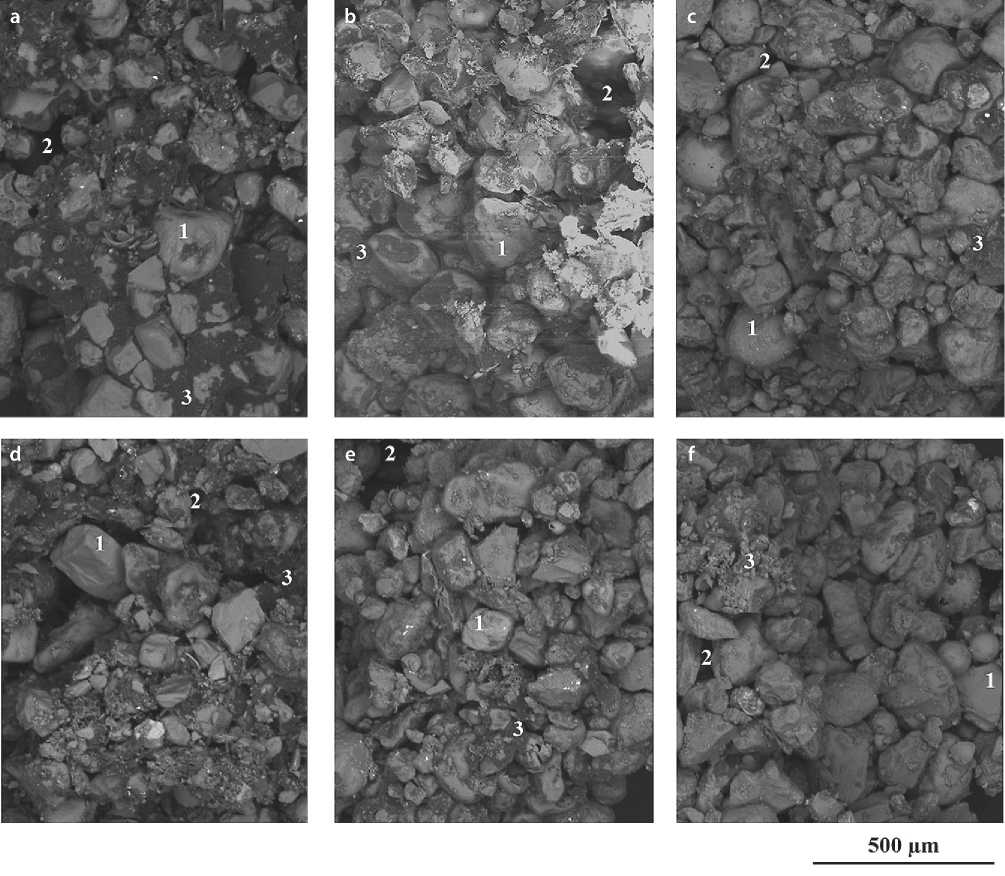
Fig. 4. SEM-images of chemically strengthened sand obtained by treatment rock with one-solution polyurethane compounds SR and FR. Ratio of liquid SR compound to rock: a – 0.2; b – 0.1; c – 0.05. Ratio of liquid FR compound to rock: d – 0.2; e – 0.1; f – 0.05. 1 – sand grains; 2 – intergranular voids; 3 – cured polymers
Nanotechnologies in construction
Нанотехнологии в строительстве
2026; 18 (2): 242–253
Nanob
THE RESULTS OF THE SPECIALISTS’ AND SCIENTISTS’ RESEARCHES
geomaterials have both small closed voids in the cured polymer aggregates and significant number of larger intergranular pores with average diameter of 12 µm. Reducing the volume of the liquid polyurethane FR compound to resin/rock ratios of 0.1 and 0.05, decreases the cured polymer content in the samples to 25–45%, or 1.2–1.9 times (Fig. 5). The obtained geomaterials acquire a contact structure, similar to the observed in the sand strengthened with the low-viscosity SR compound. The sizes of the binding polymer aggregates are 12–16 µm (Fig. 4). Intergranular pores predominate in the samples. Their diameters are average of 13.5 and 17 µm for geomaterials formed at FR compound/rock ratios of 0.1 and 0.05, respectively. The linear approximation of the dependence of the cured FS polymer content in the pore volume on the FR compound/rock ratio has a determination coefficient R2 = 0.8 (Fig. 5).
The structures of rocks, strengthened with two-solution method, are similar to those obtained using one-solution method with low-viscosity SR compound. When using 20 vol. % Sr and 5 vol. % FR compounds, the pore space is filled with the cured polymer by 53– 62%. The samples have a basal structure, in which small closed pores in the polymer aggregates are predomi- nated. Their diameters range from hundreds of nanometers to several micrometers. As the total volume of liquid compounds decreases to 10 vol. %, the content of the cured polymers decreases, a number and size of intergranular pores increase, and the geomaterials obtain a contact structure.
Experimental studies have shown that at total volume ratios of liquid SR and FR compounds to rock not exceeding 0.15, a significant number of open intergranular pores are formed in the strengthened sand structure. Their size increases as the resin content decreases. Such voids can form interconnected pore channels in the samples, significantly affecting the filtration of liquids and gases and the permeability of the obtained geomaterials.
Laboratory experiments were performed to determine the permeability coefficients of geomaterials formed using various methods of chemical strengthening, types and volumetric flow rates of polyurethane resins. Using one-solution method of sand treatment with liquid FR compound/rock volume ratio of 0.2, permeability of geomaterials is 15–20 mD (Fig. 6). Chemically strengthened sand samples are stable under compressive loads of 400–800 kPa, and their permeability values are weakly changed. This is due to the properties of the cured one-
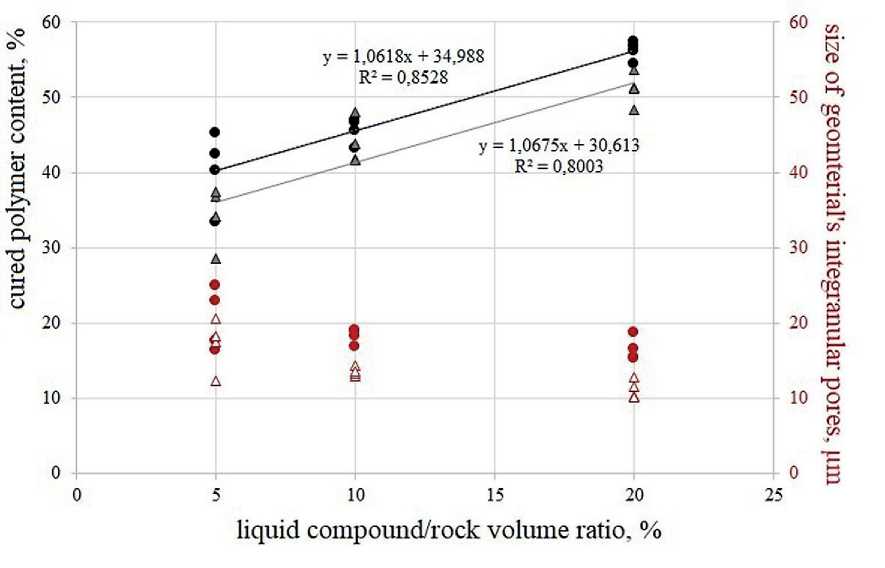
Fig. 5. Dependence of content of the cured polymers SR, FR in pores and size of intergranular pores on liquid compound/rock volume ratio according to the analysis of SEM images. Black and red circles are experimental data of study of geomaterials (content of the cured polymer and pore size, respectively), which have been obtained by one-solution treatment method with SR compound. Gray and white triangles are data of study of geomaterials (content of the cured polymer and pore size), obtained by one-solution method of sand treatment with FR composition. Black and gray lines are linear approximations of the experimental results
Nanotechnologies in construction
Нанотехнологии в строительстве
2026; 18 (2): 242–253
Nanob
THE RESULTS OF THE SPECIALISTS’ AND SCIENTISTS’ RESEARCHES
component FR compound, which is a rigid foamed material stable under significant loads.
For one-solution method of sand treatment with liquid SR compound/rock volume ratio of 0.2, the permeability of the samples is 7–13 mD. Filtration capacity of geomaterials decreases by approximately 1.5 times as the uniform compression pressure increases from 400 to 800 kPa (Fig. 6). This is explained by high content of highly elastic material in the samples (54–58%) – the cured polymer SR compound. It deforms under low compressive loads and leads to a decrease in the void volume in the structure. The addition of 5 vol.% liquid FS compound and two-solution treatment method cause a decrease in permeability by 1.5–1.8 times and an increase in the sample stability under compressive stress. This can be probably explained by the formation of a strengthening polymer “framework” in the rock structure from the cured FR composition, which binds the sand grains.
One-component treatment method and reduction of SR compound content to a liquid SR compound/sand volume ratio of 0.1, cause an increase in permeability by 1 to 2 orders to values of 500 to 700 mD. The obtained geomaterials are less sensitive to compressive loading, and permeability is maintained as uniform compression pressure doubles (Fig. 7). This is due to a decrease in the content of highly elastic deformable material (cured SR compound) to 30 to 45% in the strengthened sands. The addition of 5 vol. % liquid FR compound and two-solution rock treatment method cause a significant reduction of filtration capacity of the geomaterials. Permeability values decrease by 2.9–3.2 times (Fig. 7). The obtained geomaterials are stable under uniform compression pressures of 400 to 800 kPa.
The further two-fold reduction of SR compound to a liquid resin/rock volume ratio of 0.05, has little effect on filtration properties of the chemically strengthened sand. The permeability of geomaterials obtained using one-solution treatment method reaches 520–700 mD (Fig. 8). The additional 5 vol. % of the liquid FR compound and the use of two-solution treatment method decrease sample permeability by 1.3–1.5 times. The geomaterials are stable under compressive loads of 400–800 kPa.
The obtained permeability coefficients of chemically strengthened sand are compared with values, which are typical for different soil classes and presented in [22]. It has been established that with liquid polymer com-pound/rock volume ratio of 0.2 or greater, regardless of the polymer type and treatment method, geomaterials have permeability typical of low-permeability and semi-permeable rocks: a sandy clays, very weakly fractured
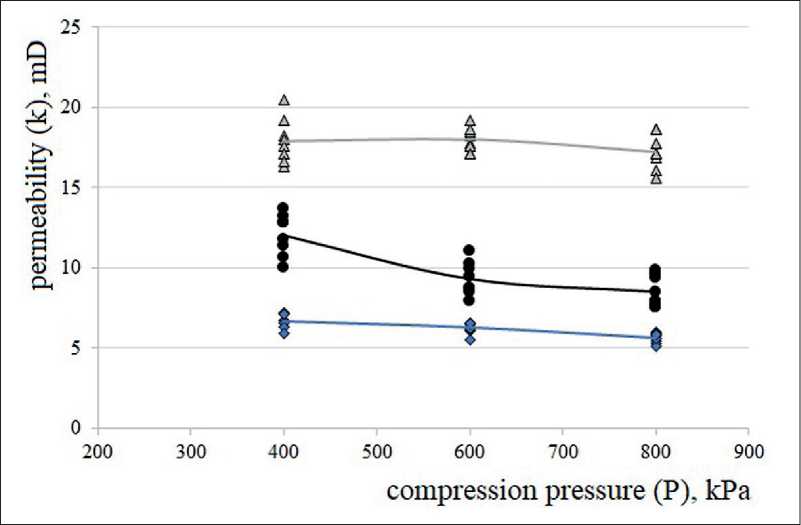
Рис. 6. Dependence of permeability of geomaterials (k) obtained with one-solution and two-solution methods of sand chemical strengthening with polyurethane SR and FR compounds on pressure of uniform compression (P). Experimental data for samples obtained with one-solution method of treatment with liquid composition/sand ratio of 0.2: black circles – strengthening with SR compound, gray triangles – strengthening with FR compound. Blue diamonds – experimental data for samples obtained with two-solution method of rock treatment with SR and FR compounds with liquid composition/rock ratios of 0.2 and 0.05, respectively. Solid lines – curves built using average values of permeability coefficients
Nanotechnologies in construction 2026; 18 (2):
Нанотехнологии в строительстве 242–253
Nanob
THE RESULTS OF THE SPECIALISTS’ AND SCIENTISTS’ RESEARCHES
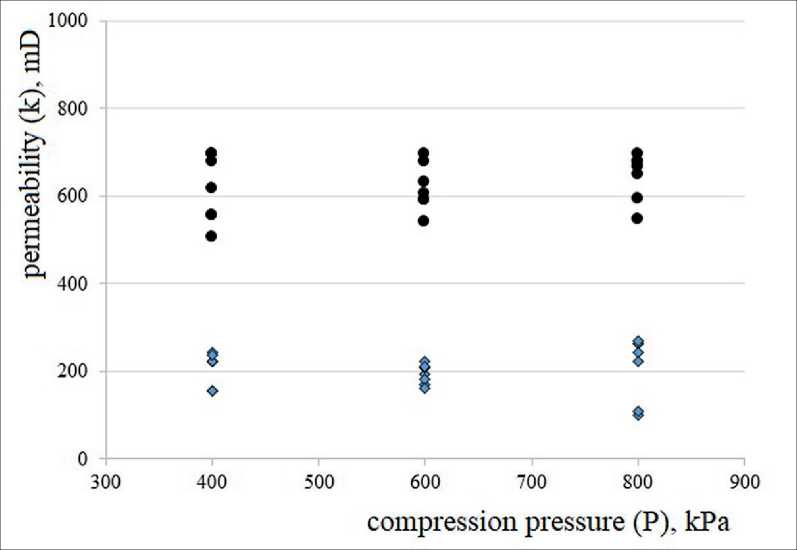
Fig. 7. Dependence of permeability of geomaterials (k) obtained using one- and two-solution methods of sand chemical strengthening with polyurethane SR and FR compounds on pressure of uniform compression (P). Black circles – experimental data for samples obtained using one-solution treatment method with liquid SR compound/ rock ratio of 0.1. Blue diamonds – data for samples obtained using two-solution treatment method of rock with SR and FR compounds with liquid composition/rock ratios of 0.1 and 0.05, respectively
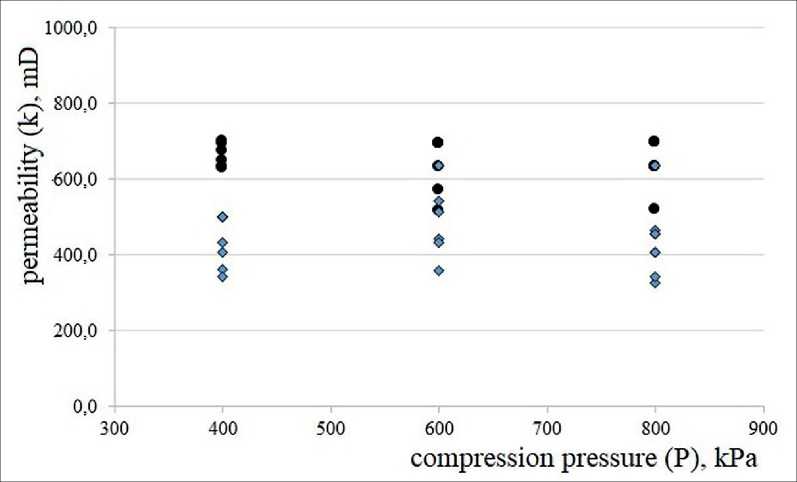
Fig. 8. Dependence of permeability of geomaterials (k) obtained using one- and two-solution methods of sand chemical strengthening with polyurethane SR and FR compounds on pressure of uniform compression (P). Black circles – experimental data for samples obtained using one-solution treatment method with liquid SR compound/ rock ratio of 0.05. Blue diamonds – data for samples obtained using two-solution method of rock treatment with SR and FR compounds with liquid composition/rock ratios of 0.05 and 0.05, respectively
Nanotechnologies in construction 2026; 18 (2):
Нанотехнологии в строительстве 242–253
THE RESULTS OF THE SPECIALISTS’ AND SCIENTISTS’ RESEARCHES
Nanob
rocks, and loams (Table 2). A low filtration capacity can be associated with the predominance of closed voids in the structure, ranging in size from hundreds of nanometers to several micrometers, that do not form continuous pore channels.
With liquid polymer/rock volume ratio of 0.05–0.15, the obtained geomaterials exhibit permeability typical of permeable rocks [22]. The increased filtration capacity of chemically strengthened sands is associated with an increase in the number and size of open intergranular pores in the structure, which can form continuous pore channels facilitating fluid filtration.
CONCLUSION
The method of sand chemically strengthening with polyurethane compounds and the volumetric resin consumption significantly affect the filling of voids with cured polymer, residual porosity, and permeability of the obtained geomaterials. It is found that when sand is treated with two-component highly elastic polyurethane at the liquid resin/rock volume ratio of at least 0.2, the samples acquire a basal structure. It is characterized by the sand grain distribution within the bulk of the binder which is the cured polymer. The structure is dominated by small, closed voids ranging in size from hundreds of nanometers to several micrometers. At total volumetric liquid polyurethane compound/rock ratios not exceeding 0.15, open intergranular pores are common in the structure of the geomaterials. The size of such pores increases as the resin content decreases. These voids form interconnected pore channels, significantly affecting the permeability of chemically strengthened sands. The change in the permeability of the geomaterials depending on the method of sand strengthening with polyurethane resins is determined based on experimental results. It is found that in the case of one-solution treatment method of sand with two-component highly elastic resin/rock volume ratio
of 0.2, the permeability of the geomaterials ranges from 7 to 13 mD. It also decreases by approximately 1.5 times as the compressive load increases from 400 to 800 kPa. This is due to the high content of highly elastic material, which deforms under compression which causes a decrease in the void volume in the structure. The addition of 5 vol. % rigid one-component resin and the use of the two-solution treatment method cause a 1.5- to 1.8- fold decrease in permeability and an increase in the stability of the geomaterials under similar compressive stresses. It is found that the use of one-solution strengthening method and the two-fold reduction of the highly elastic resin consumption effect an increase in the permeability by 1 to 2 orders of magnitude, to values of 500–700 mD. The addition of 5 vol. % liquid one-component polyurethane compound causes a decrease in permeability by 2.9 to 3.2 times. The obtained geomaterials are stable at uniform compression pressures of 400 to 800 kPa. The further twofold decrease in the polyurethane content to the liquid resin/rock volume ratio of 0.05 slightly affects permeability of chemically strengthened sand. Comparison of the obtained geomaterial permeability with typical soil ones has been carried out. It is found, that with a liquid polymer composition/rock volume ratio of 0.2 or more, the geomaterials have permeability characteristic to a low-permeability and semi-permeable rocks: a sandy clays, very slightly fractured rocks, loams. The practical significance of the obtained results consists in the increase efficiency of polyurethane resins to reduce the filtration properties of loose soils. The established dependencies of geomaterial permeability on sand properties, treatment method, liquid resin/rock volumetric ratios, and sample loading conditions indicate the need to choose the optimal chemical treatment method based on the current geotechnical problem. This will provide both effective reduction of the filtration properties of a loose soils and a decrease in the consumption of expensive polymer compounds when constructing impermeable barriers and screens in rock mass.
Table 2. Permeability of chemically strengthened sand with different treatment methods, polymer volumetric flow rates, and compression pressures
|
Method of sand treatment with polymer resins |
Content of compounds, vol. % (SR compound; FR compound) |
Average permeability value of strengthened sand, kav (mD) at different compression pressures, P (kPa) |
||
|
P = 400 |
P = 600 |
P = 800 |
||
|
One-solution |
(20; 0) |
12 |
9.3 |
8.5 |
|
One-solution |
(10; 0) |
614.7 |
618.6 |
644.3 |
|
One-solution |
(5; 0) |
665.2 |
635.5 |
636.0 |
|
Two-solution |
(20; 5) |
6.7 |
6.3 |
5.6 |
|
Two-solution |
(10; 5) |
205.0 |
198.2 |
202.4 |
|
Two-solution |
(5; 5) |
459.4 |
509.8 |
436.4 |
Nanotechnologies in construction 2026; 18 (2):
Нанотехнологии в строительстве 242–253
THE RESULTS OF THE SPECIALISTS’ AND SCIENTISTS’ RESEARCHES
Nanob
