
Circadian Rhythmicity of Body Surface Temperature Responses in Red Sokoto Bucks Subjected to 12-hour Feed Deprivation During the Hot-dry Season
Journal: Journal of Stress Physiology and Biochemistry @jspb
Article in issue: 3 т.22, 2026.
Free access
Background. This study investigated the circadian rhythmicity of body surface temperatures (forehead, ear, nose, and eye) in Red Sokoto bucks subjected to 12-hour feed deprivation during the hot-dry season in Nigeria’s Northern Guinea Savannah. Fourteen bucks were divided equally into an ad libitum-fed control group and a 12-hour feed-deprived experimental group, with surface and environmental temperatures measured at 2-hour intervals over a 26-hour period using infrared thermometry. Results. Environmental measurements (mean temperature-humidity index of 74.18 ± 1.29) indicated that the animals were under thermal stress. Body surface temperatures showed significant correlations (P < 0.05) with the time of day. In both the control and fasted groups, peak temperatures for the forehead, eye, ear, and nose generally occurred during the hottest parts of the day (between 14:00 h and 16:00 h), while the lowest temperatures for all measured areas were recorded at 06:00 h. Conclusions. Despite the presence of environmental thermal stress during the hot-dry season, a 12-hour period of feed deprivation does not significantly alter the natural circadian rhythms of body surface temperatures in Red Sokoto bucks.
Short address: https://sciup.org/143186168
IDS: 143186168
Text of the scientific article Circadian Rhythmicity of Body Surface Temperature Responses in Red Sokoto Bucks Subjected to 12-hour Feed Deprivation During the Hot-dry Season
Goats (Capra aegagrus hircus ) are among the oldest domesticated livestock, contributing significantly to meat, milk, skin, and fiber production worldwide (Shrestha and Fahmy, 2005). In Nigeria, goat production is a major agricultural activity, with over 34.5 million goats, predominantly in the northern region due to favourable semi-arid conditions. The Red Sokoto goat, Sahel goat, and West African warf goat are the main indigenous breeds, with the Red Sokoto being the most populous. Goats are valued for their hardiness, adaptability, and multiple uses, including milk, meat, manure, and even by-products like horns and intestines for crafts and musical instruments (Lawal Adebowale, 2012).
Goat production faces several constraints, including poor nutrition, diseases, parasites, climate change, and limited veterinary and extension services, especially for small-scale farmers. (Kahi and Wasike, 2019) Seasonal variations, particularly the hot-dry season, impose thermal stress that adversely affect physiological processes, such as body temperature regulation and reproduction. Circadian rhythms, which are endogenous 24-hour cycles driven by biological clocks, play a crucial role in regulating body temperature and other physiological processes. Environmental factors like ambient temperature and photoperiod may disrupt these rhythms, exerting negative effects on animal health and productivity (Minka and Ayo, 2016)
This study focused on the circadian rhythmicity of body surface temperature in Red Sokoto bucks subjected to 12-hour feed deprivation during the hot-dry season in Nigeria’s Northern Guinea Savannah. Understanding how thermal stress and feed scarcity affect body temperature rhythms is essential for the improvement of goat management and productivity under harsh climatic conditions. The study aimed to evaluate thermal environmental conditions, body surface temperature responses, and the effects of feed deprivation on circadian rhythms. It was hypothesised that the understanding of the body surface temperature responses of bucks to concomitant feed deprivation and thermal environmental conditions during the hot dry season may provide better insights to improving the breeding and husbandry practices of goats exposed to the thermally stressful season.
MATERIALS AND METHODS
The study was conducted at the livestock research pen of the epartment of Veterinary Physiology, Ahmadu Bello University, Zaria (11 °10′ N, 7°38′ E), located in Nigeria’s Northern Guinea Savannah zone. The experiment took place over two days (18th and 21st March, 2026) during the hot/dry season. Fourteen apparently, healthy Red Sokoto bucks (8 months to 1-year old, weighing 13 ± 3 kg) were purchased from Makarfi market, screened for parasites, and acclimatized for three weeks. Bucks were fed beans husk, hay and concentrate, and given access to water ad libitum ( Ethical approval, animal use and care U14VM1100).
Bucks were randomly assigned to control (n = 7) and experimental (n = 7) groups and housed in adjacent, well ventilated iron bar pens with concrete floors and aluminum roofs. Experimental bucks were feed deprived for 12 h; from 06:00 h to 18:00 h on each experimental day, while controls were fed ad libitum .
ry bulb and wet bulb temperatures were recorded every 2 hours using a hygrometer (G.H. Zeal Ltd., UK) inside the pen. Relative humidity was derived from Osmon’s hygrometric tables, and temperature humidity index (THI) was calculated as 0.72 (W + ) + 40.6. External meteorological data were obtained from the Institute for Agricultural Research, Samaru, Zaria.
Live weight was measured on day 1 using a calibrated scale (OgotexHarson, China). Body surface temperature was recorded on the forehead, eye, ear base and nose of each buck at 2 h intervals from 06:00 h (day 1) to 08:00 h (day 2), covering 26 h by an infrared thermometer (Rycom JXB181, China) at ≤1.2 m distance. All measurements were repeated 48 h later.
ata were expressed as mean ± SEM. Repeated measures ANOVA and Pearson’s correlation analysis were performed (GraphPad Prism 5.0, California, USA); and significance was set at P < 0.05.
RESULTS
Meteorological Conditions
The dry-bulb temperature recorded was highest
(24.50 ± 0.50°C) at 04:00 h to (24.00 ± 1.00) at 06:00 h of day 2 of the recording. The lowest value of 23.50 ± 3.50 % was obtained at 06:00 h of the first day of the recording. It attained its peak at 14:00 h, but gradually decreased to 24.00 ± 1.00 % at 06:00 h on day 2 of the recording. The relative humidity which was highest at 08:00 h (35.50 ± 14.50%) decreased to its lowest level (16:00 ± 6:00%) at 14:00 h (Table 1). The THI was highest at 14:00 h (81.64 ± 0.00), while the lowest value (66.88 ± 1.80) occurred at 06:00 h on the first day of the recording. (Figure 1).The wind direction was 241.06 ± 27.24 ° , while the wind speed was 2.03 ± 0.33 km/h. The solar radiation was 22.74 ± 1.92 MJ/m2/day. uring the experimental period, there was no rainfall (Table 2).
Body Surface Temperature
The lowest fore-head temperature was recorded at 06:00 h (24.95 ± 0.42 % ) in the ad libitum -fed bucks and (25.81 ± 0.30 % ) in the fasted bucks of the first day of the recording, while the highest value was recorded at 14:00
h, both in the fed and fasted bucks. The hour of the day and fore-head temperature were significantly (P< 0.05) correlated in ad libitum fed (r = 0.705) and 12-h fasted (r = 0.733) bucks (Table 3).
The ear temperature was least at 06:00 h on the first day of recording both in the ad libitum -fed and the fasted bucks, while the peak values were attained at 14:00 h in ad libitum -fed bucks (37.01 ± 0.39 % ). In fasted bucks, the peak ear temperature of 36.69 ± 0.19 % was attained at 16:00 h (Table 4).
The lowest value of nose temperature was recorded at 06:00 h on the second day of the recording (23.77 ± 1.55°C) in the fed bucks, while in the fasted bucks the nose temperature was 24.87 ± 1.32°C. The highest nose temperature was obtained in ad libitum -fed bucks at 14:00 h (36.34 ± 0.32°C); but in the fasted bucks, the peak value (36.11 ± 0.20°C) was attained two hours later; that is, at 16:00 h. Overall, the nose temperature in the ad libitum -fed and fasted bucks did not differ significantly (Table 5).
Table 1 Thermal Environmental Parameters inside the Bucks’ Pen during the Hot-dry Season
|
Time of the day(h) |
Dry-bulb temperature (°C) |
Relative humidity (%) |
|
06:00 |
23.50 ± 3.50 |
26.50 ± 21.50 |
|
(27-20) |
(48-5) |
|
|
08:00 |
25.50 ± 0.50 |
33.00 ± 14.00 |
|
(26-25) |
(47-19) |
|
|
10:00 |
32.00 ± 0.00 |
26.00 ± 23.00 |
|
(32-32) |
(49-3) |
|
|
12:00 |
35.00 ± 1.00 |
19.50 ± 12.50 |
|
(36-34) |
(32-7) |
|
|
14:00 |
37.00 ± 1.00 |
16.00 ± 6.00 |
|
(38-36) |
(22-10) |
|
|
16:00 |
36.00 ± 2.00 |
15.00 ± 8.00 |
|
(38-34) |
(23-7) |
|
|
18:00 |
35.00 ± 1.00 |
16.50 ± 2.50 |
|
(36-34) |
(19-14) |
|
|
20:00 |
31.00 ± 1.00 |
18.50 ± 7.50 |
|
(32-30) |
(26-11) |
|
|
22:00 |
29.50 ± 0.50 |
23.50 ± 11.50 |
|
(30-29) |
(35-12) |
|
|
00:00 |
27.50 ± 0.50 |
28.00 ± 16.00 |
|
(28-27) |
(44-12) |
|
|
02:00 |
25.50 ± 0.50 |
33.00 ± 14.00 |
|
(26-25) |
(47-19) |
|
|
04:00 |
24.50 ± 0.50 |
35.00 ± 18.00 |
|
(25-24) |
(53-17) |
|
|
06:00 |
24.00 ± 1.00 |
34.50 ± 17.50 |
|
(25-23) |
(52-17) |
|
|
08:00 |
27.00 ± 0.00 |
35.50 ± 14.50 |
|
(27-27) |
(50-21) |
|
|
Overall mean ± SEM |
29.50 ± 1.29 |
25.75 ± 2.05 |
|
(38-20) |
(53-3.0) |
Values in parentheses are maximum and minimum within the hour of study. Mean ± SEM, n = 4
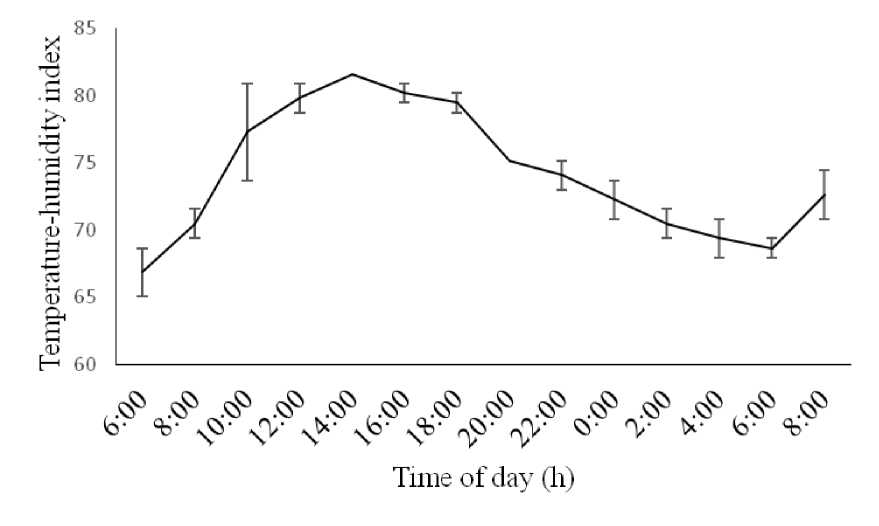
Figure 1. Temperature-Humidity Index inside the Bucks’ Pen during the Hot-dry Season. Mean ± SEM, n
Table 2 Meteorological ataRecorded outside the Bucks’ Pen during the Hot-dry Season
|
Parameter |
Mean ± SEM |
|
Minimum relative humidity (%) |
8.10 ± 0.56 (9.40-6.80) |
|
Maximum relative humidity (%) |
34.95 ± 11.05 (59.30-15.00) |
|
Minimum temperature (°C) |
20.05 ± 0.34 (20.60-19.10) |
|
Maximum temperature (°C) |
38.48 ± 0.94 (40.60-36.20) |
|
Rainfall (mm) |
0.00 ± 0.00 (0.00-0.00) |
|
Wind direction (°) |
241.06 ± 27.24 (298.67-182.83) |
|
Wind speed (km/h) |
2.03 ± 0.33 (2.88-1.33) |
|
Solar radiation data (MJ/m2/day) |
22.74 ± 1.92 (26.91-19.34) |
|
ew (°C) |
-0.67 ± 3.97 (-7.65-5.03) |
Values in parentheses represent maximum and minimum, n = 4
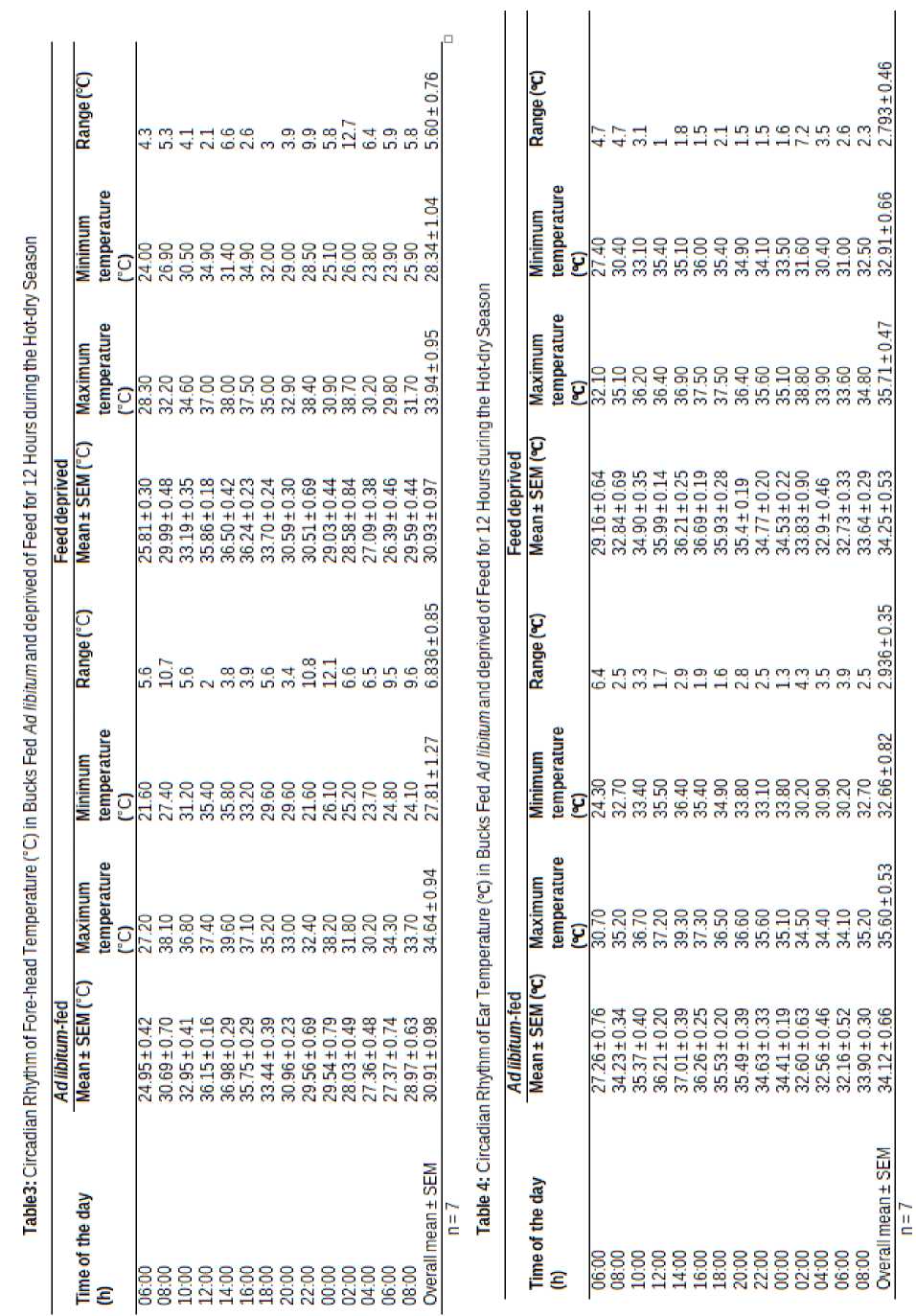
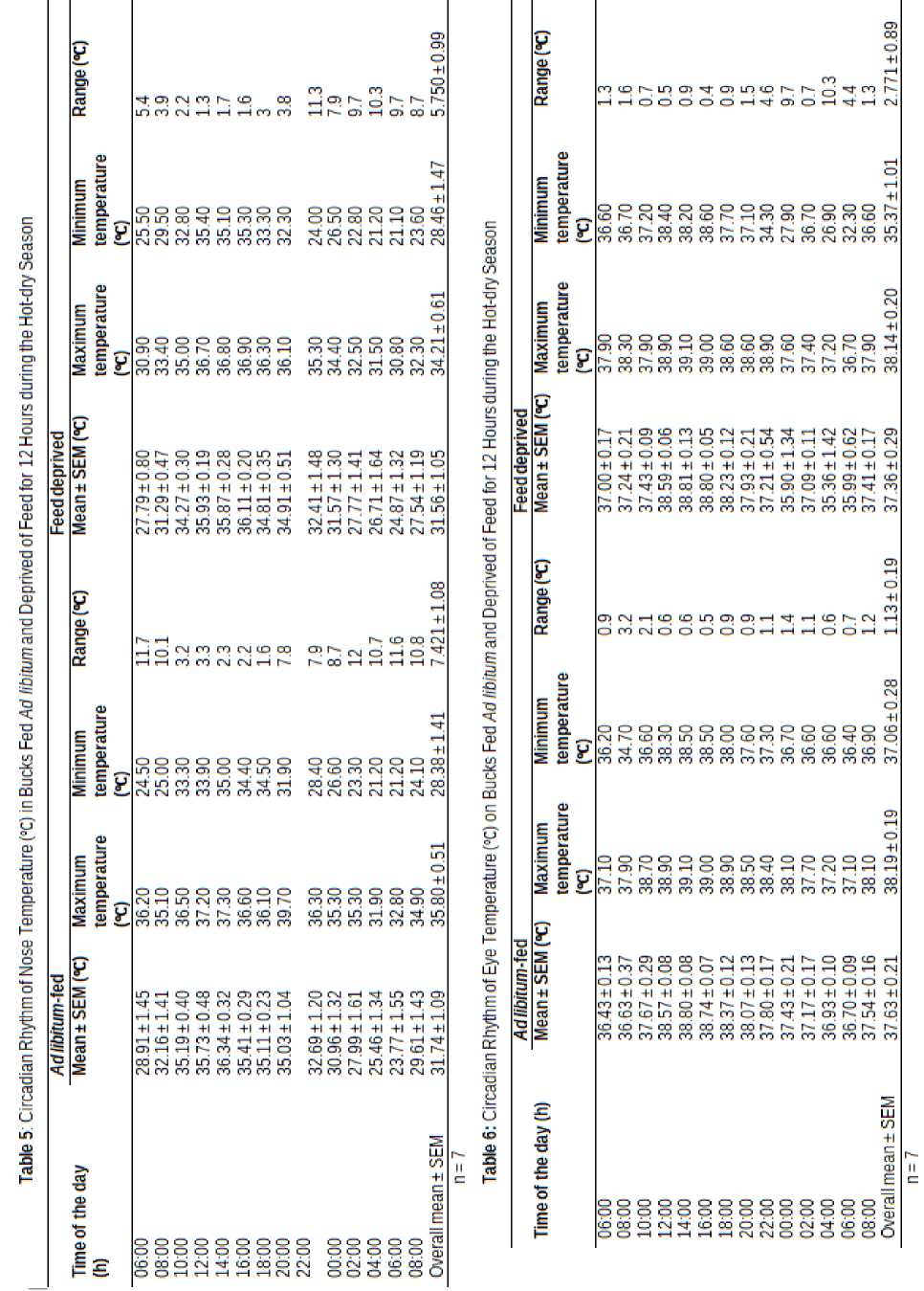
Table 7 The Relationship between the Hours of the ay and the Body Surface Temperatures (°C) of Bucks Fed Ad libitum and eprived of Feeds for 12 Hours during the Hot-dry Season
|
Correlated Parameters Ad libitum- Fed (n = 7) |
Fasted (n = 7) |
|
Hour of day and fore-head temperature 0.705** Hour of day and ear temperature 0.782*** Hour of day and nose temperature 0.731** Hour of day and eye temperature 0.758** Temperature-humidity index and fore-head temperature 0.953*** Temperature-humidity index and ear temperature 0.979*** Temperature-humidity index and nose temperature 0.939*** Temperature-humidity index and eye temperature 0.968*** |
0.733** 0.731** 0.775** 0.628* 0.981*** 0.968*** 0.891*** 0.904*** |
= Significant (P < 0.05); ** = Very significant (P < 0.01); *** = Very highly significant (P < 0.001) correlation
Table 8 The Relationship between the Body Surface Temperature (°C) Values in Bucks Fed Ad libitum and Fasted for 12 Hours during the Hot-dry Season
|
Correlated body surface temperatures |
Ad libitum- Fed (n = 7) |
Fasted (n = 7) |
|
Fore-head temperature and ear temperature |
0.974*** |
0.903*** |
|
Fore-head and nose temperature |
0.960*** |
0.903*** |
|
Fore-head temperature and eye temperature |
0.877*** |
0.908*** |
|
Ear temperature and nose temperature |
0.952*** |
0.934*** |
|
Ear temperature and eye temperature |
0.943*** |
0.881*** |
|
Nose temperature and eye temperature |
0.859*** |
0.899*** |
= Very highly significant (P < 0.001) correlation
The eye temperature was lowest in ad libitum -fed bucks at 06:00 h (36.43 ± 0.13°C), obtained on the first day of the recording. In the fasted bucks, the lowest value (35.36 ± 0.42°C) was recorded at 04:00 h on the second day of the recording. The overall mean value of eye temperature in the ad libitum -fed bucks fluctuated with the hour of the day, but did not differ significantly (Table 6). The hour of the day was positively and significantly (P < 0.05) correlated with the fore-head, ear, nose and eye temperatures (Table 7). Furthermore, the relationships between the body surface temperature values were positive and very highly significant to one another, both in the fasted and ad libitum -fed bucks (Table 8).
DISCUSSION
The results of the present study demonstrate a distinct circadian rhythmicity in the body surface temperatures (forehead, ear, eye, and nose) of Red Sokoto bucks during the hot-dry season. The recorded ambient conditions, specifically the TemperatureHumidity Index (THI) of 74.18 ± 1.29, indicate that the animals were actively experiencing heat stress. Previous research has well established that a THI exceeding the threshold of 72 induces moderate to severe heat stress in small ruminants, necessitating active thermoregulatory responses to maintain physiological homeostasis (Marai et al., 2007; Silanikove, 2000).
The circadian peaks in body surface temperatures were primarily observed between 14:00 h and 16:00 h. This timing corresponds directly to the periods of peak ambient dry-bulb temperatures and maximum environmental thermal load in tropical climates. Conversely, the acrophase (lowest values) for all measured anatomical sites occurred consistently at 06:00 h. This rhythmic physiological pattern aligns with the findings of Piccione et al. (2003) and Giannetto et al. (2010), who reported that diurnal variations in the peripheral temperatures of domestic ruminants are heavily entrained by environmental cues, particularly ambient temperature cycles and photoperiods.
Among the anatomical sites measured via infrared thermometry, the eye temperature exhibited the highest values (peaking at 38.80°C in the control and 38.81°C in the fasted group) and demonstrated the least fluctuation. This observation is consistent with existing literature which identifies the ocular surface—particularly the region of the lacrimal caruncle — as a highly reliable, non-invasive indicator of core body temperature. The stability of the eye temperature is attributed to its rich capillary network and direct blood supply shared with the brain (Church et al., 2014; Johnson et al., 2011). In contrast, extremities like the ears and nose showed wider thermal variations (dropping to 27.26°C and 27.79°C at 06:00 h, respectively), reflecting their role as primary vascular beds for sensible heat dissipation via vasodilation and vasoconstriction (Salles et al., 2016).
Crucially, the imposition of a 12-hour feed deprivation did not significantly alter the overarching circadian rhythm of body surface temperatures. While the heat increment of feeding (metabolic heat production) is a major contributor to thermal balance in ruminants, the short-term withdrawal of feed for 12 hours was insufficient to disrupt established thermoregulatory rhythms. This resilience highlights the robust adaptive capacity of the Red Sokoto breed to arid and semi-arid environments, where transient feed scarcity and high environmental heat loads occur concurrently (Ayo et al. , 1998; aramola et al. , 2012). The ability of these bucks to preserve their circadian rhythmic patterns under combined nutritional and environmental stressors underscores their evolutionary adaptation to the harsh climatic conditions of the Northern Guinea Savannah (Fadare et al. , 2012).
CONCLUSIONS
The Body surface temperatures showed clear circadian patterns, while the hot-dry season was characterized by high THI values (79–82), indicating significant exposure of the bucks to heat stress during the season. Twelve-hour feed deprivation did not significantly alter body temperature responses of the Red Sokoto goats during the hot-dry season.
ACKNOWLEDGEMENTS
We appreciate the technical staff for their support and expertise in carrying out this research.
CONFLICTS OF INTEREST
All authors declare that they have no conflicts of interest.
