
Cognitive Overload and its Plausibility in Impairing the Academic Performance of Professors in State-run Universities – A Qualitative Study in Indian Microenvironment
Journal: International Journal of Cognitive Research in Science, Engineering and Education @ijcrsee
Article in issue: 2 vol.14, 2026.
Free access
In this qualitative study, I analysed the magnitude of cognitive overload among professors employed in Indian state-run universities and its impairment of their academic performance. The research was conducted in the Indian higher education framework, where the ever-increasing cognitive overload has significantly impacted academic performance and role expectations of professors. This qualitative study examines the causes of cognitive overload among professors at state-run universities, as well as its impact on their academic performance. This study offers a clearer understanding aimed at establishing cognitive overload as an obstacle to work efficiency within the Indian micro-environment. Semi-structured interviews were conducted with 40 assistant professors, associate professors and professors working at 20 state-run universities in India. The collected data were then examined thematically. Seven interrelated themes surfaced: (1) Task switching and interruptions - continuous juggling between tasks; (2) Pedagogical impact - effects on teaching quality; (3) cognitive symptoms - difficulty in thinking and understanding; (4) Social symptoms - difficulty in interaction and collaboration; (5) Behavioural manifestations - altering behavioural patterns; (6) Physical and emotional toll - complete physical and mental exhaustion and (7) Coping and support - dealing with the problem and assistance. These themes were persistently mirrored across participants, indicating robust data saturation. The study provides insights on the challenges faced by professors in managing their job-related responsibilities in the context of rising cognitive load arising from the administrative setup of Indian universities. The study reveals the impact of cognitive overload on the effectiveness of academic and research performance of Indian professors.
Short address: https://sciup.org/170213600
IDS: 170213600 | UDC: 159.944.4.072:378.091.12(540) | DOI: 10.23947/2334-8496-2026-14-2-193-210
Text of the scientific article Cognitive Overload and its Plausibility in Impairing the Academic Performance of Professors in State-run Universities – A Qualitative Study in Indian Microenvironment
In recent decades, the demand for higher education in India has increased rapidly, especially from groups that have traditionally been left behind or excluded from educational networks. This has put already tightened governments under enormous pressure to provide support to their endeavour of imparting quality education to all ( Bhatty et al., 2022 ). Higher education in India is principally administered by the state-run education network, which is controlled by the government at the central, state, and local levels ( Robert, 2021 ). The current state of the teaching profession in state universities in India is experiencing a profound contradiction. While new reforms are being implemented to bring transparency and improve teacher welfare, the profession is facing a serious crisis due to the increasing reliance on contractual and guest faculty ( Takker and Ramchand, 2022 ).

© 2026 by the authors. This article is an open access article distributed under the terms and conditions of the Creative Commons Attribution (CC BY) license .
not be able to adapt quickly to changes in their role expectations and be unable to meet the teaching and mentoring needs ( Narayanan et al., 2025 ). In a typical state-run university in India factors such as high teaching loads, large class sizes, multiple modalities, diversity in student learning needs and curriculum updates particularly after the implementation of NEP-2020 etc are giving rise to cognitive overload among professors ( Apat and Swain, 2023 ).
Cognitive overload is defined as a psychological condition that arises when the volume of information or the number of concurrent tasks outpaces the capacity of a person’s working memory. In such a state, our brain turns “saturated”, making it tough to productively process, understand or hold on to new information ( Krish, 2000 ; Jaeggi et al., 2007 ; Pace et al., 2021 ; Lahlou, 2025 ). Cognitive overload relates to the openness of people to massive amount of information that has a comprehensive meaning. More specifically, it can interfere with information processing and decision-making abilities ( Bolisani et al., 2018 ). Cognitive overload implies to a state of affairs in which the processing demands involved in a task may surpass the processing capability of the cognitive system ( Mayer and Moreno, 2003 ). Accordingly, it reflects the inability of an individual to demonstrate problem-solving capability or make decisions due to severe cognitive processing limitations. To study the impact of cognitive overload on professors is of great importance as it relates to pertinent outcomes like job satisfaction, quality of student progression and overall academic performance. It can sizeably affect the quality of life of professors alongside the teaching quality and academic upliftment of the future workforce.
Cognitive overload has much to do with many of our intellectual problems. Professors today have a multitude of tasks and responsibilities, so much so that multitasking has become a way of life. Information is perpetually forced upon professors, and regardless of how much information is received, they feel that more is needed, and of reasonable standard and distinctness. The universities need to help address these issues. But the means and efforts remain deficient ( Martini et al., 2019 ; Rodríguez, 2011 ). In a typical setting today, professors in universities have to perform multiple roles like that of a teacher, examiner, researcher and administrator and mentor. A satisfactory performance of all these roles requires continual overhauling of information processing on his end, thereby giving rise to cognitive overload ( García-Arroyo and Segovia, 2019 ). The overall implication of cognitive overload on university professors is serious. When the compulsions of teaching, research, publications, and administrative tasks intersect simultaneously, the brain’s information processing capacity begins to collapse. This makes it difficult to maintain focus, reduces decision-making ability, and reduces creativity. As a result, professors face hardships in attaining academic excellence, producing high-quality research papers and often fail when trying to apply creative teaching pedagogies in their classrooms ( García-Arroyo and Segovia, 2019 ). Constant mental fatigue increases stress, which reduces productivity in general and creates a profound sense of discontent with academic endeavours.
In the current study the researcher has made an attempt to comprehend the implication of cognitive overload on task related performance of professors teaching in various state-run universities across northern India. The research has been carried out by conducting a qualitative study through focused interviews of 40 assistant professors, associate professors and professors working across twenty staterun universities. The target audience of participants are the professors who are actively employed as permanent/regular teaching faculties in various academic streams like humanities, sciences, commerce, management, engineering, medical science, linguistics, agricultural science, music and law and are also discharging administrative assignments simultaneously at a state-run university in India. Therefore, there are certain fundamental questions concerned with cognitive overload among professors which the researcher thinks are worth considering:
-
1. How does regular task switching and interruptions affect the state of cognitive overload among Indian professors?
-
2. How do Indian professors subjectively perceive and explain the manifestations of pedagogy, cognition, behaviour, emotions social relations on their cognitive overload?
-
3. What coping strategies do Indian professors use to manage cognitive overload for maintaining their professional performance?
The answers to the above questions should enlighten social science researchers who prepare surveys on cognitive overload of professors. Expanding the knowledge of cognitive overload can help researchers build models by analysing trends collected. This will enable professors to develop more effec- tive strategies to optimize the performance for attaining professional distinction. This study investigates the current state of cognitive overload among professors in India and its potential impact on academic performance, thereby enhancing the standard of professional assignments delivered by the academicians. The existing literature lacks empirical research on the level of cognitive overload among university professors. In light of recent regulatory developments in India like National Educational Policy-2020 rollout, the viewpoint of professors on cognitive overload requires further study to upgrade academic and overall professional performance. Thus, the objective of this research is to delineate the factors and impact of cognitive overload from the standpoint of state-run university professors, to achieve desirable academic performance.
Theoretical Foundation
This paper is based on the notion of Cognitive Load Theory propounded by Sweller (2011) that differentiates three kinds of cognitive load:
-
• Intrinsic cognitive load – It is related to the intrinsic complicatedness of the material under process. In a typical university setting, this coincides with the innate cognitive stipulations of teaching, research and executive decision making.
-
• Extraneous cognitive load – It is the load created by the way information is dispensed or by the processes surrounding a task. This implies administrative procedures, meeting arrangements, accreditation paperwork and university workflows that introduce needless cognitive load to the deep-rooted complexness of the activity.
-
• Germane cognitive load – The cognitive load associated with filtering, learning, and purposeful obligation. For university professors, this is about the intellectual resources that are engaged in contemplative teaching, innovative research, and scholarly reasoning.
As stated by Sweller, cognitive overload is the result of the total intrinsic and extraneous load exceeding the dimensions of an individual’s functional memory, leaving inadequate supplies for germane processing. Cognitive overload for university professors occurs when the mingling of complicated academic activities (intrinsic) and burdensome administrative processes (extraneous) exceeds cognitive capability and hinders worthwhile participation in teaching and research (germane).
Kirsh’s (2000) supporting framework additionally emphasizes that cognitive overload extends beyond the mere accumulation of facts and encompasses the configuration, timeliness and feasibility of the flow of information. This perspective is particularly important for professors who have to deal with many demands at the same time and are constantly interrupted.
Methodology
Study design
This is a qualitative interview-based study that focuses on the awareness of cognitive overload and its potential impact on academic performance among professors currently teaching in various public universities in North India. A detailed review of the literature indicates that there exists no detailed literature identifying patterns of teacher cognitive overload in the Indian context. Therefore, the qualitative research methodology through semi-structured interviews is appropriate for gaining new knowledge about the effects of cognitive overload. Semi-structured interviews are the most suitable method for collecting primary data because open-ended questions allow the researcher to procure complete details and gain a deeper comprehension of the subject.
Operationalization of cognitive overload
The author operationalised cognitive overload using a multilayered structure advanced by Sweller (2011) and Kirsh (2000) for conducting this qualitative research. Cognitive overload in data capturing and data interpretation was recognized by the researcher based on the following four interpretive benchmarks:
-
(i) Functional memory saturation – periods when participants reported incompetency in processing, retaining or recalling information while managing multiple coinciding activities. This was differentiated from normal workload in that it focused on handling collapses rather than the magnitude of activity.
-
(ii) Task switching cost – specific proof of performance deterioration (e.g. zoning out, problems in reclaiming attention, fumbles) when moving between pedagogical and executive tasks. The focus was on the standard of cognitive execution, not the quantity of tasks.
-
(iii) Personal cognitive stress – self-assessed mental exhaustion, concentration hurdles, and decreased decision-making capability specifically related to information filtering demands in opposition to behavioural or motivational objections.
-
(iv) Information processing deficit – self-reported inability to categorize or reject immaterial information, resulting in a sense of cognitive “saturation” that hindered academic obligations.
The study meticulously separated cognitive overload from job-related stress, burnout and normal workload:
-
• Occupational strain was coded if respondents reported anxiety, stress or mental stimulation without explicit cognitive processing defaults.
-
• Burnout was coded when respondents reported emotional fatigue, dissociation or decreased professional efficiency, irrespective of cognitive execution.
-
• Normal workload was coded when respondents mentioned task magnitude or time constraint but were still cognitively functioning without any stated memory or distraction issues.
Data were construed as cognitive overload solely when respondents expressly connected their problems to information handling restrictions (e.g. lapse in memory, ‘mind blanking’, inability to pursue conversations). This systematic differentiation is presented in Table 1 below:
|
Table 1. Distinction between cognitive overload and other associated constructs |
||
|
Construct |
Fundamental Indicators |
Distinction from Cognitive Overload |
|
Cognitive Overload |
Loss of memory, difficulty in concentration, reduced ability to process information, impaired decision making. |
Emphasis on cognitive capability overloaded by filtering demands |
|
Occupational Stress |
Anxiety, stress, mental stimulation, concern |
Devoid of the explicit cognitive-processing default element |
|
Burnout |
Emotional fatigue, dissociation, curtailed personal achievement |
Behavioural/emotional decline as opposed to cognitive saturation |
|
Natural Workload |
Time constraint, task magnitude, work pressure |
Not necessarily beyond cognitive processing capability; can be handled |
Participant selection
The interviewees selected for the study are assistant professors, associate professors and professors working across 20 universities run by the Central Government of India and other state governments of various states of North India. The researcher utilised his professional connections, developed during 10 years of service at a State-run University of Uttar Pradesh (the largest Indian province in terms of population and number of universities). After the professors were interviewed, the researcher asked the professors to share recommendations from their academic networks about who would be the best fit for this study. There were also referrals from professors who refused to participate in the study. The main inclusion criteria were that professors must be employed as permanent/regular faculty members at public universities and must hold at least one non-academic portfolio at their respective universities. Few professors openly stated that they were unable to answer interview questions because of their reluctance/hesitation to participate in the research. Some professors directly emphasized that the opinions expressed reflected their personal worldviews developed during their time at the university and did not necessarily align with the university in which they worked. All of the professors interviewed requested personal and institutional anonymity, which is understandable. Some of the referrals pertained to those professors who had already retired from a university department and therefore could not qualify to be a part of the research.
Sampling method
The researcher has used chain-referral sampling also known as snowball sampling to select participants from various universities with the aim of developing an understanding on the subject matter through real-time experiencers, from distinctive viewpoints and dynamics. Snowball sampling is a widespread sampling technique mainly used for approaching the covered inner circle and the classes basically found far away from the conventional researches in social sciences (Atkinson and Flint, 2001). The chainreferral or snowball sampling was of immense help in getting referrals from the interviewed professors to further approach more professors. The rationale behind the use of chain-referral sampling was to gain access to such professors who hold expertise in the relevant domain, these included professors particularly from different academic disciplines right from humanities, science, social sciences and commerce who had a sizeable experience in terms of working in the administrative domain alongside their regular teaching assignments. The respondent professors were employed across different universities holding key administrative positions like Head of the department, Dean of the faculty, Course coordinators, Committee conveners/members, Proctor, Warden etc.
Sampling size
This study has been finalized with a sample size of 40 professors, almost all of these professors are employed in state-run universities as head of department, dean of faculty, course coordinators, among others. The fundamental premise of qualitative research is that it is based on the study of phenomena rather than numbers of responses. Comparing the response rates of quantitative studies to qualitative studies is not regarded as reasonable and does not save time. This study is highly insistent, interactive and reiterative. Every single interview was cautiously examined until the point at which fresh patterns ceased to emerge in the responses. This was the point at which the researcher resolved to wind up further interviews. This is called saturation i.e., the procedure of conducting a series of interviews, one after another, usually with different respondents until all concepts begin to appear multiple times during the interview without any new concepts emerging ( Trotter II, 2012 ).
Collection of Data
The discussion with professors were conducted primarily over video calls, physical interactions and telephone. The interviews were conducted in a cost-effective manner and at the convenience of the concerned professor. The researcher made an attempt to incorporate questions that would provide assistance in finding the pertinent information which was needed to reach the eventual conclusion. Every interactive session was carried out for a mean time-span of 29.22 minutes. The actual duration of each session is specified at a later stage in the research paper. A time tracker was utilized by the researcher in order to document the exact time consumed in all the interviews. The researcher went ahead with seven semi-structured questions which were asked for organizing the interviews. The physical interviews were administered in the cities of Varanasi, Lucknow and Siddharth Nagar while video call-based interviews and over the telephone interviews were organized from cities like Kanpur, Ayodhya and Gorakhpur. To start with, the researcher introduced himself to the professors, a small introduction of the interviewee professor was also pursued, accompanied by the objective of the research which was elucidated to the professors. The interviews were conducted only after the objective of this research was comprehended and consented to.
Analysis of Data
As the purpose of this study is to get a deeper understanding of the experiences and perceptions of professors, qualitative content analysis is considered as a method of data analysis as it can furnish invaluable insights through the analysis of texts in detail. In qualitative data analysis, a researcher has the alternative to carry out the same methods used in quantitative studies as well ( Bhatia et al., 2020 ). High quality content analysis does not refute a hypothesis, but aims to develop hypotheses for prospective quantitative studies. Content analysis is only useful if it is outlined systematically and clearly ( Elo and Kyngäs, 2008 ). Latent analysis is executed on raw data accumulated during the interview to extract purposeful inferences.
This study takes into consideration two significant stages of qualitative content analysis which are data synthesis and data structuring. The primary step consisted of transcribing each interview and integrating the data, which decreases the risk of omissions. The secondary step consisted of an orderly qualitative content analysis of the professors’ remarks on research questions. This is followed by coding and classification to identify broad themes such as task switching and interruptions, pedagogical impact, cognitive symptoms, social manifestations, behavioural manifestations, physical and emotional toll and coping and support.
According to our analysis, major thematic areas and topics related to cognitive overload and academic performance emerged during the 34th interview. Redundancy began to step into the response at this point, and was hardly ever ascertained after that. It is satisfactory to draw out that approximately 85% of the factors connected to cognitive overload that can negatively affect academic performance were discovered during the 35th interview. Therefore, the study was conceptually based and deductive.
Diligence
This study was carried out by me as the sole author, an assistant professor at a state-run university in India (the opinions articulated by the author are the outcome of research and personal worldviews advanced during his work at the university, and do not inevitably correspond with the university in which he works). The complete research is segregated into multiple parts, and its maintenance is the sole responsibility of the author. The interview process began with a succinct introduction of the faculty member who participated in the interview process. All data was transcribed by the author. All activities, including faculty searches, scheduling faculty interviews, developing semi-structured questionnaires, and literature reviews, were performed solely by the author. It also required considerable meetings with fellow experienced researchers which usually persisted for some minutes to even an hour.
Ethical Implications
Participants voluntarily confirmed their participation by replying to the messages sent to them by the researcher on platforms like WhatsApp, e-mail, or LinkedIn. This research is neither listed at any place nor has been appraised by an institutional ethics committee. Confidentiality of the study is maintained by destroying all audio recordings post-decryption of the data considering its sensitivity and potential ramifications for the respondents. Moreover, this was also done anonymously. In all the data presented in this study efforts have been made by the researcher to maintain confidentiality by giving indicative introduction of various universities where the participant professors are currently employed and their explicit or implied relationship with cognitive overload.
Findings
Since the brain’s working memory capacity is limited and the sheer amount of available information is quite large many teaching faculties across the globe are susceptible towards cognitive overload. Post experiencing unsettling circumstances teaching faculties in higher education may choose sub-optimal alternative which actually is heuristic streamlining. According to Sweller (2011) , cognitive overload represents a state of affairs where the demands laid down on the working memory transcends its already bounded dimension, obstructing information filtering and learning.
Table 2 presents the questions developed during the interviews. Considering the opinion-based complexion of the subject matter under exploration and keeping in view that the objective of the investigation is significantly probative, the comprehension of participant insight and supplementary qualitative details were favoured than the sole study of quantitative data. At the end of each interview the findings were compiled and studied. The transcripts were cautiously analysed by the researcher for identifying patterns and drawing conclusions.
|
Table 2. Theme based semi-structured questions for interview |
||
|
No. |
Theme |
Questions |
|
1 |
Task switching and interruptions |
Do you find it difficult to regain your concentration after being interrupted by non-academic tasks like attendance, committee work, administrative chores, accreditation planning and event planning? |
|
2 |
Pedagogical impact |
Have you recently delivered a lecture where you felt you were just “going through the motions” rather than deeply engaging with students because your mind was preoccupied with pending administrative deadlines? |
|
3 |
Cognitive symptoms |
Do you walk into a classroom or office and forget what you were about to do because your mind was processing too many other tasks? |
|
4 |
Social manifestations |
Do you avoid taking on new and interesting academic projects like new research collaborations simply because you feel too “mentally full” to handle them? |
|
5 |
Behavioural manifestations |
Have you noticed yourself becoming short-tempered or less patient with students or colleagues when you are under a high volume of simultaneous demands? |
|
6 |
Physical and emotional toll |
Do you experience physical symptoms like headaches, eye strain or fatigue specifically linked to days with high administrative or grading loads? |
|
7 |
Coping and support |
Is there a formal or informal support system within your university that helps you manage overwhelming workloads? If not so, where do you currently “offload” your tasks? |
Table 3 gives the demographic characteristics of all the respondents participating in the study. The transcripts from the study which were analysed, encompassed 40 interviews with 21 assistant professors, 12 associate professors and seven professors working across 20 state-run university of India. Thirty-one respondents (77.5%) were men while nine respondents (22.5%) were women. Respondents reported a mean ± standard deviation of 8.00 ± 6.54 years of university teaching experience.
Table 3. Demographics of the professors participating in the interview
|
Attributes |
Figure |
|
Age |
|
|
25-35 |
03 |
|
35-45 |
12 |
|
45-55 |
15 |
|
55-65 |
10 |
|
Gender |
|
|
Male |
31 |
|
Female |
09 |
|
Experience |
|
|
0-10 years |
16 |
|
10-20 years |
15 |
|
20-30 years |
07 |
|
30-40 years |
02 |
|
>40 years |
00 |
|
Current position |
|
|
Assistant Professor |
21 |
|
Associate Professor |
12 |
|
Professor |
07 |
|
Number of administrative portfolios being held |
|
|
0-1 |
19 |
|
1-2 |
11 |
|
2-3 |
06 |
|
Attributes |
Figure |
|
3-4 |
03 |
|
>4 |
01 |
|
Administrative portfolio wise distribution (Assistant Professor/ Associate Professor/ Professor) |
|
|
Dean of Faculty |
04 |
|
Head of Department |
09 |
|
Course Coordinator |
11 |
|
Director/Coordinator – Internal Quality Assurance Cell (IQAC) |
03 |
|
Chief Proctor |
02 |
|
Hostel Warden |
05 |
|
Controller of Examinations |
03 |
|
Faculty Incharge – University Guest House |
01 |
|
Member – Admission / Examination Committee |
14 |
|
Member – Departmental Research Committee |
12 |
|
Member – National Assessment and Accreditation Council (NAAC) / National Institution Ranking Framework (NIRF) Committee |
15 |
Table 4 presents particulars about the interviewed professors and the universities they are currently working at (names of the universities have not been disclosed as per the requests of the respondents), and the scheduled dates for each interview. The interviews took place over a six-month period, from September 2025 to February 2026. The researcher has strictly tried to maintain the confidentiality of all respondents. In fact, at the very outset of the interview the researcher informed the respondents that their identities will be disclosed only if they explicitly agree to be identified, to which all the respondents were reluctant considering the sensitivity of the subject matter.
|
Table 4. Details of the professors interviewed |
|||
|
Professors |
University |
Designation |
Interview date (dd/mm/yyyy) |
|
Professor 01 (P01) |
A noteworthy agricultural and technology university accredited A++ by NAAC |
Assistant Professor |
21-09-2025 |
|
Professor 02 (P02) |
One of the oldest technology universities having a 105- year history and accredited A+ by NAAC |
Assistant Professor |
24-09-2025 |
|
Professor 03 (P03) |
A reputed law university established in 2005 and accredited A by NAAC |
Professor |
27-09-2025 |
|
Professor 04 (P04) |
A 115-year medical university accredited A++ by NAAC with a CGPA of 3.67 |
Assistant Professor |
30-09-2025 |
|
Professor 05 (P05) |
A language university situated in the capital city of a key Indian state and accredited B++ by NAAC |
Assistant Professor |
02-10-2025 |
|
Professor 06 (P06) |
One of the prominent open universities having more than 80,000 learners enrolled |
Associate Professor |
05-10-2025 |
|
Professor 07 (P07) |
A university dedicated to the study of Sanskrit language and accredited A by NAAC |
Assistant Professor |
06-10-2025 |
|
Professor 08 (P08) |
A leading technology university ranked in top 100 for engineering and accredited A by NAAC |
Assistant Professor |
11-10-2025 |
|
Professor 09 (P09) |
A university established for the welfare of persons with disabilities and accredited A by NAAC |
Professor |
17-10-2025 |
|
Professor 10 (P10) |
One of the largest universities of India with more than 4,00,000 enrolments and accredited A by NAAC |
Associate Professor |
22-10-2025 |
|
Professor 11 (P11) |
A 100-year-old university established for the promotion of music and accredited A++ by NAAC |
Assistant Professor |
26-10-2025 |
|
Professor 12 (P12) |
A leading university with more than 550 affiliated colleges and accredited A++ by NAAC |
Assistant Professor |
01-11-2025 |
|
Professor 13 (P13) |
One of the top 5 universities in India as per NIRF rankings and granted with institute of eminence status |
Assistant Professor |
08-11-2025 |
|
Professors |
University |
Designation |
Interview date (dd/mm/yyyy) |
|
Professor 14 (P14) |
A 150-year-old central university accredited A+ by NAAC with a CGPA of 3.26 |
Assistant Professor |
11-11-2025 |
|
Professor 15 (P15) |
A recently established and rapidly growing central university accredited A++ by NAAC |
Associate Professor |
14-11-2025 |
|
Professor 16 (P16) |
A university running many professional and vocational study programmes accredited A++ by NAAC |
Associate Professor |
19-11-2025 |
|
Professor 17 (P17) |
An almost 70-year-old state government university recently accredited by A++ by NAAC |
Professor |
24-11-2025 |
|
Professor 18 (P18) |
A more than 100-year-old state university with a large alumni base accredited B++ by NAAC |
Assistant Professor |
24-11-2025 |
|
Professor 19 (P19) |
One of the reputed state government universities of India recently accredited A++ by NAAC with a CGPA of 3.55 |
Assistant Professor |
24-11-2025 |
|
Professor 20 (P20) |
A relatively new state government university growing quickly with more than 250 affiliated colleges |
Associate Professor |
29-11-2025 |
|
Professor 21 (P21) |
A university dedicated to the study of Sanskrit language and accredited A by NAAC |
Associate Professor |
04-12-2025 |
|
Professor 22 (P22) |
One of the oldest technology universities having a 105- year history and accredited A+ by NAAC |
Assistant Professor |
08-12-2025 |
|
Professor 23 (P23) |
A university established for the welfare of persons with disabilities and accredited A by NAAC |
Assistant Professor |
13-12-2025 |
|
Professor 24 (P24) |
One of the top 5 universities in India as per NIRF rankings and granted with institute of eminence status |
Associate Professor |
17-12-2025 |
|
Professor 25 (P25) |
A relatively new state government university growing quickly with more than 250 affiliated colleges |
Professor |
20-12-2025 |
|
Professor 26 (P26) |
A university established for the welfare of persons with disabilities and accredited A by NAAC |
Assistant Professor |
24-12-2025 |
|
Professor 27 (P27) |
A leading technology university ranked in top 100 for engineering and accredited A by NAAC |
Assistant Professor |
30-12-2025 |
|
Professor 28 (P28) |
A leading university with more than 550 affiliated colleges and accredited A++ by NAAC |
Associate Professor |
31-12-2025 |
|
Professor 29 (P29) |
A noteworthy agricultural and technology university accredited A++ by NAAC |
Assistant Professor |
07-01-2026 |
|
Professor 30 (P30) |
One of the reputed state government universities of India recently accredited A++ by NAAC with a CGPA of 3.55 |
Professor |
14-01-2026 |
|
Professor 31 (P31) |
A 150-year-old central university accredited A+ by NAAC with a CGPA of 3.26 |
Associate Professor |
19-01-2026 |
|
Professor 32 (P32) |
One of the prominent open universities having more than 80,000 learners enrolled |
Assistant Professor |
23-01-2026 |
|
Professor 33 (P33) |
A leading technology university ranked in top 100 for engineering and accredited A by NAAC |
Assistant Professor |
28-01-2026 |
|
Professor 34 (P34) |
A more than 100-year-old state university with a large alumni base accredited B++ by NAAC |
Associate Professor |
31-01-2026 |
|
Professor 35 (P35) |
A relatively new state government university growing quickly with more than 250 affiliated colleges |
Assistant Professor |
03-02-2026 |
|
Professor 36 (P36) |
A 115-year medical university accredited A++ by NAAC with a CGPA of 3.67 |
Associate Professor |
05-02-2026 |
|
Professor 37 (P37) |
An almost 70-year-old state government university recently accredited by A++ by NAAC |
Assistant Professor |
12-02-2026 |
|
Professor 38 (P38) |
A more than 100-year-old state university with a large alumni base accredited B++ by NAAC |
Professor |
15-02-2026 |
|
Professor 39 (P39) |
A language university situated in the capital city of a key state and accredited B++ by NAAC |
Associate Professor |
22-02-2026 |
|
Professor 40 (P40) |
One of the top 5 universities in India as per NIRF rankings and granted with institute of eminence status |
Professor |
28-02-2026 |
Figure 1 presents the time span of each professor interview and the majority of interviews fell within the duration range of 23 minutes to 34 minutes. The mean length of the interview was 29.22 minutes where the shortest interview took place with associate professor 31 which lasted for 19 minutes. The interview with assistant professor 5 was the lengthiest, spanning a total of 42 minutes.
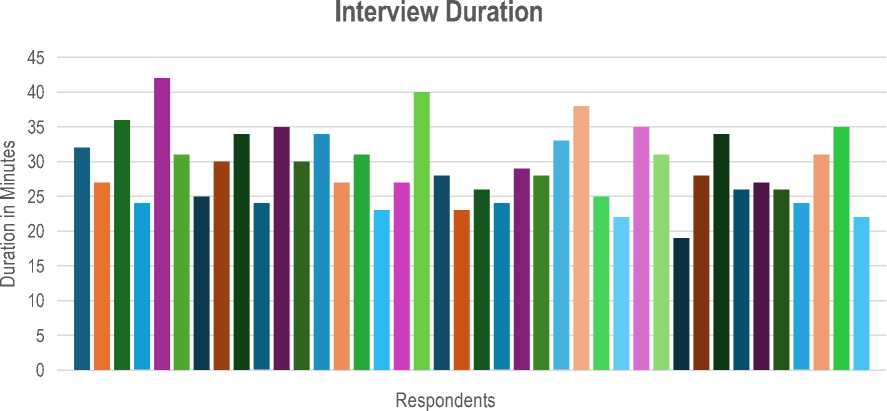
■ P01 ■ P02 ■ P03 ■ P04 ■ P05 ■ P06 ■ P07 ■ P08 ■ P09 ■ P10 ■ P11 ■ P12 ■ P13 ■ P14
■ P15 ■ P16 ■ P17 ■ P18 ■ P19 ■ P20 ■ P21 ■ P22 ■ P23 ■ P24 ■ P25 ■ P26 ■ P27 ■ P28
■ P29 ■ P30 ■ P31 ■ P32 ■ P33 ■ P34 ■ P35 ■ P36 ■ P37 ■ P38 ■ P39 ■ P40
Figure 1: Time consumed in interviewing professors
In accordance with the operational definition elucidated above, the study emphasized on the identification of failures encountered in cognitive processing particularly related to information overload. Each theme in the list below is related to one or more of the four interpretive benchmarks (functional memory saturation, task switching cost, personal cognitive stress, or information processing deficit). The under mentioned seven themes surfaced constantly throughout all interviews. The core themes that transpired through the careful scrutiny of transcripts collected by the researcher were task switching and interruptions, pedagogical impact, cognitive symptoms, social manifestations, behavioural manifestations, physical and emotional toll, coping and support.
Task switching and interruptions
The fundamental notion of “non-academic work” is now out of the equation, every single thing that the university administration expects us to do has to be at the very top of our priority list. If, while we are engaged in teaching a key concept in the class and we are at once asked to prepare for an urgent accreditation meeting, the psychological association breaks entirely. Thereafter, simply regaining that level of focus takes at least two days. This has happened so many times now that we have submitted to the belief that “multitasking” is our basic motto—although the quality of the delivery is compromised (P01, P04 ). So, the frequent switching between teaching and administrative tasks is detrimental to quality. The repeated loss of focus makes effective classroom performance lacklustre, leading to imminent dejection among professors ( McInnis, 2000 ). On similar grounds, continuous disruptions diminish the quality of research, and academic writing also suffers drastically. I view regular task switching and continuous interruption as a hurdle. Yes, repeated obstructions are definitely an issue—mainly when you are involved in extensive research or original writing. The trouble emerges when some tasks are abruptly forced upon you. Although I strive to set clear boundaries but regaining the lost focus is difficult (P02, P11, P16).
This constitutes a form of organized cruelty being imposed on our intellectual being. If the administrative machinery feels that teachers are machines, then they should be reminded that even the most well-oiled machines need time to reboot (P10). The ever-increasing cognitive burden in universities is gravely testing the mental limits of professors. Today’s workload is excessive, and while keeping pace with time is essential, it is equally important that university administration respects human capabilities (Berg and Seeber, 2025). After three decades of active service, I can state this with utmost sincerity and certainty that while working in a university you are bound to manage a multitude of tasks concurrently. Through my observations I can state that when I first came into service some 32 years ago, the sheer volume of tasks was far less than it is today. Still, the right way to move forward is to reconcile with the modern times; or else, stress is bound to occur (P30).
This question aligns with the thought process of every teacher who had set his foot in academics to teach and perform quality research, yet today finds himself narrowed down to the status of an office worker. The single most worrisome mess affecting our universities is mental fatigue. The sad part is that by the time we somehow manage to reclaim our focus, the day is almost over (P05, P13). In such an alarming situation where, mental fatigue is diverting state-run university professors from teaching and research, the core competencies are clearly getting eroded ( Foli et al., 2025 ). It is indeed a matter of grave concern which needs to be dealt with immediately. I would take this liberty and say that we, as teachers, are slowly giving up on our core competence since we have turned ourselves into ‘managers,’ rather than ‘educators’, whatever may be the reason (P07).
Pedagogical impact
Very recently, the deadline for submitting the Annual Performance Assessment Report (APAR) was approaching at my university. I was engaging a class for the M.Sc. students. I was standing there, writing quantum mechanics equations on the board—but my mind was roaming in the midst of the APAR modules which were yet to be finalized. At one point, a student came up with a query, which I answered; nonetheless, I later figured out that I didn’t even entirely listen to the question (P06). The preoccupation of mind with administrative tasks is impairing uninterrupted academic dialogue between the teacher and the taught ( Mintrop and Charles, 2017 ). The circumstances have become so intense that professors are getting forced to present study material mechanically. Once, while I was delivering a lecture on the Union Territories under the Indian Constitution, my mind was engrossed with a University Purchase Committee meeting prior to which I had to sign the semester mark sheets also. Even though I kept going with my verbal flow, I had this feeling that I was not fully involved in a ‘discourse’ with the students, rather I was merely lecturing them (P15).
Honestly, sometimes it feels like a ‘spiritual failure.’ One day, I was teaching the poetry of John Milton, However, my focus remained with the committee convened in the Registrar’s office, where the Pre-Ph.D. coursework matter awaited resolution. Though, I recited the poetry, I failed to become absorbed in its true meaning. Although, I have resolved that, from now on, I observe at least ten minutes of silence before entering the classroom (P05). The persistent inability of state-run university professors to immerse themselves in teaching due to cognitive overload is making them feel that there is a serious lack of full presence on their part. Yet, there is a belief that in times of lack of energy there is no harm in taking honest breaks ( Headlee, 2020 ). I would call this issue a ‘multitasking failure.’ Whenever I notice that the students are getting bored because of lack of energy in me, I pause the lecture midway with the intention to hold extra classes on the next working day. I believe it is far better to honestly take a break in such situations. The students appreciate this as well (P08, P21). Moreover, expanding administrative pressure in universities is eroding academic discipline, making this disconnect a strange routine. Nevertheless, the administrative pressures in universities have become so immense that academics has been confined to a secondary role. No innovation involved, no voluntary dialogue. It is an upsetting state of affairs, but this is the ‘new normal.’ (P10, P29, P37)
Cognitive symptoms
This question strikes a deep chord with me because the incidents like these have now become very common. The brain simultaneously swirls with thoughts of administrative files, a Ph.D. scholar’s thesis, and my electricity bill. My mind continues to be a storehouse of knowledge, still the key to approach it has probably gotten buried somewhere underneath a soaring stack of non-academic work (P21). There is a mental tangle encountered in the midst of university-level tasks known as ‘cognitive overload.’ Further, while negotiating committee coordination, admissions and examination related work in the university, professors tend to lose sight of their core purpose. This shows that this is not merely a usual occurrence, but rather a sign of deeper concern. I would term this a ‘cognitive overload.’ And yes, this has been occurring with me frequently. Not long ago, I was made the convener of a committee within my faculty, and concurrently, admission work was in progress. I came to my office, unlocked the door, went in, and then sat there thinking about the exact purpose I had come for? I don’t believe that this is a normal phenomenon, rather a warning sign (P36).
Yes, this happens to me. When you are simultaneously serving as the chairperson of three university-level committees, supervising five research scholars, and confronting the pressure of collecting data for rankings like NAAC and NIRF, the mind gets confined in a ‘multitasking trap.’ It depicts the critical point where the mind fundamentally refuses to take any further load (P27). While the “multitasking trap” represents the brain’s limit, the “professorial blank moments” refer to an intense form of mental fatigue ( Vveinhardt and Sroka, 2022 ). The mind becomes absolutely drained due to mounting workload, which underscores the mental state of professors. They have come to a point, where the brain disapproves of any further supplementary load. I’ve even coined a name for situations like these—’Professorial Blank Moments.’ What happens with me is that sometimes, I just stare at my notes, striving to find out the exact topic which was covered in the previous session. It becomes extremely draining (P14, P18).
Social symptoms
At the beginning of my career, I used to say ‘yes’ to every research collaboration and every new research opportunity. Yet, over a period of time, I have hopelessly declined many opportunities for international association. I feel “mentally overcharged” just because I do not have sufficient time for research (P18, P26, P39). Cognitive overload induced time constraint is now forcing even those professors who are in the early stages of their career to turn down international collaborative opportunities as they are left with no choice ( Koudsia and Kirchner, 2024 ). This mental burden reaches its peak when administrative responsibilities, such as headship of the department, compel them to refuse even gripping research collaborations. I was recently about to commence on a research paper in sustainable marketing alongside a young researcher. The theme was completely new and stimulating to me. But once I went through my schedule, I figured out that the administrative responsibility of being the Head of the Department, attending perpetual administrative meetings and on top of that, the reporting requirements forced me to give up on the exciting collaboration. I had to eventually decline (P16). Cognitive overload has risen has a threat because it has completely inundated the capacity of professors by making the new partnership seem certain to fail. I would go to the extent to say that I have reached the point of overflow. I presently have four Ph.D. scholars, two ongoing research projects, and in addition to this, I serve as the Secretary of the department’s Research Committee. Considering this, I have a strong feeling that If I take on any new research collaboration, either the project will fail, or I will (P11).
Behavioural manifestations
“In recent times, perhaps, I have noticed, a distinct note of irritability in my voice. Patience is a quality for which I am widely known. My students always said, “Ma’am, do you ever get angry?” Yet, in recent months, I have started to witness changes in me. On one occasion, I was concurrently drafting minutes of the meeting for two different committees when an M.Sc. student came up to me. She asked a simple question which was regarding the Fredholm integral equation formula. I looked at her in irritation and replied “That is elementary knowledge, you should have memorized it by now?” This incident serves as a stark reminder that the cognitive overload we bear is slowly robbing us of our gentleness (P22 ). Cognitive workload has caused a severe decline in the patience level of Indian professors. It has not only inflated the irritability factor but is also affecting the relationship structures ( Das, 2025 ). Moreover, cognitive overload is impairing the composure. Yes, it happens. And I feel no hesitation in admitting it. However, I would also like to add that I am not solely responsible for this. When you are subjected to so many pressures simultaneously, your patience begins to wear thin. Sometimes, we do get this realization that our exasperation is not directed at our colleagues or students, but rather at the establishment that is overtiring us and just because of this our relationships are the first thing to suffer (P17, P25, P37). It is important for professors to acknowledge that losing patience under extreme pressure is natural, which can impact relationships. But what matters is the resolve to prioritize personal relationships and remain patient. Over the past few months, I have found myself growing irritable even towards my peers, family and some close acquaintances. Perhaps a hint of impatience in my tone has crept in. Honestly, I have started to feel that people are shying away from me. But now, I have made a firm resolve that no matter how big the workload, I would never lose patience with people I really care for (P14).
Physical and emotional toll
I have noticed myself minutely that on days when I have to spend seven or eight consecutive hours attending back-to-back physical and virtual meetings or evaluating end semester examination answer books, by evening, my eyes start to feel burning sensations, and I experience head pressure. This is not ordinary fatigue; rather, it is the integrated effect of ‘digital eye strain’ and ‘mental fatigue.’ The sad part is that I cannot afford avoidance as the deadlines are stiff and the system commands that results must be delivered quickly (P05). The two fundamental reasons behind the problems faced by professors are persistent workload and emotional fatigue. They suffer from “health-related issues” like digital eye strain and neck and shoulder stiffness ( Wood, 2020 ). Still, they feel compelled to disregard their health in the face of challenging times. Being the senior most professor and the chief proctor in my university, I have to juggle committee meetings, resolve disciplinary matters and above all evaluate the answer sheets. These days, I have begun to invariably experience stiffness in my neck and shoulders by late afternoon, followed by a blurring of vision. The worst part is that these health issues don’t usually get cured with ordinary medication because they are not a result physical exertion only, but of mental fatigue as well (P25). Therefore, a rational assessment is that prolonged sitting and mental stress are causing physical problems such as stiffness in the neck and shoulders and blurred vision ( Jasnak and Rao, 2025 ). Furthermore, the inability to take rest at regular intervals is making these issues even worse.
Last semester, when I spent around 45 consecutive days preparing the self-study report of my university to be submitted on the NAAC portal, the pain in my neck became so grievous that I just could not move my head. Seeking medical attention, I had to approach a physiotherapist who told me that my posture has deteriorated due to prolonged sitting and I have become a possible candidate of spondylitis. But still when deadlines emerge and there is pressure to submit data, how can I hardly just get up and go for a walk? Although, I am now planning to make it a rule to take a ten-minute break every hour (P20). The extent of despair among professors is such that despite doctor’s warnings, they do not envision a possibility of change in their lifestyle unless changes are instituted in university functioning. The doctors are now literally reprimanding us to either change our lifestyle or invite stress-induced hypertension. Nonetheless, we are helpless, because unless changes are installed in the way the university functions a lifestyle change seems like a joke and the pain behind it runs deep (P18, P23, P31, P35, P40).
Coping and support
At our university, there is no formal support system in place where we can offload the sheer volume of work we are burdened with. Informally, I “redistribute” it to my research scholars. All the rudimentary administrative tasks like filing and document compilation are handled entirely by our research students. We know this isn’t just, but we are short on choices (P23, P34, P38). In the light of growing cognitive burden on professors, they are forced either to shift a sizeable portion of the workload onto the students or to make temporary arrangements at their own level ( Manuel et al., 2018 ). On top of this, there is a serious lack of robust policies and systems at university level. The one who is once bestowed upon the responsibility of a task by the administration does it till eternity. There is no mental health support at the university, nor is there any precise policy for the allocation of workload. However, informally, I have created a small “support system” of my own. Yet, these are all only makeshift measures. The real respite must come at the institutional level (P05).
Frankly speaking, I don’t see any staff help desk or a workload assessment committee in the university, and even if there is one, it is probably functional only on paper. So, to offload my work, I have conceived a mechanism-I have learned to “prioritize my procrastination.” The most compelling tasks are completed first and the rest keeps getting rescheduled (P29). In the absence of university-level formal support, professors resort to prioritizing through procrastination for cognitive load management. They do not shy away from recognizing that psychological counselling for them is limited merely to paperwork, and the true support comes informally. The formal support system is merely nominal. Our university has a ‘Psychological Counselling Cell,’ but its activities have been confined to nothing more than organizing guest lectures. The actual support is informal—our colleagues. At the institutional level, we are all fundamentally unattended (P20, P25). Eventually, state-run university professors from India admit that formal support system is minimal, with the universities failing to provide psychological support ( Kundu and Bej, 2025 ). In our universities, ‘mental support’ seems to be missing. As a personal coping mechanism, we go out into our gardens and water the plants, in the evenings-This is our ‘therapy.’ (P16, P28, P32)
Conclusion
The findings of the qualitative investigation lay out interesting factors that address the three research questions developed earlier about the different possible effects, manifestations and strategies to mitigate cognitive overload. This paper set out to investigate the current status of cognitive overload and its critical role in affecting the performance of state-run university professors in India. Findings clearly suggest that professors working in the state-run university framework in India endure immoderate cognitive overload. The primary contribution is to examine the challenges faced by the professors in efficiently managing their job-related responsibilities in the context of rising cognitive load coming from the administrative modus operandi of each university. The secondary contribution is to reveal the impact of cognitive overload on the effectiveness of academic and research performance of Indian professors.
Practical implications
This research carries diverse implications for university administrative staff and students. Professors at state-run universities in India confront a fundamental choice: whether to prioritize academic work over administrative tasks or the reverse. Ideally, professors should work more on the academic endeavours-such as instructional delivery, curriculum development, research mentorship and educational innovation-while treating administrative responsibilities as peripheral. The most prominent, though challenging, would be that professors treat their administrative role and their academic role as two distinct jobs that happen to be done by the same person. They need to build a strict psychological and behavioural firewall between the two ( Mady, 2019 ). This research adds extensively to the existing knowledge of cognitive overload, academic exhaustion and coping and support of Indian professors because, till date studies in Indian scenario are scarce. The results of this research have direct and practical inferences for university executives, policy makers, and academicians. The recommendations that follow arise directly from the seven themes that have emerged from the study and are presented within a multi-layered university level framework as opposed to generic suggestions:
-
A. Recommendations derived from Findings:
-
1. Task switching and interruptions:
-
• Assign certain days in a week as “academic priority days” where professors are free of administrative gatherings and low-priority correspondence.
-
• Provide at least two to three hours per day on a continuous basis for teaching readiness, research and student assistance cum mentoring.
-
• Confinement of administrative meetings to only two particular days in a week.
-
2. Pedagogical impact:
-
• Enforce a compulsory and quick 10-minute “de-pressurization” session before each class in which faculty revisit their teaching goals bereft of any administrative interruptions.
-
• Establish a rigorous “no interruptions” policy during teaching time, deferring all administrative correspondence until the class is done.
-
• Provide a way for professors to label “teaching preference” status on their schedules, to signify that they are not available for administrative assignments.
-
3. Cognitive symptoms:
-
• Create a simplified quarterly self-appraisal mechanism for professors with administrative portfolios according to the four criteria employed in this research (functional memory saturation, task switching cost, personal cognitive stress, or information processing deficit).
-
• Develop a “cognitive load index” that aggregates academic load, number of administrative portfolios, membership of committees, and accreditation responsibilities; establish a maximum admissible threshold score.
-
• The university administration needs to ensure that no one professor can hold more than two major administrative positions at a time.
-
4. Social symptoms:
-
• Provide a “research sabbatical leave” every three years wherein administrative responsibilities are decreased to the extent of 50% to make room for research collaborations.
-
• Create an earmarked university fund to recruit research assistants on part time basis to undertake administrative documentation for funding proposals and collaborative projects.
-
• Develop a mentoring scheme for junior professors to partake administrative loads with experienced colleagues during high-demand intervals of research activity.
-
5. Behavioural manifestations:
-
• Offer compulsory training sessions on emotional intelligence, endurance and self-assured correspondence for professors who have administrative roles.
-
• Arrange monthly “debriefing sessions” among professors to share tough interpersonal experiences and comprehend coping schemes.
-
• Make sure that classified advisory services are available and diligently advertised to professors who encounter testiness or relationship stress.
-
6. Physical and emotional toll:
-
• Implement mandatory 10-to-15-minute motion breaks after every 90 minutes of rigorous administrative or grading task.
-
• Ergonomic assessments and adaptable workspaces for professors with elevated administrative burdens.
-
• Offer health and wellness interventions like sponsored physiotherapy, subsidized eye care and psychological health consultancy.
-
• Limit sustained screen-based tasks to a capping at six hours a day.
-
7. Coping and support:
-
• Form an institutionalised Workload Assessment and Support Committee at the university level to evaluate and fairly spread administrative duties among all faculty members.
-
• Establish a dedicated Staff Help Desk to assist faculty with critical administrative support (filing and documentation) during high intensity periods.
-
• Build a peer assistance circle so professors can briefly unload low priority tasks to coworkers during contingencies.
-
• Validate the role of Ph.D. scholars in helping with administrative tasks, if the ethical protocols are adhered to and their personal academic endeavour is not hampered.
-
B. Comprehensive university level framework for cognitive overload minimization:
The recommendations proposed in this study can be skilfully integrated through a three-layered pathway:
Table 5. Proposed framework for cognitive overload reduction
|
Tier |
Level |
Interventions |
Accountable Party |
|
1 |
Individual (Professor centered) |
Cognitive load self-appraisal, block scheduling training, conscientiousness workshops, subsidized health camps |
Professional / Human Resource Development Cell of the university |
|
2 |
Faculty / Department (Operational unit) |
Task preference mechanism, peer task offloading system, combined administration calendars, workload allocation cell / committee |
Dean of the Faculty / Head of the Department / Faculty committees |
|
3 |
Institution (Structural) |
Administrative duty restrictions, policy for academic time priority, dedicated psychological cell assistance, persistent audits of cognitive load, definitive workload distribution policy |
University Senate or Executive Council/ Office of the Vice Chancellor / NAAC or NIRF Coordination Committees |
-
C. Model implementation framework:
-
• Phase 1 (0-6 months): Collect threshold cognitive load data, initiate mindfulness campaigns and set up faculty workload assessment committees.
-
• Phase 2 (6-9 months): Execute secured time policies, establish professors help desk and initiate workload reallocation.
-
• Phase 3 (9-12 months): Assess effectiveness with qualitative response cum assessment and quantitative cognitive load analysis; adapt interventions according to results.
Research limitations
Due to its qualitative nature, this study is limited by the inability to generalize the results. The purpose of qualitative research is to focus on concept development rather than universal applicability ( Draper, 2004 ). Therefore, future studies should accentuate quantitative methodologies. Specifically, the factors identified in the results and discussion could be operationalized into a questionnaire, allowing a large-scale study to assess the influence of the themes identified in the interviews with professors. Furthermore, the relationships between the factors identified, namely task switching and interruptions, pedagogical impact, cognitive symptoms, social manifestations, behavioural manifestations, physical and emotional toll, coping and support would provide another encouraging opportunity for further research. Another alluring pathway for fresh research could be a study of the differences in perception of professors from state-run universities and private universities towards cognitive overload.
Conflict of interests
The author declares that he has no financial or personal associations that may have inappropriately directed him in writing this research paper.
Author Contribution
Funding
This research received no specific grant from any funding agency in the public, commercial or not-for-profit sectors.
Data Availability Statement
The datasets generated and analysed during the current study consist of semi-structured interview transcripts. These data are not publicly available due to confidentiality agreements with participants and the sensitive academic information contained within them. Illustrative, de-identified excerpts relevant to the study’s findings are provided within this research paper.
Institutional Review Board Statement
The views and opinions expressed in this research paper are those of the author and are the product of professional research. They do not necessarily reflect the official policy or position of any affiliated institution, funder, agency or that of the publisher. The author is responsible for this research paper’s results, findings and content.
Acknowledgement
The author would like to extend his profound admiration to the assistant professors, associate professors and professors at the state-run universities who gave their kind consent to participate in the study. Their time, observations and cooperation were indispensable to the accomplishment of this research.
