
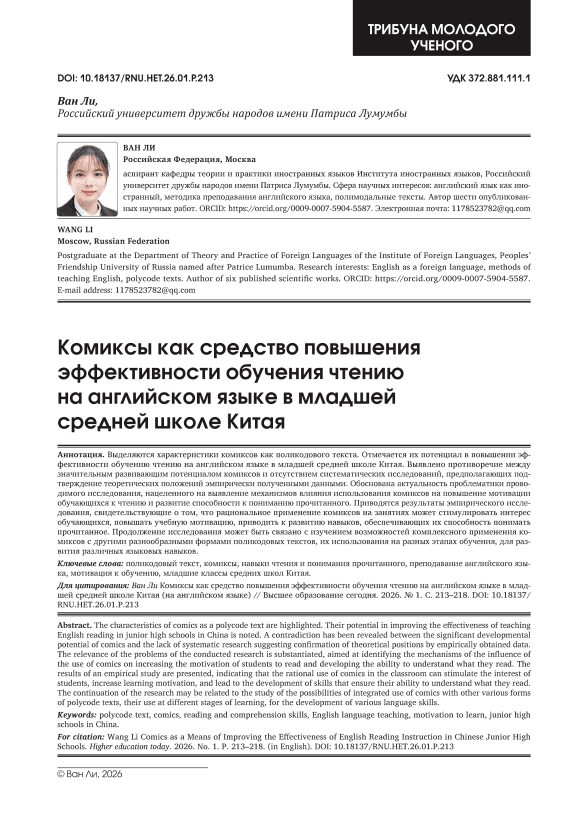
Comics as a Means of Improving the Effectiveness of English Reading Instruction in Chinese Junior High Schools
Журнал: Высшее образование сегодня @hetoday
Рубрика: Трибуна молодого ученого
Статья в выпуске: 1, 2026 года.
Бесплатный доступ
The characteristics of comics as a polycode text are highlighted. Their potential in improving the eff ectiveness of teaching English reading in junior high schools in China is noted. A contradiction has been revealed between the significant developmental potential of comics and the lack of systematic research suggesting confirmation of theoretical positions by empirically obtained data. The relevance of the problems of the conducted research is substantiated, aimed at identifying the mechanisms of the influence of the use of comics on increasing the motivation of students to read and developing the ability to understand what they read. The results of an empirical study are presented, indicating that the rational use of comics in the classroom can stimulate the interest of students, increase learning motivation, and lead to the development of skills that ensure their ability to understand what they read. The continuation of the research may be related to the study of the possibilities of integrated use of comics with other various forms of polycode texts, their use at different stages of learning, for the development of various language skills.
Похожие статьи в разделе Education
Короткий адрес: https://sciup.org/148333214
IDS: 148333214 | УДК: 372.881.111.1 | DOI: 10.18137/RNU.HET.26.01.P.213
Комиксы как средство повышения эффективности обучения чтению на английском языке в младшей средней школе Китая (на английском языке)
Выделяются характеристики комиксов как поликодового текста. Отмечается их потенциал в повышении эффективности обучению чтению на английском языке в младшей средней школе Китая. Выявлено противоречие между значительным развивающим потенциалом комиксов и отсутствием систематических исследований, предполагающих подтверждение теоретических положений эмпирически полученными данными. Обоснована актуальность проблематики проводимого исследования, нацеленного на выявление механизмов влияния использования комиксов на повышение мотивации обучающихся к чтению и развитие способности к пониманию прочитанного. Приводятся результаты эмпирического исследования, свидетельствующие о том, что рациональное применение комиксов на занятиях может стимулировать интерес обучающихся, повышать учебную мотивацию, приводить к развитию навыков, обеспечивающих их способность понимать прочитанное. Продолжение исследования может быть связано с изучением возможностей комплексного применения комиксов с другими разно образными формами поликодовых текстов, их использования на разных этапах обучения, для развития различных языковых навыков.
Текст научной статьи Comics as a Means of Improving the Effectiveness of English Reading Instruction in Chinese Junior High Schools
аспирант кафедры теории и практики иностранных языков Института иностранных языков, Российский университет дружбы народов имени Патриса Лумумбы. Сфера научных интересов: английский язык как иностранный, методика преподавания английского языка, полимодальные тексты. Автор шести опубликованных научных работ. ORCID: Электронная почта:
Postgraduate at the Department of Theory and Practice of Foreign Languages of the Institute of Foreign Languages, Peoples’ Friendship University of Russia named after Patrice Lumumba. Research interests: English as a foreign language, methods of teaching English, polycode texts. Author of six published scientific works. ORCID: E-mail address:
Introduction. The formation and development of reading skills is the basis of learning in the practice of teaching English in the lower grades of secondary school. At the initial stage, students often have many problems. Within the framework of traditional approaches, reading instruction is based on texts without illustrations. Their use does not arouse students’ interest or motivation to learn a foreign language. For children with a relatively weak language base, using the single text input method leads to insufficient depth of reading comprehension. In this regard, the question of how to stimulate the learning motivation of younger schoolchildren and improve the effectiveness of reading instruction is relevant and is widely discussed in modern research in the field of English language teaching.
The researchers consider comics as innovative educational materials that are potentially useful for solving the problems discussed above. A comic book is a series of drawings with text that form a coherent narrative of a humorous or adventurous nature. As a text form that combines visual elements with test ones, comics have such characteristics as clarity and dynamism of the plot. As an art form, comics attract readers with their grotesque humor and interesting plots.
Comics are examples of polycode (or creolized) texts. They represent messages that combine heterogeneous means: verbal (linguistic – text) and non-verbal (images, symbols, sounds, video), which form a unified semantic, structural, and functional whole.
The concept of the polycode text was originally proposed by A.G. Sonin. It was considered as a text consisting of audio text components with different semiotics and signals with various semiotic properties, located within a single visual space [1]. Based on polystylistic and pol-ysemiotic approaches, comics can be defined as texts or- ganized using a polycode system [12]. They convey information to readers in a simple and understandable way through the combination of image and text.
Based on a search in the Web of Science database, we have identified that scientists from various countries have conducted numerous studies on the use of comics in teaching within the fields of literature, engineering, computer science, instrumentation, and history. According to Google Scholar data, comics are widely used in education for children aged 4 to 18 in emergency departments (G. Ashwal, A.L. Drendel, A. Hanson, A. Thomas); as educational materials in social studies programs (M. Senturk, U. Simsek); in science disciplines (N. Akcanca, F.K. Anggoro, B.D. Jee, M. Koutníková); and for child education (W. Arya Pageh, N. Damayani, Y.K.P. Gede, H. Hafiar, S. Nyoman; N. Rina, J. Suminar). It has been found that the use of comics positively affects student academic performance [13], becomes a powerful auxiliary tool for explaining abstract concepts (e.g., those related to physical phenomena), and ensures engagement with scientific concepts [3; 5; 6].
Works on the use of comics in teaching reading in the native language and their application in English language teaching discuss them as means of stimulating schoolchildren's interest in learning and the ability to achieve good results [9] (development of English language skills [8; 14], reading comprehension [7; 10; 11]). A positive attitude of students towards the use of digital comics in the process of learning English is noted [2; 4]. Thus, individual studies have been conducted on various aspects of using comics in education. The least studied areas remain the issues of teaching foreign languages in lower secondary school. A contradiction can be observed between the significant developmental potential of comics and the lack of systematic research that would involve confirming theoretical propositions with empirically obtained data. In this regard, the subject of our ongoing research is relevant, aimed at identifying the mechanisms of how the use of comics influences the increase in students' motivation to read and the development of reading comprehension abilities. The main objectives of the ongoing work are to determine the theoretical foundations and formulate practical recommendations for the effective use of comics in lower secondary school in the process of teaching English.
Organization of the study. Study period. The research was conducted from April 1st to April 28th in 2025.
Contingent and research base: The research subjects were 100 students from Guanzhen Middle School in Huai’an City, China, Eighth-grade students of lower secondary school, aged 13–14 years. Two classes were selected: the experimental group (hereinafter – EG) – 27 boys and 23 girls, and the control group (hereinafter – CG) – 24 boys and 26 girls. Before the start of the experiment, the average English language scores in the two classes were the same, ensuring the comparability of the groups.
Research methods: testing, pedagogical observation, interviews, analysis and interpretation of the obtained data.
КОМИКСЫ КАК СРЕДСТВО ПОВЫШЕНИЯ ЭФФЕКТИВНОСТИ ОБУЧЕНИЯ ЧТЕНИЮ НА АНГЛИЙСКОМ ЯЗЫКЕ В МЛАДШЕЙ СРЕДНЕЙ ШКОЛЕ КИТАЯ
Empirical methods are used to test the impact of com-ics-based learning on the development of students’ reading comprehension abilities. Learning motivation is considered the primary variable in the study.
The work on studying the influence of using comics on the ability of lower secondary school students to comprehend written English was organized in four stages:
-
• Initial diagnostic assessment – an English language proficiency test;
-
• Formative stage – instruction using comics in the EG, instruction according to the standard program in the CG;
-
• Final diagnostic assessment – a reading comprehension test based on the completed instruction;
-
• Final interview (survey and interview) to identify the dynamics of motivation.
At the first stage, a preliminary test was conducted to assess the participants' initial level of English proficiency. All 100 schoolchildren completed a standard English language test provided by EF Education within 15 minutes. The test consisted of 20 tasks: 10 on reading and 10 on listening. The maximum total score was 100 points. Levels of English proficiency were identified:
-
• Beginner level – from 0 to 60 points;
-
• Intermediate level – from 61 to 85 points;
-
• Advanced level – from 86 to 100 points.
The test results showed: in listening, 92 subjects were at the beginner level, 8 at the intermediate level; in reading, 88 schoolchildren were at the beginner level, 12 at the intermediate level. Based on the test results, all students were allowed to participate in the experimental instruction using basic reading materials.
During the formative stage, one teacher taught English to the two classes using the same textbook for four weeks. Each week, three reading lessons were scheduled, each lasting 45 minutes. In the EG, comics were additionally used in the learning process.
After the instruction, as part of the final diagnostic assessment, a multiple-choice reading comprehension test was administered. The test also consisted of 20 questions, with a maximum score of 100 points. It assessed the students' understanding of the main ideas of the read works (excerpts), details of the events described in the text, and the conclusions contained in the reading materials. The test was conducted for all participants at the same time under the supervision of the same teacher to ensure equal testing conditions.
Follow-up Interviews and Motivation Analysis. To gain a deeper understanding of the influence of comics on reading comprehension ability, we selected three students from the EG who achieved the highest scores on the test to conduct semi-structured interviews. During the interview, the subjects were asked to describe their learning experience during the lessons, their attitude towards comics, and the impact of their use on their interest in reading. In addition, the teacher used the method of participant observation, assessing the impact of using comics on the learning motivation of students in the EG, as well as the change in their attitude towards learning, active participation in lessons, engagement in completing tasks, enthusiasm when answering questions, and the frequency of discussions with peers.
The results of the study and their discussion. Figure 1 shows the results of the final testing in EG and KG.
According to the data presented in Figure 1, the EG had more students scoring in the 80–100 point range (52%) than the CG (38%). In the CG, the total number of subjects scoring below 80 points was 62%, while in the EG it was 48%. Thus, the EG shows a more pronounced improvement in student outcomes related to reading comprehension in English compared to the CG.
During the interviews, the three selected study participants spoke about the advantages of learning with comics. They noted that comics help them learn to visualize and understand content by combining words and images. They convey specific situations in a visual form and create vivid imagery, which increases interest and motivation to read. This, in turn, ensures the development of reading comprehension skills. The use of comics also leads to a reduction in student anxiety in the classroom and enlivens the atmosphere of interaction between the teacher and students.
Here is an example of a statement from one of the respondents: “I really like it when the teacher uses comics in English lessons. I love comics; they are interesting and easy to understand. It's so fun to read and study comics with my classmates! We all actively discussed them, and suddenly felt that the atmosphere in the class became relaxed. I don't like boring reading comprehension materials.”
50 EG students filled out a questionnaire stating “Using comics in the classroom increases my motivation to learn English.” It was necessary to choose one of the possible answers: “I completely agree” (1), “I rather agree” (2), “I find it difficult to answer” (3), “I rather disagree” (4), “I completely disagree” (5). The survey results are shown in Figure 2.
According to the survey results, the number of students who expressed confidence that the use of comics in lessons increases their motivation to learn English increased. The number of students who remained neutral and disagreed with the survey statement decreased. Thus, the opinion of the subjects regarding the role of using comics in English lessons changed after the experimental instruction.
Conclusion. Based on the results of the experimental work using comics as a type of polycode text in teaching English reading in lower secondary school, it is concluded that their rational use in lessons can stimulate student interest, increase learning motivation, and lead to the development of skills that ensure their ability to comprehend written text. This effect is due to the fact that comics express meaning through images, providing foreign language learners with the opportunity to understand and remember material using multiple types of coding,
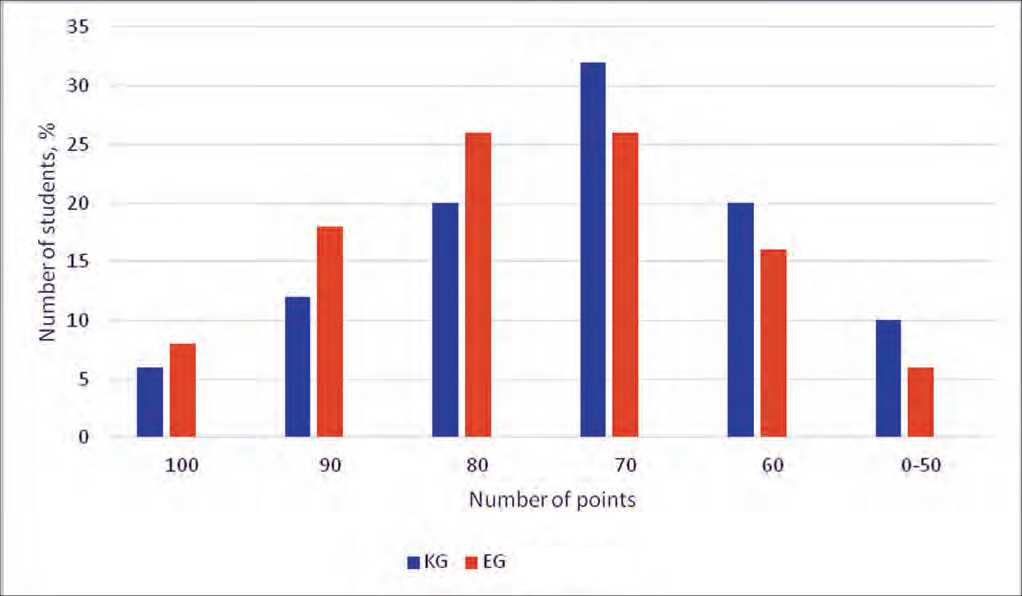
Figure 1. Final test results
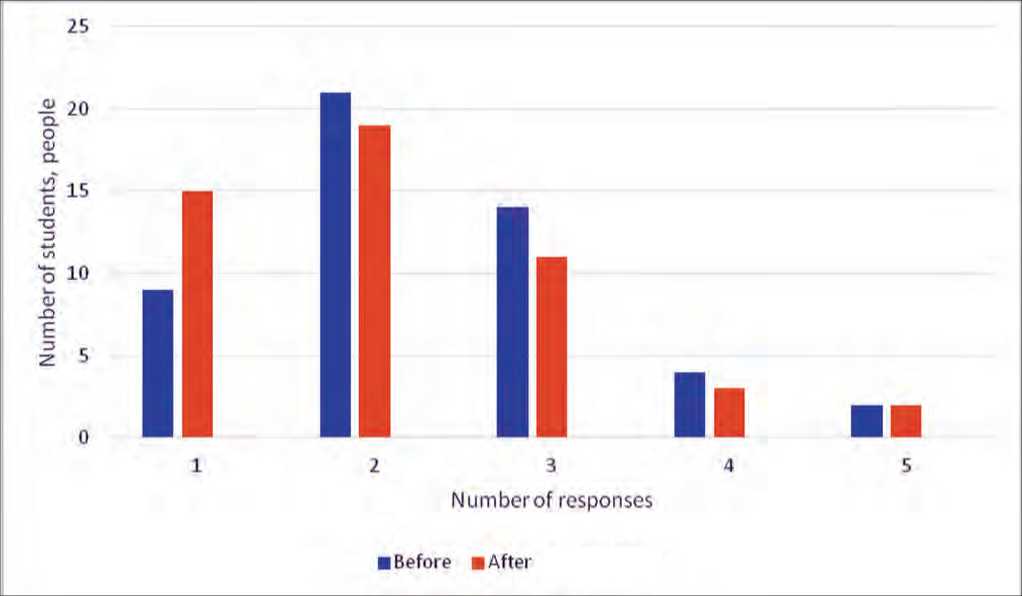
Figure 2. Survey results before and after training
КОМИКСЫ КАК СРЕДСТВО ПОВЫШЕНИЯ ЭФФЕКТИВНОСТИ ОБУЧЕНИЯ ЧТЕНИЮ НА АНГЛИЙСКОМ ЯЗЫКЕ В МЛАДШЕЙ СРЕДНЕЙ ШКОЛЕ КИТАЯ thereby reducing barriers to language comprehension and increasing student engagement in the educational process.
The characteristics of comics as a polycode text can provide visual support for students as they process textual information, making abstract linguistic material more comprehensible and ensuring its easier perception. The combined presentation of images and text not only reduces cognitive load but also encourages students to actively make sense of what they have read, thereby ensuring a deeper understanding of the material. Engaging topics, concise phrases, and the humorous nature of the content effectively hold students' attention and strengthen their intrinsic motivation for extended reading.
This conducted study confirms the effectiveness of using polycode materials in teaching a foreign language. The results of the reading comprehension tests in the EG and CG, along with the survey and interview data, provide empirical evidence reflecting the advantages of us-
ing comics in teaching English reading in lower secondary school, as well as the feasibility and value of integrating polycode learning resources into traditional reading instruction. It is advisable to select comics related to the topics being studied when developing teaching materials and choosing resources for teaching reading in a foreign language. Comics, as inexpensive and highly effective materials, can compensate for certain shortcomings of existing textbooks. Their use is particularly relevant for stimulating interest in reading among students with a low level of language proficiency.
Continuation of the research could involve exploring the possibilities of the integrated use of comics alongside other diverse forms of polycode texts, their application at different stages of learning, and for developing various language skills. This would open up new directions for the development of polycode learning resources to optimize language acquisition.
