
Comparative Analysis of Tax Regimes for Small Businesses in the EAEU Member States
Journal: Bulletin of Science and Practice @bulletennauki
Section: Социальные и гуманитарные науки
Article in issue: 5 т.12, 2026.
Free access
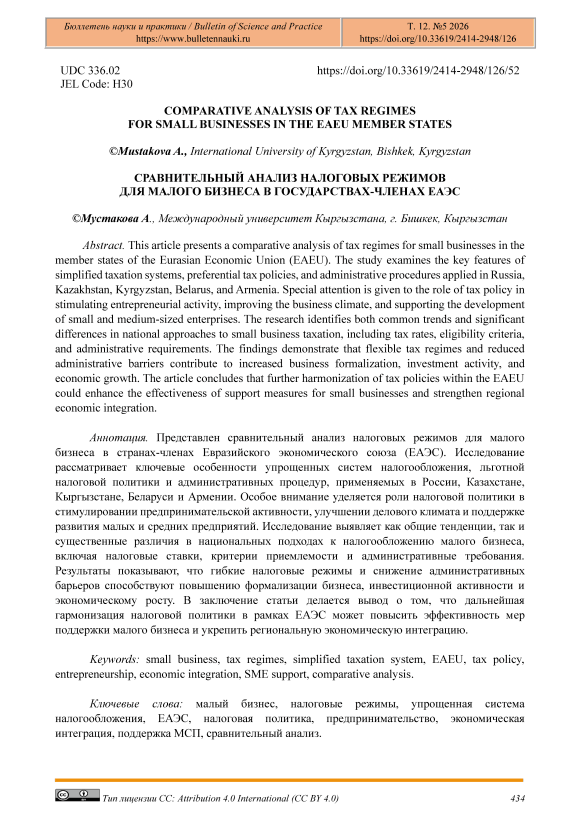
This article presents a comparative analysis of tax regimes for small businesses in the member states of the Eurasian Economic Union (EAEU). The study examines the key features of simplified taxation systems, preferential tax policies, and administrative procedures applied in Russia, Kazakhstan, Kyrgyzstan, Belarus, and Armenia. Special attention is given to the role of tax policy in stimulating entrepreneurial activity, improving the business climate, and supporting the development of small and medium-sized enterprises. The research identifies both common trends and significant differences in national approaches to small business taxation, including tax rates, eligibility criteria, and administrative requirements. The findings demonstrate that flexible tax regimes and reduced administrative barriers contribute to increased business formalization, investment activity, and economic growth. The article concludes that further harmonization of tax policies within the EAEU could enhance the effectiveness of support measures for small businesses and strengthen regional economic integration.
Similar articles in the section Finance

Short address: https://sciup.org/14135667
IDS: 14135667 | UDC: 336.02 | DOI: 10.33619/2414-2948/126/52
Сравнительный анализ налоговых режимов для малого бизнеса в государствах-членах ЕАЭС
Представлен сравнительный анализ налоговых режимов для малого бизнеса в странах-членах Евразийского экономического союза (ЕАЭС). Исследование рассматривает ключевые особенности упрощенных систем налогообложения, льготной налоговой политики и административных процедур, применяемых в России, Казахстане, Кыргызстане, Беларуси и Армении. Особое внимание уделяется роли налоговой политики в стимулировании предпринимательской активности, улучшении делового климата и поддержке развития малых и средних предприятий. Исследование выявляет как общие тенденции, так и существенные различия в национальных подходах к налогообложению малого бизнеса, включая налоговые ставки, критерии приемлемости и административные требования. Результаты показывают, что гибкие налоговые режимы и снижение административных барьеров способствуют повышению формализации бизнеса, инвестиционной активности и экономическому росту. В заключение статьи делается вывод о том, что дальнейшая гармонизация налоговой политики в рамках ЕАЭС может повысить эффективность мер поддержки малого бизнеса и укрепить региональную экономическую интеграцию.
Text of the scientific article Comparative Analysis of Tax Regimes for Small Businesses in the EAEU Member States
Бюллетень науки и практики / Bulletin of Science and Practice
Small and medium-sized enterprises (SMEs) play a crucial role in ensuring sustainable economic growth, job creation, and innovation in modern economies. In the member states of the Eurasian Economic Union (EAEU), small businesses represent a significant share of economic activity and are considered a key driver of regional development. Effective tax policy is one of the most important instruments for supporting SMEs, as it directly influences business sustainability, investment capacity, and entrepreneurial activity [1].
The EAEU countries — Russia, Kazakhstan, Kyrgyzstan, Belarus, and Armenia — apply various tax regimes aimed at stimulating small business development, including simplified taxation systems, preferential tax rates, and special administrative procedures. These regimes are designed to reduce the tax burden and administrative barriers faced by entrepreneurs, thereby encouraging business formalization and expansion. Studies indicate that simplified tax systems contribute to increased compliance, improved financial stability of enterprises, and higher rates of new business creation [2, 5].
Despite common goals, tax regimes across EAEU member states differ significantly in terms of eligibility criteria, tax rates, reporting requirements, and administrative procedures. Such differences create both opportunities and challenges for entrepreneurs operating within the integrated economic space. A comparative analysis of national tax systems is therefore essential to identify best practices and areas for policy harmonization within the union [3].
Previous research has examined the impact of simplified taxation systems on small business development, emphasizing their role in reducing administrative costs and stimulating entrepreneurial activity [4, 7]. However, comprehensive comparative studies focusing specifically on the EAEU countries remain limited. This article aims to fill this gap by analyzing the key features of tax regimes for small businesses in the EAEU member states and assessing their effectiveness in supporting entrepreneurship.
The purpose of this study is to conduct a comparative analysis of tax regimes applied to small businesses in the EAEU countries and to identify the main factors influencing their effectiveness. The research focuses on the structure of simplified taxation systems, administrative procedures, and policy measures aimed at supporting SMEs. The findings may contribute to the development of recommendations for improving tax policy and enhancing economic integration within the EAEU.
This study employs a comparative research design to analyze tax regimes for small businesses across the member states of the Eurasian Economic Union (EAEU). The methodological framework is based on a combination of qualitative and quantitative approaches, allowing for a comprehensive assessment of national tax policies and their impact on small and medium-sized enterprises [3].
The research is grounded in the principles of comparative economic analysis, which enable the identification of similarities and differences in taxation systems among Russia, Kazakhstan, Kyrgyzstan, Belarus, and Armenia. The study examines simplified taxation systems, preferential tax rates, eligibility criteria, and administrative procedures applied to small businesses in each country.
Data collection is based on the analysis of official legal documents, tax codes, government reports, and international analytical publications. In addition, statistical data from international organizations, including the OECD and the World Bank, are used to evaluate the effectiveness of tax regimes in supporting entrepreneurship and improving the business climate [1, 3].
The following research methods were applied:
-
— Comparative analysis, to identify differences and common features of tax regimes across EAEU member states;
-
— Systemic approach, to assess the role of tax policy within the broader framework of economic regulation;
-
— Content analysis, to examine legislative and regulatory documents related to small business taxation;
-
— Statistical analysis, to evaluate indicators of SME development and tax burden levels;
— Synthesis and generalization, to formulate conclusions and policy recommendations.
The object of the study is the system of taxation for small businesses in the EAEU countries, while the subject of the research is the effectiveness of simplified tax regimes as an instrument of state support for entrepreneurship.
The limitations of the study include differences in statistical reporting standards among EAEU member states and the dynamic nature of tax legislation, which may affect the comparability of data. Nevertheless, the applied methodology ensures the reliability and validity of the results and allows for the identification of key trends in the development of tax policy within the EAEU.
The comparative analysis of tax regimes for small businesses in the EAEU member states revealed both common trends and substantial differences in national approaches to SME taxation. All countries of the union — Russia, Kazakhstan, Kyrgyzstan, Belarus, and Armenia — have introduced simplified taxation systems designed to reduce the fiscal and administrative burden on entrepreneurs and stimulate business activity. These regimes typically replace multiple taxes with a single payment and simplify accounting and reporting procedures, thereby lowering compliance costs for small enterprises. However, despite the shared objective of supporting SMEs, the structure and parameters of these systems differ significantly across countries, including variations in tax rates, eligibility thresholds, reporting requirements, and sectoral restrictions [2].
The findings indicate that simplified tax regimes positively affect the business environment by facilitating business entry, reducing barriers to formalization, and improving the sustainability of small enterprises. In countries where tax administration procedures are less complex and tax rates are relatively low, SMEs demonstrate stronger financial performance, higher survival rates, and greater investment capacity [1]. Lower compliance costs allow entrepreneurs to allocate more resources to business development, innovation, and workforce expansion. Furthermore, simplified systems enhance predictability of tax obligations, which is crucial for long-term planning and access to financing.
Evidence from the World Bank supports these conclusions, showing that streamlined tax reporting procedures and digital tax administration significantly reduce the time and financial costs associated with tax compliance [2]. As a result, businesses are more likely to operate within the formal economy, which improves access to credit, legal protection, and government support programs. Simplified regimes therefore play a dual role: they stimulate entrepreneurial activity while simultaneously expanding the tax base through increased formalization.
At the same time, differences in national legislation create uneven conditions for entrepreneurs operating within the EAEU economic space. Variations in income thresholds, turnover limits, and sectoral eligibility criteria may influence business decisions regarding expansion, relocation, or organizational restructuring. For instance, stricter income caps in certain countries may discourage business growth, as exceeding the threshold leads to transition to the general taxation system with significantly higher fiscal obligations [6]. This “growth barrier” effect may limit the scalability of successful enterprises and reduce incentives for innovation.
Additionally, research indicates that special tax regimes play a particularly important role during periods of economic instability, such as financial crises or external shocks. By reducing tax pressure and administrative complexity, these regimes help small enterprises maintain liquidity and operational continuity [7].
In this context, simplified taxation systems function as an anti-crisis policy tool, supporting employment and economic resilience. Overall, the analysis demonstrates that while simplified tax regimes are effective instruments for SME support across the EAEU, their impact depends on national policy design and implementation. Greater harmonization of tax rules and exchange of best practices among member states could reduce disparities and create more favorable conditions for cross-border entrepreneurship within the union.
Table
KEY CHARACTERISTICS OF TAX REGIMES
FOR SMALL BUSINESSES IN EAEU MEMBER STATES [1, 2, 6]
|
Country |
Type of Simplified Regime |
Main Features |
Impact on SMEs |
|
Russia |
Simplified Tax System |
Choice of tax base (income or income minus expenses) |
Increased business registration and compliance |
|
Kazakhstan |
Simplified declaration regime |
Reduced reporting requirements |
Improved financial sustainability |
|
Kyrgyzstan |
Patent and simplified tax regimes |
Fixed tax payments for certain activities |
Growth of self-employment |
|
Belarus |
Simplified taxation for SMEs |
Reduced tax rates for small enterprises |
Expansion of small business sector |
|
Armenia |
Turnover tax system |
Simplified accounting procedures |
Increased business formalization |
The findings indicate that flexible tax regimes combined with digital tax administration systems provide the most favorable conditions for SME development in the EAEU member states. Flexibility in tax policy allows governments to adjust tax rates, eligibility criteria, and reporting requirements in response to changing economic conditions and business needs. At the same time, the integration of digital technologies into tax administration significantly reduces administrative barriers and compliance costs for entrepreneurs. Electronic reporting systems, online tax accounts, automated calculation of tax liabilities, and digital payment platforms simplify interactions between businesses and tax authorities, making the taxation process more transparent and efficient.
Countries implementing advanced digital tax solutions demonstrate higher levels of tax compliance and improved efficiency in tax collection. Automated systems reduce the risk of errors, minimize opportunities for corruption, and ensure timely processing of tax data. For small businesses, digitalization eliminates the need for extensive accounting resources and reduces time spent on administrative procedures, allowing entrepreneurs to focus on core business activities. Research indicates that such measures substantially lower administrative costs and increase voluntary compliance with tax obligations [9].
Moreover, digital tax administration contributes to the formalization of business activities by making registration and reporting processes more accessible. Simplified online procedures encourage entrepreneurs operating in the informal sector to legalize their activities, thereby expanding the official tax base and improving economic transparency. Digital platforms also enable real-time monitoring of business activity, which enhances the effectiveness of government support programs and policy evaluation.
Overall, the results confirm that harmonization of tax policies within the EAEU could significantly enhance the effectiveness of support measures for small businesses and strengthen economic integration among member states. The adoption of unified principles for simplified taxation systems, coordinated digital infrastructure, and standardized reporting requirements would reduce disparities between national tax regimes and facilitate cross-border entrepreneurial activity.
The exchange and adoption of best practices from individual countries may contribute to the creation of a more unified and competitive entrepreneurial environment within the union. For example, countries with advanced digital tax administration systems can serve as models for others, while those with effective simplified tax regimes can provide insights into policy design. Such cooperation would support the development of a common economic space in which small businesses can operate more efficiently and with fewer institutional barriers.
In this context, the harmonization of tax policy should be accompanied by broader measures aimed at improving the business climate, including access to financing, regulatory simplification, and innovation support. A coordinated approach would strengthen the resilience of SMEs and enhance their contribution to economic growth, employment, and regional integration across the EAEU.
The results of the study confirm that tax policy plays a decisive role in shaping the conditions for small business development in the EAEU member states. In the context of regional economic integration, taxation mechanisms act not only as fiscal instruments but also as tools of economic regulation that influence entrepreneurial incentives, investment behavior, and the degree of business formalization. Simplified taxation systems serve as an essential instrument for reducing fiscal pressure and administrative complexity, thereby facilitating business entry and expansion. By lowering compliance costs and simplifying reporting procedures, these regimes make formal economic activity more attractive, particularly for microenterprises and start-ups with limited financial and administrative resources. These findings are consistent with previous research emphasizing the importance of special tax regimes in improving the business climate, encouraging self-employment, and supporting SME development [4, 5].
Furthermore, simplified tax systems contribute to increasing the transparency of economic activity and expanding the tax base through voluntary compliance. Entrepreneurs operating under predictable and manageable tax conditions are more likely to invest in business development, workforce expansion, and technological innovation. As a result, tax policy becomes a catalyst for sustainable economic growth and employment generation within the EAEU countries.
At the same time, the comparative analysis reveals that the effectiveness of simplified tax regimes depends largely on national policy design and institutional capacity. Countries with lower tax rates, flexible eligibility criteria, and streamlined administrative procedures demonstrate more favorable outcomes in terms of SME growth, survival rates, and financial sustainability. Such conditions enable businesses to accumulate capital, reinvest profits, and expand operations without facing abrupt increases in tax obligations. In addition, effective institutional frameworks — including transparent regulatory systems and efficient tax administration — enhance the overall impact of simplified regimes on entrepreneurial activity.
Conversely, restrictive thresholds and complex reporting requirements may limit the scalability of businesses and reduce the overall effectiveness of support measures. When income limits for eligibility are set too low, enterprises may deliberately restrict their growth to retain access to preferential taxation, resulting in a phenomenon known as the “growth trap”. Similarly, burdensome administrative procedures can offset the benefits of simplified taxation, discouraging entrepreneurs from expanding or formalizing their operations. These factors highlight the importance of balanced policy design that supports business growth while maintaining fiscal sustainability [6].
A significant factor influencing the success of tax regimes is the level of digitalization of tax administration. The implementation of electronic reporting systems and automated tax procedures has proven to reduce compliance costs and improve transparency. These measures contribute to higher voluntary compliance and reduce the incentives for operating in the informal economy [9]. Thus, digital transformation emerges as a key component of modern tax policy aimed at supporting small enterprises.
The study also highlights the existence of structural disparities among EAEU member states, which may hinder the creation of a unified economic space and limit the effectiveness of regional integration processes. Despite the common objectives of supporting small businesses, national tax systems differ substantially in their design, implementation mechanisms, and administrative capacity. Variations in tax rates, eligibility thresholds, reporting requirements, and sectoral restrictions create uneven competitive conditions for entrepreneurs operating within the union. As a result, businesses may face difficulties in expanding their activities across borders, as they must adapt to different regulatory environments and fiscal obligations in each country [8, 10].
These disparities may also influence the geographical distribution of entrepreneurial activity within the EAEU, encouraging firms to register or relocate in jurisdictions with more favorable tax conditions. While such competition can stimulate policy improvements, excessive differences may undermine the stability of the common market and complicate cross-border trade and investment. Therefore, harmonization of tax policies, while respecting national economic specificities and fiscal sovereignty, could enhance economic integration and facilitate the mobility of small enterprises within the union. Coordinated standards for simplified taxation systems, unified eligibility criteria, and mutual recognition of tax regimes would reduce administrative barriers and promote the development of cross-border entrepreneurship.
Furthermore, the findings suggest that tax policy alone is insufficient to ensure sustainable SME development. Although preferential tax regimes reduce financial pressure on businesses, long-term growth requires a comprehensive approach that integrates fiscal measures with broader economic policies. Effective support for small enterprises should include improved access to financing, development of credit guarantee mechanisms, simplification of regulatory procedures, and expansion of business education and training programs. Innovation support, digital transformation initiatives, and infrastructure development are also essential for enhancing the competitiveness of SMEs in both domestic and international markets.
The integration of tax incentives with these complementary measures would maximize their impact and create a supportive ecosystem for entrepreneurship. Such a holistic strategy would strengthen the resilience of small businesses, enabling them to adapt to economic shocks and technological changes. In addition, coordinated policies across EAEU member states could facilitate knowledge exchange, dissemination of best practices, and joint initiatives aimed at SME development.
In general, the discussion underscores the need for continuous improvement of tax regimes for small businesses in the EAEU countries. Adoption of best practices, expansion of digital tax administration, and gradual harmonization of policies may significantly strengthen the role of SMEs as drivers of economic development and regional integration. By creating a more predictable and business-friendly environment, the EAEU can enhance the contribution of small enterprises to innovation, employment, and economic diversification across the region [11].
This study has demonstrated that tax regimes for small businesses play a critical role in shaping the entrepreneurial environment within the EAEU member states. Simplified taxation systems significantly reduce fiscal and administrative burdens, thereby encouraging business formalization, improving financial stability, and stimulating investment activity among SMEs. The comparative analysis revealed that although all EAEU countries implement special tax regimes aimed at supporting small enterprises, the design and effectiveness of these systems vary considerably [12].
The findings indicate that flexible tax policies, combined with digital tax administration, provide the most favorable conditions for SME development. Countries with simplified reporting procedures, lower tax rates, and advanced electronic systems demonstrate higher levels of compliance and business sustainability. At the same time, restrictive eligibility criteria and complex regulatory requirements may limit business growth and reduce the overall effectiveness of support measures.
The study also highlights the importance of policy harmonization within the EAEU. Differences in national tax regimes create uneven conditions for entrepreneurs and may hinder economic integration. Coordinated efforts aimed at aligning tax policies, sharing best practices, and developing unified digital infrastructure could enhance the competitiveness of SMEs and facilitate cross-border business activities.
In conclusion, effective taxation of small businesses requires a balanced approach that considers both fiscal objectives and the needs of entrepreneurs. Continuous reform of tax regimes, integration of digital technologies, and comprehensive support measures are essential for ensuring sustainable SME development and strengthening the economic integration of the EAEU member states.
