
Current Status of Caryophyllaceae Juss. in the Lachin District
Journal: Bulletin of Science and Practice @bulletennauki
Section: Естественные науки
Article in issue: 2 т.12, 2026.
Free access
The article provides information on the biological, ecological, and coenosis-forming characteristics of representatives of the Caryophyllaceae Juss. family found in the Lachin district, their distribution patterns, and limiting factors for the protection of rare and endangered species. The research was mainly carried out in mountain-meadow tall-herb meadows, forest-meadow vegetation, and steppe vegetation types, as well as in various plant communities. The abundance of Caryophyllaceae Juss. representatives in plant communities was assessed at 1–2 points. Studies on populations of Minuartia intermedia (Boiss.) Hand.-Mazz. revealed irreversible unidirectional changes. A gradual decrease in the number of M. intermedia populations and high sensitivity to adverse environmental factors were observed. Without timely conservation measures, the populations may completely disappear. The species Paronychia azerbaijanica Chaudhri was found in the Lachin district within mountain steppe and mountain-xerophyte steppe vegetation types in the form of localities. A decreasing trend in the number of individuals was observed, making conservation measures necessary. This species is included in the third edition of the “Red Book” of Azerbaijan. Direct observations and studies on populations of Silene cephalantha Boiss. revealed that, due to anthropogenic factors, the quality of the habitat has declined (A2ac). The growth dynamics of individuals were found to be at a low level. The absence of young individuals indicates an ongoing continuous decline (C1). In the observed area, only 3–5 individuals were found per 10 m². All these factors indicate a potential threat of extinction in the future. Therefore, the development dynamics of the species should be monitored.
Similar articles in the section General botany
Short address: https://sciup.org/14134418
IDS: 14134418 | UDC: 581 | DOI: 10.33619/2414-2948/123/06
Современное состояние Caryophyllaceae Juss. В Лачинском районе
Представлены сведения о биологических, экологических и ценообразующих данных представителей семейства Caryophyllaceae Juss., произрастающих в Лачинском районе, закономерностях их распространения и лимитирующих факторах охраны редких и находящихся под угрозой исчезновения видов. Исследования проводились преимущественно на горно-луговых высокотравных лугах, лесо-луговой растительности и степной растительности, а также в различных растительных сообществах. Численность представителей Caryophyllaceae Juss. в растительных сообществах оценивалась в 1–2 пункта. Исследования популяций Minuartia intermedia (Boiss.) Hand.-Mazz. выявили необратимые однонаправленные изменения. Наблюдалось постепенное сокращение численности популяций M. intermedia и высокая чувствительность к неблагоприятным факторам окружающей среды. Без своевременных мер по сохранению популяции могут полностью исчезнуть. Вид Paronychia azerbaijanica Chaudhri был обнаружен в Лачинском районе в горно-степных и горно-ксерофитовых степных типах растительности в виде местонахождений. Наблюдалась тенденция к сокращению численности особей, что делает необходимыми меры по сохранению вида. Этот вид включен в третье издание «Красной книги» Азербайджана. Прямые наблюдения и исследования популяций Silene cephalantha Boiss. показали, что из-за антропогенных факторов качество среды обитания ухудшилось (A2ac). Динамика роста особей оказалась низкой. Отсутствие молодых особей указывает на продолжающееся непрерывное сокращение численности (C1). На наблюдаемой территории было обнаружено всего 3–5 особей на 10 м². Все эти факторы указывают на потенциальную угрозу исчезновения в будущем. Поэтому необходимо отслеживать динамику развития вида.
Text of the scientific article Current Status of Caryophyllaceae Juss. in the Lachin District
UDC 581
The enchanting and unique region of Lachin, with its distinctive climate and rich vegetation, remained under enemy occupation for nearly 30 years. As a result of the victory achieved in the Second Karabakh War, the Lachin district was liberated from occupation. At the same time, many plant species that are endemic only to Azerbaijan—species that are not found naturally anywhere else in the world—were also freed from the captivity of Armenian vandalism.
Guided by Clause 3 of Article 109 of the Constitution of the Republic of Azerbaijan and in accordance with Decree No. 3378 of the President of the Republic of Azerbaijan dated July 22, 2022, approving the “Socio-Economic Development Strategy of the Republic of Azerbaijan for 2022– 2026,” the “First State Program on the Great Return to the Liberated Territories of the Republic of Azerbaijan” was adopted .
In line with the tasks arising from this decree, the study of natural resources—particularly the vegetation—of the liberated areas, including Lachin district, is among the priority objectives.
Purpose of the Study
The main objective of the study is to determine the place and role of representatives of the Caryophyllaceae Juss. family in various plant communities under different ecological conditions in Lachin district; to evaluate the impact of environmental factors on species morphogenesis; to investigate their coenosis-forming characteristics, distribution patterns, and the limiting factors in conserving rare and endangered species; and to develop conservation measures.
Materials and Methods
The research was mainly carried out in the villages of Sus and Zabux, in the vicinity of Turshsu, and along the Hekari River in Lachin district, across various vegetation types. The systematic position of the species in the study area was clarified using APG IV (, World Flora Online , and The Euro+Med PlantBase . For the study of bioecological characteristics of plant communities, references such as Flora of Azerbaijan, Flora of the Caucasus [1-7, 25].
Geobotanical descriptions were prepared using modern methods [8-11, 19-24].
Based on the results of the conducted studies, the conservation status of rare species was determined according to the criteria of the IUCN Red Data Book and the Red Book of Azerbaijan .
Results and Discussion
The Lachin district is located in the southwest of Azerbaijan, in a mountainous area. It borders Kalbajar to the north, Khojaly, Shusha, and Khojavend to the east, Qubadli to the south, and Armenia to the west. The district’s terrain is mountainous: its northern part lies on the southwestern slopes of the Karabakh Range, the northeast on the southeastern slopes of the Mikhtoken Range, and the southwest on the Karabakh Plateau. Its highest peak is Mount Gizilbogaz (3594 m). The main river is the Hekari and its tributaries. The district is dominated by soddy mountain-meadow soils, brown mountain-forest soils, and carbonate-rich mountain black soils. The vegetation consists of shrublands and sparse forest meadows, broad-leaved mountain forests (oak, hornbeam, beech), and subalpine and alpine meadows.
The research was conducted at altitudes between 871 and 1804 meters above sea level. First, the vegetation types of the areas were identified, and then the position and role of representatives of the Caryophyllaceae Juss. family within these vegetation types were studied. A number of literatures were also referred to when assessing the general status of the species [8-14].
In the Lachin district, the mountain-meadow tall-herb meadow vegetation type is distributed at elevations of 1500–1900 m a.s.l. (39°43′11.90″N; 46°40′67.20″E; elevation 1,557 m). This vegetation type has been recognized by botanists as a distinct type of vegetation and has not been included in any other vegetation classification.
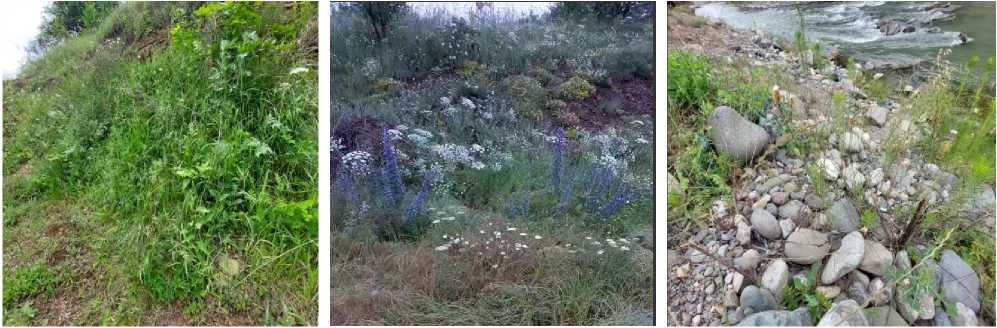
In the Lachin district, the mountain-meadow tall-herb vegetation type has a distinctive structure due to its physiognomic and phytocoenological characteristics. The sod-forming process is weak, and unlike other tall-herb communities, a certain degree of stratification is noticeable. Research has shown that this vegetation type was formed on the sites of destroyed forests. Based on our studies and those of A. A. Grossheim (1936), it has been established that the species composition of tall-herb vegetation contains few elements from the ancient Tertiary period [24]. However, Grossheim notes that in the Greater Caucasus region, Tertiary relict elements—particularly Colchic elements—are abundant and concentrated mainly in forest coenoses. All the plants found in the tall-herb communities formed in Azerbaijan are of Caucasian origin.
A
B C
Figure 1. Vegetation types in the Lachin district (A – Forest-meadow vegetation; B – Tall-herb meadow vegetation; C – Steppe vegetation)
A. A. Grossheim classifies tall-herb vegetation into primary and secondary types. Primary tall-herb vegetation develops in places where both moisture is abundant and the relief forms depressions. Secondary tall-herb vegetation forms on sites where forests have been cut down by humans, as well as in areas once cultivated and later abandoned. In the study area, the main bulk of the tall-herb vegetation is formed by species such as Heracleum sosnovskyi, Aconitum orientale, Silene cephalantha Boiss., Cerastium davuricum Fisch. ex Spreng., C. holosteoides Fries, Dactylis glomerata, Cephalaria gigantea, Knautia montana, Symphytum asperum, Senecio platyphyllus, Senecio lampsanoides, and Delphinium flexuosum.
Formation Class: Tall-herb meadows
Formation Group: Hogweed-dominated (Heracleta)
Associations: Sosnovsky’s hogweed community ( Heracleta sosnovskyi ),
Rough-leaved hogweed community ( Heracleta trachylomae )
Formation Group: Monkshood-dominated (Aconileta)
Association: Eastern monkshood community ( Aconileta orientale )
Formation Group: Large-leaved doronicum-dominated (Doroniceta macrophyllum)
Association: Large-leaved doronicum community ( Doronicum macrophyllum )
Formation Group: Ragwort-dominated ( Senecieta platyphyllus )
Association: Broad-leaved ragwort community ( Senecio platyphyllus )
Formation Class: Dry-grass tall-herb meadows
Formation Group: Reed-like soft broomgrass-dominated ( Calamagrosticeta arundinacea )
Association: Reed-like soft broomgrass community ( Calamagrostis arundinacea )
Formation: Valesian fescue community ( Festuca valesiaca )
Association: Sclerophyllous broomgrass–fescue community ( Festuca valesiaca f. sclerophylla – Bromus japonicus )
Forest-meadow vegetation differs from other plant communities by its complex coenoses and high species diversity, owing to various forms of atmospheric precipitation and the abundance of natural water sources. In such plant communities (39°40′30.10″N; 46°35′97.60″E), geobotanical studies were conducted starting from an altitude of 1,314 m a.s.l. Representatives of the genera Minuartia L., Cerastium L., Arenaria L., and Stellaria L. from the Caryophyllaceae Juss. family were recorded.
Steppe vegetation in the Lachin district was studied beginning at an altitude of 871 m a.s.l. (39°37′59.90″N; 46°31′98.80″E). In the district’s steppe-type vegetation, steppe phytocoenoses were identified as dominated by sod-forming grasses, including mountain-xerophyte, mountain-steppe, and dry-steppe communities. Sod-forming grasses, Stipa , Festuca , Agropyron , Bothriochloa , as well as shrubs, are constant components of the steppe.
Overall, in the Lachin district, changes in ecological conditions along the vertical gradient influence the composition of coenoses, including the species diversity of Caryophyllaceae . In some cases, zonality is lost, and the vegetation appears in patches. Some literature sources indicate that steppe vegetation forms as a result of the destruction of forest vegetation.
In our research, representatives of the Caryophyllaceae Juss. family found in the following plant communities within the steppe vegetation type were studied and their status evaluated:
Formation Class: Dry steppes
Formation Group: Astragalus–feathergrass steppe ( Astragaletum–Stiposum )
Association: Bare Astragalus–hairy feathergrass community ( Astragaletum denudata– Stiposum capillata )
Formation Class: Grass–forb steppes
Formation Group: Feathergrass steppe ( Stipeta )
Association: Pure feathergrass community ( Stipa capillata )
Depending on the slope gradient, desert-steppe vegetation can also be found. In these areas, xerophytic species such as Silene wallichiana Klotzsch, Stellaria persica Boiss., Dichodon cerastoides (L.) Rchb., and Herniaria cinerea DC. ( H. stevenii Sims) occur, altering the physiognomy of these coenoses. Sometimes, these species form micro-associations together with other forbs (e.g., Silene wallichiana + Thymus kotschyanus + Centaurea squarrosa ). Representatives of the Caryophyllaceae Juss. family found in these communities were evaluated at an abundance score of 1–2 points.
Studies and literature data have shown that morphological variation is often found in taxa that cover a wide geographical range and different altitudes [12, 13].
As a result, geographically separate but phylogenetically distinct populations are identified. The delimitation of taxonomic categories corresponds to different floristic regions, which requires precise identification of plant species and clarification of taxonomic boundaries. This process is especially important for floristic studies in complex and poorly studied regions [14-18].
Following liberation from occupation, research conducted in the Lachin district revealed certain limiting natural factors affecting some representatives of the Caryophyllaceae Juss. family whose population trends are declining. During the occupation period, as in other districts of the Karabakh region, the flora of Lachin was exploited destructively. Therefore, the current status of some Caryophyllaceae Juss. species found in various vegetation types in the Lachin district was assessed.
Minuartia intermedia (Boiss.) Hand.-Mazz. – In the flora of Azerbaijan, this species occurs only in the Lesser Caucasus. In our research, it was studied in subalpine meadow vegetation in the Lachin district (39°41′66.40″N; 46°38′86.80″E) at an altitude of 1,904 m a.s.l. Studies on its populations revealed irreversible unidirectional changes, with successions occurring in the sample plots during the final stage. Due to the reduced density of M. intermedia populations, young individuals disappear, resulting in an increased proportion of old individuals, ultimately leading to the extinction of the coenopopulation. Such irreversible unidirectional changes are highly dangerous for Lachin district, as these areas are constantly exposed to various impacts. A gradual decline in M. intermedia populations and a high sensitivity to adverse environmental factors were observed. The significant reduction in individual numbers was determined through direct observations (a) and abundance index assessments (b). Without timely conservation measures, the number of populations may decrease to the point of complete disappearance. Other articles also provide information about the status of the species in the flora of Azerbaijan [19-14].
Paronychia azerbaijanica Chaudhri – Based on our research and literature data, there is little comprehensive information available on this species. In the Lachin district, P. azerbaijanica was found in steppe vegetation types—specifically in mountain-steppe and mountain-xerophyte steppe— occurring in localities. Its position within plant communities was determined, and observations on ontogenetic individuals were conducted. A decreasing trend in population numbers was observed. Therefore, conservation measures are necessary. This species is included in the third edition of the “Red Book” of Azerbaijan.
Silene cephalantha Boiss. – This species was found in the Lachin district within various formation classes of the steppe vegetation type. Direct observations and studies on its populations revealed that, as a result of the impact of anthropogenic factors, the quality of its habitat has also

decreased (A2ac). The development dynamics of the individuals of the species were at a low level. The absence of young individuals indicates a continuous decline (C1). In the area where the species was found, only 3–5 individuals were recorded per 10 m². All of this is an indication that the species is at risk of extinction in the future. Therefore, the development of the species must be kept under control.
Conclusion
For the first time, after the liberation of the Lachin district from occupation, the current state of representatives of the Caryophyllaceae Juss. family was studied and assessed. The research was mainly carried out in mountain-meadow tall-herb meadows, forest-meadow undergrowths, and steppe vegetation types, in various plant communities. In these plant communities, the abundance of representatives of the Caryophyllaceae Juss. family was evaluated at 1–2 points. Studies were conducted on populations of Minuartia intermedia (Boiss.) Hand.-Mazz., and irreversible unidirectional changes were observed. A gradual decrease in the number of M. intermedia populations and high sensitivity to the negative effects of environmental factors were noted. If timely conservation measures are not taken, the population numbers will decrease completely.
The species Paronychia azerbaijanica Chaudhri was found in the Lachin district within the mountain steppe and mountain-xerophytic steppe vegetation types in the form of localities. A declining trend in the number of the species was observed. Therefore, the implementation of conservation measures is essential. It is included in the third edition of the Red Book of Azerbaijan. Studies and direct observations on Silene cephalantha Boiss. revealed that, due to the impact of anthropogenic factors, the quality of the habitat had also decreased (A2ac). The development dynamics of individuals of the species were at a low level. The absence of young individuals indicates a continuous decline (C1). In the area where the species was recorded, only 3–5 individuals were found per 10 m². All of this is an indication that the species is at risk of extinction in the future. Therefore, the development of the species must be kept under control.
