
Digital Documentation and GIS-Based Research on the Archaeological Landscape of the Sokh Basin
Journal: Bulletin of Novosibirsk State University. Series: History and Philology @historyphilology
Section: Археология Евразии
Article in issue: 5 т.25, 2026.
Free access
Purpose. The study aims to create a comprehensive digital database of archaeological sites in the Sokh Basin (Uzbekistan) and reconstruct the region’s archaeological landscape dynamics based on surveys conducted between 2019 and 2023. Results. Using a multi-source methodology combining remote sensing (CORONA, SRTM DEM), GIS analysis, and field excavations, the research identified 112 sites, including 29 previously unrecorded locations. The findings encompass diverse categories: urban settlements, fortresses, burial mounds, and petroglyphs. Conclusion. The study demonstrates the effectiveness of digital integration in landscape archaeology, providing a vital foundation for heritage management and future scholarly research in Central Asia.
Similar articles in the section Archaeology
Short address: https://sciup.org/147253845
IDS: 147253845 | UDC: 902.2:528.8(575.1) | DOI: 10.25205/1818-7919-2026-25-5-87-102
Цифровая документация и исследование археологического ландшафта Сохского бассейна на основе ГИС
Цель. Данная статья посвящена представлению результатов комплексных археологических разведочных работ, осуществленных в период 2019–2023 гг. в Сохском бассейне, который расположен в юго-западной части Ферганской долины (Узбекистан). Основная цель проведенного исследования заключалась в формировании систематизированной цифровой базы данных археологических памятников региона, а также в детальной реконструкции динамики развития и трансформации археологического ландшафта данной территории на протяжении различных исторических эпох. Результаты. Методологическая основа работы базируется на интеграции многокомпонентных источников данных, включая материалы дистанционного зондирования Земли (архивные спутниковые снимки системы CORONA, советские военные топографические карты, цифровую модель рельефа SRTM DEM и современные изображения Google Earth высокого разрешения), глубокий анализ исторической литературы, а также результаты непосредственных полевых обследований и локальных раскопок. Все собранные данные прошли процедуру геопривязки и были обработаны в среде геоинформационных систем ArcGIS и QGIS, что позволило провести глубокий пространственный анализ и составить точные археологические карты. В результате исследований было выявлено и задокументировано 112 археологических объектов и локаций, при этом 29 памятников были обнаружены впервые и ранее не фигурировали в научных реестрах. Созданная база данных охватывает широкий спектр объектов: сельские и городские поселения, фортификационные сооружения, некрополи, курганные могильники, комплексы наскальных изображений (петроглифы), пещерные стоянки и места концентрации подъемного материала. Заключение. Проведенное исследование наглядно подтверждает высокую научную эффективность применения междисциплинарного цифрового подхода при изучении сложных археологических ландшафтов. Полученные результаты создают надежную информационную платформу для проведения будущих академических изысканий в Ферганском регионе. Кроме того, сформированная цифровая база данных имеет практическое значение для разработки стратегий устойчивого управления, мониторинга и сохранения богатого культурного наследия Республики Узбекистан в современных условиях.
Text of the scientific article Digital Documentation and GIS-Based Research on the Archaeological Landscape of the Sokh Basin
Цель . Данная статья посвящена представлению результатов комплексных археологических разведочных работ, осуществленных в период 2019–2023 гг. в Сохском бассейне, который расположен в юго-западной части Ферганской долины (Узбекистан). Основная цель проведенного исследования заключалась в формировании
систематизированной цифровой базы данных археологических памятников региона, а также в детальной реконструкции динамики развития и трансформации археологического ландшафта данной территории на протяжении различных исторических эпох.
Результаты . Методологическая основа работы базируется на интеграции многокомпонентных источников данных, включая материалы дистанционного зондирования Земли (архивные спутниковые снимки системы CORONA, советские военные топографические карты, цифровую модель рельефа SRTM DEM и современные изображения Google Earth высокого разрешения), глубокий анализ исторической литературы, а также результаты непосредственных полевых обследований и локальных раскопок. Все собранные данные прошли процедуру геопривязки и были обработаны в среде геоинформационных систем ArcGIS и QGIS, что позволило провести глубокий пространственный анализ и составить точные археологические карты. В результате исследований было выявлено и задокументировано 112 археологических объектов и локаций, при этом 29 памятников были обнаружены впервые и ранее не фигурировали в научных реестрах. Созданная база данных охватывает широкий спектр объектов: сельские и городские поселения, фортификационные сооружения, некрополи, курганные могильники, комплексы наскальных изображений (петроглифы), пещерные стоянки и места концентрации подъемного материала.
Заключение . Проведенное исследование наглядно подтверждает высокую научную эффективность применения междисциплинарного цифрового подхода при изучении сложных археологических ландшафтов. Полученные результаты создают надежную информационную платформу для проведения будущих академических изысканий в Ферганском регионе. Кроме того, сформированная цифровая база данных имеет практическое значение для разработки стратегий устойчивого управления, мониторинга и сохранения богатого культурного наследия Республики Узбекистан в современных условиях.
1. Introduction1.1. Background and Research Objectives
In recent years, the introduction of digital technologies has become one of the most pressing directions in the field of archaeology. In particular, digital databases developed based on Geographic Information Systems (GIS) are recognized as an effective scientific and practical tool for the systematic inventory, analysis, and preservation of archaeological heritage sites. This approach not only integrates diverse characteristics of monuments into a unified system but also creates favorable opportunities for future research and enhances the efficiency of cultural heritage management.
Although in Uzbekistan practical work on the registration and digitization of archaeological objects has been carried out in recent years, the bulk of the available data is still based on reconnaissance surveys conducted in the 1980s –1990s. New investigations, meanwhile, have been limited to certain districts of particular provinces. As a result, the information on monuments has become outdated, the inventories remain incomplete, scientific conclusions lose precision, and various challenges emerge in the management of cultural heritage. Many monuments – especially those that have not been inventoried or are only recorded in archival documents – are being lost due to natural and anthropogenic factors.
According to official statistics, Uzbekistan has 4,797 registered archaeological sites [Statistics Agency of Uzbekistan, 2021]; however, specialists emphasize that their actual number exceeds 8,500. This discrepancy highlights the fact that the country’s archaeological heritage has not yet been fully and systematically documented, thereby underscoring the necessity of conducting large-scale reconnaissance surveys, digitizing existing data, and reanalyzing them through GIS technologies.
This research focuses on the archaeological reconnaissance surveys carried out between 2019 and 2023 in the Sokh basin, located in the southwestern part of the Fergana Valley, and the results obtained. The region, historically known as a center of irrigated agriculture, handicrafts, and cultural interactions, is distinguished by its rich archaeological landscape [Anarbaev, 2017].
The aim of the study is to create a digital database of archaeological sites in the Sokh basin and to investigate the dynamics of its archaeological landscape. The chronological framework of the research spans from the Paleolithic to the developed Middle Ages. Such a comprehensive approach makes it possible to more fully analyze the historical dynamics of the sites in the region, to identify monuments that were previously recorded in archival sources but not inventoried, and to systematize them within a digital database. Furthermore, the establishment of a GIS-based database of archaeological sites in the Sokh basin not only fills existing scholarly gaps but also contributes to the preservation and sustainable management of archaeological heritage.
1.2. Geographical Location
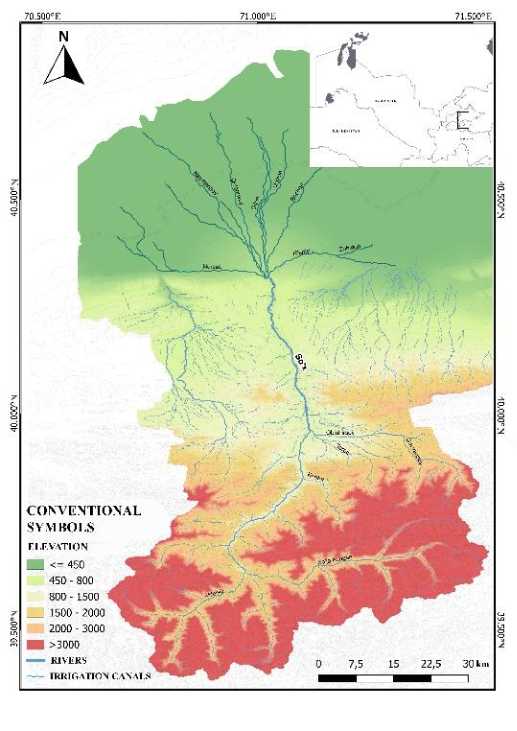
The Sokh basin includes the Sokh, Rishtan, Uzbekistan, Buvayda, Uchkuprik, Dangara and Bagdad districts in Uzbekistan and Karatokai, Bozadyr, Haftqand, Akturpaq, Chungara and Burgandi districts in Kyrgyzstan. The basin’s main river is the Sokhsay, formed by the confluence between the Akterak and Khojaochgan rivers. This river originates from the northern ridges of the Alay Mountains. Its length is 124 km, and the basin area is 3,510 km². It is one of the most water-abundant rivers in southern Fergana, and is fed mainly by melting snow and glaciers, so the highest water level falls on June-September.
The upper part of the basin is within a seismically active high mountain zone, with its highest point reaching 5,881 m, where the Tilbe River orginates. Upon exiting the foothill zone into the Central Fergana Plain, the Sokh River forms an extensive alluvial fan, stretching approximately 70 km in width and 50 km in length. At the point where the river leaves the foothills, the fan’s surface lies at an elevation of 700 m above sea level, gradually descending to approximately 300 m near the floodplain terraces of Syr Darya. Along this gradient, the mechanical composition and thickness of alluvial and proluvial deposits, as well as agro-irrigation sediments, undergo gradual changes.
Owing to its inland location within the Eurasian continent and its surrounding mountain ranges, Sokh Basin’s climate is not as sharply continental as in the lowland regions of Central Asia. The climate of the region was greatly influenced by the movement of air masses from the west [Bojmirzaev et al., 2019] (Figure 1).
Fig. 1. Topographic map of Sokh basin
Рис. 1. Топографическая карта бассейна Сохa
1.3. History of Archaeological Research
The earliest studies in the Sokh Basin were conducted in the last quarter of the 19th century by historian-orientalists N. I. Veselovsky, geologist V. N. Weber, and topographer A. D. Petrov [Weber, 1913; Petrov, 1914]. The data collected during this period were primarily descriptive in nature. Later, in the 1930s, archaeological research and monitoring related to the construction of hydraulic structures was initiated in the Fergana Valley. As a result, the first systematic information on the region’s history was obtained from the work of researchers B. A. Latynin, M. Y. Masson, M. Y. Voronets, Y. G. Gulomov, T. G. Oboldueva, and V. D. Zhukov [Latynin, 1956; Masson, 1940; Voronets, 1940; Zhukov et al., 1951].
During the 1940s and 1950s, large-scale investigations were conducted by scholars A. N. Bern-shtam, B. A. Litvinsky, Y. A. Zadneprovsky, and S. S. Sorokin covered certain parts within the Sokh Basin. Their research confirmed the regional coexistence of nomadic pastoralists with sedentary agricultural communities [Bernshtam, 1952; Litvinsky, 1959; Zadneprovsky, 1985; Sorokin, 1958].
From the 1960s onward, scholars including N. G. Gorbunova, T. G. Oboldueva, A. Y. Shigin, Y. D. Baruzdin, and G. A. Brykina cataloged numerous archaeological sites, clarified their chronological affiliations, and contributed to the creation of an archaeological map of the Fergana Valley [Gorbunova, 1979; Shigin, 1984; Baruzdin & Brykina, 1962; Brykina, 1982].
However, most of these studies were concentrated on certain micro-regions and sites, rather than offering an overall view of the Sokh Basin’s ancient history. As a result, the processes of anthropogenic landscape formation and expansion in this region have not been systematically investigated. Most archaeological research to date has been exploratory and survey-based, with large-scale, interdisciplinary investigations mostly focusing on Stone Age sites [Krivoshapkin, et al., 2020; Markova, 2013].
2. Methods
Archaeological research in the Sokh Basin was conducted between 2019 and 2023 by the Kokand team of the Akhsikent Complex Archaeological Expedition, under the National Center for Archaeology of the Academy of Sciences of Uzbekistan. This study’s main goal was to create an archaeological map of basin and digitize the information of the valley’s ancient sities. The work followed four basic steps: 1) detection of archaeological objects by remote sensing techniques; 2) Literature review; 3) ground validation; 4) data processing and analysis.
2.1. Spatial datasets
Spatial data serve as the primary source for identifying and analyzing archaeological landscapes in the study area. In this research, they were used to detect lost sites through the integration of historical and modern geospatial datasets.
2.1.1. Satellite Imagery
Satellite images have also been utilized in archaeological projects in Uzbekistan in recent years [Rondelli & Tosi, 2006;
The CORONA satellite images used in this work are from 1968–1970, specifically mediumresolution images DS1104-2169DF083 and DS1110-1153DA074 (KH4-B camera system), captured between 1967 and 1970 (Figure 2). They are nearly cloud-free, and despite the resolution not being very high, it still allows for the identification of most archaeological mounds.
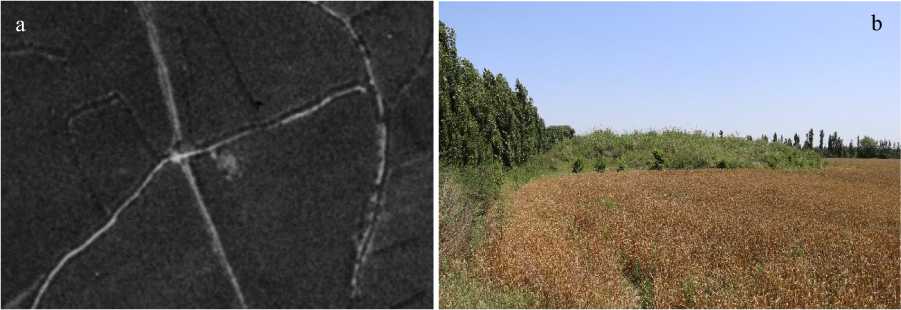
Fig. 2. Aerial view of Chakhtepe from the 1968 Corona imagery (a) and 2023 photo (b)
Рис. 2. Аэрофотоснимок Чахтепе: изображение с CORONA 1968 года ( а ) и фотография 2023 года ( б )
2.1.2. Topographic Maps
Military topographic maps which were prepared by the General Staff of the USSR in 1950’s have proven highly effective in identifying ancient archaeological sites in Central Asia. If we check the legends of the Soviet military maps, we find specific categories identifying the topographical anomalies considered here such as burial mound and tailings pile (drawn to scale!) [Rondelli et al., 2013, 272].
Military topographic maps at scales of 1:50,000 and 1:100,000 (sheet K-42-130, K-42-131, K-42-143, and J-42-011) were used for this research, as well as cadastral and agricultural maps at a 1:10,000 scale. In addition to these sources, CORONA KH-4B satellite imagery (missions 1968– 1972) was used as a primary dataset. Complementary remote sensing data included high-resolution Google Earth imagery (2019–2022), Landsat 8 OLI (30 m resolution), Sentinel-2 MSI (10–20 m resolution), and SRTM DEM (30 m resolution), which were integrated to analyze elevation, terrain, and surface anomalies.
Georeferencing of the Soviet military maps and CORONA imagery was carried out using Google Earth Pro and Global Mapper v20.10. Ground Control Points (GCPs) were selected based on stable and clearly identifiable features, such as river junctions, road intersections, and geomorphological landmarks that have remained unchanged over time. The georeferencing process was performed in the WGS 84 coordinate system (EPSG:4326), applying polynomial transformation methods where necessary.
The integration of georeferenced maps and multi-source remote sensing data enabled the systematic identification of traces of ancient human activity. These identified points were assigned precise coordinates and subsequently tested in the field to determine their archaeological significance.
2.2. Literature Review
As previously noted, numerous archaeological investigations have been conducted in the study area. A vast territory, including the middle and lower sections of the Sokh River, was surveyed by V. M. Masson during the construction of the Great Fergana Canal in 1939. Y. Gulamov led the third expedition team, which documented several archaeological sites that served as the principal sources for our research. During archaeological monitoring carried out by the third detachment in the northern part of the basin, in connection with canal construction works, more than ten archaeological sites dating to the Antiquity and Early Middle Ages were identified [Zhukov et al., 1951]. However, the report provides only descriptive information on the sites, without supplying cartographic materials indicating their precise locations. The sites were often referenced in relation to administrative units or neighboring monuments. For instance: “The settlement of Mikhchagar is located east of the village of Bachkir, Bagdad district…,” “Aktepa is situated 1 km southeast of the Munchaktepa site, south of the railway” [Zhukov et al., 1951]. Over time, with the expansion of settlements, changes in the names of administrative centers, and the disappearance of certain archaeological sites, the precise locations of monuments described in relation to other landmarks have become increasingly obscure. In addition, the movement of shifting sand dunes in the area has completely concealed the traces of some of these sites.
However, the report provides only descriptive information about the archaeological sites, without including cartographic materials that indicate their precise locations. The sites are often identified in relation to administrative units or, in some cases, through reference to the position of other monuments. For example: “The settlement of Mikhchagar is located east of the village of Bachkir in the Bagdad district…”, or “Oqtepa is situated 1 km south-east of the Munchaktepa site, south of the railway” [Zhukov et al., 1951]. Over time, the expansion of settlements, changes in the names of administrative centers, and the disappearance of certain historical sites have rendered the locations of sites-defined only in relation to other objects – increasingly ambiguous. Furthermore, the constant movement of sand dunes in the region has obscured or completely concealed the traces of these sites.
In addition, sites identified in the N. G. Gorbunova’s “Archaeological Monuments of the Fergana Region (Layout Scheme)” which created during the 1973–1976 Fergana Expedition were revisited and re-registered.
In N. G. Gorbunova’s schematic map, more than 200 archaeological sites across the region are depicted, including a total of 41 sites located within the Sokh River basin, where our research is concentrated [Gorbunova, 1979, pp. 16–35]. However, a number of these sites have not saved to the present day (such as Khushyor (Uchyor), Qizilkiyak, Muynioq, Obishir burials, Chongara, and Mozortepa), while others have been repurposed for cemeteries or alternative uses.
Althouth, this schematic map of the Fergana region’s archaeological sites is characterized by several significant shortcomings. First, it lacks precision, as the representation of sites is predominantly schematic rather than based on exact spatial data. Second, the topographic base is highly limited, offering only simplified depictions of natural features, which reduces the potential for analyzing the relationship between archaeological sites and their environmental context. Third, the absence of a clearly defined scale makes it difficult to accurately assess distances and spatial correlations between monuments. Finally, the map was created primarily for reporting purposes, which explains its weak analytical character and restricts its applicability for in-depth scientific research.
Additional information was gathered from the 1987 archaeological survey conducted by the Institute of Archaeology of the Academy of Sciences of Uzbekistan in connection with the construction of the Sokh Reservoir [Matbabaev et al., 1988].
Similar to the previous work, this survey also presented a schematic map rather than precise cartographic data. Several sites were lost during the construction of the reservoir or because of the expansion of rural settlements, while others became difficult to identify. Overall, the same methodological shortcomings noted above – schematic representation, lack of spatial precision, and weak analytical value – persisted in this survey as well.
In addition, a number of sites mentioned in other scholarly publications – such as Otukchi, Simab, Kalabadtepa, and others – were found to have been investigated but, for various reasons, were not included in the aforementioned archaeological maps.
As a result, when the available literature was systematically analyzed and the data from all previous surveys were consolidated, the total number of archaeological sites identified within the Sokh basin amounted to 83.
2.3. Ground validation: field survey and documentation
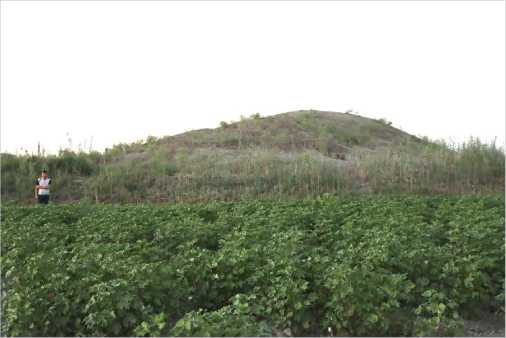
As part of the 2019 initiative to catalog and map archaeological sites in the Fergana region, a reconnaissance survey was conducted in Sokh district. This included reassessment and systematic documentation of 18 sites previously mentioned in archival records and scholarly publications [Saidov et al., 2020; Pardaev, 2021]. Additionally, from 2022 to 2023, the Kokand team of the Akhsikent Expedition, under the National Center for Archaeology of Uzbekistan, conducted further field surveys within the study area [Pardaev, 2022] (Figure 3).
Intensive field studies were carried out from 2022 to 2023 to gather detailed information on the study area. The following methods were used in field research:
Systematic field-walking : An organized survey was conducted across defined areas, during which visible artifacts were collected. Each finding was allocated a unique identification number and mapped.
Excavations : As part of the research, the Kokand Expedition of the Akhsikent Complex Archaeological Expedition (ACAE) excavated Tepakurgan archaeological site in 2022, which located in the central part of Kokand city [Anarbaev et al., 2023].
For the field survey and documentation, the WGS84 coordinate system was applied to record site locations, which were collected using a Garmin Montana 680t GPS device. Site names were documented based on previous research references, or as they are known by local people. A completed archaeological database for the Sokh Basin was produced, which included the following attributes:
• An archaeological site ID
• Site name (as recorded in prior investigations) [Zhukov et al., 1951; Gorbunova, 1979; Anarbaev & Saidov, 2014]
• Geographical coordinates of sites
• Administrative location
• Chronological period
• Site type
• Preservation status
• Morphology and spatial dimensions
• Research methodology (survey, excavation, test trenching)
• Source references (published literature, reports, topographic maps, and photographs with hyperlinks)
• Name of the recording researcher and date of documentation.
 2.4. Formation of the GIS Database
Fig. 3. Teshiktepa archaeological site (photo taken from the south) Рис. 3. Археологический памятник Тешиктепа (фото, сделанное с юга)
For this study, a dedicated Geoinformation System (GIS) was developed to integrate heterogeneous datasets, including Soviet military topographic maps, CORONA satellite imagery, Landsat 8, Sentinel-2, SRTM DEM, and high-resolution Google Earth imagery. All spatial datasets were georeferenced to the WGS 84 coordinate system (EPSG:4326).
The GIS was structured to include several thematic layers:
1. Base cartographic layers – georeferenced topographic and cadastral maps.
2. Remote sensing layers – CORONA KH-4B, Landsat 8 OLI, Sentinel-2 MSI, SRTM DEM.
3. Archaeological features – point, line, and polygon data marking burial mounds, settlement remains, irrigation traces, and mining sites.
4. Field survey data – GPS-collected coordinates and descriptions of verified archaeological sites.
3. Results
The system was built and managed using ArcGIS 10.8 and QGIS 3.28, while Global Mapper v20.1 and Google Earth Pro were employed for georeferencing and preliminary spatial analysis. Spatial queries, overlay analysis, and digitization of archaeological features were performed in the GIS environment, providing a coherent framework for both spatial interpretation and field verification (Figure 4).
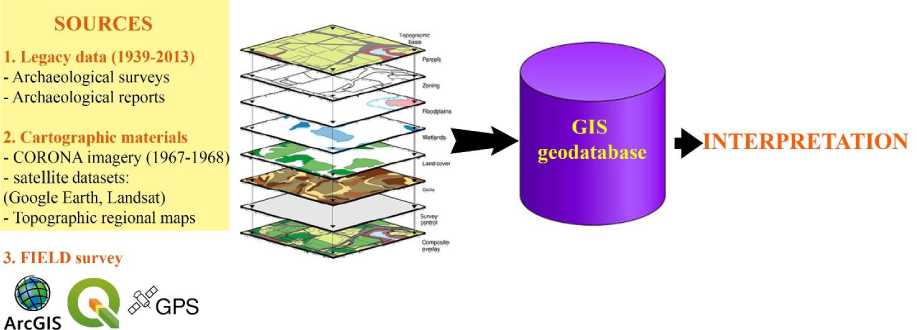
Fig. 4. General workflow
Рис. 4. Общая схема работы
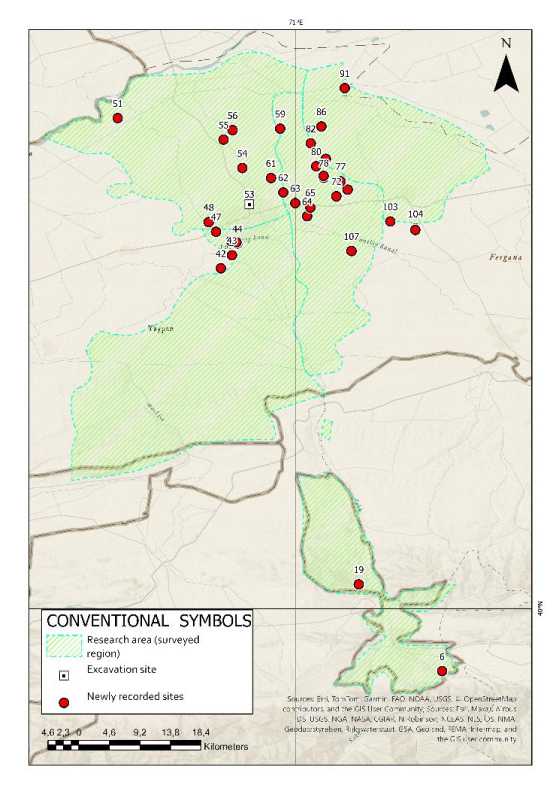
As a result of our research conducted between 2019 and 2023, which combined remote sensing techniques, literature review, and ground validation, a total of 112 archaeological sites and findspots were identified within the Sokh Basin. Among them, 29 previously undocumented sites were successfully discovered and recorded (Figure 5). The overall dataset includes 81 urban and rural settlements, 3 petroglyph complexes, 4 fortresses, 11 cemeteries and burial mounds, 9 scattered findspots, and 4 cave sites [Pardaev, 2023; Pardaev, 2024]. These newly identified sites, such as small rural settlements and burial mounds, substantially enrich the archaeological inventory of the region. Their documentation not only supplements earlier surveys but also provides deeper insights into the spatial distribution and cultural diversity of the Sokh Basin’s archaeological landscape. The collected data were organized in digital, graphical, and textual formats, ensuring accessibility for further scientific research and cultural heritage management.
Compared to previous studies, the results obtained have been greatly expanded. For instance, N. G. Gorbunova (1979) had documented 41 sites, while A. A. Anarbaev and M. Saidov (2014) recorded 63 sites (Figure 6). Thus, the present study nearly doubles the number of known archaeo- logical sites in the Sokh Basin.
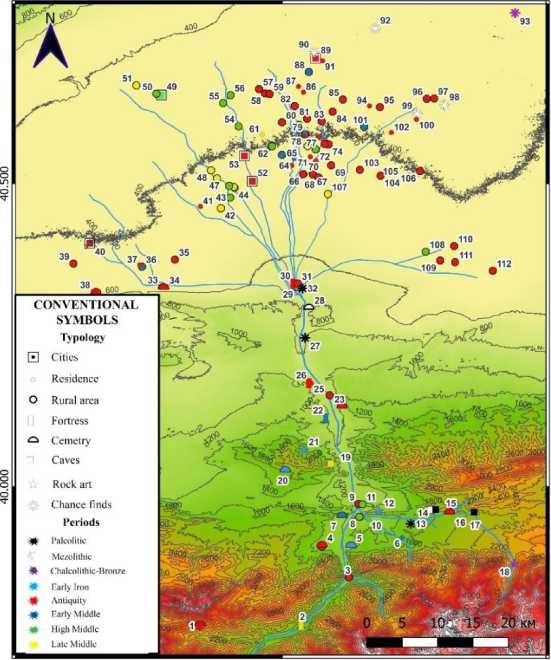
In addition, a geospatial database and a digital archaeological map of the Sokh Basin were developed on the basis of surveys, partial excavations, and remote sensing research (Figure 7). These datasets not only provided accurate geographic coordinates for each site but also allowed for an analysis of spatial distribution patterns in relation to natural and anthropogenic factors.
The relative contribution of different datasets used for the initial detection of archaeological sites is summarized in Table below.
Fig. 5. Archaeological sites identified during the 2019–2023 surveys Рис. 5. Археологические объекты, выявленные в ходе исследований 2019–2023 годов
Number of objects shown on an archaeological map
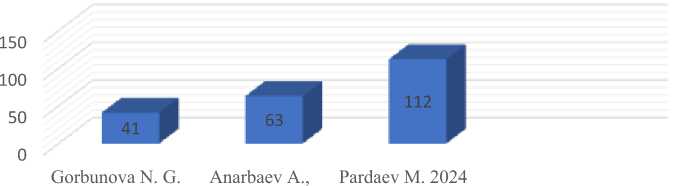
1979 Saidov M. 2016
Fig. 6. Histogram showing the number of monuments on archaeological maps compiled in different periods
Рис. 6. Количество памятников на археологических картах, составленных в разные периоды
71.000
-
I.Sitnab; 2.Kan; 3.Kshtut; 4.Xushyor; 5.Kurgans; 6.Kaspidantcpa; 7.Kyzylqiyatpa; K.Mazartcpa II; 9.Mazartcpa; lO.Klwja Arif;
11 .Gorystontcpa; 12.Yangariksoy: 13.Chashma; 14.ObishirV; l5.Surungur; 16.Obishir: 17.Sclungur; l8.Gaviyan; !9.Dckhvairon: 2O.Kuktash;
-
1О9.Лкуспсра; I lO.Zokhidon; ULSoxibi Hidoya; 112.Kalobodlepa.
-
4. Discussion
4.1. Archaeological landscape transformation and settlement dynamics in the Sokh Basin
Fig. 7. The archaeological map of the Sokh Basin Рис. 7. Археологическая карта бассейна Сохa
Relative effectiveness of initial detection sources for archaeological site identification prior to field validation
Относительная эффективность источников первичного обнаружения для идентификации археологических памятников до их верификации в полевых условиях
|
Initial detection source |
Sites |
Main detected site types |
Strengths |
Limitations |
|
|
n |
% |
||||
|
Modern high-resolution satellite imagery (e.g., Google Earth) and published sources |
10 |
34.5 |
Surface-visible settlements and geomorphological features |
Rapid large-area survey; interpretation of surface anomalies |
Limited reliability without field verification |
|
Local knowledge (interviews) |
8 |
27.6 |
Mounds, abandoned cemeteries, former settlement remains |
Identification of undocumented or forgotten sites |
Memory limited to relatively recent past |
|
CORONA satellite imagery |
7 |
24.1 |
Low-relief settlements and residential complexes |
Detection of erased micro-topography |
Many features obscured by modern land use |
|
Soviet military topographic maps |
4 |
13.8 |
Burial mounds, mining traces, terrain anomalies |
Systematic mapping of terrain and water sources |
Cartographic generalization; small sites omitted |
The results of this study demonstrate that the archaeological landscape potential of the Sokh Basin has not yet been fully revealed. In particular, the discovery of 29 new archaeological sites, consisting mainly of rural settlements and individual dwellings, shows that the region hosted both nomadic and sedentary communities, reflecting its socio-economic and cultural diversity.
In comparison with earlier archaeological maps, the findings of this research both confirmed many previously recorded sites and substantially expanded their number. Numerous previously known sites were re-identified and systematically registered.
Based on surface materials and trench excavations, it became clear that the majority of these sites belong to the period of antiquity and the early Middle Ages, and are represented by small rural-type settlements and individual dwellings. While earlier studies were largely limited to descriptive information, this research introduced precise geospatial data, in several cases refined chronological attributions, and proposed an updated classification of site types. As a result, the accuracy of site localization has significantly improved, providing a more reliable basis for analyzing settlement systems and cultural development in the Sokh Basin (Figure 8).
The integration of remote sensing, field surveys, and literature analysis in this study clearly demonstrated the effectiveness of a multi-source approach for the identification of archaeological sites. While each method produced valuable results on its own, their combination provided more accurate and comprehensive information. For instance, remote sensing helped to identify the location of potential sites, field surveys confirmed them on the ground, and literature analysis enabled comparison with previous research, clarification of the historical context, and refinement of the chronological and cultural interpretation of the sites.
As a result, the synergy of multi-source approaches and modern technologies made it possible to construct a more holistic picture of the archaeological landscape of the Sokh Basin. This methodology not only facilitated the discovery of new sites but also improved the accuracy of localization and functional characterization of previously recorded ones.
The collected data show that over the past 70 years, approximately one-quarter of the sites in the basin have been destroyed, and nearly one-fifth are on the verge of disappearing [Pardaev, 2022, 101]. These losses are partly attributable to natural processes, such as erosion and the movement of sand dunes, and partly to anthropogenic impacts, including village expansion, new infrastructure development, intensified irrigated agriculture, and the conversion of sites into cemeteries. Such changes present serious risks and challenges for the preservation and management of cultural heritage. The disappearance of archaeological sites leads not only to the loss of material evidence but also significantly restricts the possibilities of reconstructing the region’s historical processes.
According to unofficial sources, more than 30,000 archaeological sites existed in the territory of present-day Uzbekistan before 1960. By the early 1980s, largely due to their absorption into agricultural land, this number had declined to about 9,000. By the mid-1990s, the number dropped further to 5,391, while current official statistics register 4,797 sites. Specialists, however, estimate the real number to be around 8,500, noting that the inventory process remains incomplete.
For this reason, the GIS database and digital archaeological maps developed during this study not only precisely defined the geographic coordinates of sites but also enabled the analysis of their spatial distribution in relation to both natural and anthropogenic factors. This provides a practical foundation for introducing modern tools of cultural heritage preservation, monitoring, and management.
The findings also made it possible to reconstruct the dynamics of settlement in the Sokh Basin during antiquity and the early medieval period. The spatial distribution of archaeological sites shows that large and small settlements, fortresses, and cemeteries were closely tied to irrigation systems
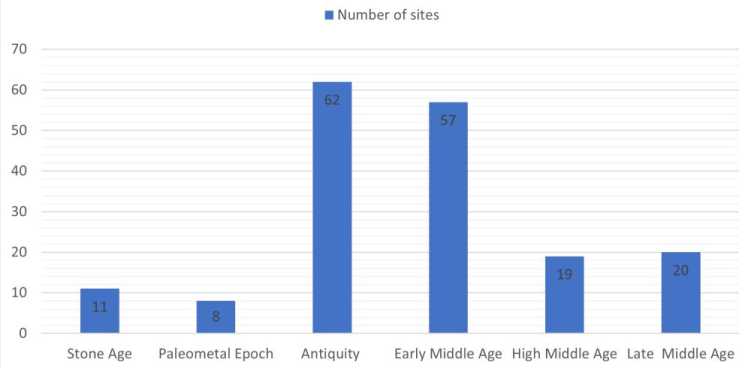
Fig. 8. Archaeological sites by period
Рис. 8. Археологические памятники по периодам and natural water sources, highlighting the fundamental role of irrigated agriculture in the region’s economy. Moreover, the proximity of some large sites to ancient trade routes and transit zones indicates the active participation of the Sokh Basin in the economic and cultural exchange processes of Central Asia. This demonstrates the strategic significance of the region and allows it to be interpreted as one of the most important Fergana Valley’s cultural centers.
The results showed that the Sokh Basin was ultimately not only a center of local economic and social life but also played an important role in broader regional interactions. Through this, the interconnection between settlement patterns, irrigation systems, and trade routes in antiquity and the early Middle Ages is clearly revealed.
4.2. Methodological implications of multi-source archaeological detection
Intensification of agriculture, changes in modern land use, and increasing urban pressure associated with the expansion of Kokand city have significantly altered the landscape, rendering many archaeological features barely visible in the present-day terrain. In response to these challenges, this study employed a multi-source archaeological detection approach integrating multi-temporal remote sensing data, historical cartographic materials, and locally derived knowledge. Within the GIS database, each identified site was linked to its initial detection source, allowing the relative effectiveness of pre-field datasets to be assessed.
The results indicate that the largest number of sites were initially identified using modern high-resolution satellite imagery (e.g., Google Earth) combined with published scientific sources. In total, 10 archaeological sites were detected through this source category, representing 34.5% of the total 29 identified sites. These datasets proved particularly useful for interpreting ambiguous geomorphological features within the landscape. However, many of these features could not be confidently classified through remote analysis alone, making subsequent field verification essential.
The second most significant initial detection source was local knowledge obtained through interviews with residents. This approach led to the identification of 8 archaeological sites, accounting for 27.6% of the total dataset. These observations primarily concerned ancient mounds, abandoned cemeteries, and traces of former settlements that were not clearly visible in satellite imagery or historical maps.
The third most effective dataset consisted of declassified CORONA satellite imagery, through which 7 archaeological sites were initially detected (24.1% of the total). These historical images proved particularly valuable for identifying micro-topographic features that have since been flattened or obscured by modern agricultural activities and urban development. The sites identified from CORONA imagery primarily correspond to ancient rural settlements and isolated residential complexes.
Finally, Soviet military topographic maps provided additional evidence through the systematic documentation of geomorphological anomalies in the terrain, enabling the identification of 4 archaeological sites, or 13.8% of the total sample. Importantly, these maps also record the distribution of springs, which represent a critical ecological factor influencing human settlement patterns in antiquity. Consequently, the presence of mapped water sources served as an additional indicator for identifying potential settlement locations.
It is important to note that all sites identified through remote sensing, cartographic analysis, or local knowledge were subsequently verified during field investigations (field validation), during which their presence and archaeological characteristics were confirmed and documented.
Overall, the results demonstrate that in heavily transformed landscapes a single dataset is insufficient for reliable archaeological site detection. Instead, the integration of multi-temporal remote sensing imagery, historical cartography, modern high-resolution satellite data, and locally preserved knowledge forms a multi-source archaeological detection model that significantly enhances detection reliability. Such an integrated methodological framework provides a robust basis for conducting landscape-scale archaeological research in environments that have undergone substantial anthropogenic transformation.
5. Conclusion
The research results, particularly the identification of 29 archaeological sites, demonstrate that the archaeological landscape potential of the Sokh Basin has not yet been fully revealed and many historical issues of the region remain insufficiently explored. The diversity of site types within the study area, including settlements characteristic of both nomadic and sedentary communities, indicates the socio-economic and cultural complexity and diversity of the region.
The multi-source approach applied in the study – integrating remote sensing, field surveys, and literature analysis – has been highly effective in archaeological landscape research. The GIS database and digital maps enabled precise localization of sites and facilitated the analysis of their spatial distribution in relation to both natural and anthropogenic factors.
These findings not only enhance our current understanding of the archaeological landscape of the Sokh Basin but also provide a solid scientific basis for future research aimed at a more comprehensive and in-depth exploration of the region’s historical development dynamics.
