
Ecological Variability of the Phytochemical Composition of Punica granatum L. Populations in the Northeastern Lesser Caucasus
Journal: Bulletin of Science and Practice @bulletennauki
Section: Естественные науки
Article in issue: 1 т.12, 2026.
Free access
The article deals with the determination of the composition and quantitative diversity of phytochemicals - phenols, flavonoids, anthocyanins, tannins, and organic acids - in Punica granatum L. populations distributed in the northeastern part of the Lesser Caucasus. The main reason for studying this diversity is to evaluate the interaction between ecological factors, including altitudinal gradients, soil properties, humidity, temperature, and light regimes. The article reflects, on a scientific basis, the mechanisms of influence of ecological variability on the phytochemical profile. These populations, depending on the ecological conditions reflecting the climate and soil diversity of the region, undergo regular changes and spread throughout the territory, playing an important role in the formation of the adaptive capabilities and phytochemical diversity of the species. The levels of tannins and phenolic acids in pomegranate populations increased significantly under nitrogen limitation. This increase reflects the adaptation of the plant to metabolic stress. The increase in anthocyanin and total phenol levels in populations accompanied by water deficit is explained by the compensation of drought-induced oxidative stress.
Similar articles in the section Geographic botany. Plant geography (phytogeography). Floras. Geographic distribution of plants
Short address: https://sciup.org/14135568
IDS: 14135568 | UDC: 581.9 | DOI: 10.33619/2414-2948/122/06
Экологическая изменчивость фитохимического состава популяций Punica granatum L. в северо-восточной части Малого Кавказа
Статья посвящена определению состава и количественного разнообразия фитохимических веществ (фенолов, флавоноидов, антоцианов, дубильных веществ, органических кислот) в популяциях граната Punica granatum L., распространенных в северо-восточной части Малого Кавказа. Основной причиной этого разнообразия является оценка взаимодействия экологических факторов, включая высотный градиент, свойства почвы, влажность, температуру и световой режим. Механизмы влияния экологической изменчивости на фитохимический профиль отражены в статье на научной основе. Эти популяции, в зависимости от экологических условий, отражающих климат и почвенное разнообразие региона, претерпевают закономерные изменения и распространяются по территории, играя важную роль в формировании адаптивных возможностей и фитохимического разнообразия вида. Уровни танинов и фенольных кислот в популяциях граната значительно возросли при дефиците азота. Это увеличение отражает адаптацию растения к метаболическому стрессу. Увеличение уровней антоцианов и общих фенолов в популяциях, сопровождающихся дефицитом воды, объясняется компенсацией окислительного стресса, вызванного засухой.
Text of the scientific article Ecological Variability of the Phytochemical Composition of Punica granatum L. Populations in the Northeastern Lesser Caucasus
Бюллетень науки и практики / Bulletin of Science and Practice
UDC 581.9
Punica granatum L. is a rare woody plant species distributed in the northeastern part of the Lesser Caucasus. It has been determined that pomegranate populations exist in the ecologically and chemically diverse regions of the Lesser Caucasus and that these populations exhibit high phytochemical variation in accordance with the variability of environmental factors. Natural populations of pomegranate are found in some specially protected areas of the Lesser Caucasus, such as the Goygol National Park, Korchay and Garayazi State Natural Reserves, and these populations have been stably formed in various ecological conditions characterized by the microclimatic differences of the region [1-3].
Its origin is Iran, Afghanistan, India, China, and also spreads to the Mediterranean countries such as Spain from the west. Due to the adaptation of pomegranate trees to the changing climatic conditions of Morocco, Egypt, Tunisia and Turkey, it is manifested in the wide spread of wild forms throughout Eurasia. It is currently widely cultivated in subtropical and tropical areas in many changing climates. Analysis of conditions in different countries, rapid development, and geographical analysis show that pomegranate has the ability to adapt to a wide range of climates. Today, in addition to being a fruit, pomegranate has many properties that are applied in various fields [4].
It has attracted the attention of many researchers in different countries in the food industry and has conducted extensive research. Pomegranate trees grow in natural climatic conditions, can adapt to a wide area, and various soil conditions. The trees are sensitive to poorly drained soils. Such conditions reduce the quality of the product in them and the plant does not grow. In general, the best soil for pomegranate growth in natural conditions is sandy-clay soils. The highest crop growth, productivity and quality can be achieved in warm areas. In this case, the pomegranate tree is long-lived. Pomegranate populations are of great strategic importance in preserving the genetic diversity of the region, distinguished by a high variation of phytochemical components against the background of variability of ecological conditions. These populations are mainly concentrated in landscapes on the edges of forest-shrubs, on stony-gravel slopes and in sunny exposures. At the same time, these pomegranate populations play an important role in ecosystem functions, support pollination and seed dispersal, and also constitute a valuable resource for biotechnological and genetic research. With these features, pomegranate populations in the northeastern zone of the Lesser Caucasus are of strategic importance both in terms of biodiversity conservation and phytochemical resource assessment [5].
Material and methods
The study was conducted in the natural distribution zones of pomegranate ( Punica granatum L.) populations in the northeastern part of the Lesser Caucasus. These areas have different altitude, soil composition, illumination, and microclimatic conditions, which create favorable conditions for the analysis of ecological gradients. Healthy, mature, and productive pomegranate plants were selected from natural populations. Samples were taken from at least 10 individual plants from each population. Leaf, fruit, and stem fragments were collected for phytochemical analysis (Figure).
Samples were collected during the active phase of the vegetation period in summer and autumn. The following ecological parameters were recorded in the area of distribution of populations. Altitude was measured with a GPS device.
Soil properties – pH, texture, organic matter content and mineral elements were measured in situ and determined by laboratory analyses. Samples were analyzed in the laboratory using the following methods:
Total phenols – determined by Folin-Ciocalteu method. Flavonoids – pH-differential method and spectrophotometry. Anthocyanins – quantified by pH-differential method and HPLC. Tannins – vanillin-HCl method.
Organic acids – analyzed by HPLC and GC-MS methods.
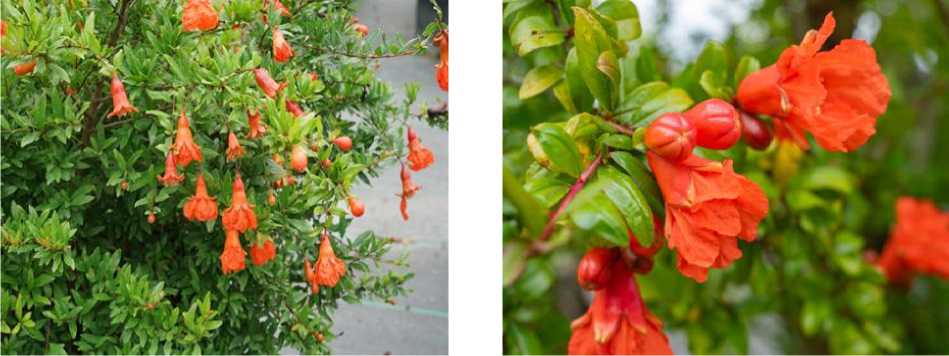
Figure. Punica granatum L.
The relationships between ecological parameters and phytochemical components were assessed using Pearson and Spearman correlation analyses. Analysis of variance (ANOVA) was applied to identify phytochemical differences between populations, and multivariate statistical analyses, including principal component analysis (PCA), were performed based on the phytochemical profiles of the populations [6].
Discussion of the work
Punica granatum L. populations distributed in the northeastern part of the Lesser Caucasus exhibit significant variation in terms of phytochemical composition. The synthesis of phytochemical compounds in plants shows high sensitivity to environmental stress factors. Phenols, flavonoids, anthocyanins and tannins are mainly components of defense reactions and reflect adaptation strategies to environmental factors. The content of total phenols, flavonoids, anthocyanins, tannins and organic acids is directly related to ecological differences in the distribution area of populations. Low temperatures stimulate anthocyanin biosynthesis, which acts as a defense mechanism against cold stress in plants [7].
Ecological factors, such as differences in soil composition, light, and humidity, significantly affected the phytochemical profile of pomegranate depending on altitude. For example, increased light at high altitudes led to an increase in the content of anthocyanins and flavonoids. This result suggests that the adaptation mechanism of pomegranate to environmental stresses is related to the activation of the phenylpropanoid biosynthesis pathway. High temperatures induce oxidative stress, which is a plant defense mechanism that increases the amount of phenols and flavonoids. The increase in temperature amplitude causes the activation of the phenylpropanoid biosynthesis pathway, which results in an increase in the amount of phenols and flavonoids. At the same time, the results of soil pH and mineral elements showed statistically significant differences between populations, affecting the levels of tannins and organic acids, reflecting the adaptation potential of plants to different soil conditions [8].
Phytochemical differences between populations were shown by ANOVA (p<0.05). These differences were mainly related to environmental variability, microclimatic characteristics and soil chemical composition. PCA analysis grouped populations based on their phytochemical profiles and revealed that altitude, light and soil characteristics played a role as principal components. This clearly demonstrates the ecological plasticity and adaptive responses of the species. The phytochemical variation observed during the study may be related to the adjustment of defense mechanisms of pomegranate populations in response to environmental stresses. Stress factors such as drought, high light and low soil moisture increase the amount of anthocyanins, flavonoids and phenols, thereby enhancing the defense function against oxidative stress. Increased light intensity stimulates the accumulation of anthocyanins, which is explained by the strengthening of the photoprotective function. These results are consistent with similar studies conducted in other tropical and subtropical regions [9].
The formation of the phytochemical composition of populations depending on ecological variability is of strategic importance for both the protection of biodiversity and the identification of valuable resources from a biotechnological point of view. Wild pomegranate populations can be evaluated as a genetic resource both in terms of seed resources and phytochemical components.
Results
The study shows that Punica granatum L. populations in the northeastern zone of the Lesser Caucasus exhibit high phytochemical variation against the background of environmental variability. This variation plays an important role in maintaining the genetic diversity of populations and ensuring the plant’s ability to adapt to environmental stresses. The main phytochemical components in populations – total phenols, flavonoids, anthocyanins, tannins, and organic acids – vary in accordance with the variability of environmental factors.
Temperature, illumination, soil pH, and the level of mineral elements have a significant impact on the amount of these components. High altitude and illumination stimulate anthocyanin and flavonoid biosynthesis, which enhances the plant’s photoprotection and defense mechanism against oxidative stress. Low temperature, on the other hand, increases anthocyanin accumulation, providing adaptation to cold stress. ANOVA and PCA results showed that phytochemical profiles among populations are related to ecological differences.
This clearly confirms the ecological plasticity and adaptive responses of pomegranate. Wild pomegranate populations can be evaluated as a strategically important resource for both biodiversity conservation and biotechnological and genetic research. The richness and variation of their phytochemical components, as well as their ability to adapt to environmental stresses, create a potential basis for species conservation and future research.
