
EDS Analysis of the Main Mineral and Organogenic Elements of AshED Camel Milk and Its Derived Products
Журнал: Вестник Алматинского технологического университета @vestnik-atu
Рубрика: Технология пищевой и перерабатывающей промышленности
Статья в выпуске: 3 (153), 2026 года.
Бесплатный доступ
The article presents an EDS analysis of ash from camel milk and its derived products. Based on the results of the EDS analysis, the composition of the main mineral and organogenic elements in ash from camel milk, cottage cheese, kurt, and whey has been determined. The mass fractions of the main macroand microelements contained in these products sodium, potassium, calcium, phosphorus, magnesium, chlorine as well as organogenic elements such as oxygen and carbon have been identified. The elemental composition of camel milk and derivatives obtained in the autumn and winter seasons has been compared, and the influence of feed and physiological factors on the formation of the elemental profile has been determined. Changes during technological processing of camel milk into fermented milk products have also been analyzed, and their functional significance for human body has been assessed. The experimental data indicate a high level of mineralization of the produced products, which determines their nutritional and biological value. Overall, the obtained research results substantiate the feasibility of using camel milk and its processed products in functional and therapeutic-preventive nutrition for various population groups.
Короткий адрес: https://sciup.org/140316614
IDS: 140316614 | УДК: 65.63.05 | DOI: 10.48184/2304-568X-2026-3-100-109
EDS-анализ основных минеральных и органогенных элементов озолённого верблюжьего молока и производных продуктов
В статье проведён EDS-анализ озоленного верблюжьего молока и его производных продуктов. По результатам проведённого EDS-анализа определён состав основных минеральных и органогенных элементов озолённого верблюжьего молока, творога, курта и молочной сыворотки. Определены массовые доли входящих в эти продукты основных макрои микроэлементов натрия, калия, кальция, фосфора, магния, хлора и органогенных элементов кислорода и углерода. Проведено сравнение элементного состава верблюжьего молока и продуктов, полученных в осенний и зимний сезоны, и на этой основе выявлено влияние кормовых и физиологических факторов на формирование элементного профиля. Также проведён анализ изменений в процессе технологической переработки верблюжьего молока в кисломолочные продукты и проведена оценка их функциональной значимости для организма человека. Экспериментальные данные свидетельствуют о высоком уровне минерализации вырабатываемых продуктов, что обусловливает их пищевую и биологическую ценность. В совокупности полученные результаты исследований обосновывают целесообразность использования верблюжьего молока и продуктов его переработки в составе функционального и лечебно-профилактического питания различных слоёв населения.
Күлдендірілген түйе сүті мен одан алынған өнімдердің негізгі минералдық және органогендік элементтерінің EDS-талдауы
Мақалада күлдендірілген түйе сүті мен оның туындыларының EDS-талдауs жүргізілді. ЭДС талдауының нәтижелеріне сүйене отырып, күлдендірілген түйе сүтінің, сүзбенің, құрттың және сарысудың негізгі минералды және органогенді элементтерінің құрамы анықталды. Бұл өнімдердегі негізгі макрожәне микроэлементтердің – натрий, калий, кальций, фосфор, магний, хлордың – және органогенді элементтердің – оттегі мен көміртектің – массалық үлестері анықталды. Күзгі және қысқы маусымдарда алынған түйе сүті мен оның туындыларының элементтік құрамы салыстырылды, сондай-ақ жем мен физиологиялық факторлардың элементтік профильдің қалыптасуына әсері анықталды. Түйе сүтін ашытылған сүт өнімдеріне технологиялық өңдеу кезіндегі өзгерістер де талданды және олардың адам ағзасы үшін функционалдық маңыздылығы бағаланды. Тәжірибелік деректер алынған өнімдердің минералдану деңгейінің жоғары екенін көрсетеді, бұл олардың тағамдық және биологиялық құндылығын анықтайды. Жалпы алғанда, алынған зерттеу нәтижелері түйе сүті мен оның өңделген өнімдерін халықтың әртүрлі топтары үшін функционалды және емдік тамақтануда пайдаланудың орындылығын дәлелдейді.
Текст научной статьи EDS Analysis of the Main Mineral and Organogenic Elements of AshED Camel Milk and Its Derived Products
SRSTI: 65.63.05
Amid the steady growth of alimentary-dependent diseases, including mineral metabolism disorders, osteoporosis, cardiovascular and metabolic conditions, the development of scientifically based approaches to creating functional foods has become particularly relevant [1, 2]. According to date from the World Health Organization, deficiencies of essential macro- and microelements remain one of the leading causes of decreased quality of life of the population and the growth of chronic pathologies [3]. In this regard, a priority area of modern food science is the search for natural sources of nutrients with high bioavailability and physiological activity [4].
Camel milk is of particular interest, as in recent years it has been considered as a promising raw material for the production of functional and therapeutic-preventive food products.
Unlike cow's milk, camel milk is characterized by a specific ratio of proteins, lipids, mineral and organogenic substances, as well as resistance to adverse climatic conditions of raw material production [5, 6].
Studies show that its chemical profile is largely determined by the adaptive characteristics of animals to arid zones, which is reflected in the electrolyte composition and the level of mineralization of the product.
The mineral composition of milk plays a key role in formation of its biological value. Macronutrients such as calcium, phosphorus, potassium, sodium, magnesium, and chlorine are involved in maintaining the structural integrity of bone tissue, regulating water-electrolyte balance, transmitting nerve impulses, and promoting enzymatic processes [7-9].
At the same time, milk processing to produce cottage cheese and its products, yogurt, whey, and other products is accompanied by a redistribution of mineral components between fat, protein, and aqueous fractions, which can significantly change their quantitative ratios and physiological significance.
Despite the existence of publications on the chemical composition of camel milk, systematic data on the transformation of the mineral profile in the production of traditional products (cottage cheese, curd) and whey, especially taking into account seasonal factors in the southern regions of Kazakhstan, are fragmentary. Meanwhile, the feeding season is a determining factor in the variability of the elemental composition of animal-derived dairy products [10-12].
The absence of systematic data limits the possibility of scientific substantiation of regulatory indicators of quality and safety, as well as the development of new functional products based on these raw materials [13, 14]. In addition, without assessing the mineral composition of milk and its processed products, it is difficult to analyze their functional significance [15].
In this regard, the purpose of the present study is to conduct a comparative analysis of the mineral and organogenic composition of camel milk obtained during the autumn and winter milking periods and of its processed products, with an assessment of the impact of technological operations on the redistribution of macro- and microelements.
The scientific novelty of the work lies in the comparative analysis of the mineral and organogenic profile of several types of products obtained from the same type of raw material, taking into account the influence of technological factors. The practical significance of the study lies in the possibility of using the data obtained in the development of new types of functional dairy products [16].
Thus, the presented work corresponds to the current priorities of food science development and is aimed at expanding scientific understanding of camel milk as a promising source of physiologically significant mineral elements.
Materials and research methods
The studies were conducted using camel milk samples and dairy products obtained from Bactrian two-humped camels. To identify the influence of diet and climatic conditions on the formation of the mineral and organogenic profile of the studied foods, the method of comparative analysis of camel milk samples and dairy products produced in autumn and winter, was used.
To ensure a unified methodological approach and controlled experimental conditions, all analytical studies have been conducted at the accredited Structural and Biochemical Materials Testing Laboratory of M. Auezov South Kazakhstan University.
The elemental composition has been determined by energy dispersive X-ray spectrometry (EDS). Modern highly sensitive equipment has been employed to ensure the reliability of the quantitative assessment of macro-and microelements and organogenic elements. The EDS analysis was performed using a JEOL JSM-6490LV scanning electron microscope equipped with the INCA Energy elemental analysis system and the HKL-Basic structural data processing module. The use of this hardware and software package ensured the correct identification and quantification of the studied elements of ashed camel milk and its processed products with a high degree of accuracy. The technical characteristics of the equipment contributed to the increased sensitivity of the method and ensured the reproducibility and reliability of the results obtained.
The objects of the study were camel milk obtained during the autumn and winter milking periods, as well as products of its processing: cottage cheese, whey, kurd.
The raw materials were obtained from the “Bagdat” farm located in the Suzak district of the Turkestan region (Republic of Kazakhstan). Sampling was carried out in the autumn and winter periods, which made it possible to assess the influence of the seasonal factor on the formation of the mineral and organogenic profile and physicochemical parameters of the studied products.
The milk was characterized by a homogeneous consistency, white color with a slight creamy tint, and a specific taste and aroma.
Cottage cheese was produced by the method of acid coagulation of proteins, followed by separation of whey and self-pressing. Its consistency is dense and spreadable; the color was white with a creamy tint; the taste was clean and fsour-milk.
Curd whey was a transparent liquid of light yellow color with a slightly acidic taste.
Kurt was produced by thermal evaporation of the fermented milk mass, followed by molding and drying. The product was characterized by a dense structure.
Collected milk samples were transported to the laboratory in hermetically sealed containers at a temperature of (4 ± 2) °C. Before analysis, the milk was thoroughly mixed until a homogeneous state was achieved.
Cottage cheese was homogenized; kurt was preliminary crushed to a powder-like state to ensure the representativeness of the sample portion.
Curd whey was filtered through a paper filter to remove mechanical impurities.
The studies included preliminary ashing of the studied samples in a muffle furnace at a temperature of 500-550 °C until light gray ash was obtained, followed by determination of their elemental composition by using energy dispersion spectrometry.
The results and their discussion
The study analyzed the mineral and organogenic composition of natural camel milk obtained during autumn and winter milking periods, as well as the cottage cheese, kurt and whey produced from it, were analyzed. The results make it possible to trace the changes in the mineral composition during technological processing of the raw material.
In order to determine the influence of seasonal factors, changes in the quantitative amounts of mineral and organogenic elements were evaluated, and their dynamics and differences were systematized. The mineral content of camel milk and products obtained from it in winter period was compared with the amount of minerals in these products in the autumn period.
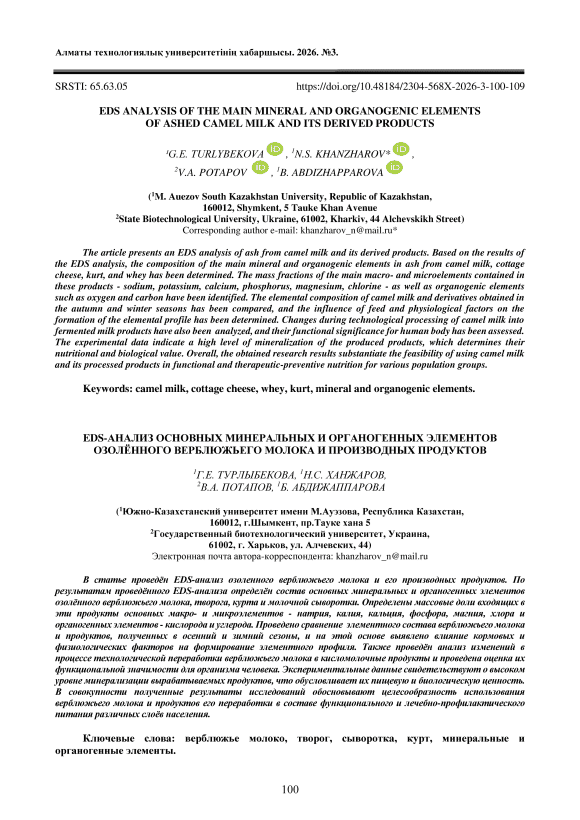
The results of the study of the mineral composition of camel milk and its products are presented in Tables 1 and 2. The microstructure and EMF spectra of the mineral and organogenic composition of camel milk ash and cottage cheese are shown in Figures 1a and 1b, and curd ash and curd whey from camel milk are shown in Figures 2a and 2b, respectively.
Table 1. Comparative indicators of the mineral and organogenic composition of camel milk and cottage cheese obtained from it in the autumn and winter milking periods
|
1. |
2. Element |
3. Content of the element, % |
|||
|
4. Camel milk |
5. Cottage cheese |
||||
|
|
|
|
||
|
14. |
15. Na |
16. 9.48 |
17. 5.66 |
18. 9.63 |
19. 22.93 |
|
20. |
21. Mg |
22. 1.15 |
23. 1.02 |
24. 0.83 |
25. 0.60 |
|
26. |
27. P |
28. 8.22 |
28. 5.90 |
30. 10.92 |
31. 5.23 |
|
32. |
33. K |
34. 11.39 |
35. 16.71 |
36. 7.36 |
37. 3.28 |
|
38. |
39. Ca |
40. 10.89 |
41. 10.60 |
42. 12.79 |
43. 5.18 |
|
44. |
45. Cl |
46. 16.02 |
47. 15.43 |
48. 13.26 |
49. 37.77 |
|
50. |
51. С |
52. 10.13 |
53. 13.80 |
54. 13.19 |
55. 7.33 |
|
56. |
57. О |
58. 32.46 |
59. 30.87 |
60. 32.02 |
61. 17.68 |
Based on the data presented in Table 1, a comparative analysis of the mineral and organogenic composition of camel milk and cottage cheese obtained from it was carried out. The results of the study showed that the elemental profile of both the raw materials and the finished product changes significantly under the influence of seasonal factors and processing. The observed differences are, on the one hand, caused by changes in the diet of animals and climatic conditions, and, on the other hand, by the physicochemical processes occurring during milk coagulation and whey separation.
First and foremost, the dynamics of sodium content deserves special attention. According to the data, its proportion in milk was 9.48% in the autumn period, decreasing to 5.66% in winter. In contrast, cottage cheese shows a marked increase, rising from 9.63% in autumn to 22.93% in winter. This divergent trend indicates the leading role of the technological factor: during coagulation process, part of the moisture is removed, and soluble salts become concentrated in the protein clot. Consequently, the high concentration of sodium in the final product is due not so much to seasonal fluctuations as to the effect of dehydration and redistribution of mineral components during processing.
Magnesium levels show a consistent decreasing trend: in milk, from 1.15% in autumn to 1.02% in winter, in cottage cheese - from 0.83% to 0.60%. Considering the water-soluble nature of magnesium, the majority of it passes into the whey phase. Thus, the reduction of magnesium content in cottage cheese is mainly due to the technological separation of phases, rather than the influence of seasonal conditions.
Phosphorus distribution is characterized by a more complex pattern. In milk, its concentration decreases from 8.22% in autumn to 5.90% in winter, reflecting seasonal influence. At the same time, an increase to 10.92% is observed in autumn cottage cheese, which indicates the binding of phosphorus to casein micelles and its accumulation in the protein fraction. The winter decrease in phosphorous content in cottage cheese to 5.23% correlates with the reduction of the initial element content in milk. Therefore, the dynamics of phosphorus is determined by a combination of seasonal changes and the degree of its incorporation into the protein-mineral complex.
The potassium content confirms its predominant localization in the aqueous phase of milk: 11.39% in autumn and 16.71% in winter. In cottage cheese, the indicators are significantly lower (7.36% and 3.28%, respectively), which is due to the transfer of potassium into whey during coagulation. Thus, the decrease in potassium concentration in the dense product is a direct consequence of the technological separation of the liquid phase.
The analysis of calcium indicates the comparative stability of the protein-mineral complex. In milk, its content remains almost unchanged (10.89% in autumn and 10.60% in winter). In autumn cottage cheese, the concentration increases to 12.79%, which confirms the strong bond of calcium with casein. In winter cottage cheese, the indicator decreases to 5.18%.
Among the organogenic elements, oxygen remains in camel milk because after ashing (under insufficient oxygen), the organic portion is removed, but remains in the form of "mineral components" in the composition of oxides and phosphates. The dynamics of changes in oxygen content in camel milk in autumn and winter are insignificant - 32.46% and 30.87%, respectively. And there is a strong decrease in cottage cheese -32.02% and 17.68%, respectively. The strong decrease in oxygen content in cottage cheese produced in winter is due to the fact that when it is heated to 500-600 ° C, there are fewer inorganic mineral compounds containing oxygen. In this case, these are oxides of calcium, magnesium and potassium.
Similarly, the changes in carbon content can be explained in the same way, since carbon in camel milk and its produced products remains due to lack of oxygen during ashing. The dynamics of the changes in carbon content is similar to the dynamics of changes in oxygen and amount to 10.13% for camel milk in autumn, 13.80% in winter, and 13.19% and 7.33% for cottage cheese, respectively. The similarity of oxygen and carbon changes is quite logical and can be explained by the fact that they occur together, for example, as part of oxides.
The maximum concentration of chlorine was recorded in winter cottage cheese (37.77%), while the minimum value was recorded in autumn milk (16.02%). Seasonal fluctuations are insignificant in milk (16.02% → 15.43%), but a sharp increase is observed in cottage cheese in winter. This fact correlates with the growth of sodium, since both elements form an electrolytic pair. Therefore, the simultaneous increase in Na and Cl reflects a change in the ion balance in winter and confirms the influence of the feeding factor.
Thus, a comparison of the autumn and winter periods demonstrates that seasonal changes are most reflected in the sodium-chloride complex, whereas calcium remains a relatively stable component.
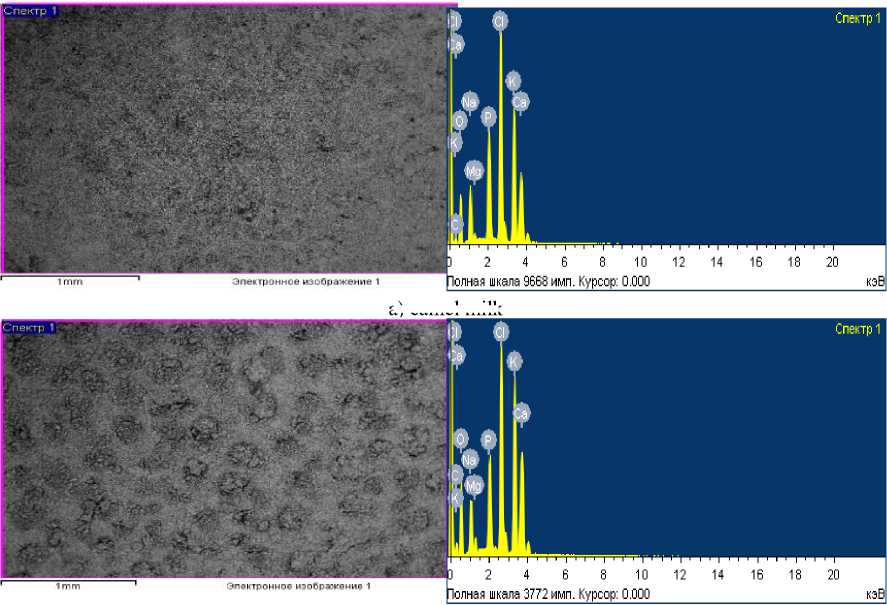
а) camel milk
b) cottage cheese
Figure 1. Microstructure and EDS spectra of the elemental composition of ash of camel milk and cottage cheese in the winter period
The mineral and organogenic composition autumn and winter periods is presented in Table 2.
of experimental samples of kurt and whey in the
Table 2. Comparative indicators of the elements of the mineral and organogenic composition of kurt and whey from camel milk in the autumn and winter periods.
|
№ |
Element |
Content of the element, % |
|||
|
Kurt |
Whey |
||||
|
autumn period |
winter period |
autumn period |
winter period |
||
|
1 |
Na |
14.63 |
23.10 |
6.30 |
7.55 |
|
2 |
Mg |
0.30 |
0.53 |
0.84 |
0.74 |
|
3 |
P |
4.82 |
5.50 |
9.21 |
8.47 |
|
4 |
K |
2.88 |
3.48 |
17.15 |
16.62 |
|
5 |
Ca |
4.72 |
4.91 |
10.63 |
9.67 |
|
6 |
Cl |
21.75 |
35.78 |
17.70 |
19.64 |
|
7 |
С |
32.76 |
7.87 |
8.56 |
11.02 |
|
8 |
О |
17.98 |
18.82 |
29.62 |
26.30 |
Based on the presented data, a comparative analysis of the mineral and organogenic composition of kurt and whey obtained from camel milk in the autumn and winter periods was also carried out. It has been established that both the seasonal factor and individual technological operations (fermentation, coagulation, separation, drying, etc.) have a direct effect on the redistribution of elements between the protein, aqueous, and fatty phases.
The dynamics of changes in the sodium content in these products demonstrate a clear seasonal dependence: in kurt, its content increases from 14.63% in autumn to 23.10% in winter, while in whey it increases from 6.30% to 7.55%, respectively. This increase is explained by a change in the electrolyte composition of the original milk and by the concentration of salts during dehydration and salting.
A similar trend is typical for chlorine: in kurt the indicator increases from 21.75% to 35.78%, in whey - from 17.70% to 19.64%. The parallel growth of Na and Cl confirms the preservation of their ionic relationship during the processing process.
Magnesium is characterized by lower concentrations: in kurt - 0.30-0.53%, in whey -0.84-0.74%. Since magnesium belongs to watersoluble cations, its main part remains in whey, which reflects the phase-specific distribution.
Phosphorus shows a predominant localization in whey (9.21% and 8.47%), whereas in kurt its proportion is 4.82-5.50%. This confirms that phosphorus is mainly associated with the protein and aqueous phases and practically does not transfer into the fat system.
Calcium, functionally related to phosphorus, is concentrated in the protein product: in kurt, its content increases from 4.72% to 4.91%, while in whey it decreases from 10.63% to 9.67%.
Potassium in whey is 17.15% and in winter - 16.62%, while in kurt its concentration is significantly lower - 2.88 and 3.48 %, respectively. This confirms that the stage of serum separation determines the main migration direction of potassium, as a typical water-soluble element.
The dynamics of changes in the oxygen content in the soil is not significant - 17.98% in autumn and 18.82% in winter. The oxygen content in the serum is higher, respectively, 29.62% and 26.30%. A significant increase in the oxygen content in the serum is due to the fact that the "heavier elements" of minerals remain more in the extract, which has a higher density compared to the serum, and oxygen, which has a lower molecular weight, passes into the serum.
Thus, the results obtained lead to the conclusion that the formation of the mineral profile of camel milk processing products is determined by the combined influence of seasonal variability of raw materials and specific technological operations. Calcium and phosphorus are mainly concentrated in protein products, potassium and magnesium in whey, but in winter the proportion of salts increases. The revealed patterns are of practical importance for assessing the nutritional value and functional orientation of the products obtained.
Consequently, the formation of the mineral profile of each product is the result of a complex interaction of the seasonal factor and specific technological operations (coagulation, separation, salting and dehydration). The revealed patterns are of practical importance, since they make it possible to differentiate camel milk processing products according to their nutritional and functional orientation.
The results of the present study, reflecting the seasonal transformation of the mineral profile of camel milk and its processed products, are generally consistent with the findings reported in the contemporary scientific literature. At the same time, their comparative analysis shows that the data obtained not only confirm the known patterns, but also allow for a more precise interpretation of the mechanisms of macronutrient redistribution under the simultaneous influence of seasonal and technological factors. To substantiate this position, it is necessary to compare the identified patterns with the results of key publications in recent years.
A critical review by Gaukhar Konuspayeva, Bernard Faye, and Mohammed Bengoumi systematized data on the mineral composition of camel milk in various natural and climatic zones. The authors identified three stable characteristics: an increased content of Na and Cl compared to cow's milk, relative stability of Ca, and pronounced variability of K and Mg depending on the season and feeding conditions [17].
The results obtained in the present study confirm these observations but also reveal their functional dynamics. In particular, the increase in Na and Cl in winter period is observed not only in the raw milk, but is also intensified after coagulation and dehydration. Thus, seasonal changes in the electrolyte balance act as a initial factor, whereas technological processing performs as a concentration mechanism. In other words, the natural variability is not smoothed by processing technology; rather, it becomes more pronounced due the reduction of moisture content and the redistribution of phases.
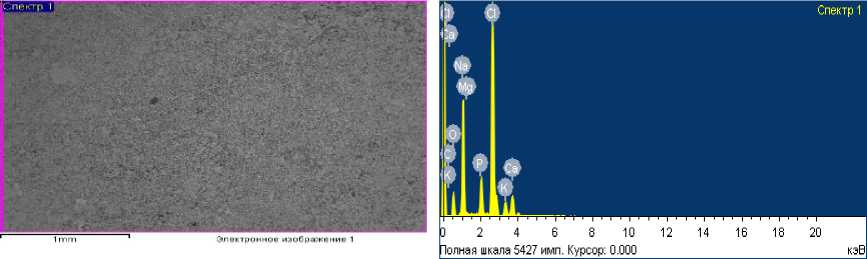
a) kurt
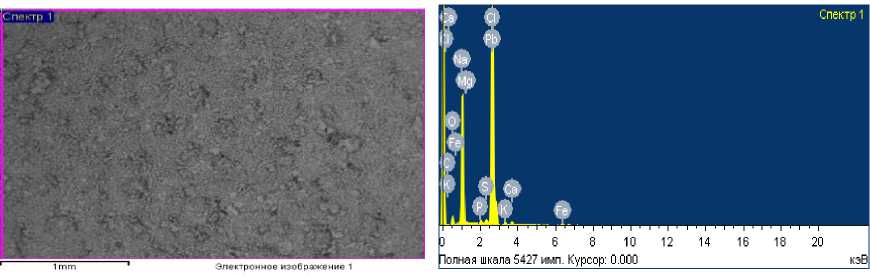
b) whey
Figure 2. Microstructure and EDS spectra of the elemental composition of ash of kurt and camel milk whey in winter.
The behavior of calcium is of particular importance. While the review by G. Konuspayeva emphasazies its relative physiological stability, the present study additionally demonstrates that during processing, calcium is selectively accumulated in dense protein structures (such as cottage cheese, kurt) and simultaneously decreased in whey during the winter period [18]. Thus, the theoretical model describing the association of calcium with casein micelles receives experimental confirmation at the level of specific processed products. This makes it possible to move from a purely biochemical explanation to a technologically verified pattern.
The regional specificity of the mineral composition of camel milk in Kazakhstan is examined in detail in the study of Aidana Yessenova et al.. The authors established a relationship between the electrolyte profile and natural and climatic conditions, noting an increase in Na and Cl in arid regions while Ca and P remain relatively stable [19].
The data obtained for the Turkestan region fully confirm this pattern: the winter period is accompanied by an increase in the concentration of Na and Cl, reflecting the adaptation of animals to changes in feeding regimes and water-salt metabolism. However, the principal distinction of this study lies in the fact that the analysis is not limited to raw milk. The further evolution of these changes in processed products has also been traced.
Thus, an increase in Na in milk in winter (up to 13.77%) leads to its further concentration in cottage cheese (22.93%) and maximum values in whey (36.30%). Consequently, a causal chain is formed: a change in the electrolyte composition under the influence of the seasonal factors protein coagulation and moisture separation a relative increase in the proportion of dissolved salts.
Thus, the technological stage enhances the natural variability, acting as a multiplier of the seasonal effect. In previous Kazakh studies, such a sequence of processes was not systematically analyzed.
In the study by E.A. Gabrilyants et al., devoted to camel cheese technology, it was shown that coagulation promotes the accumulation of calcium and phosphorus in the cheese clot, while water-soluble elements are mainly transferred to the whey. An increase in sodium content after processing was also noted [20].
The results of the present study are fully consistent with these conclusions, but expand their interpretation. First, the accumulation of Ca was confirmed not only in cottage cheese (an analog of cheese), but also in kurt, indicating the preservation of the calcium-phosphate complex under different degrees of dehydration. Second, a predominant accumulation of K and Mg in whey was recorded, which reflects their water-soluble nature and explains the decrease in their proportion in dense products. Third, it is shown that the increase in Na is not solely a consequence of technological processing, but rather results a preliminary seasonal shift in the composition of raw materials.
Consequently, while the study by E.A. Gabrilyants focused on a single coagulated product, the present study demonstrates the universality of the element redistribution mechanism across various technological models -coagulation (cottage cheese), dehydration (kurt), separation (whey). This allows the identified patterns to be considered systemic for dairy matrices.
A comparative analysis of the literature shows that most studies focus either on the characteristics of raw milk or on one type of processed product without taking into account seasonal dynamics. In contrast, in the present study:
-
– four objects were studied simultaneously (milk, cottage cheese, kurt, whey);
-
– a seasonal comparison was carried out (autumn–winter);
-
– the method of energy dispersion spectrometry was employed to quantify the elemental and organogenic composition.
Particularly illustrative is the identified relationship between the structural organization of the product and its mineral profile. Dense protein systems accumulate Ca and P due to their incorporation in the casein complex; while whey concentrates watersoluble cations (K, Mg, and partly Na).
Thus, the results of the study allow for the development of an integrated model of seasonal and technological transformation of the mineral composition. First, the season establishes the initial electrolyte background of milk; then coagulation and phase separation redistribute the elements; finally, dehydration enhances their relative concentration in the dry matter. It is precisely the sequence of these interconnected processes that determines the final nutritional profile of each product.
Consequently, the data obtained not only confirm the findings of contemporary studies but also complement them with an experimentally substantiated concept of the interaction between biological and technological factors in shaping the mineral status of camel dairy products.
Conclusion
The conducted EDS analysis of the major mineral and organogenic elements in ashed camel milk and its derivative products in the autumn and winter periods revealed patterns of their seasonal and technological transformation.
It has been established that the concentration of sodium and chlorine increases in winter, which is caused by changes in the diet of animals and affects all processed products. Protein coagulation promotes the accumulation of calcium and phosphorus in cottage cheese, while potassium and magnesium are mainly transferred to whey.
Consequently, the mineral profile is shaped under the combined influence of natural (seasonal) and technological factors. From a practical perspective, this allows products to be differentiated according to their functional orientation: cottage cheese as a source of calcium and phosphorus; whey as a carrier of water-soluble mineral elements; kurt as a product with pronounced osmotic properties.
The data obtained expand the understanding of the seasonal variability of the mineral composition and can be applied in the development of functional and therapeutic and preventive dairy products with a targeted nutritional focus.
