
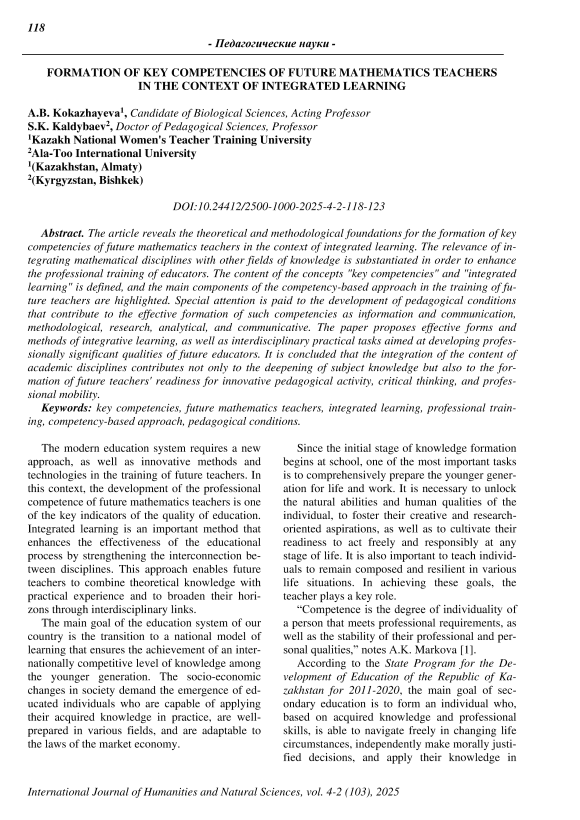
Formation of key competencies of future mathematics teachers in the context of integrated learning
Journal: International Journal of Humanities and Natural Sciences @intjournal
Section: Педагогические науки
Article in issue: 4-2 (103), 2025.
Free access
The article reveals the theoretical and methodological foundations for the formation of key competencies of future mathematics teachers in the context of integrated learning. The relevance of integrating mathematical disciplines with other fields of knowledge is substantiated in order to enhance the professional training of educators. The content of the concepts "key competencies" and "integrated learning" is defined, and the main components of the competency-based approach in the training of future teachers are highlighted. Special attention is paid to the development of pedagogical conditions that contribute to the effective formation of such competencies as information and communication, methodological, research, analytical, and communicative. The paper proposes effective forms and methods of integrative learning, as well as interdisciplinary practical tasks aimed at developing professionally significant qualities of future educators. It is concluded that the integration of the content of academic disciplines contributes not only to the deepening of subject knowledge but also to the formation of future teachers' readiness for innovative pedagogical activity, critical thinking, and professional mobility.
Similar articles in the section Fundamentals of education. Theory, policy, etc.
Short address: https://sciup.org/170210192
IDS: 170210192 | DOI: 10.24412/2500-1000-2025-4-2-118-123
Формирование ключевых компетенций будущих учителей математики в условиях интегрированного обучения
В статье раскрываются теоретико-методологические основы формирования ключевых компетенций будущих учителей математики в условиях интегрированного обучения. Обоснована актуальность интеграции математических дисциплин с другими областями знаний с целью повышения профессиональной подготовки педагогов. Определено содержание понятий «ключевые компетенции» и «интегрированное обучение», выделены основные компоненты компетентностного подхода в обучении будущих учителей. Особое внимание уделено разработке педагогических условий, способствующих эффективному формированию таких компетенций, как информационно-коммуникационная, методическая, исследовательская, аналитическая и коммуникативная. В работе предложены эффективные формы и методы интегративного обучения и междисциплинарные практические задания, направленные на развитие профессионально значимых качеств будущего педагога. Сделан вывод о том, что интеграция содержания учебных дисциплин способствует не только углублению предметных знаний, но и формированию у будущих учителей готовности к инновационной педагогической деятельности, критическому мышлению и профессиональной мобильности.
