
Growing Conditions Effect on the Tannic Substances Content in the Sanguisorba Officinalis L. Above-Ground and Underground Organs
Journal: Bulletin of Nizhnevartovsk State University @vestnik-nvsu
Section: Экология растений
Article in issue: 2 (74), 2026.
Free access
For the great burnet (Sanguisorba officinalis L.) raw material rational harvesting, as well as ensuring its comprehensive, waste-free utilization, it is necessary to assess the influence of growing locations, age, vegetation phase, climatic, and soil conditions on the tannins accumulation in its above-ground and underground organs. The research was conducted during the period 2018–2020. Raw material harvesting was carried out in three natural cenopopulations (CP): CP I – floodplain grass-herbaceous meadow, CP II – dryland herbaceous meadow, CP III – birch forest, during different vegetation periods. The tannin content in the raw material was determined by permanganatometric titration in accordance with the requirements of the XV edition State Pharmacopoeia. It was found that in the herb maximum tannins amount accumulates during the flowering phase (6.096–9.323 %) and the minimum during the fruiting period (4.049–7.998 %). Rhizomes and roots are characterized by the presence of two accumulation maxima: at the beginning of vegetation (19.194–24.698 %) and during the flowering period (21.310–26.595 %). The tannin content in the fruiting phase decreases in underground organs by an average of 1.3 times, and in the above-ground organs – by 1.2 times. The studies showed that the moisture level and light availability, soil factors (high content of humus, phosphorus, potassium) contribute to greater tannin accumulation. Its highest content was observed in the above-ground and underground organs of burnet in CP I and CP II. The calculated extremality hydrothermal coefficient (Kextr.) ranged from 0.22 to 0.26 in the study years. The highest Kextr. was obtained for 2019 (0.26), which showed the lowest tannin content. The tannin accumulation patterns obtained data in the great burnet above-ground and underground organs have a practical importance for the pharmaceutical industry.
Similar articles in the section General ecology and biodiversity
Short address: https://sciup.org/14138406
IDS: 14138406 | UDC: 574.24: 615.322 | DOI: 10.36906/2311-4444/26-2/08
Влияние условий произрастания на содержание дубильных веществ в надземных и подземных органах Sanguisorba officinalis L.
Для организации рациональной заготовки растительного сырья кровохлёбки лекарственной (Sanguisorba officinalis L.), а также обеспечения комплексного, безотходного использования данного растения, необходимо оценить влияние мест произрастания, возраста, фазы вегетации, климатических и почвенных условий на накопление дубильных веществ её надземными и подземными органами. Исследования проводились в период 2018−2020 гг. Заготовку сырья осуществляли в трех природных ценопопуляциях (ЦП): ЦП I – заливной злаково-разнотравный луг, ЦП II – суходольный разнотравный луг, ЦП III – березовый лес, в разные периоды вегетационного развития. Содержание дубильных веществ в сырье определяли методом перманганатометрического титрования в соответствии с требованиями ГФ XV издания. Установлено, что максимальное количество дубильных веществ накапливается в траве в фазу цветения (6,096−9,323 %), а минимальное в период плодоношения (4,049−7,998 %). Для корневищ и корней, характерно наличие двух максимумов накопления, в начале вегетации (19,194−24,698 %) и в период цветения (21,310−26,595 %). Содержание дубильных веществ в фазу плодоношения снижается в подземных органах в среднем 1,3 раза, в траве – 1,2 раза. Исследования показали, что уровень влагообеспеченности и освещённости, почвенный фактор (высокое содержание гумуса, фосфора, калия) способствуют большему накоплению дубильных веществ. Наибольшее их содержание отмечено в надземных и подземных органах кровохлёбки в ЦП I и ЦП II. Рассчитанный гидротермический коэффициент экстремальности (Kэкстр.) в годы изучения составил от 0,22 до 0,26. Наибольший Кэкстр. получен для 2019 года (0,26), в котором было отмечено наименьшее содержание танинов. Полученные данные о закономерности накопления дубильных веществ надземными и подземными органами кровохлёбки лекарственной имеют практическое значение для фармацевтической промышленности.
Text of the scientific article Growing Conditions Effect on the Tannic Substances Content in the Sanguisorba Officinalis L. Above-Ground and Underground Organs
Among tannin-containing medicinal plants of Kemerovo Region (Kuzbass), Sanguisorba officinalis L. (Rosaceae) is one of the representatives. In the territory of the region, it forms fairly large stands suitable for industrial harvesting of raw material [5]. Due to a complex of biologically active compounds (BAC), including hydrolysable and condensed tannins, S. officinalis exhibits a wide spectrum of pharmacological (anti-inflammatory, antimicrobial, antifungal, antioxidant, antiviral, antiproliferative, etc.) activity [3; 7; 18; 28].
In official medicine, the underground organs of the plant – rhizomes and roots – are used, while the herb is applied in folk medicine [12; 21; 22]. In recent years, the integrated utilization of the great burnet has attracted increasing interest from the scientific community [7; 10].
The accumulation of tannins in different plant organs is influenced by a wide range of biotic and abiotic factors, as well as by age, developmental stage, and habitat conditions [9; 11; 13; 17; 24].
The literature presents contradictory data regarding tannin accumulation in S. officinalis. Most studies focus on rhizomes and roots – the medicinal plant raw material included in the State Register of Medicinal Products of the Russian Federation (2015). Some authors report that the highest tannin content in underground organs occurs at the beginning of vegetation [22], while others indicate the budding stage [20], flowering [2; 8; 13. 27], fruiting [9; 14; 20], or the end of the vegetation period [6]. There is limited information available on tannin content in the herb of

great burnet across vegetation phases. Some data suggest that maximum accumulation in the herb should occur during the flowering stage [4].
According to literature data, herbaceous plants, including S. officinalis , growing on soils sufficiently supplied with available phosphorus [16; 23], tend to accumulate higher levels of tannins [22].
Earlier studies by N. O. Egorova [4; 5] presented results on tannin content in rhizomes and roots of S. officinalis, growing in selected districts of the region, as well as the distribution of tannins among plant organs. However, no published data are available on tannin accumulation across vegetation phases in both above-ground and underground organs of S. officinalis growing in the Kemerovo Region (Kuzbass).
The aim of this study is to evaluate the influence of certain habitat-related factors on tannin accumulation in the above-ground and underground organs of Sanguisorba officinalis L. growing in Kemerovo Region (Kuzbass).
Materials and methods
The object of the study was the great burnet raw material ( Sanguisorba officinalis L. , Rosaceae), including herb and rhizomes with roots, collected in three cenopopulations (CPs) located in Topkinsky District of Kemerovo Region (Kuzbass).
CP I – floodplain grass-herbaceous meadow (55.364814° N, 85.795937° E). Soil moisture is provided by both groundwater and atmospheric precipitation. Mean light intensity is 90,704.0 lux. The soil is heavy loam with pH (salt extract) of 5.6, humus content of 7.3%, elevated levels of available phosphorus (106 mg/kg), very high levels of available potassium (340 mg/kg), and increased nitrate content (25.1 mg/kg). The occurrence of S. officinalis was relatively abundant (score 3). Yields of fresh raw material ranged from 124.59 to 301.97 g/m² for rhizomes with roots and from 143.43 to 688.03 g/m² for herb.
CP II – dryland herbaceous meadow (55.360304° N, 85.793537° E). The site was fully exposed to sunlight, with an average illumination of 73,343.3 lux. Moisture supply is provided exclusively by atmospheric precipitation. The soil is heavy loam. Soil acidity (pH salt extract) is 5.8, humus content ranges up to 6.2%, available phosphorus is elevated (114 mg/kg), exchangeable potassium is very high (345 mg/kg), and nitrate content is moderate (17.8 mg/kg). Yields of fresh raw material ranged from 91.12 to 127.78 g/m² for rhizomes with roots and from 213.14 to 225.79 g/m² for herb.
CP III – birch forest (55.355562° N, 85.819864° E). The birch was the dominant tree species. The shrub layer is poorly developed. Mean illumination is 59,938.4 lux. Moisture supply is atmospheric. The soil is heavy loam. Soil acidity (pH salt extract) is 5.6, humus content is 5.6%, available phosphorus content is moderate (73 mg/kg), exchangeable potassium content is high (180 mg/kg), and nitrate content is moderate (11.8 mg/kg). Yields of fresh raw material ranged from 21.55 to 25.66 g/m² for rhizomes with roots and from 36.98 to 66.60 g/m² for herb.

The productivity of S. officinalis rhizomes and roots at the study sites was calculated through the model specimen method, while above-ground biomass productivity was assessed using the sampling plot method.
Raw material was collected from June to September in 2018 and 2019, and from May to August in 2020, during different vegetation phases (fully expanded leaf phase, budding phase, flowering phase, and fruiting phase), in accordance with established requirements. Drying of the raw material was carried out naturally in the shade. The raw material was stored in paper bags in a cool dry place.
Simultaneously, soil samples were collected from the root zone of S. officinalis (0–20 cm depth). Agrochemical soil parameters were assessed at the accredited testing centre of the Kemerovo branch of RosAgrokhimsluzhba Federal State Budgetary Institution in accordance with the following standards: GOST 26483-85 (soil extract pH), GOST 26213-2021, sections 1 and 2 (organic matter, %), GOST 26204-91 (mass fraction of available phosphorus (P₂O₅) and potassium (K₂O) compounds, mg/kg), and GOST 26951-86 (nitrate content, mg/kg).
Illumination (lux) at the study sites was measured by using a TESTO 540 luxmeter.
The tannin content in the raw material was assessed in accordance with the requirements of General Pharmacopoeial Monograph OFS.1.5.3.0008 in the 15th edition of the State Pharmacopoeia of the Russian Federation through the Leventhal permanganate metric method (Method 1). A total of 108 plant samples were analyzed.
Climatic conditions of Topkinsky District were evaluated by using data from the Topki meteorological station. Two indicators were used to characterize weather conditions during the 2018–2020 vegetation periods: precipitation amount (mm) and mean daily air temperature (t, °C).
According to the data from the Topki meteorological station, the years of the study differed markedly in weather conditions during the vegetation period, which is clearly demonstrated by the data presented in Table 1.
Table 1 Temperature regime and precipitation during the vegetation periods of 2018–2020
|
Months |
Long-term average |
Years |
|||
|
2018 |
2019 |
2020 |
|||
|
Mean daily air temperature, °C |
|||||
|
May |
10.4 |
6.2 |
10.0 |
14.6 |
|
|
June |
17.2 |
19.0 |
15.7 |
15.6 |
|
|
July |
18.7 |
17.5 |
18.2 |
18.5 |
|
|
August |
16.3 |
15.9 |
17.6 |
17.9 |
|
|
September |
10.0 |
10.5 |
10.5 |
10.0 |
|
|
Sum of mean monthly temperatures during the vegetation |
72.6 |
69.1 |
72.0 |
76,6 |
|
|
Precipitation, mm |
|||||
|
May |
53 |
59 |
30 |
56 |
|
|
June |
69 |
82 |
58 |
32 |
|
|
July |
78 |
71 |
73 |
156 |
|
|
August |
75 |
37 |
69 |
42 |
|
September |
60 |
57 |
45 |
69 |
|
Total monthly precipitation during the vegetation period |
335.0 |
306.0 |
275.0 |
355.0 |
Notes: ,
To analyze the influence of temperature and precipitation on tannin accumulation during the vegetation periods from 2018 to 2020, the extremality hydrothermal coefficient (Kextr.) proposed by Zykova I.D. (2015) was used. This coefficient represents the ratio of the mean temperature during the observation months (May-September) to the mean precipitation amount for the same period [29].
All experiments were performed in triplicate. The obtained data were processed by using MS Office 2013 software. The paper discusses values considered statistically significant at p ≤ 0.05.
Results and Discussion
The study results are presented in Table 2. Quantitative assessment of tannin content in Sanguisorba officinalis showed that their accumulation depends on the vegetation phase, weather conditions, and habitat conditions.
Table 2 Tannin content in the herb, rhizomes, and roots of S. officinalis (mean values, %) during 2018–2020
|
Vegetation phase |
Collection Date |
Raw material |
Tannin content, % |
||
|
CP I |
CP II |
CP III |
|||
|
FLP |
12.06.18 |
Hb. |
8.698±0.108 |
8.773 ± 0.056 |
6.362 ± 0.053 |
|
Rh.&Rt. |
24.698±0.112 |
24.367 ± 0.184 |
23.565 ±0.049 |
||
|
12.06.19 |
Hb. |
5.822±0.073 |
5.669 ± 0.056 |
4.398 ± 0.055 |
|
|
Rh.&Rt. |
22.207±1.086 |
23.060 ± 0.041 |
20.980 ± 0.066 |
||
|
24.05.20 |
Hb. |
7.697±0.070 |
7.768±0.137 |
5.946 ± 0.047 |
|
|
Rh.&Rt. |
22.667±0.624 |
23.216 ± 0.054 |
19.194 ± 0.146 |
||
|
BP |
15.07.18 |
Hb. |
8.880±0.080 |
8.966 ± 0.155 |
6.968 ± 0.032 |
|
Rh.&Rt. |
23.320±0.570 |
23.878 ± 0.178 |
23.06 ± 0.083 |
||
|
13.07.19 |
Hb. |
6.679±0.045 |
6.135 ± 0.058 |
5.929 ± 0.083 |
|
|
Rh.&Rt. |
22.746±0.066 |
22.365 ± 0.176 |
20.22 ± 0.362 |
||
|
30.06.20 |
Hb. |
7.776±0.058 |
7.292 ± 0.125 |
6.165 ± 0.074 |
|
|
Rh.&Rt. |
22.157±0.057 |
20.944 ± 0.205 |
18.14 ± 0.104 |
||
|
FP |
04.08.18 |
Hb. |
9.323 ± 0.050 |
9.105 ± 0.033 |
7.622 ± 0.089 |
|
Rh.&Rt. |
26.225 ± 0.126 |
26.304 ± 0.117 |
25.370 ±,127 |
||
|
08.08.19 |
Hb. |
7.146 ± 0.048 |
6.587 ± 0.137 |
6.096 ± 0.055 |
|
|
Rh.&Rt. |
25.853 ± 1.083 |
25.165 ± 0.612 |
23.54 ± 0.105 |
||
|
17.07.20 |
Hb. |
8.797 ± 0.058 |
8.959 ± 0.071 |
6.465 ± 0.051 |
|
|
Rh.&Rt. |
24.798 ± 0.083 |
26.595 ± 0.169 |
21.31 ± 0.603 |
||

|
FrP |
16.09.18 |
Hb. |
7.998 ± 0.047 |
7.514 ± 0.038 |
5.824 ± 0.042 |
|
Rh.&Rt. |
23.484 ± 0.074 |
24.742 ± 0.075 |
19.498 ± 0.248 |
||
|
07.09.19 |
Hb. |
5.485 ± 0.045 |
5.013 ± 0.068 |
4.049 ± 0.047 |
|
|
Rh.&Rt. |
19.436 ± 0.050 |
17.844 ± 0.322 |
15.396 ± 0.446 |
||
|
23.08.20 |
Hb. |
6.460 ± 0.057 |
6.179 ± 0.069 |
5.627 ± 0.531 |
|
|
Rh.&Rt. |
19.858 ± 0.274 |
19.022 ± 0.228 |
19.170 ± 0.054 |
||
|
Notes: FLP – fully expanded leaf phase; |
P – budding phase; |
P – flowering phase; FrP – fruiting phase; |
|||
Herb (Hb.) – above-ground parts; Rhizomes and roots (Rh.&Rt.) – underground organs of Sanguisorba officinalis .
At the beginning of the vegetation period, Sanguisorba officinalis is characterized by a relatively high tannin content both in the herb (4.398–8.773%) and in the underground organs (19.194–24.698%) (Table 2, Figs. 1, 2). During this period, the plant actively increases the vegetative mass of the basal leaf rosette and forms vegetative shoots, therefore, intensive synthesis of many organic compounds, including tannins, occurs in the assimilating tissues [3; 10]. These compounds gradually accumulate during vegetation and development of the vegetative organs, reaching their maximum during the flowering phase (6.096–9.323%) (Fig. 1), when plants accumulate substances performing protective functions, including this group of biologically active compounds [19; 26].
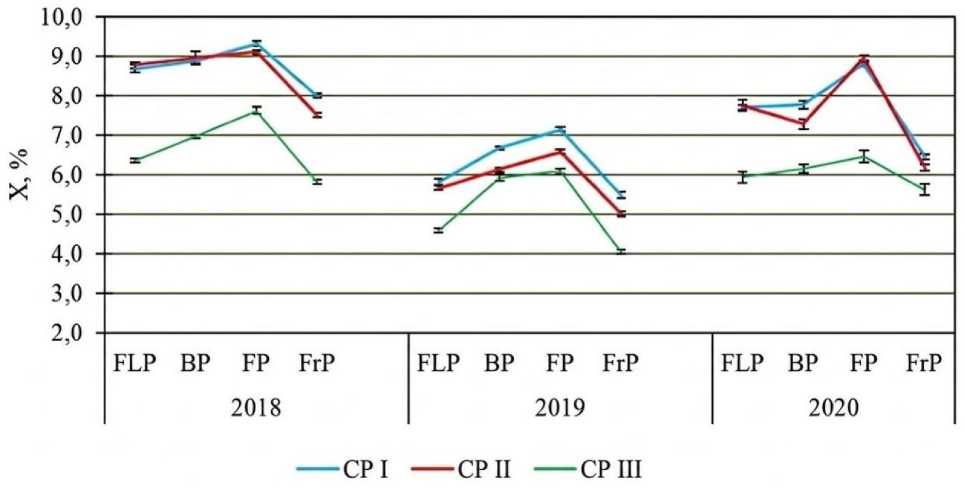
Fig. 1. Dynamics of tannin accumulation (X%) in the herb of S. officinalis during the study period (2018–2020) by phenological phases
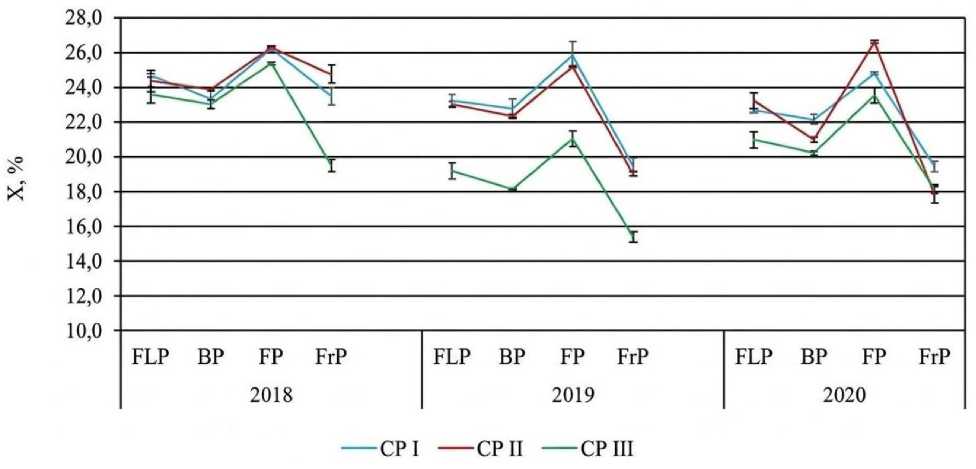
Fig. 2. Dynamics of tannin accumulation (X%) in the rhizomes and roots of S. officinalis during the study period (2018–2020) by phenological phases
A decrease in tannin content in the herb of S. officinalis occurs during the fruiting period, reaching 4.049–7.998% (Fig. 1), which is associated with the plant’s preparation for deep physiological dormancy at the end of the vegetation period. During this time, all physiological processes slow down, and the intensity of photosynthesis decreases, resulting in reduced tannin synthesis, as these compounds are then used exclusively for maintenance functions [25].
For rhizomes and roots, two peaks of tannin accumulation can be distinguished: during the fully expanded leaf phase (FLP) and during the flowering phase (FP). In the first case, tannin content ranged from 19.194 to 24.698%, and in the second from 21.31 to 26.595% (Table 2, Fig. 2). During the period of active plant growth, the amount of tannins in the underground organs decreases, as at this stage they are required for the formation of vegetative plant organs, after which the second accumulation maximum occurs during flowering. Subsequently, during the fruiting phase, a gradual decrease in tannin content up to 15.396–24.742% was observed. During this period, tannin content in rhizomes and roots decreased on average by 1.3 times, and in the herb by 1.2 times. This pattern of tannin accumulation is also characteristic of other higher plants [1; 11].
Thus, the study demonstrated that regardless of habitat conditions, S. officinalis showed a similar pattern of tannin accumulation during the years of observation (Figs. 1, 2), both in the herb and in rhizomes with roots, depending on the vegetation phase. This confirms previously published data on the variability in the content of this group of natural compounds [1; 9; 11; 13; 25].
Many researchers have noted that the determining factors for the synthesis of polyphenolic compounds in plants are illumination under conditions of optimal moisture availability [9; 13; 25]. The maximum tannin content in the rhizomes and roots of S. officinalis under conditions of sufficient moisture and illumination only confirms this observation. Conversely, in drier habitats the quantitative content of tannins decreases, which is explained by the fact that under water deficit
phenolic compounds are utilized to perform protective functions (Figs. 1, 2) [8; 25]. Our study established that under the conditions of Kemerovo Region (Kuzbass), the levels of moisture availability and illumination during the study years (2018–2020) were among the key factors determining the synthesis and accumulation of tannins in all organs of S. officinalis (Table 2, Figs. 1, 2). Thus, in the studied cenopopulations, the highest tannin content in both above-ground and underground organs was recorded in CP I and CP II compared with CP III (Table 2, Figs. 1, 2). Considering that illumination at both sites is relatively high (from 90,704.0 to 73,343.3 lux), we assume that the limiting factor affecting tannin accumulation in S. officinalis growing at these sites is primarily the level of moisture availability [9; 11; 13; 17], since moisture deficiency negatively affects all metabolic processes occurring in the plant organism [11].
Considering the influence of illumination on tannin accumulation in S. officinalis, it can be noted that plants collected from shaded habitats — the understory of the birch forest (CP III) — contained lower amounts of tannins than plants growing in areas with sufficient solar insolation (CP I, CP II) (Figs. 1, 2).
Correlation analysis showed that tannin content in the herb, rhizomes, and roots of S. officinalis correlated with soil moisture (r = 0.71, r = 0.67, p < 0.05) and habitat shading (r = 0.68, r = 0.39, p < 0.05).
When studying the influence of soil conditions on tannin accumulation in S. officinalis, a relationship was established between tannin content and the levels of humus, phosphorus, and potassium in the soil. Based on the data of Prosyannikova O.I. (2007) and the agrochemical characteristics of soils at the study sites, these soils correspond to those of the forest-steppe zone of the Kuznetsk Basin (district B) [15]. The highest tannin content was observed in samples collected from the floodplain grass-herbaceous meadow (CP I) and the dryland herbaceous meadow (CP II), while the lowest tannin content was recorded in the understory of the birch forest (CP III).
The closest relationship between tannin accumulation in S. officinalis and soil parameters was established for the content of available potassium compounds (K₂O), both in the herb (r = 0.65) and in the underground organs (r = 0.73), as well as available phosphorus compounds (P₂O₅) (r = 0.59 and r = 0.73, respectively). A moderate correlation was observed between tannin content and soil humus levels in both the above-ground (r = 0.49) and underground (r = 0.50) plant organs.
Assessment of the influence of temperature and precipitation on tannin content during the vegetation period (May-September) in the study years (2018–2020) was carried out by using the extremality hydrothermal coefficient (EC) [8]. For this purpose, averaged data on tannin content in the herb, rhizomes, and roots during the studied periods were obtained (Fig. 3).
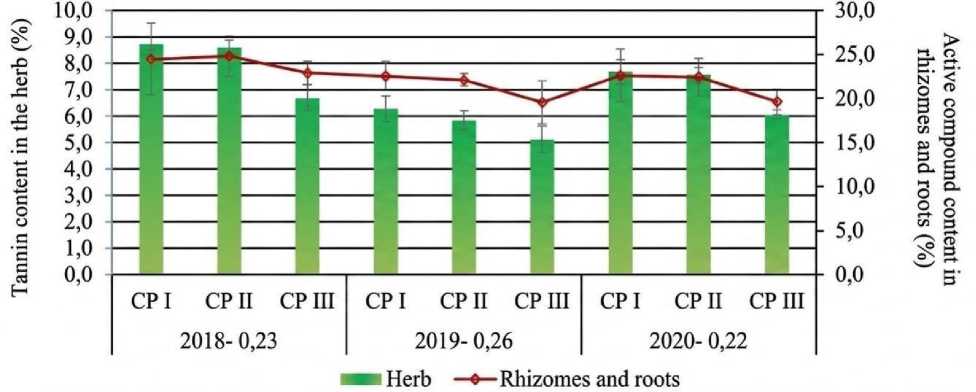
Fig. 3. Dependence of tannin content (TC) in S. officinalis on the extremality hydrothermal coefficient (EC) during the study years (2018–2020)
The EC values during the study years ranged within close limits from 0.22 to 0.26. As noted by I.D. Zykova (2015), this indicator makes it possible to assess the extremality of weather conditions during the study period. The highest EC value was obtained for 2019 (0.26). It was that year that was characterized by the lowest tannin content in S. officinalis, both in the herb and in the rhizomes with roots (Fig. 3).
During the study period, a rather strong negative correlation was revealed between tannin content in the herb and EC (r = - 0.79), as well as a moderate negative correlation for rhizomes and roots (r = - 0.39). This confirms the undeniable influence of these environmental factors (temperature and precipitation) on the quantitative tannin content in the great burnet during the vegetation periods of the study years.
Conclusion
The study results demonstrated that the accumulation of tannins in Sanguisorba officinalis L. (Rosaceae) within the territory of Kemerovo Region – Kuzbass is influenced by the following factors: sufficiently moist soils rich in humus and nutrients (high phosphorus and potassium content), high illumination of the habitats, and warm humid weather during the vegetation period. The maximum tannin content in the above-ground and underground organs of the great burnet occurs at the middle of the mass flowering phase.
Identifying the patterns of tannin accumulation in plants is of great practical importance for the proper organization of medicinal plant raw material harvesting and its comprehensive utilization.
The work was carried out under the state assignments of the Federal Coal and Coal Chemistry Research Centre, the Siberian Branch of the Russian Academy of Sciences, Project No. 124041100075-7, and the state assignment of Kemerovo State Medical University, Project No. 056-00034-25-02.
