
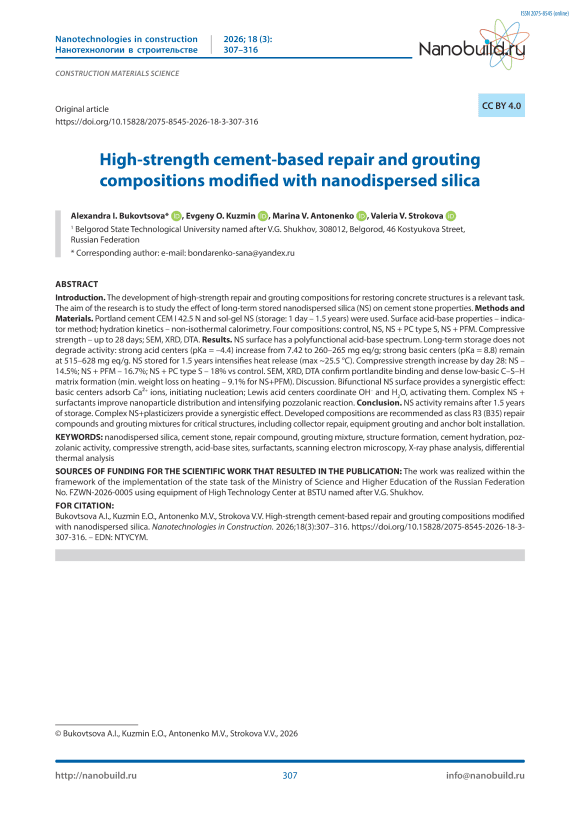
High-strength cement-based repair and grouting compositions modified with nanodispersed silica
Journal: Nanotechnologies in Construction: A Scientific Internet-Journal @nanobuild-en
Section: Construction materials science
Article in issue: 3 Vol.18, 2026.
Free access
Introduction. The development of high-strength repair and grouting compositions for restoring concrete structures is a relevant task. The aim of the research is to study the effect of long-term stored nanodispersed silica (NS) on cement stone properties. Methods and Materials. Portland cement CEM I 42.5 N and sol-gel NS (storage: 1 day – 1.5 years) were used. Surface acid-base properties – indicator method; hydration kinetics – non-isothermal calorimetry. Four compositions: control, NS, NS + PC type S, NS + PFM. Compressive strength – up to 28 days; SEM, XRD, DTA. Results. NS surface has a polyfunctional acid-base spectrum. Long-term storage does not degrade activity: strong acid centers (pKa = –4.4) increase from 7.42 to 260–265 mg eq/g; strong basic centers (pKa = 8.8) remain at 515–628 mg eq/g. NS stored for 1.5 years intensifies heat release (max ~25.5 °C). Compressive strength increase by day 28: NS – 14.5%; NS + PFM – 16.7%; NS + PC type S – 18% vs control. SEM, XRD, DTA confirm portlandite binding and dense low-basic C–S–H matrix formation (min. weight loss on heating – 9.1% for NS+PFM). Discussion. Bifunctional NS surface provides a synergistic effect: basic centers adsorb Ca²+ ions, initiating nucleation; Lewis acid centers coordinate OH– and H2O, activating them. Complex NS + surfactants improve nanoparticle distribution and intensifying pozzolanic reaction. Conclusion. NS activity remains after 1.5 years of storage. Complex NS+plasticizers provide a synergistic effect. Developed compositions are recommended as class R3 (B35) repair compounds and grouting mixtures for critical structures, including collector repair, equipment grouting and anchor bolt installation.
Similar articles in the section Civil and structural engineering in general
Short address: https://sciup.org/142248066
IDS: 142248066 | DOI: 10.15828/2075-8545-2026-18-3-307-316
