
Impact of artificial intelligence digital storytelling on the enhancement of comprehensive writing and speaking proficiencies in pre-service English teachers: a Kazakhstan perspective

Journal: Education Integration @edumag-mrsu
Section: Международный опыт интеграции образования
Article in issue: 2 (123) т.30, 2026.
Free access
Introduction. The digitalization of higher education in Kazakhstan presents future English language teachers with the challenge of developing linguistic and cognitive skills using innovative approaches. One such approach, based on artificial intelligence, is digital storytelling. However, the impact of integrating artificial intelligence tools into digital narrative creation on the development of future teachers’ productive skills in the Kazakhstani context remains understudied. The aim of this study was to examine the impact of artificial intelligence-based digital storytelling on the development of students’ advanced written and oral communication skills. Materials and Methods. 77 students participated in the experiment. The experimental group (n = 39) used artificial intelligence tools (Grammarly, ChatGPT, QuillBot, Unifire, and Hemingway Editor) to create digital storytelling, while the control group (n = 38) completed similar tasks using traditional teaching methods. Common European Framework of Reference criteria were used for assessment, and productive language skills were qualitatively assessed. Qualitative data were analyzed using inductive thematic analysis, while quantitative data were analyzed using ANOVA. Results. The statistically significant advantage of the experimental group in most components of verbal skills (p < 0.05) compared to the control group confirms the positive impact of digital storytelling using artificial intelligence tools on the development of students’ written and oral communication skills. Students in the experimental group outperformed the control group in their ability to paraphrase text, as well as combine and restructure individual sentences in writing. In oral communication, the experimental group demonstrated significant improvements in fluency, confidence, coherence, active listening, and interaction. No significant differences in pronunciation or intonation were found between the groups. Conclusion. The findings demonstrate the effectiveness of integrating digital storytelling with the support of artificial intelligence technologies in improving the productive skills of future English language teachers. This study expands our understanding of the capabilities and potential of using artificial intelligence tools in the educational process, contributing not only to the development of foreign language communicative competence but also to the development of digital literacy and student autonomy. The proposed methodology can be used by university professors and curriculum developers to integrate artificial intelligence technologies into foreign language teacher training courses. The results will be useful for students to independently improve their language proficiency and develop digital literacy.
Short address: https://sciup.org/147254467
IDS: 147254467 | UDC: 004.9:81’255(574) | DOI: 10.15507/1991-9468.26302.274-290
Роль цифрового сторителлинга на основе искусственного интеллекта во всестороннем развитии навыков письма и говорения у будущих педагогов английского языка: опыт Казахстана
Введение. Цифровизация высшего образования в Казахстане ставит перед будущими учителями английского языка задачу развития языковых и когнитивных навыков с использованием инновационных подходов. Один из таких подходов на основе искусственного интеллекта – цифровой сторителлинг. Однако влияние интеграции инструментов искусственного интеллекта при создании цифровых нарративов на развитие продуктивных навыков будущих педагогов в казахстанском контексте остается малоизученным. Цель исследования – проанализировать степень влияния цифрового сторителлинга на основе искусственного интеллекта на развитие расширенных навыков письменной и устной речи у студентов. Материалы и методы. В эксперименте приняли участие 77 студентов. Экспериментальная группа (n = 39) при создании цифрового сторителлинга использовала инструменты искусственного интеллекта (Grammarly, ChatGPT, QuillBot, Unifire и Hemingway Editor), а контрольная (n = 38) – выполняла аналогичные задания, опираясь на традиционное обучение. Диагностика осуществлялась с помощью критериев Common European Framework of Reference. Проводилась качественная оценка продуктивных речевых умений. Качественные данные анализировались методом индуктивного тематического анализа, а количественные – с использованием ANOVA. Результаты исследования. Статистически значимое преимущество экспериментальной группы по большинству компонентов речевых умений (p < 0,05) по сравнению с контрольной подтверждает положительное влияние применения цифрового сторителлинга с использованием инструментов искусственного интеллекта на развитие навыков письменного и устного общения у студентов. Обучающиеся экспериментальной группы превзошли контрольную в умении перефразировать текст, а также объединять и реструктурировать его отдельные предложения на письме. В устной речи у экспериментальной группы отмечен существенный прогресс в беглости, уверенности, связности высказываний, активном слушании и взаимодействии. Значимых различий в произношении и интонации между группами выявлено не было. Заключение. Полученные данные демонстрируют эффективность интеграции цифрового сторителлинга с поддержкой технологий искусственного интеллекта в совершенствовании продуктивных навыков будущих учителей английского языка. Проведенное исследование расширяет представления о возможностях и потенциале использования инструментов искусственного интеллекта в образовательном процессе, способствуя не только развитию иноязычной коммуникативной компетенции, но и формированию цифровой грамотности и автономности обучающихся. Предложенная методика может быть использована преподавателями вузов и разработчиками учебных программ для интеграции технологий искусственного интеллекта в курсы подготовки педагогов иноязычного образования. Результаты будут полезны студентам для самостоятельного повышения уровня владения языком и развития цифровой грамотности.
Text of the scientific article Impact of artificial intelligence digital storytelling on the enhancement of comprehensive writing and speaking proficiencies in pre-service English teachers: a Kazakhstan perspective
EDN:
Astana, Republic of Kazakhstan, b Karaganda Buketov University,
Karaganda, Republic of Kazakhstan, c Francisk Skorina Gomel State University,
Gomel, Republic of Belarus, d National Research Mordovia State University,
Saransk, Russian Federation, e Ufa University of Science and Technology, Ufa, Russian Federation,
Despite the robust incorporation of digital technology in Kazakhstan’s education, the training of future English teachers often does not correspond with the contemporary requirements and challenges posed by the trilingual education system and current educational standards [1]. Traditional teaching methods rarely promote the development of complex productive skills, such as academic writing and oral communication [2; 3]. Oversight by the Ministry of Education of the Republic of Kazakhstan and numerous studies reveal that less than 40% of graduates from pedagogical fields demonstrate proficient mastery of modern multimodal communication tools and are skilled in employing the English language for discourse and the composition of professional written materials1.
Recent research indicates that digital storytelling (DSt), especially through the use of generative artificial intelligence (AI) tools, offers innovative avenues for the rapid enhancement of productive language skills in higher education [4; 5]. Studies from prominent international and national sources demonstrate that the application of AI-driven digital storytelling (AI-DSt) technology reduces students’ speech anxiety while improving the interactivity and effectiveness of learning [6–8].
The application of AI-DSt in Kazakhstan’s educational practices is challenging because of the lack of established localized methodologies, inadequate ICT literacy, and irregular access to licensed AI services and equipment [9; 10]. Moreover, educators often face difficulties in integrating novel approaches into the traditional educational framework, exacerbated by inadequate systematic feedback and external support [11]. Thus, a gap arises between graduates’ aspirations as digitalization facilitators and their actual ability to creatively and critically utilize the English language in a varied multimodal setting [12].
This highlights the need to scientifically assess the effectiveness and conditions for the successful expansion of AI-DSt to promote comprehensive writing and speaking abilities among future English educators. Resolving this issue requires a comprehensive examination of the impact of this technology on the development of specific language subskills, an inquiry into the factors and challenges associated with the integration of AI tools into curricula and teacher training, and an assessment of the generalizability of findings across various educational contexts, including institutions with varying levels of technological infrastructure. An appropriate response to this issue is crucial for the successful implementation of Kazakhstan’s educational policy2 and the development of a new generation of educators who can promote sustainable English language proficiency among students during the digital transformation in education.
This study aims to determine how employing AI-DSt helps future English language teachers in Kazakhstan improve their writing and speaking skills.
In this context, the study tries to answer two research questions:
-
1. To what extent does the usage of AI tools in DSt improve pre-service English teachers’ extensive writing and speaking skills compared to DSt without AI support?
-
2. What are the perceived advantages and challenges of using AI-DSt for developing productive language skills among per-service teachers?
Literature Review
With the rapid increase in interest in communicative competence, proficiency in speaking and writing remains crucial for prospective English as a foreign language educators, particularly in multilingual nations such as Kazakhstan. Proficient writing and speaking abilities are essential for pre-service English teachers’ prospective professional competence [13]. Recent studies highlight that extensive writing enhances fluency, coherence, and critical reflective thinking, particularly through narrative and journaling practices, wherein students consistently generate significant amounts of text [14; 15].
The mastery of text construction subskills, including paraphrasing, sentence merging, and restructuring, is essential, as these elements collectively enhance academic writing fluency and originality [16–18]. Effective composition arises from structured practice, scaffolding, and iterative peer review processes [19]. Research highlights the significance of activities that enhance fluency, coherence, and interactive skill in speaking, including digital storytelling, debates, and presentations [20]. Effective extensive speaking necessitates the amalgamation of discourse techniques, precise pronunciation, and prosodic elements [21; 22], optimally cultivated by varied, communicative activities [23]. Experience-based methodologies facilitate learners in developing confident, spontaneous, and contextually suitable oral expression.
Recently, DSt has been shown to improve English proficiency, particularly in conversational abilities. Recent assessments show that DSt creates an integrated learning environment where students create multimedia narratives, reflect, share, and socialize [24; 25]. When it comes to teacher training, this method is crucial because it develops speech organization, deep concept processing, and critical thinking, which improves speaking and writing skills quickly.
The use of AI technologies like ChatGPT, Grammarly, and QuillBot in education can improve writing and speaking skills [26–28]. Modern research shows that AI-generated automated feedback enhances written assignments, speeds error correction, and develops students’ self-editing and reflection skills. AI helps create a personalized, adaptive educational setting, which is vital in teacher training since these tools allow educators to detect and rectify their weaknesses interactively [29]. Beyond error correction, AI in digital storytelling models dialogue scenarios, improvises, and presents content through automated prompts, improving public speaking and writing skills [30]. It is also crucial to ensure equal access to new technologies, train instructors in their use, and handle ethical issues like data protection and evaluation automation.
The results are convincing, yet questions remain. Ethical and legal discussions about training data are rare. While most of the research studied advantages lasting up to 12 weeks, their long-term sustainability is unknown, since anglocentric AI system interfaces hinder learners with inadequate English proficiency [12]. AI-DSt’s impact on teacher training in Kazakhstan’s diverse educational institutions is poorly studied.
When properly implemented, AI-DSt can help Kazakhstani English educators develop professionally and improve their linguistic, digital, and creative skills. Storytelling projects should be disseminated throughout the semester, AI prompts used under professional supervision, and ethical and digital hygiene practices enforced to optimize their benefits. Finally, all projects must follow the “Roadmap for the Digitalization of Education in Kazakhstan–2025”3, the main goal of which is to educate university graduates for hybrid learning4. To achieve this, longitudinal research across institutions must analyze skill acquisition efficacy and support approaches for students with different language proficiency levels. To avoid over-reliance on AI and protect future educators’ critical thinking, we must develop methodological guidelines for balancing automated and human input.
Obviously, the scientific community’s interest in AI-DSt is growing. However, a number of issues remain unresolved. Firstly, existing studies are largely limited to short-term interventions, while the comprehensive development of productive skills within a unified multimodal system is rarely examined, thereby leaving the long-term sustainability of improvements in writing and speaking skills unclear. Also, students’ cognitive engagement with AI feedback lacks attention. The biggest concern appears to be the risk for students to become overly reliant on AI support. Furthermore, it is still unclear how to assess productive skills, especially regarding the balance between general and specific assessment criteria for writing and speaking. That’s what we aim to address by conducting the current study, integrating AI-DSt, a structured assessment system, and both quantitative and qualitative approaches.
Materials and Methods
Research Design. The present study employed a quasi-experimental design to investigate the impact of AI-DSt on pre-service English teachers’ extensive writing and speaking skills. The design is consistent with prior studies that have examined the impact of multimodal task design on fourth graders’ communication abilities [31], and the influence of learning tools on speaking skills using similar methodological approaches [32]. Two groups were involved. An experimental group utilized AI tools during storytelling tasks, while a control group completed similar tasks without AI support.
The design enabled a comparative analysis of learning outcomes between two groups over 15-week period. Pre-test and post-test assessment were administered to both groups to evaluate changes in students’ productive language skills.
Participants. The study involved 77 second-year pre-service English teachers who voluntarily enrolled in a mandatory course titled “Development of Communication Skills” after achieving Intermediate Language Proficiency as per the National Entrance Testing standards5. The participants were divided into two non-randomly selected groups: the experimental group (EG) ( n = 39) and the control group (CG) ( n = 38).
This design qualifies as quasiexperimental, as evidenced by L. Cohen et al. [33], who reported moderate outcomes in educational research involving 30–50 participants; C.J. Lai’s multimodal task design with 74 participants (40 in the experimental group and 34 in the control group) [31]; and A. Uslu and N.A. Uslu’s collaboration in digital storytelling with 60 participants, evenly divided between the two groups [34].
The legitimacy of 2nd-year students in English-centric pedagogical education is supported by the following rationale: the principal audience for AI-DSt research consists of future educators who will integrate these technologies into their professional practice; also, a fundamental command of English is adequate for the use of AI tools [35].
Participants were randomly allocated to intact groups, a methodologically robust approach: intact groups are preferable for educational research as they replicate authentic learning environments and present fewer ethical dilemmas than deliberately segregating learners, while statistical matching assists educational researchers in identifying comparable groups6.
Nonetheless, total randomization was constrained by the constancy of class structure, so categorizing the study as quasiexperimental, the efficacy of which has been substantiated by contemporary research, investigating positive behavioral support in educational settings with a quasi-experimental design that included a control group, highlighting the need of control groups for ensuring validity [36].
We disclosed the procedures and purpose of the study to all participants, who subsequently provided their informed consent to participate. The study adhered to ethical standards prioritizing confidentiality, anonymity, and voluntary participation.
The study duration of 7 to 15 weeks is appropriate for long-term educational assessment as N. Kasami proved while investigating the impact of digital storytelling on English learning over a period exceeding 15 weeks [37].
Research Procedure. The experiment lasted 15 weeks. This timeframe aligns with the academic term duration for the course titled “Development of Communication Skills”, ensuring uniformity in instructional time and content.
The instructional process was structured into five sequential phases: weeks 1–2 establish the theme; 3–5 focus on design, 6–8 facilitate expansion; 9–12 emphasize construction; and 13–15 involve reconstruction. This framework aligns with recent studies, investigated digital storytelling in history classes over seven weeks [38], and explored the enhancement of social and emotional skills through digital storytelling over six weeks [39]. This phased approach ensured gradual progression from idea generation to final product development, fostering both writing and speaking skills.
Figure illustrates the prevailing educational research and methodological standards that underpin the 15-week quasiexperimental design including intact groups and a sample size of 77 participants.
A comprehensive overview of the approach for implementing AI-enhanced tools for a certain activity is provided in Table 1.
AI is well-integrated into English education to improve students’ writing and speaking: Grammarly and Hemingway Editor served as real-time grammar and style evaluators to help students spot faults and improve sentence clarity; ChatGPT helped to brainstorm, plan, and get input on coherence and structure as well as compared student essays to academic resources to improve formal writing; Turnitin taught students about plagiarism and citation, fostering academic integrity; Unifire was used in class writing tasks to assess style and tone to help students develop a cohesive writing voice. To ensure content and construct validity, two certified instructors authenticated all writing and speaking assignments.
Instruments. This study uses a skillbased assessment system based on Common European Framework of Reference7 descriptors and S.C. Weigle’s second language assessment framework8, tailored to digital storytelling tasks to ensure valid and
6 Fraenkel J., Wallen N., Hyun H. How to Design and Evaluate Research in Education. McGraw-Hill Education. 2006.
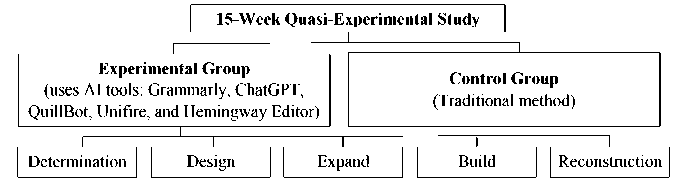
F i g u r e. 15-week quasi-experimental study
Source : Compiled by the authors.
T a b l e 1. AI-Enhanced tool application steps and weekly tasks
|
Weeks |
Phase |
Group |
|
|
Experimental |
Control |
||
|
1–2 |
Determination |
Students choose a topic, make a first draft, and then utilize Grammarly, Unifire, and Hemingway Editor to improve grammar and readability. They then use ChatGPT for coherence and logical feedback |
Brainstorm ideas with peers and select a topic |
|
3–5 |
Design |
Design plans are co-designed by students in pairs or groups. They produce arguments and counterarguments using Grammarly, Unifire, Quillbot, and ChatGPT then analyze the responses to better their reasoning and organization |
Discuss with peers and create a design plan |
|
6–8 |
Expand |
Students produce creative stories using Unifire and Quillbot and use AI tools like ChatGPT to brainstorm plot ideas, character descriptions, and dialogue to improve their narrative writing skills |
Generate content with peers |
|
9–12 |
Build |
Students exchange drafts of DSt and use ChatGPT and Canva to create DSt |
Use Canva to create a digital story |
|
13–15 |
Reconstruction |
Conduct peer reviews and make final adjustments |
Conduct peer reviews and make final adjustments |
Source : Tables 1, 3, 4 compiled by the authors. reliable evaluation of learners’ extensive writing and speaking progress9. Because productive language skills are complex, each target skill was broken into subskills with performance indicators to assess and improve learners’ task performance.
These indicators helped teachers provide focused feedback during implementation by providing formative assessment and organizing summative pre- and post-test scores to ensure comparability between experimental and control groups. The addition of two performance criteria for each subskill improved the evaluation of linguistic accuracy (grammar, clarity) and cognitive or organizational ability (argument structure, coherence). To enhance construct validity and ensure consistent measurement of learners’ productive performance, the assessment rubric differentiates Common Components applicable to both extensive writing and speaking from Skill-specific Components reflecting skill specific features of performance. This structure reduces redundancy and maintains comparability between the two productive modes. Table 2 delineates the subskills and the criteria for evaluating these skills to assess student performance in prolonged writing and speaking activities.
Data Collection and Analysis. To evaluate the influence of AI-DSt on students’ English language acquisition, we conducted a quantitative analysis utilizing comprehensive English writing and speaking assessments, which were created according to CEFR criteria and underwent pre-testing.
Two assessments were comprised. English Writing Assessment examined sentence rewriting, merging, restructuring, and composing abilities in accordance with the CEFR, while Comprehensive Speaking Assessment included four elements, such as fluency and confidence, coherence and cohesion, pronunciation and intonation, active listening and interaction.
The reliability coefficients for the assessments were: 0.87 for English Writing Assessment and 0.81 for Comprehensive speaking.
To ascertain whether a statistically significant difference existed between the EG and the CG, ANOVA was employed.
A comprehensive writing analysis was performed to evaluate the students’
T a b l e 2. Assessment criteria for extensive writing and speaking skills
|
Skill |
Subskill |
Performance Indicator |
Assessment Criteria |
Common Components |
Skill-specific Components |
|
|
1 |
2 |
|||||
|
Extensive |
Sentence |
Idea organi- |
Sentence |
Logical ideas |
Coherence and |
Written |
|
Writing skills |
rewriting |
zation and coherence |
variety |
structuring |
cohesion; lexical and grammatical accuracy (inclu- |
clarity; sentence-level editing |
|
Merging |
Vocabulary and grammar application |
Logical sentence connections |
Use of transition words |
ding appropriate range); task achievement (content rele-vance/ communi- |
Use of cohesive devices in written text |
|
|
Restructuring Composition |
Argument development and creativity Revision and editing of content |
Paragraph-level cohesion Overall structural organization |
Clarity and logical reasoning Logical flow of information |
cative purpose) |
Academic paragraphing; written argumentation Genre and writing convention |
|
|
Extensive |
Fluency |
Speaking |
Using |
Use of linking |
Coherence and |
Fluency; pace; |
|
Speaking |
and con- |
smoothly |
connected |
words to orga- |
cohesion; |
real-time |
|
fidence |
without long pauses |
speech naturally |
nize thoughts and ideas |
lexical resource; grammatical |
speech production |
|
|
Cohe- |
Organizing |
Using |
Message |
range and |
Spoken |
|
|
rence and |
thoughts |
discourse |
clarity; use of |
accuracy; task |
discourse |
|
|
cohesion Pronunciation and intonation Active listening and interaction |
logically Speaking clearly with correct stress patterns Using a wide range of words for clarity and precision |
markers Using appropriate pitch and rhythm Applying grammatical structures correctly |
linking words and logical flow Accurate stress, rhythm, and intonation Usage of words and grammatical structures accurately to convey the intended meaning and avoid ambiguity. |
achievement (message rele-vance/ communicative purpose) |
markers; clarity in real-time delivery Pronunciation (stress, rhythm, intonation) Responding appropriately; maintaining interaction |
|
Source: Compiled by the authors based on Common European Framework of Reference for Lan- guages: Learning, teaching, assessment [Electronic resource]. Available at: (accessed 01.08.2025).
reflective writings. M.Q. Patton’s inductive thematic analysis [40] was employed to discern themes that emerged spontaneously from the data, devoid of pre-established categories.
Two autonomous coders performed the analysis. Discrepancies were examined and reconciled until consensus was achieved, resulting in a coefficient of agreement of 0.87.
The subsequent actions were executed:
-
1. The essays were meticulously examined to comprehend the learners’ experiences.
-
2. A coding method was established to classify the data into emerging topics,
-
3. Codes were categorized into overarching themes, and successive readings enhanced these themes.
including the perceived advantages and obstacles of AI-DSt.
The discovered topics were Extensive English-Writing Proficiency, Extensive English-Speaking Proficiency, Perceived Advantages of AI-DSt, and Perceived Obstacles of AI-DSt.
The themes were derived from the prevalence of associated codes and the comprehensiveness of the material supplied by students. This dual-method strategy enhanced the internal validity of the study by triangulating qualitative data with quantitative learning outcomes.
Using AI Tools for Manuscript Preparation. In alignment with modern academic publishing standards and the core theme of the current study, such generative AI tools as Quillbot and Grammarly Premium were used to prepare the manuscript. Particularly, these tools were employed to refine the text linguistically, to proofread it stylistically, and to improve the English text readability. The authors fully controlled the content including all research design, pedagogical data collection, thematic analysis, and scientific conclusions. These items are the original intellectual contribution of the research team.
Results
To answer the first research questions, which examines the extent to which AI-DSt improves pre-service English teachers’ writing and speaking skills, a comparative analysis of pre-and post-test results between the EG and CG was conducted using ANOVA. We analyzed groups of 3–4 students through their reflective writings and test outcomes. Table 3 displays the descriptive statistics for students’ extensive writing and speaking abilities, indicating the averages and standard deviations for each component in both the EG and CG.
Analysis of Results on English Writing Skills. To guarantee the comparability of our treatment groups regarding their extensive writing skills as a core component of comprehensive proficiency, ANOVA test findings indicated no significant differences among the groups in these skills, F (4.71) = 1.45, p > 0.05. This confirmed baseline equivalence between the groups prior to the intervention.
A univariate test demonstrated significant effects of the intervention on three components of extensive writing skills: sentence rewriting, F (1.74) = 5.81, p < 0.05, η² = 0.07; sentence merging, F (1.74) = 6.96, p < 0.05, η² = 0.09; and restructuring, F (1.74) = 10.43, p < 0.05, η² = 0.12.
No significant effects were observed in the composition, F (1.74) = 0.43, p > 0.05, η² = 0.06. This finding indicated that students who developed DSt with the aid of AI-enhanced tools significantly outperformed the control group in sentence rewriting, sentence merging, and restructuring skills.
Table 4 illustrates the qualitative evaluation of the representative excerpts from student essays titled “Gathering student feedback using presentations: Some tips and examples”.
As can be seen in Table 4, the representative excerpts from one EG and one CG student before and after the AI assistance are quite contrasting. In the EG, the student initially used informal register (“from my point of view”). He/she also used repetitive phrasing (“feedback... feedback... feedback”), fragmented syntax (“to find out... and to know”), and run-on sentence structures. Their ‘after’ version contains more varied vocabulary and syntax, as well as seems more academic itself. Alternatively, the CG student shows modest improvement in connector use (“Another example”) and slightly more elaborated explanations but
T a b l e 3. Extensive writing and speaking skills in experimental and control group mean and standard deviations
retains similar syntax and vocabulary in both samples.
Analysis of Results on Extensive Speaking Skills. Prior to comparing the comprehensive speaking abilities of the two groups, the assumption of homogeneity of variance was evaluated and deemed satisfactory, with F = 6.06 ( p = 0.28 > 0.05) for the pre-experimental phase and F = 2.21 ( p = 0.14 > 0.05) for the post-experimental phase. The ANOVA analysis confirmed that there was no significant difference between the groups prior to the experiment, F (4.71) = 1.28, p > 0.05.
The analysis comparing AI-enhanced tools in the creation of DSt indicated a significant effect of these tools, F (4.71) = 2.98, p < 0.05, η² = 0.14, demonstrating that students in the EG outperformed those in the CG.
A univariate test of between-subjects effects demonstrated significant impacts of EG on three aspects of extensive speaking: fluency and confidence, F (1.74) = 4.43, p < 0.05, η² = 0.06; coherence and cohesion, F (1.74) = 7.18, p < 0.01, η² = 0.09; and active listening and interaction, F (1.74) = 4.02, p < 0.05, η² = 0.05.
No notable variation was seen in pronunciation and intonation, F (1.74) = 0.24, p > 0.05, η² = 0.01.
Table 3 presents the mean values and standard deviations for the EG and CG prior to and following the intervention. The results indicate that students from EG who utilized AI techniques to develop DSt had considerable enhancements in speaking skills, namely in fluency and confidence, cohesiveness and coherence, as well as active listening and interaction. Improved outcomes were noted in sentence merging, rewriting, and restructuring. Nevertheless, no notable discrepancies were detected in sentence structure, pronunciation, and intonation, indicating that although AI-DSt significantly enhanced most facets of broad language output, certain areas may necessitate further assistance. The results underscored the potential of AI-integrated instructional methods to enhance extensive writing and speaking abilities in English language learners.
To address the second research question, which explores pre-service teachers’ perceptions of the advantages and challenges of AI-DSt, we assessed qualitative data from reflective essays. An analysis of the reflective work of prospective English teachers revealed four main themes regarding their experiences of using AI-based tools: (1) comprehensive proficiency in written English, (2) comprehensive proficiency in spoken English, (3) perceived benefits of AI-based tools, (4) perceived barriers associated with AI-based tools.
T a b l e 4. Comparative illustration of two examples of students’ reflective essays from the experimental and control group
|
Group of students |
Essay fragments |
|
|
Before AI-assistance |
After AI-assistance |
|
Experimental
“From my point of view, feedback is very important in a presentation to find out how well I conveyed information to the audience and to know what percentage of the information they mastered by listening and seeing my slides. And on the other hand, through their feedback, I can correct my speech or presentation. For example, if I speak quickly and incomprehensibly, then my listeners can say this through feedback and I will take this point into account next time”.
“Gathering student feedback through presentations can be a dynamic way to engage students and gain valuable information. This allows students to be involved in the learning process and understand how they understand the topic or articles that are shown in the Presentation. In addition, it allows students to know their strengths in the presentation and what nuances are in the slides”.
Control
“One example of using presentations for gathering student feedback is to have students present on a specific topic related to the course material. After the presentation, students can be asked to provide feedback on their peers’ presentations, focusing on areas such as content, delivery, and engagement”.
“Another example is to have students present on their learning experience throughout the semester. They can share what they found most helpful, what they struggled with, and any suggestions for improvement. This type of presentation can provide valuable insights into how students are experiencing the course and what changes can be made to enhance their learning experience”.
Theme 1 “Extensive English-Writing Proficiency”. Reflective essays revealed that 58% of the cases ( n = 35) showed significant enhancements in extensive writing skills attributable to DSt involvement utilizing AI-enhanced tools. Students emphasized enhancements in grammar, sentence structure, and general coherence, crediting these achievements to the interactive feedback and instruction offered by the AI.
“The AI’s grammar corrections and style suggestions significantly improved my writing. It’s like having a tutor that guides you through each step” (student 7, female, 20 years old) (Hereinafter in this article, the style and grammar of the respondents’ answers have been preserved. – Ed .). “AI-DSt helped me understand the nuances of extensive writing, making my essays more structured and my arguments clearer” (student 18, female, 19 years old).
Theme 2 “Extensive English-Speaking Proficiency”. A total of 40 cases underscored the enhancement of public speaking skills, including fluency, coherence, and confidence, throughout tale presentations. Students highlighted that using AI technologies facilitated feedback, hence enhancing their logical reasoning.
Theme 3 “Perceived Advantages of AI-DSt” . Students valued the AI tool’s supportive role in creating a secure linguistic environment conducive to enhancing their outcomes, with 20 cases highlighting benefits such as motivation, learner autonomy, and access to diverse language resources.
Theme 4 “Perceived Obstacles of AI-DSt” . A total of 15 cases highlighted issues such as unreliable internet connectivity, technical obstacles in utilizing certain advanced AI functionalities, and insufficient human-like emotional responses.
These insights highlight the difficulties associated with incorporating AI into the educational process. The development of AI-DSt presents considerable advantages; nonetheless, the shift to this novel learning modality is fraught with challenges. Technical difficulties hinder the learning process, and the impersonal quality of AI feedback causes certain students to desire greater human involvement.
Moreover, understanding and utilizing AI-driven applications like ChatGPT, Canva, Unifire, Copilot, Quillbot, and Grammarly’s advanced suggestions necessitate a learning curve. Confronting these problems is essential for optimizing the efficacy of AI-driven technologies in developing DSt and guaranteeing a nurturing, fulfilling educational experience for every student.
Discussion
Prior studies have established the efficacy of DSt in fostering creativity, critical thinking, and communication skills; yet the integration of AI-driven tools to generate content that improves students’ comprehensive writing and speaking competencies in English is still inadequately investigated. This research seeks to address this gap by thoroughly examining the potential advantages, obstacles, and methodologies for the implementation of AI technologies.
The findings from our experimental investigation indicate a substantial influence of the AI-DSt on sentence rewriting, sentence merging, and the reorganization of writing skills. This further substantiates the efficacy of AI-DSt utilizing ChatGPT, Canva, Unifire, Copilot, Quillbot, and Grammarly in improving comprehensive writing abilities, particularly in sentence rewriting, merging, and restructuring. Their findings corroborate prior studies, which emphasized the function of AI virtual assistants in language analysis and enhancement, including rectifying verb tenses, proposing superior synonyms, or streamlining phrase structures [41; 42]. Moreover, our results align with Y. Wang asserted that AI-enhanced tools aid users in articulating or translating their concepts into written form [43], hence reinforcing the notion that such tools enhance the productive skills of English language learners [44]. These results underscore that AI possesses considerable potential to enhance extensive writing skills through real-time feedback and suggestions [45].
The testing results demonstrated the substantial superiority of EG in comprehensive speaking skills, including fluency and confidence, coherence and cohesiveness, as well as active listening and interaction, in comparison to CG. Extensive speaking is an essential component of language acquisition that enhances fluency, coherence, and communicative proficiency. Diverse comprehensive speaking exercises, including monologues, conversations, and role-plays, enhance learners’ oral ability. To evaluate prolonged speech, one must consider factors like fluency, coherence, pronunciation, and communication efficacy. By concentrating on these factors, educators facilitate the effective enhancement of learners’ spoken communication skills.
The study’s conclusions align with and enhance prior research about the function of AI tools in foreign language instruction. The enhancements shown in participants’ speaking and writing abilities correspond with T.N. Fitria’s research, devoted to AI virtual assistants, which demonstrated that these tools significantly aid learners in producing coherent and grammatically accurate written compositions [41]. T.N. Fitria underscores the capacity of AI assistants to deliver prompt, personalized feedback, aligning with the insights of participants in the current study, particularly concerning their utilization of tools like ChatGPT and Grammarly to enhance argumentation and elucidate sentence structure [41].
In accordance with prior study, the reflective essay data demonstrated a significant influence on the extensive writing skills of EG students. AI-driven applications such as ChatGPT, Canva, Unifire, Copilot, Quillbot, and Grammarly provide real-time feedback mechanisms that facilitate learning, promoting advanced linguistic results including sophisticated and creative writing [45].
The research conducted by S. Rafiq et al., which demonstrated the efficacy of AI-enhanced tools in enhancing language competency, particularly in fostering learner autonomy and advancing multimodal production, corroborates the results of the present study [46]. This extends the existing findings indicating that individuals utilizing AI-DSt tools like Canva and Unifire enhanced both their writing proficiency and speaking fluency. The study highlights the potential for AI-enhanced tools to be intentionally utilized in the classroom to enhance both written and spoken language.
Through the utilization of AI-enhanced technologies in DSt, students encountered a nurturing atmosphere that fostered experimentation and learning from errors, resulting in improved confidence and proficiency in extensive English speaking [12].
The delivery of customized feedback enabled students to address their weaknesses, resulting in individualized progress paths. This further substantiates the capability of AI-driven tools to enhance speaking skills significantly, providing a tailored learning experience that meets individual requirements and fosters active learning and growth.
The enhancement of decision-making skills among preservice English teachers, facilitated by AI-enhanced tools, also indicated that the use of ChatGPT, Canva, Unifire, Copilot, Quillbot, and Grammarly improved their associative thinking, situational problem-solving and shape-based reasoning in creative problem-solving.
AI-driven tools offer students a diverse selection of multimedia resources, including photographs, videos, and audio snippets, which may be utilized to construct more captivating and intricate tales [47]. According to the reflective essays, utilizing these materials enables students to forge more imaginative connections among diverse parts, resulting in enhanced storytelling [48]. Simultaneously, AI-driven technologies aid students in producing advanced visual representations, including dynamic animations and interactive diagrams, which significantly enhance their comprehension of spatial relationships and patterns [49; 40].
This study additionally delineates two categories of advantages associated with the utilization of AI technologies for DSt.
The initial dimension encompasses the advantages of improved learning engagement and self-assurance. Students indicated that the development of DSt enhanced the interactivity and enjoyment of learning through AI-enhanced tools, hence increasing their confidence in utilizing English, particularly in writing. This discovery corroborates other research indicating that AI technologies in narrative composition enhance creativity, writing proficiency, engagement, and pleasure among university students and adults [10].
The second dimension encompasses the advantages of personalized feedback and adaptability, particularly in the design of AI-DSt that deliver targeted feedback on students’ comprehensive writing and speaking abilities, while adjusting to their learning pace, thereby enhancing the effectiveness and motivation of the learning experience. Although advantages are evident, obstacles and challenges must not be disregarded. Students experienced technical malfunctions that impeded their learning advancement and struggled to adjust to AI input. The intricacy of AI recommendations can occasionally inundate users, complicating the process of determining which guidance to adhere to.
Likewise, the research conducted by S. Rafiq et al., which demonstrated the efficacy of artificial intelligence technologies in enhancing language competency, particularly in fostering learner autonomy and advancing multimodal production, corroborates the results of the present study [46]. This extends the existing findings indicating that individuals utilizing AI-tools like Canva and Unifire enhanced both their language and fluency skills. The study highlights the potential of AI tools to be intentionally utilized in the classroom to enhance both written and spoken language.
It is crucial to explore the cognitive and metacognitive dimensions of learning in relation to human collaborative writing and the advancement of AI technology. Future research should investigate the seamless and efficient collaboration between AI technologies and students in the creation of DSt.
Furthermore, limited research examines the possible effects of AI technologies on cognitive burden. Further research is required to investigate how AI technologies in DSt might be refined to attain an equilibrium between educational outcomes and cognitive burden.
Conclusion
The present study provides empirical evidence that the integration of AI-enhanced DSt significantly improves pre-service English teachers’ comprehensive writing and speaking skills. The result demonstrate that AI-enhanced tools such as ChatGPT, Canva, Unifire, Copilot, Quillbot, and Grammarly contribute to enhance linguistic accuracy, coherence, fluency and communicative effectiveness.
This study might provide important theoretical, practical and methodological perspectives to language instructions. One important contribution of this study is that it helps advance understanding of productive language skills development by demonstrating the effectiveness of combining multimodal learning with AI-assisted feedback. The results indicate that AI-DSt can be effectively integrated into interdisciplinary course design, enabling students to develop a deeper understanding of how AI can be applied across various topics and contexts, while also enhancing their proficiency in writing and speaking skills. Moreover, the use AI-driven technologies encourages students to explore narrative strategies, multimodal elements and interactive features, fostering greater learner autonomy, engagement and a sense of ownership over the learning process. The study also makes an important contribution from a methodological perspective, since it proposes an assessment framework that distinguish between common and skill-specific components of writing and speaking, ensuring a more valid and balanced evaluation of productive skills.
