
Improving the quality and safety of meat products through digital control of storage conditions
Journal: Bulletin of Almaty Technological University @vestnik-atu
Section: Технология пищевой и перерабатывающей промышленности
Article in issue: 1 (151), 2026.
Free access
With increasing demands on the quality and safety of meat products, it is becoming urgent to find solutions that combine functional additives and modern storage technologies. The present study aims to assess the impact of digital control of storage conditions and the addition of a vegetable component on the quality and microbiological stability of national meat products. The object of the study was products made according to the same formulation: in one group, a standard formula was used, in the second— an additional herbal component with potential antioxidant properties was introduced. Each group was stored for 30 days in two modes: The Dixell XWEB300 system is digitally controlled and in traditional conditions without automated monitoring. The comprehensive analysis included the determination of physico-chemical parameters (acid number, peroxide number, TBARS), microbiological parameters and organoleptic assessment. The results showed that the best preservation indicators were demonstrated by samples with a plant component stored under digital monitoring conditions: they were characterized by more stable organoleptic properties, lower oxidation rates, and stable microbiological characteristics. Thus the combination of functional ingredients with digital storage control provides a synergistic effect in improving the quality and safety of meat products.
Similar articles in the section Communication and transport industries. Accountancy. Business management. Public relations
Short address: https://sciup.org/140314146
IDS: 140314146 | UDC: 65.59.31 | DOI: 10.48184/2304-568X-2026-1-40-46
Повышение качества и безопасности мясных изделий за счёт цифрового контроля условий хранения
В условиях усиления требований к качеству и безопасности мясных продуктов актуальным становится поиск решений, сочетающих функциональные добавки и современные технологии хранения. Настоящее исследование направлено на оценку влияния цифрового контроля условий хранения и добавления растительного компонента на качество и микробиологическую стабильность национальных мясных изделий. Объектом исследования стали изделия, изготовленные по одной и той же рецептуре: в одной группе использовалась стандартная формула, во второй — дополнительно введён растительный компонент с потенциальными антиоксидантными свойствами. Каждая группа хранилась в течение 30 суток в двух режимах: под цифровым контролем система Dixell XWEB300 и в традиционных условиях без автоматизированного мониторинга. Комплексный анализ включал определение физико-химических показателей (кислотное число, перекисное число, TBARS), микробиологических параметров и органолептической оценки. Результаты показали, что наилучшие показатели сохранности продемонстрировали образцы с растительным компонентом, хранившиеся в условиях цифрового мониторинга: они отличались более стабильными органолептическими свойствами, меньшими темпами окисления и устойчивыми микробиологическими характеристиками. Таким образом, совмещение функциональных ингредиентов с цифровым контролем хранения обеспечивает синергетический эффект в повышении качества и безопасности мясных изделий.
Сақтау шарттарын цифрлық бақылау арқылы ет өнімдерінің сапасы мен қауіпсіздігін арттыру
Ет өнімдерінің сапасы мен қауіпсіздігіне қойылатын талаптарды күшейту жағдайында функционалды қоспалар мен заманауи сақтау технологияларын біріктіретін шешімдерді іздеу өзекті болып табылады. Осы зерттеу Өсімдік компонентін сақтау және қосу жағдайларын цифрлық бақылаудың ұлттық ет өнімдерінің сапасы мен микробиологиялық тұрақтылығына әсерін бағалауға бағытталған. Зерттеу нысаны сол формула бойынша жасалған өнімдер болды: бір топта стандартты формула қолданылды, екіншісінде потенциалды антиоксиданттық қасиеттері бар өсімдік компоненті қосымша енгізілді. Әр топ 30 күн бойы екі режимде сақталды: сандық бақылауда DIXELL XWEB300 жүйесі және дәстүрлі жағдайларда автоматтандырылған бақылаусыз. Кешенді талдау физикалық-химиялық көрсеткіштерді (қышқыл саны, пероксид саны, TBARS), микробиологиялық параметрлерді және органолептикалық бағалауды анықтауды қамтыды. Нәтижелер цифрлық мониторинг жағдайында сақталған өсімдік компоненті бар үлгілердің ең жақсы сақталу көрсеткіштерін көрсеткенін көрсетті: олар тұрақты органолептикалық қасиеттерімен, тотығу жылдамдығының төмендігімен және тұрақты микробиологиялық сипаттамаларымен ерекшеленді. Осылайша, функционалды ингредиенттерді сақтаудың сандық бақылауымен біріктіру ет өнімдерінің сапасы мен қауіпсіздігін арттыруда синергетикалық әсерді қамтамасыз етеді.
Text of the scientific article Improving the quality and safety of meat products through digital control of storage conditions
IRSTI 65.59.31
The quality and safety of meat products remain the top priorities of the food industry. Despite the development of processing and packaging technologies, a significant part of product losses occurs precisely at the storage stage, because of unstable temperature and humidity conditions, acceleration of oxidative processes and the development of microflora [1]. Traditional meat products are particularly vulnerable, including national products, the formulation of which often does not provide for heat treatment or synthetic stabilizers.
Digitalization of food storage processes is one of the most promising areas of modern food science. The use of automated monitoring systems such as the Dixell XWEB300 allows for continuous monitoring of temperature and humidity, rapid response to deviations, and data collection for real-time analysis [2]. Such technologies have already shown effectiveness in cold storage chains for fish, dairy products and chilled meat [3–4], However, scientific data on the use of digital monitoring specifically for traditional meat products, especially those enriched with functional additives, is still insufficient.
Modern research confirms that even minor temperature fluctuations (more than 2 ° C) can lead to activation of opportunistic microflora and accelerated oxidation of fats, which reduces not only the shelf life, but also the organoleptic properties of products национальные мясные изделия, хранение,
-
[ 5]. At the same time, digital control of environmental parameters ensures stability of storage conditions, prevents fluctuations and helps prolong the consumer suitability of products [6].
Against this background, the relevance of comprehensive research is increasing, which simultaneously considers the recipe features of meat products and the technological conditions of their storage. In particular, the study of the impact of digitalization on the stability of products with various compositions (including plant components) will allow us to form scientifically sound approaches to ensuring product safety and quality.
The purpose of the study is to conduct a comparative analysis of the influence of digital and traditional control of storage conditions on the microbiological, physico-chemical and organoleptic characteristics of national meat products with and without the addition of a vegetable component.
Materials and research methods
The object of the study was national meat products made from horse meat, prepared according to a traditional recipe with the addition of a functional component — sea buckthorn extract ( Hippophae rhamnoides ). For the experimental group, a 5% extract was used, evenly distributed over the entire mass of the product. The control group contained only basic meat raw materials and standard spices (salt, pepper, coriander).
Fresh horse meat purchased from certified suppliers and subjected to preliminary veterinary and sanitary control was used for production [7]. After grinding and adding the components, the minced meat was molded, packed in a vacuum film and divided into two groups depending on the storage conditions.
Sea buckthorn fruits were dried at a temperature of 50 ° C for 16-18 hours in a convection dryer, followed by grinding to a powdery state. Extraction was carried out in ethanol (70%) in the ratio of raw material: solvent — 1:10. Ultrasound exposure was performed in a bath at a temperature of 55-60 °C for 30 minutes. The solution was then filtered and evaporated on a rotary evaporator until a concentrated extract was obtained. After drying in a vacuum drying chamber, a powder was obtained, which was added to the formulation in an amount of 5% by weight of meat [8].
The samples of each group were vacuum packed and stored at a temperature of 0...+2 °C and humidity of 85-90%. The control group consists of storage in a standard refrigerator with manual measurement of parameters. The experimental group consists of storage in a chamber with a connected Dixell XWEB300 digital monitoring system that automatically registers temperature, humidity and deviations in real time [9].
The XWEB300 system recorded storage parameters every 10 minutes, allowing it to detect deviations over the entire period. Such data was used to analyze the stability of storage conditions and their impact on product quality [10].
The quality of meat products was assessed by a set of indicators, including organoleptic properties, microbiological safety, and physicochemical stability.
Organoleptic evaluation was performed on the first, seventh and fourteenth days of storage on a five-point scale. The estimated parameters were color, smell, taste, and texture. The examination was carried out by a commission of five specialists in accordance with the methodology established by the GOST 9959-2015 standard [10].
Microbiological studies included the determination of the total number of mesophilic aerobic and facultative anaerobic microorganisms, as well as monitoring for the presence of pathogenic bacteria Salmonella spp. They were detected according to the requirements of GOST 31659-2012, and Listeria monocytogenes — according to GOST 32031-2012. Samples were taken and analyzed on the seventh and fourteenth days of storage using selective nutrient media [11].
The physico-chemical characteristics of oxidative stability included the determination of the following indicators:
-
- acid number — according to GOST 554802013 [12];
-
- peroxide value is according to GOST 341182017 [13];
-
- thiobarbituric number — according to GOST 55810-2013 [14].
Temperature and humidity control were carried out daily. In the control group, the parameters were recorded manually, and in the experimental group, using the Dixell XWEB300 digital monitoring system. The device recorded data every ten minutes, providing automatic monitoring of temperature and relative humidity. This made it possible to analyze the stability of storage conditions and their impact on product quality.
Results and discussion
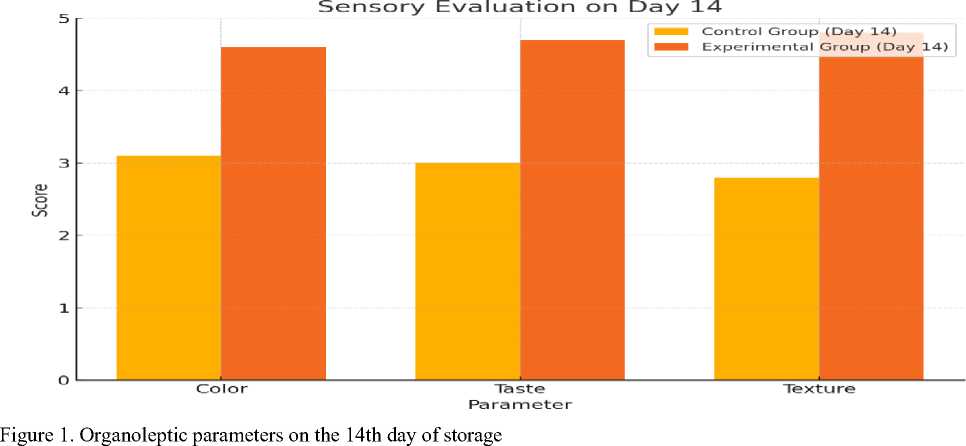
Sensory evaluation showed that by the 7th day of storage, the products from the experimental group had higher scores for color, taste, and texture compared to the control group (Table 1). On the 14th day, a deterioration in texture and the appearance of an off-odor were observed in the control samples (Figure 1), while the experimental group retained acceptable sensory characteristics.
Table 1. Sensory properties on the 7th day of storage
|
Parameters |
Control group |
Experimental group |
|
Color |
3.1 |
4.6 |
|
Taste |
3.0 |
4.7 |
|
Texture |
2.8 |
4.8 |
During the experiment, it was found that in the control group, which was stored without digital monitoring, temperature fluctuations of up to 3.5 °C and a decrease in relative humidity of up to 80% were observed. While in the experimental group equipped with the Dixell XWEB300 digital control system, the parameters remained stable: temperature — within 0...+2 °C, humidity — 85 90%. This confirms the effectiveness of using digital systems to maintain optimal storage conditions (Table 2) [15].
Table 2. Temperature and humidity indicators during the storage period
|
Parameters |
Control group |
Experimental group |
|
Average temperature |
3,5 °C |
1,8 °C |
|
Average humidity |
80% |
87% |
By the 14th day of storage, the total number of mesophilic aerobic and facultative anaerobic microorganisms in the control group reached 4.8x10⁵ CFU/g, while in the experimental group it reached 2.5x10⁵ CFU/g, which indicates a decrease in bacterial contamination of 48%. This confirms the influence of stable storage conditions and antimicrobial properties of sea buckthorn extract. The presence of pathogenic microorganisms (Salmonella spp.) was recorded only in the control group.
Table 3. Microbiological parameters on the 14th day of storage
|
Parameters |
Control group |
Experimental group |
|
Bacterial Contamination (CFU/g) |
4,8x10⁵ |
2,5x10⁵ |
|
Presence of Salmonella spp. |
Trace |
Not found |
|
Listeria monocytogenes |
Not found |
Not found |
To assess lipid degradation processes, three oxidative indicators were measured on days 1, 7, and 14 of storage: acid value (AV), peroxide value (POV), and thiobarbituric acid reactive substances (TBARS).
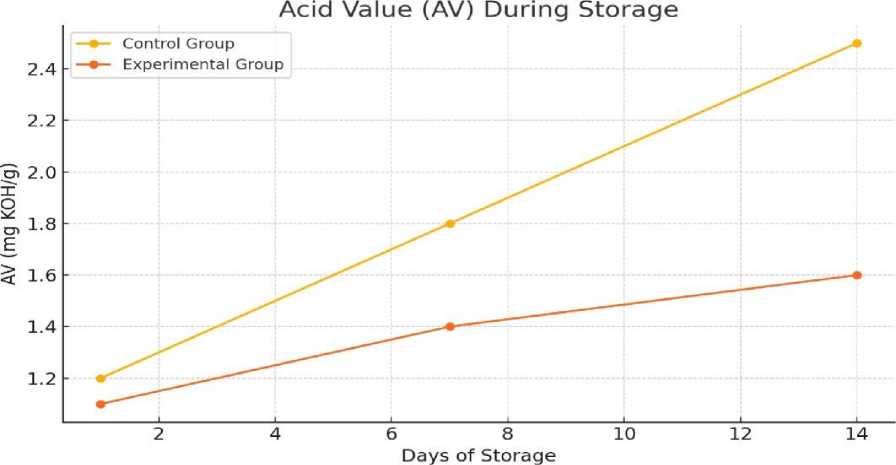
Figure 2. Dynamics of acid value (AV) during storage
The acid value increased progressively in both groups, but more markedly in the control group. On day 14, the AV reached 2.5 mg KOH/g in the control group versus 1.6 mg KOH/g in the experimental group — a 36% reduction, indicating slower hydrolytic lipid degradation under digitally monitored storage with added sea buckthorn extract.
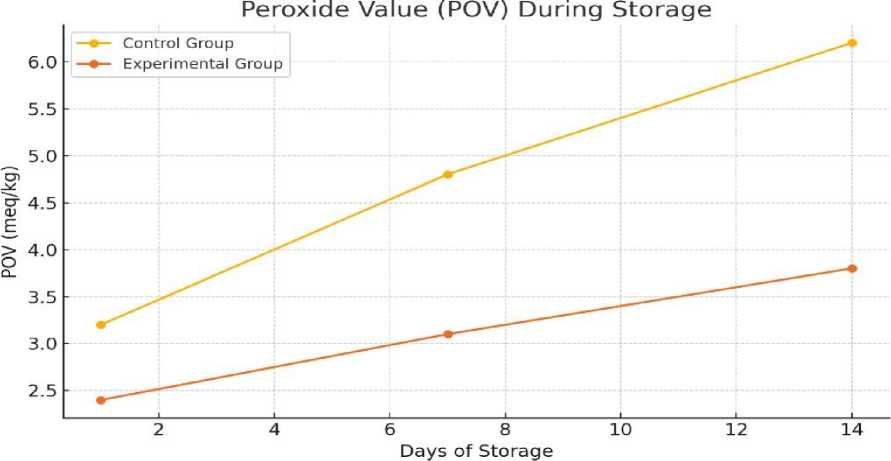
Figure 3. Dynamics of peroxide value (POV) during storage
The peroxide value (POV), a marker of primary lipid oxidation, rose significantly in the control group (from 3.2 to 6.2 meq/kg). In contrast, the experimental group exhibited a more moderate increase (from 2.4 to 3.8 meq/kg), a 39% lower final value, suggesting enhanced oxidative stability.
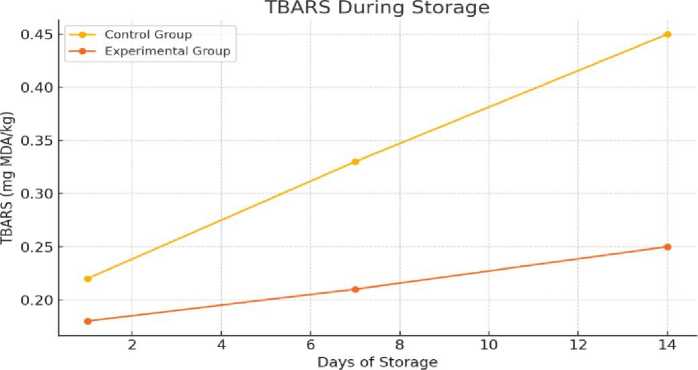
Figure 4. Dynamics of TBARS during storage
TBARS values, which reflect secondary oxidation products, increased in both groups, with the control reaching 0.45 mg MDA/kg by day 14. The experimental group remained at 0.25 mg MDA/kg — a 44% reduction. This indicates that the experimental storage conditions effectively suppressed secondary lipid oxidation.
Across all three oxidative indicators, the experimental group — combining 5% sea buckthorn extract and real-time digital monitoring — demonstrated significantly improved lipid stability. This suggests a synergistic protective effect of both technological and bioactive interventions during meat storage.
Conclusions
The conducted research has shown the high efficiency of integrating digital technologies for monitoring storage conditions and functional herbal additives to improve the quality and safety of traditional meat products. Under conditions close to real storage, samples of the national horsemeat meat product enriched with 5% sea buckthorn extract powder and stored using the Dixell XWEB300 digital monitoring system showed better performance compared to the control group stored under standard conditions.
The use of the Dixell XWEB300 system ensured a stable temperature and humidity regime (0...+2 °C, humidity 85-90%), allowed for rapid response to deviations and ensured continuous data collection. This contributed to a significant reduction in microbiological risks and a slowdown in fat oxidation processes. Microbiological research data showed lower levels of the total microbial count, as well as the absence of pathogenic microflora in the experimental group by the 14th day of storage.
The inclusion of 5% sea buckthorn extract in the formulation had a positive effect on the antioxidant stability of the products. The values of the acid number, peroxide number, and TBK index in the experimental samples were significantly lower than in the control samples. This indicates the inhibition of lipid oxidation processes due to the high content of polyphenols, tocopherols and carotenoids in sea buckthorn. In addition, the organoleptic evaluation showed that the products of the experimental group retained a more attractive color, aroma and texture throughout the shelf life.
The results obtained provide a scientifically sound basis for the introduction of digital storage systems into the production practices of meat processing enterprises, especially in the production of functional and ethnic meat products. A promising area of further research is to study the impact of digitalization on logistics processes in the cold chain, as well as product shelf-life modeling using machine learning.
Funding information
This research was prepared with the project IRN BR24993234 “Innovative technologies for the production of National products: intensification and digitalization of the production of meat and dairy products”.
