
Isolation and FTIR Characterization of Nitrogen-Rich Condensation Products from the Allantoin–Dicyandiamide System
Journal: Bulletin of Science and Practice @bulletennauki
Section: Естественные науки
Article in issue: 1 т.12, 2026.
Free access
This study investigates the acid-catalyzed condensation between allantoin and dicyandiamide, focusing on the structural identification of nitrogen-rich intermediates and final products. The reaction system was examined under controlled reflux conditions, allowing the isolation of two major fractions, designated LG-5A and LG-5B. FTIR spectroscopy was applied as the primary analytical technique to evaluate functional-group transformations, including shifts in carbonyl, amide, imide, and guanidine-related bands. LG-5A demonstrated sharper, well-defined peaks, suggesting a more ordered condensation product, while LG-5B exhibited broader absorptions, consistent with higher hydrogen-bonding or partial unreacted material. The results support a mechanism in which dicyandiamide undergoes nucleophilic addition to the ureido carbonyl of allantoin, followed by dehydration and formation of extended C-N conjugation. These findings contribute to a deeper understanding of urea- and guanidine-based frameworks, which are relevant in polymer science, functional materials, and nitrogen-rich compound design.
Similar articles in the section Organic chemistry
![Azomethine derivatives of 2-[(3-formyl-4-hydroxyphenyl) diazenyl] benzoic acid](/file/thumb/170208602.png "Azomethine derivatives of 2-[(3-formyl-4-hydroxyphenyl) diazenyl] benzoic acid")
Short address: https://sciup.org/14135544
IDS: 14135544 | UDC: 547.458 | DOI: 10.33619/2414-2948/122/04
Выделение и FTIR-характеристика азотсодержащих продуктов конденсации из системы аллантоин-дициандиамид
Изучена кислотно-катализируемая конденсация аллантоина и дициандиамида, с акцентом на выделении и спектроскопической идентификации азотсодержащих продуктов. Реакция проводилась в условиях контролируемого нагрева, что позволило выделить две основные фракции - LG-5A и LG-5B. FTIR-спектроскопия использовалась как главный метод анализа для оценки изменений карбонильных, амидных, имидных и гуанидиновых групп. Фракция LG-5A показала более четкие полосы поглощения, указывающие на формирование более упорядоченного продукта, тогда как LG-5B характеризовалась широкими полосами, связанными с повышенным водородным связыванием или частично незавершённой реакцией. Результаты подтверждают предполагаемый механизм, включающий нуклеофильное присоединение дициандиамида к карбонильной группе аллантоина с последующей дегидратацией и образованием расширенной C-N-конъюгации.
Text of the scientific article Isolation and FTIR Characterization of Nitrogen-Rich Condensation Products from the Allantoin–Dicyandiamide System
Бюллетень науки и практики / Bulletin of Science and Practice
UDC 547.458
Allantoin and dicyandiamide are well-established nitrogen-containing compounds that have attracted considerable scientific interest due to their high reactivity and structural diversity. Each molecule carries functional groups capable of participating in nucleophilic–electrophilic interactions and stepwise condensation reactions. Allantoin possesses an imidazolidine-2,4-dione ring system that contains ureido and carbonyl groups, whereas dicyandiamide features a guanidine-like framework with strongly reactive amino and nitrile functionalities. Because of this combination of electrophilic carbonyl centers and nucleophilic amino groups, the joint behavior of these two compounds under acidic conditions offers a promising platform for obtaining structurally enriched nitrogen-based materials.
In recent years, nitrogen-rich organic frameworks have received increasing attention in material science. Compounds containing multiple C–N and C=N linkages often display improved thermal stability, enhanced hydrogen-bonding capability, and chemical robustness. These features make them attractive for applications ranging from functional polymer additives and corrosion inhibitors to surface-active agents, catalytic supports, and specialty fine chemicals. Therefore, understanding how such frameworks form from simple precursors like allantoin and dicyandiamide is valuable both from a synthetic and an application-oriented perspective.
Previous studies have shown that dicyandiamide readily undergoes acid-catalyzed additions to carbonyl-bearing molecules, often accompanied by dehydration and rearrangement steps that lead to extended conjugated C–N networks. Protonation of allantoin’s carbonyl groups increases their electrophilicity, making them favorable targets for nucleophilic attack by the amino groups of dicyandiamide. This provides a plausible foundation for multi-stage transformations, resulting in products that may retain part of the original heterocycle while incorporating newly formed guanidinederived fragments. Despite the known reactivity of both components, their combined transformation pathways and the structural diversity of the resulting products remain insufficiently explored. Differences in reaction temperature, acidity, and local concentration can lead to multiple molecular outcomes, including linear condensation, partial cyclization, or formation of cross-linked nitrogenrich networks. Identifying and characterizing these products is essential for understanding the underlying mechanism and for evaluating their potential as functional materials.
The aim of the present study is to investigate the acid-catalyzed condensation between allantoin and dicyandiamide, isolate the major reaction products, and analyze their structural features using FTIR spectroscopy. Two distinct fractions, designated LG-5A and LG-5B, were obtained under the same reaction conditions, suggesting a stepwise or competitive pathway. FTIR examination of these fractions allows the assessment of key functional-group transformations and provides insight into the structural evolution of this nitrogen-rich system.
Materials and Methods
The condensation reaction was carried out using equimolar amounts of allantoin and dicyandiamide in acidic medium. The mixture was heated under reflux at approximately 95 °C for several hours. Periodic sampling allowed monitoring of the transformation, after which solid fractions were separated, washed, dried, and purified. FTIR spectra were recorded using an Agilent Cary 630 FTIR spectrometer in the range 4000-600 cm-1. The spectral profiles of LG-5A and LG-5B were compared with those of the starting materials to evaluate structural changes. Equimolar amounts of allantoin and dicyandiamide were introduced into an acidic solution and heated under gentle reflux at approximately 95 °C. The mixture was stirred continuously to ensure uniform contact between the reactants. Samples were periodically withdrawn to monitor the progress of the condensation. Once the reaction reached a consistent state, the solid material that formed was filtered, washed, and dried. Two distinguishable fractions, labelled LG‑5A and LG‑5B, were isolated.
FTIR spectra of the starting materials and the two products were recorded on an Agilent Cary 630 FTIR instrument across 4000-600 cm_i. The obtained spectra were analyzed to identify changes in characteristic vibrational modes and to evaluate how functional groups evolved during the reaction.
Results and Discussion
Significant changes were observed in the FTIR spectra of LG‑5A and LG‑5B compared to raw allantoin and dicyandiamide. The broad absorption around 3400 cm_i indicated O-H/N-H stretching, with LG-5B showing stronger hydrogen bonding. The carbonyl band near 1720cm"i persisted, confirming retention of the imidazolidine-2,4-dione core. A strong band between 1650-1600cm_i suggested the formation of C=N functionalities, supporting the proposed condensation pathway. A more detailed interpretation of the FTIR spectra of the isolated LG‑5A and LG‑5B fractions provides important insights into the chemical transformations occurring during the condensation of allantoin with dicyandiamide. Comparison of the spectral features with those of the starting materials confirms the formation of new functional groups and the reorganization of the nitrogen‑rich molecular framework.
N–H/O–H Stretching Region (3600–3000 cm⁻¹). Both LG‑5A and LG‑5B display broad absorptions in the 3380–3200 cm⁻¹ range. These bands arise from overlapping N–H and O–H stretching vibrations and indicate extensive hydrogen bonding within the products. The broadening is more pronounced in LG‑5B, suggesting a higher degree of intermolecular association or partial oligomerization.
Carbonyl Region (1800–1600 cm⁻¹). Allantoin contains two characteristic carbonyl bands at approximately 1765 cm⁻¹ and 1715 cm⁻¹. In both products these bands shift and lose intensity. The modified position around 1720 cm⁻¹ confirms partial retention of the imidazolidine‑2,4‑dione ring, while new bands appearing between 1650–1600 cm⁻¹ indicate the formation of C=N groups associated with the incorporation of dicyandiamide units.
C=N and C–N Stretching (1650–1450 cm⁻¹). A strong absorption near 1600 cm⁻¹ is a diagnostic feature of the condensation products and corresponds to C=N stretching vibrations. Additional bands in the 1550–1480 cm⁻¹ range reflect C–N stretching and N–H deformation, consistent with the formation of newly developed amide and guanidine‑derived fragments.
Fingerprint Region (1450–600 cm⁻¹). Both LG‑5A and LG‑5B exhibit significant changes in this region, including: bands at 1400–1310 cm⁻¹ representing C–N stretching; absorptions at 1240– 1150 cm⁻¹ related to C–O and C–N bond rearrangements; a strong peak around 1050 cm⁻¹ corresponding to C–N–C skeletal vibrations.
These features support the presence of extended nitrogen‑rich conjugated structures. LG‑5A displays sharper bands, indicating a more ordered structure, while LG‑5B exhibits broader signals attributed to increased hydrogen bonding.
Disappearance of Dicyandiamide Nitrile Band.The nitrile absorption of dicyandiamide at 2170 cm⁻¹ is absent in both products, demonstrating complete consumption of the cyano group and confirming successful condensation.Clear spectral differences were observed between the initial reactants and the isolated products. The broad bands appearing in the 3380-3200 cm_| region reflect extensive hydrogen bonding in both LG‑5A and LG‑5B, although the breadth is greater in LG‑5B, indicating stronger intermolecular interactions.The carbonyl region provides important information about structural changes. While a shifted band near 1720 cm_i confirms partial preservation of the allantoin ring, the emergence of an additional absorption around 1600cm_i marks the formation of C=N groups. These new features align with expected products of the condensation pathway.In the fingerprint region, the presence of peaks at 1400-1310cm-1 and around 1050cm_i offers strong evidence for the development of nitrogen‑rich C–N and C–N–C linkages. LG‑5A shows clearer definition in these peaks, whereas LG‑5B appears more diffuse, suggesting subtle differences in structural organization or degree of chain extension.
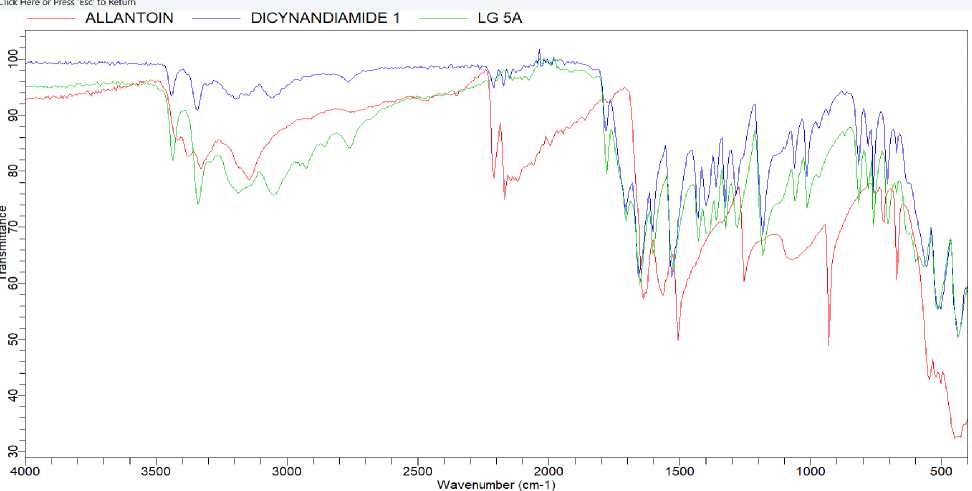
Figure 1. FTIR spectrum of product
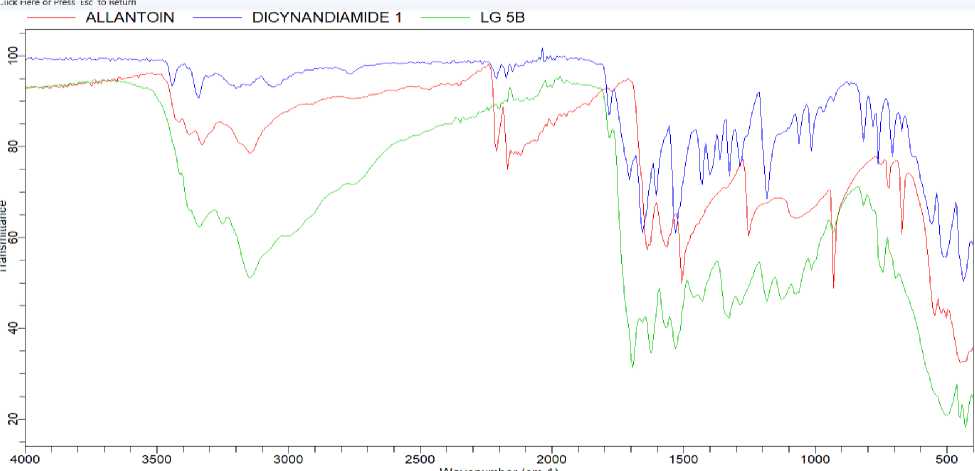
Figure 2. FTIR spectrum of product
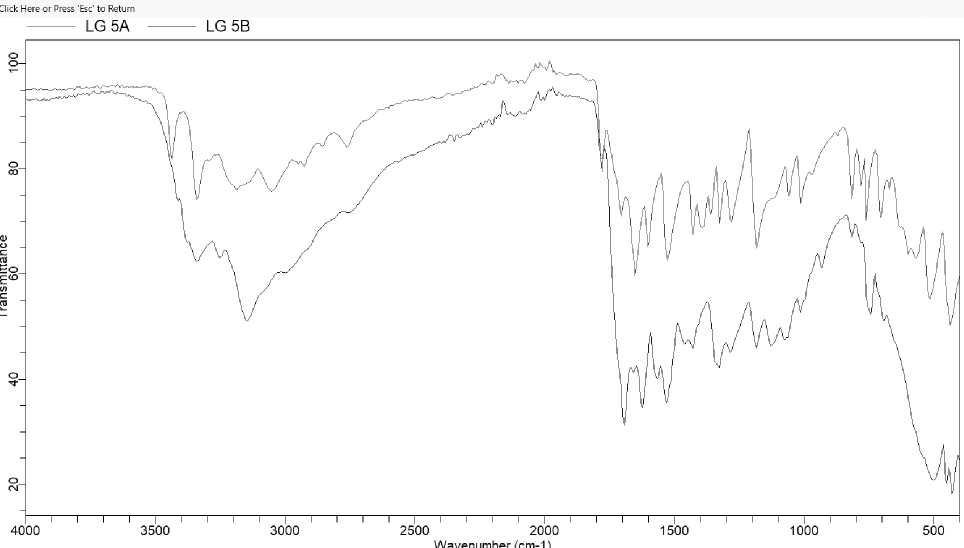
Figure 3. FTIR spectrum of product
Stoichiometric Considerations and Theoretical Nitrogen Content. In addition to the qualitative FTIR analysis, a simple stoichiometric estimate helps to illustrate why the products obtained from the allantoin–dicyandiamide system can be regarded as nitrogen-rich materials. Allantoin has the empirical formula C₄H₆N₄O₃, while dicyandiamide can be written as C₂H₄N₄. If one molecule of allantoin condenses with one molecule of dicyandiamide with the elimination of a single water molecule, a plausible idealized product would have the composition C₆H₈N₈O₂. This formula reflects the preservation of the heterocyclic core together with the introduction of an additional guanidinederived fragment.On this basis, the approximate nitrogen mass fraction can be estimated. For allantoin (C₄H₆N₄O₃, Mᵣ ≈ 158.1 g·mol⁻¹), the nitrogen content is about 35.4 %, whereas for dicyandiamide (C₂H₄N₄, Mᵣ ≈ 84.1 g·mol⁻¹) it is close to 66.6 %. For the hypothetical condensation product C₆H₈N₈O₂ (Mᵣ ≈ 224.2 g·mol⁻¹), the contribution of eight nitrogen atoms corresponds to roughly 50.0 % by mass. Although this calculation is only an idealized approximation and does not account for possible side reactions or further cross-linking, it supports the experimental observation that the materials obtained from this system fall into the category of nitrogen-rich organic frameworks. This simple estimate also underlines the potential value of such products as precursors for functional additives or advanced materials where a high nitrogen content is desirable.
Proposed Reaction Mechanism
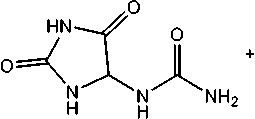
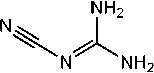
The mechanism involves nucleophilic attack of the amino group of dicyandiamide on the ureido carbonyl carbon of allantoin. This forms a tetrahedral intermediate that undergoes dehydration, producing a new C–N bond. The resulting framework exhibits extended conjugation and increased nitrogen content, consistent with the observed spectra. The reaction likely begins with protonation of the allantoin carbonyl group, followed by nucleophilic attack by dicyandiamide and subsequent dehydration. The resulting C–N and C=N linkages form a stabilized nitrogen‑rich network. Secondary interactions and further condensation reactions may contribute to the formation of more complex structures, especially in LG‑5B.
These detailed FTIR data provide strong evidence for the formation of new guanidine‑urea‑based frameworks and give a clearer understanding of the structural characteristics of the synthesized nitrogen‑rich products.
R1= allantoin
R2= dicyandiamine
R3= HCl (cons)
reflux, 1.5 h, 90°C
+cons HC1
LG 5
Conclusion
The study demonstrates that the condensation of allantoin and dicyandiamide yields structurally distinct nitrogen‑rich products. FTIR analysis reveals key functional‑group transformations, confirming partial retention of the allantoin core and incorporation of guanidine‑derived fragments. These findings provide a basis for further development of nitrogen‑rich functional materials. The experimental observations and spectral interpretations collectively demonstrate that the interaction between allantoin and dicyandiamide under acidic reflux does not proceed through a single, simple pathway. Instead, the reaction follows a sequence of condensation and rearrangement steps that gradually build a nitrogen-enriched molecular framework. The disappearance of diagnostic dicyandiamide signals, the partial preservation of the heterocyclic core of allantoin, and the emergence of new C–N and C=N vibrational modes together confirm that both precursors actively participate in forming the final structure. The differences observed between LG‑5A and LG‑5B highlight the sensitivity of this system to small variations in reaction conditions. Sharper FTIR features in LG‑5A suggest a more orderly arrangement, whereas the broader absorptions of LG‑5B point to increased hydrogen bonding or incomplete chain growth. These variations provide useful insight for optimizing future syntheses, especially for obtaining materials with controlled functional density or specific mechanical or thermal behavior. Taken as a whole, the study offers a clearer understanding of how urea‑ and guanidine‑based precursors evolve during condensation. The findings may support the design of new nitrogen‑rich materials in fields such as polymer chemistry, surface modification, and functional additives, where stable C–N frameworks are particularly valuable.
