
Изучение продуктивности сырья надземной и подземной фитомассы и некоторых физико-химических показателей корней Symphytum officinale L. и Symphytum caucasicum Bieb.
Журнал: Вестник Пермского университета. Серия: Биология @vestnik-psu-bio
Рубрика: Ботаника
Статья в выпуске: 1, 2026 года.
Бесплатный доступ
Приведены результаты изучения продуктивности и некоторых физико-химических показателей сырья Symphytum caucasicum Bieb. и S. officinale L., культивируемых на опытном поле Иркутского ГАУ. В кормопроизводстве виды не используются, но встречаются данные о возможности их применения в свиноводческой, овцеводческой и птицеводческой отраслях животноводства. Растения отличаются высоким содержанием в зеленой массе протеина, витаминов, зольных элементов и др., характеризуются быстрыми темпами роста и значительной продуктивностью сырья. В Европе и Америке корни S. officinale – официнальное лекарственное сырье, применяется в качестве иммуностимулирующего средства в научной медицине. В России корни и листья S. caucasicum и S. officinale используются в народной медицине, но химический состав сырья этих видов изучен недостаточно. Цель исследования – изучение продуктивности сырья надземной и подземной фитомассы S. caucasicum и S. officinale, а также некоторых физико-химических показателей сырья корней изучаемых видов в условиях культуры Предбайкалья. Урожайность сырья определяли типовым весовым методом. Определение показателя влажности сырья, золы общей, содержание флавоноидов в пересчете на рутин, дубильных веществ в пересчете на танин и полисахаридов проводили согласно требованиям ОФС и ФС РФ. В качестве кормовой культуры к выращиванию в Предбайкалье можно рекомендовать S. officinale как более продуктивный вид. Максимальное содержание полисахаридов и дубильных веществ в пересчете на танин обнаружено в корнях S. caucasicum, флавоноидов в пересчете на рутин – в корнях S. officinale. S. caucasicum и S. officinale – перспективные лекарственные растения для ветеринарной и фармацевтической промышленности и для кормопроизводства, Учитывая их недостаточную изученность, исследования по содержанию биологически активных веществ в сырье необходимо продолжить.
Похожие статьи в разделе Физиология растений
Короткий адрес: https://sciup.org/147253583
IDS: 147253583 | УДК: 581.192:633.88(571.53) | DOI: 10.17072/1994-9952-2026-1-13-21
Study of the productivity of above‑ground and be-low‑ground phytomass raw material and certain physicochemical parameters of the roots of Symphytum offici-nale L. and Symphytum caucasicum Bieb.
The article presents the results of studying the productivity and certain physicochemical parameters of raw material from Symphytum caucasicum Bieb. and Symphytum officinale L., cultivated in the experimental field of Irkutsk State Agrarian University. Although these species are not currently used in feed production, there is evidence of their potential application in pig, sheep, and poultry farming. The plants are notable for their high content of protein, vitamins, ash elements, and other nutrients in the green mass, as well as their rapid growth rate and considerable raw material productivity. In Europe and America, the roots of S. officinale are official raw material and are used as an immunostimulant in scientific medicine. In Russia, the roots and leaves of S. caucasicum and S. officinale are used in traditional medicine, although the chemical composition of these species’ raw material has not been sufficiently studied. The objective of the study is to investigate the productivity of above‑ground and below‑ground phytomass raw material of S. caucasicum and S. officinale, as well as certain physicochemical parameters of root raw material from these species under cultivation conditions in the Cis‑Baikal region. Raw material yield was determined using the standard weight method. Moisture content and total ash values were measured according to the requirements of the General Pharmacopoeia Monograph (OFS) and Pharmacopoeia Monographs (FS) of the Russian Federation. The results showed that S. officinale can be recommended as a fodder crop for cultivation in the Cis‑Baikal region due to its higher productivity. The maximum content of polysaccharides and tannins (expressed as tannin) was found in the roots of S. caucasicum, while the highest flavonoid content (expressed as rutin) was detected in the roots of S. officinale. These species can be considered promising medicinal resources for the veterinary and pharmaceutical industries. Given their insufficient study, further research on the content of biologically active substances in their raw material is necessary.
Текст научной статьи Изучение продуктивности сырья надземной и подземной фитомассы и некоторых физико-химических показателей корней Symphytum officinale L. и Symphytum caucasicum Bieb.
Изучение перспективных лекарственных и кормовых растений для фармацевтической промышленности и сельскохозяйственных организаций является актуальным направлением развития лекарственного растениеводства и кормопроизводства России. Особое внимание уделяется поиску новых видов, обладающих противовоспалительным действием, антимикробной активностью, иммуностимулирующими свойствами. К перспективным видам соответствующего действия можно отнести Symphytum officinale L. (окопник лекарственный) и Symphytum caucasicum Bieb. (окопник кавказский).
Род Symphytum L. (окопник) включает около 25 видов лекарственных, декоративных и кормовых растений семейства Boraginaceae (Бурачниковые), ареал произрастания рода довольно широкий – от Средиземноморья и Кавказа до Западной Сибири. В Европейской части наиболее распространен S. officinale , на Кавказе – S. caucasicum . В Предбайкалье S. officinale считается заносным видом (обнаружен в окрестностях Усольского р-на, пос. Тальяны) [Чепинога и др., 2008].
Имеются данные о том, что род Symphytum применяется в качестве кормовой культуры в свиноводческой и птицеводческой отраслях, хорошо поедается овцами и козами [Медведев, Сметанникова, 1981]. Перспектива применения окопников в кормопроизводстве обусловлена высокой продуктивностью надземной фитомассы, долголетием в культуре (10-15 лет), ранней вегетацией, устойчивостью к весенним и осенним понижениям температуры, хорошей отавностью [Ларин, 1953; Медведев, Сметанникова, 1981], высоким содержанием в зеленой массе протеина, витаминов, зольных элементов [Медведев, Сметанникова, 1981]. Окопники рекомендуются для выращивания в культуре на сено, сенную муку, витаминную пасту, сенаж и силос [Ларин, 1953; Медведев, Сметанникова, 1981]. Растение считается неплохим медоносом [Ахкубекова, Тамахина, 2020].
Надземная часть и корни Symphytum применяются в народной медицине в качестве противомикроб-ного, противовоспалительного и иммуномодулирующего средства. Исследования ученых показали, что в корнях и в траве растения обнаружены аллантоин [Тамахина, Ахкубекова, Иттиев, 2019], фенольные соединения, полисахариды, гликопептиды и некоторые токсичные пирролизидиновые алкалоиды [Salehi et al., 2019]. S. caucasicum отличается высоким содержанием лазиокарпина [Зузук и др., 2004]. Препараты из окопника обладают высоким антиокислительным, антилипопероксидантным и противовоспалительным действием, антимикробной активностью [Ахкубекова, Тамахина, 2018]. Сотрудники института фармакохимии им. И.Г. Кутателадзе изучили водорастворимые высокомолекулярные фракции полисахаридов листьев S. caucasicum и выявили высокую антикомплементарную и антиоксидантную активность, указывающую на возможность их использования в качестве противовоспалительных и ранозаживляющих агентов при лечении ран различной этиологии [Барбакадзе и др., 2010]. Исследователи Уфимского института химии РАН совместно с учеными Пятигорского медико-фармацевтического института и Уфимского института биологии РАН изучили состав липидов и липофильных компонентов семян S. оf-ficinale, индентифицировали и определили содержание нейтральных и полярных липидов, а также состав жирных кислот [Юнусова и др., 2016].
В России корни и листья S. caucasicum и S. officinale применяются исключительно в народной медицине, химический состав сырья этих видов изучен недостаточно, в кормопроизводстве виды не используются.
В Европе и Америке корни S. officinale считаются ценным лекарственным сырьем, препараты из корней растения применяются в качестве иммуностимулирующего средства в научной медицине.
Исследования по изучению продуктивности и содержанию биохимического состава сырья S. caucasicum и S. officinale в условиях культуры Предбайкалья ранее не проводились. Для выявления перспективности использования сырья в животноводстве проведено определение урожайности надземной фитомассы. Учитывая, что сырье корней S. officinale успешно применяется во многих европейских странах и США в качестве официнального, была поставлена задача изучения продуктивности подземной фитомассы и проведение первичных исследований по содержанию биологически активных веществ в сырье подземных органов растений.
Цель исследования – изучение продуктивности сырья надземной и подземной фитомассы S. caucasicum и S. officinale , а также некоторых физико-химических показателей сырья корней изучаемых видов в условиях культуры Предбайкалья.
Материалы и методы исследования
Объект исследования – сырье надземной и подземной фитомассы S. caucasicum и S. officinale. Сырье было собрано нами с коллекционного участка опытного поля Иркутского ГАУ Предбайкалья (Иркутский р-н).
S. caucasicum – многолетник с одиночными толстыми стеблями (высотой 40–60 см) и розеткой прикорневых листьев, отмирающих к цветению (рис. 1). Корневище укороченное, веретеновидное, с длинными толстыми корнями. Стебли обычно одиночные, довольно толстые, с небольшим количеством недлинных боковых побегов, так же, как и листья, коротко-серовато или пушисто-мохнато опушенные. Стеблевые листья многочисленные, продолговатые или яйцевидные, нижние листья на длинных черешках с округлым основанием, верхние и средние листья на коротком черешке или сидячие слегка низбегающие на стебель с клиновидным основанием (5–10 см длиной, 2–4 см шириной). На концах стеблей и верхних боковых побегов формируются немногоцветковые, безлистные, односторонне закрученные завитки, при отцветании выпрямляющиеся в рыхлые короткие кисти. Плодоножки сероватые пушисто-мохнатые, поникающие (3– 5 мм длиной). Чашечка сероватая железисто-опушенная зуб-чатонадрезанная, узкоколокольчатая (4–6 мм длиной), при плодах увеличивающаяся (до 8–15 мм). Венчик (до 15 мм) – голубой, трубка венчика (7–8 мм длиной) заметно длиннее чашечки, отгиб колокольчатый с треугольными короткими зубцами. Плоды – орешки (3–5 мм длиной). Произрастает по полянам, опушкам и лесам Кавказа. Вид сближается с S. officinale своими низбегающими верхними листьями и отличается антоциановыми венчиками [Попов, 1953].
S. officinale – многолетнее поликарпическое растение
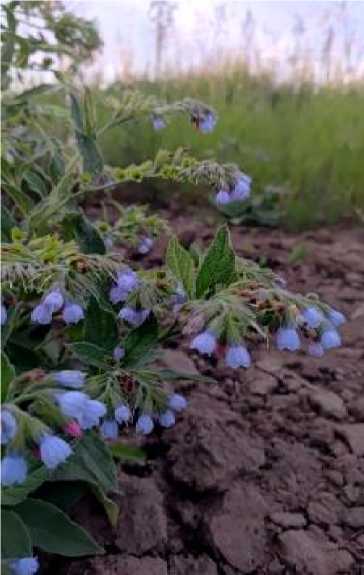
Рис. 1. Symphytum caucasicum
с длинными толстыми корнями и одиночными мощными, толстыми и высокими стеблями (50–100 см высотой), в верхней части сильноветвистые, густо щетинисто-мохнатые (рис. 2). Верхние листья с клиновидным основанием, сближенные, сидячие, в верхней части низбегающие вдоль стебля, по краю крупноволнистые. Стеблевые листья многочисленные, крупные, продолговатые, длиннозаостренные на конце. Нижние листья округлые при основании, на длинных узкокрылатых черешках. Листья сверху жестко- щетинистые, снизу сероватые опушенные или почти голые, средняя жилка снизу длиннощетинистая. Корневище мощное, короткое, с длинными толстыми корнями. Завитки в начале цветения густые, поникающие на верхушке, часто метельчатые, позднее выпрямляющиеся в удлиненные и рыхлые односто-
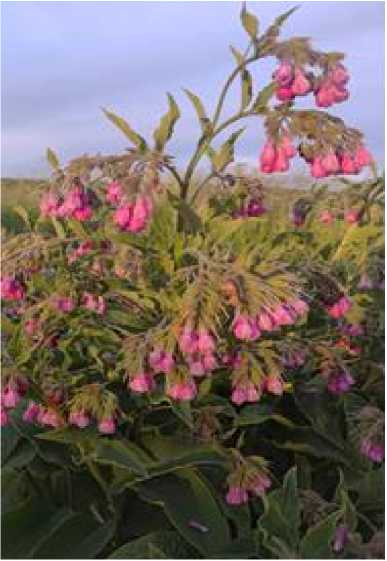
Рис. 2. Symphytum officinale
ронние соцветия. Плодоножки (5–10 мм длиной) оттопыренно-щетинистые с яйцевидной или грушевидной зубчато-рассеченной колюче-щетинистой чашечкой (10–15 мм длиной). Венчик (15–20 см длиной) розовый, розовокрасный, чаще грязно-темно-фиолетовый, реже – белый, мелкососочково-шелковистый, трубка венчика вдвое длиннее чашечки, отгиб короче трубки, овальный с широкими, треугольными и короткими зубцами. Плоды – черные, блестящие, гладкие, полусогнутые, яйцевидные орешки (4–5 мм длиной). В Европейской части произрастает по сырым лугам, заболоченным местам, у рек и ручьев в таежной и степных зонах, реже – в Крыму, на Кавказе, в Западной Сибири и Средней Азии [Попов, 1953].
Почвы опытного поля серые лесные, близкие к нейтральным (содержание гумуса – 3–5%, фосфора – 10–15 мг/100 г, калия – 10–15 мг/100 г, подвижного азота – 20–40 мг/кг) [Рябинина, 2012]. Резкоконтинентальный климат района исследования характеризуется значительными годовыми (более 80°) и суточными (около 30°) перепадами температуры воздуха. Продолжительность летнего периода составляет 90–110 дней, средняя температура самого жаркого месяца (июля) – +18°С, самого холодного (января) – 20°С. Вегетационный период – 119–120 дней [Беркин и др., 1993]. Урожайность сырья определяли типовым весовым методом в четырехкратной повторности. Надземную часть сырья срезали ножницами на уровне 2–3 см от поверхности почвы, подземную часть выкапывали садовой лопатой на глубину залегания корневой системы растения.
Определение показателя влажности [Определение влажности…: эл. ресурс], числовой показатель золы общей [Общая зола: эл. ресурс] определяли согласно требованиям Фармакопеи. Количественное содержание флавоноидов – методом УФ-спектроскопии спиртовых вытяжек, для флавонов и флавонолов, в частности рутина, характерны два максимума поглощения – коротковолновый (258–260 нм) и длинноволновый (362 нм), при этом в присутствии AlCl 3 образуется батохромный сдвиг длинноволновой полосы с образованием максимума при длине волны 412 нм (аналитическая длина волны) [Пастушьей сумки…: эл. ресурс]. Дубильные вещества в пересчете на танин определяли перманганометрическим методом [Определение содержания…: эл. ресурс]. Для определения полисахаридов использовали методику количественного определения полисахаридов в траве череды [Череды трехраздельной…: эл. ресурс]. Для определения приведенных показателей использовали сырье корней растений четвертого года жизни, повторность опытов четырехкратная. Обработка экспериментальных данных проведена с использованием программы Statistica, MS Ecxel 97.
Результаты исследования
Морфологические особенности S. officinale и S. caucasicum при интродукции в условиях Предбайка-лья изучаются сотрудниками Иркутского ГАУ [Тунгрикова, Худоногова, 2020, 2021, 2025; Худоногова и др, 2020; Тунгрикова, 2023]. Онтогенетические особенности окопника изучены на примере S. officinale [Тунгрикова, Худоногова, 2022]. В условиях культуры Иркутского района Предбайкалья S. officinale успешно проходит 3 периода онтогенеза: латентный, виргинильный и генеративный. Всходы, ювенильные, имматурные и виргинильные особи формируются в первые 3 месяца жизни. Зацветает на 1–2 годы жизни, в средневозрастное состояние вступает на 3 год. На 4-й год жизни осенью у растений наблюдается процесс партикуляции, от почек возобновления на следующий год начинают отрастать новые побеги. У растений наблюдается 2 генерации побегов (от середины мая до середины июля, и с июля по август– сентябрь) [Тунгрикова, Худоногова, 2022].
S. officinale отличается высокой продуктивностью надземной и подземной массы. Так, масса сырья травы у S. officinale возрастает от 120.1 г / 1 особи (воздушно-сухого) в 1-й год жизни до 1174.1 г / 1 особи (возд.-сух.) на 6-й год, масса сырья корней – от 1.2 кг / 1 особи до 8.1 кг / 1 особи (возд.-сух.) соответственно (табл. 1). Более медленные темпы роста наблюдаются у S. caucasicum , надземная масса сырья у вида возрастает от 66.0 г / 1 особи (возд.-сух.) в 1-й год жизни до 518.3 г / 1 особи (возд.-сух.) на 6-й год, масса сырья подземных органов в 1-й год жизни составляет 0.4 кг / 1 особи, на 6-й год – 1.2 кг / 1 особи (возд.-сух.).
Таблица 1
Продуктивность надземной и подземной фитомассы сырья [Productivity of aboveground and underground phytomass of the raw material]
|
Вид |
Год жизни |
||||
|
1 год \ |
2 год 1 |
3 год 1 4 год \ |
5 год 1 |
6 год |
|
Надземная фитомасса, г (возд.-сух.) (M±m)
|
S. officinale |
120.1±0.9 |
160.3±2.3 |
200.2±2.0 |
350.3±3.3 |
520.2±4.6 |
1174.1±5.1 |
|
S. caucasicum |
66.0±0.7 |
96.42±0.8 |
171.05±1.5 |
245.4±1.6 |
316.00±3.7 |
518.3±2.2 |
Подземная фитомасса, кг (возд.-сух.) (M±m)
|
S. officinale |
1.2±0.2 |
1.9±0.4 |
3.2±0.5 |
5.1±0.0 |
6.5±0.7 |
8.1±0.6 |
|
S. caucasicum |
0.4±0.05 |
0.8±0.1 |
0.9±0.1 |
1.1±0.3 |
1.1±0.5 |
1.2±0.1 |
Примечание: M – среднее арифметическое, m – ошибка среднего арифметического.
Биохимические показатели сырья S. officinale и S. caucasicum в настоящее время изучены недостаточно, чаще встречаются сведения по содержанию некоторых БАВ в сырье надземных органов растений, реже – по биохимическому составу сырья корней.
Согласно литературным данным, в сырье листьев S. officinale , собранной в Калининградской обл., было обнаружено 57.1±5.3 мг% рутина, 330.4±32.9 мг% катехинов, 747.9±73.6 мг% лейкоантоцианов [Масленников и др., 2014]. Сумма полисахаридов в листьях S. caucasicum (в Грузии) составляет 7.1% от воздушно-сухой массы листьев [Барбакадзе и др., 2007, 2010]. Результаты исследований общего содержания фенолов при экстракции S. officinale показали, что общее содержание фенола в экстракте вида составило 1.566…1.906…2.069 мг GAE на грамм сухого порошка [Syarifah, Suryadi, Mun'im, 2022]. В корнях S. caucasicum Кабардино-Балкарской Республики обнаружены алкалоиды – 0.31…0.48% (асперу-мин, эхимидин, эхинатин, гелиотрин, лазиокарпин) и аллантоин – 0.29…0.52% в пересчете на абсолютно сухое вещество, фруктозосодержащие углеводы – 44.0–51.4% в пересчете на воздушно-сухую массу [Ах-кубекова, Тамахина, 2018]. Максимальное содержание аллантоина в корнях растения отмечено осенью, в конце вегетации растений (0.915 %), в фазе плодоношения содержание аллантоина снижается в 1.5–2 раза, в условиях низких температур и высокой солнечной радиации в горах содержание аллантоина в сырье корней Symphytum повышается в 1.2 раза [Syarifah, Suryadi, Mun'im, 2022].
Результаты исследований физико-химических показателей сырья корней S. officinale и S. caucasicum , культивируемых в Предбайкалье, представлены в табл. 2. Для определения приведенных показателей использовали сырье корней растений четвертого года жизни.
Таблица 2
Результаты определения некоторых физико-химических показателей сырья корней Symphytum [Results of tests on some physicochemical parameters of Symphytum root raw material]
|
Вид |
Влажность, % (M±m) |
Зола общая, % (M±m) |
Флавоноиды в пересчете на рутин, % (M±m) |
Дубильные вещества в пересчете на танин, % (M±m) |
Полисахариды, % (M±m) |
|
S. officinale |
5.27±0.05 |
6.30±0.07 |
0.08±0.005 |
2.28±0.10 |
6.95±0.46 |
|
S. caucasicum |
6.40±0.02 |
6.16±0.04 |
0.02±0.001 |
2.53±0.15 |
10.40±0.09 |
Примечание: M – среднее арифметическое, m – ошибка среднего арифметического.
Показатели влажности и общей золы образцов сырья корней исследуемых видов ранее не были изучены. Влажность образцов сырья корней культивируемых растений S. officinale составляет 5.27% и S. caucasicum – 6.40%. Содержание общей золы в образцах корней изучаемых видов оказалось довольно сходным (6.16–6.30%).
Содержание суммы флавоноидов в пересчете на рутин в сырье корней видов Symphytum составляет 0.02–0.08%, дубильных веществ в пересчете на танин – 2.28–2.53%, полисахаридов – 6.59…1.40% (в литературных источниках данные по содержанию флавоноидов в пересчете на рутин, дубильных веществ в пересчете на танин, полисахаридов в сырье корней S. officinale и S. caucasicum не найдены).
Заключение
В качестве кормовой культуры к выращиванию в Предбайкалье можно рекомендовать S. officinale как более продуктивный вид, растение отличается быстрыми темпами роста и развития, высокой биологической продуктивностью как надземной (1174.1 г / 1 особи), так и подземной фитомассы (до 8.1 кг / 1 особи, возд.-сух.). Максимальная масса сырья выявлена у растений 6-го года жизни. Масса сырья травы и корней S. officinale на 6-й год жизни больше массы сырья S. caucasicum в 2.2 и 6.6 раз соответственно.
Изучение химических показателей сырья корней S. officinale и S. caucasicum свидетельствует о том, что полисахаридов и дубильных веществ в пересчете на танин больше содержится в сырье S. caucasicum, флавоноидов в пересчете на рутин – в корнях S. officinale. S. officinale и S. caucasicum – перспективные лекарственные растения для кормопроизводства, ветеринарной и фармацевтической промышленности. Учитывая недостаточную изученность видов, исследования по содержанию биологически активных веществ в растениях необходимо продолжить.
