
Макро- и микроэлементный состав вигны, кивано, момордики и бенинказы при тепличном выращивании
Журнал: Овощи России @vegetables
Рубрика: Физиология и биохимия растений
Статья в выпуске: 3 (24), 2014 года.
Бесплатный доступ
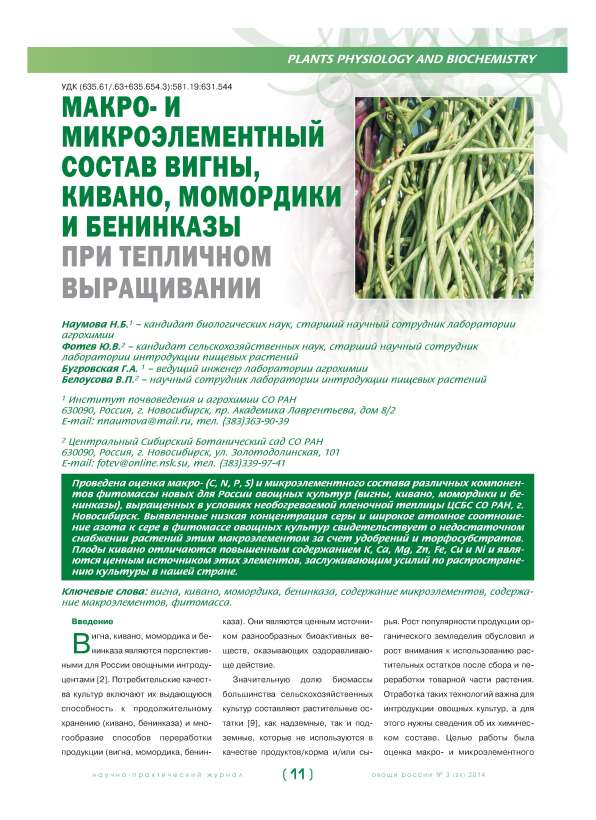
Проведена оценка макро- (С, N, Р, S) и микроэлементного состава различных компонентов фитомассы новых для России овощных культур (вигны, кивано, момордики и бенинказы), выращенных в условиях необогреваемой пленочной теплицы ЦСБС СО РАН, г. Новосибирск. Выявленные низкая концентрация серы и широкое атомное соотношение азота к сере в фитомассе овощных культур свидетельствует о недостаточном снабжении растений этим макроэлементом за счет удобрений и торфосубстратов. Плоды кивано отличаются повышенным содержанием К, Са, Mg, Zn, Fe, Си и Ni и являются ценным источником этих элементов, заслуживающим усилий по распространению культуры в нашей стране.
Похожие статьи в разделе Овощеводство и декоративное садоводство
Короткий адрес: https://sciup.org/14025094
IDS: 14025094 | УДК: (635.61/.63+635.654.3):581.19:631.544
Content of macroand micro-elements of vigna, kiwano, bitter melon, and wax gourd in greenhouse cultivation
The content of macro- (C, N, P, S) and micro-elements, as well as some metals was analyzed in fruits, leaves, stems, and roots of vigna, kiwano, bitter melon, and wax gourd growing in the condition of unheated polyethylene-covered greenhouse in Novosibirsk (Russia), The revealed low concentration of sulfur and big atomic ratio of nitrogen to sulfur in plant phytomass is the result of insufficient macro-elements supply from fertilizers and peat-substrates. The kiwano fruits are characterized by high concentration of К, Ca, Mg, Zn, Fe, Cu, and Ni and therefore is worth introducing this culture in Russia,
Список литературы Макро- и микроэлементный состав вигны, кивано, момордики и бенинказы при тепличном выращивании
- Методические указания по определению металлов в почвах с/х угодий и продукции растениеводства. М.: изд-во МСХРФ, 1992.-61 с.
- Фотев Ю.В., Кудрявцева Г.А., Белоусова В.П. Интродукция экзотических теплолюбивых овощных растений в Сибири//Овощеводство Сибири. Новосибирск: Сиб. отд-ние РАСХН, 2009. -С. 176-188.
- Agren G. I. The С: N: Р stoichiometry of autotrophs -theory and observations//Ecology Letters. 2004. -V.7.-N. 7. -P. 185-191.
- Allen A. P., Gillooly J. F. Towards an integration of ecological stoichiometry and the metabolic theory of ecology to better understand nutrient cycling//Ecology Letters. -2009. -V. 12,-N.5. -P.369-384.
- Borer E. T., Bracken M. E. S., Seabloom E., Smith J. E., Cebrian J., Cleland E.E., Elser J. J., Fagan W. F., Gruner D. S., Harpole W. S., Hillebrand H., Kerkhoff A. J., Ngai J. T. Global biogeography of autotroph chemistry: is insolation a driving force?//Oikos. 2013,-V.: P. 1121-1130.”
- Jamal A., MoonY.-S., Abdin M.Z. Sulphur -a general overview and interaction with nitrogen//Australian Journal of Crop Science. 2010. -V. 4,-N.7. -P.:523-529.
- Mohd H. I., Hawa Z.E. J. The Relationship of Nitrogen and C/N Ratio with Secondary Metabolites Levels and Antioxidant Activities in Three Varieties of Malaysian Kacip Fatimah (Labisia pumila Blume)//Molecules. 2011. -V. 16. -PP. 5514-5526.
- Niklas K.J., Owens T., Reich P.B., Cobb E.D. Nitrogen/phosphorus leaf stoichiometry and the scaling of plant growth//Ecology Letters. 2005. -V.8. -P. 636-642.
- Smil V. Crop Residues: Agriculture’s Largest Harvest//Bioscience. 1999. -V.49.-No.4. -P. 299-308.
- Stewart, B. A. Whitfield, C. J. Effects of Crop Residue, Soil Temperature, and Sulphur on the Growth of Winter Wheat//Soil Sci. Soc. Am. J. 1965. -V. 29. -PP.752-755.
- USDA National Nutrient Database for Standard Reference Release 2: http://ndb.nal.usda.gov/ndb/foods/
