
Mathematical Modeling and Experimental Evaluation of the Properties of an ED-20 / ETAL-45M Epoxy Nanocomposite Modified with Multi-Walled Carbon Nanotubes
Journal: Bulletin of Voronezh State University of Engineering Technologies @vestnik-vsuet
Section: Химическая технология
Article in issue: 2 (108) т.88, 2026.
Free access
A structural-phenomenological mathematical model was developed for the engineering description of the properties of an epoxy nanocomposite based on ED-20 resin, ETAL-45M hardener, and multi-walled carbon nanotubes. The aim of the study was to establish the trends in flexural strength, Charpy impact toughness, Brinell hardness, and gravimetric wear loss as a function of nanofiller content, as well as to assess the applicability of the model to both unreinforced and glass-fabric-reinforced composites. It was shown that, for the unreinforced system, the addition of carbon nanotubes up to 1.0 phr results in an increase in flexural strength, Charpy impact toughness, and Brinell hardness. At a filler content of 1.5 phr, the flexural strength decreases slightly, which indicates the existence of an optimal filler-content range. For the glass-fabric-reinforced composite, reinforcement was found to be the dominant factor governing the improvement of mechanical properties. The model takes into account nanofiller content, the degree of its distribution within the matrix, rheological constraints, and the structural features of five-layer glass-fabric reinforcement. The practical significance of the work lies in the possibility of using the proposed approach for the preliminary selection of composition and processing conditions for epoxy nanocomposites with a specified combination of mechanical and tribological characteristics.
Short address: https://sciup.org/140315826
IDS: 140315826 | UDC: 678.686:620.3:519.6 | DOI: 10.20914/2310-1202-2026-2-343-351
Математическое моделирование и экспериментальная оценка свойств эпоксидного нанокомпозита ЭД-20 / ЭТАЛ-45М, модифицированного многослойными углеродными нанотрубками
Разработана структурно-феноменологическая математическая модель, предназначенная для инженерного описания свойств эпоксидного нанокомпозита на основе смолы ЭД-20, отвердителя ЭТАЛ-45М и многостенных углеродных нанотрубок. Цель работы состояла в установлении закономерностей изменения прочности при изгибе, ударной вязкости по Шарпи, твёрдости по Бринеллю и весового износа при варьировании содержания нанонаполнителя, а также в оценке применимости модели для неармированных и стеклотканевых композитов. Показано, что для неармированной системы введение углеродных нанотрубок в количестве до 1,0 масс. ч. приводит к росту прочности при изгибе, ударной вязкости по Шарпи и твёрдости по Бринеллю. При содержании 1,5 масс. ч. прочность при изгибе несколько снижается, что указывает на наличие области рационального содержания наполнителя. Для стеклотканевого композиционного материала установлено, что армирование является доминирующим фактором повышения механических свойств. Модель учитывает содержание нанонаполнителя, степень его распределения в матрице, реологические ограничения и особенности пятислойного стеклотканевого армирования. Практическая значимость работы состоит в возможности использования предложенного подхода для предварительного выбора состава и условий получения эпоксидных нанокомпозитов с заданным сочетанием механических и трибологических характеристик.
Text of the scientific article Mathematical Modeling and Experimental Evaluation of the Properties of an ED-20 / ETAL-45M Epoxy Nanocomposite Modified with Multi-Walled Carbon Nanotubes
Current research in the field of epoxy resin modification is aimed at improving their performance characteristics and expanding their application areas through the targeted alteration of structure and interfacial interactions. A review of the chemical modification of epoxy oligomers emphasizes that variations in chemical structure and network topology represent one of the principal approaches to controlling the viscosity, thermal stability, and strength characteristics of epoxy materials [1]. Studies [2, 3] indicate that hybrid approaches combining elastomeric modifiers, rigid nanoparticles, and high-aspect-ratio carbon fillers are of the greatest practical interest.
In studies involving the use of carbon nanotubes as fillers for various matrices, the principal challenge remains the achievement of their uniform distribution. In the preparation of CNT-filled epoxy composites, attention should be paid not only to nanotube concentration, but also to the method of incorporation, the presence of surfactants, the dispersity of the introduced nanostructures and their agglomerates, and the nature of interfacial adhesion. This is confirmed by studies devoted to the preparation of epoxy compositions modified with carbon nanotubes, as well as investigations of masterbatches and low concentrations of nanomodifiers in epoxy systems [4, 5]. It was also shown in [6] that changes in the elastic-strength properties and impact toughness of epoxy composites are governed not only by CNT content, but also by the quality of their distribution within the matrix. Similar conclusions were reported in [7], where, for compositions containing multi-walled carbon nanotubes, the mechanical properties and fracture toughness were found to depend on the morphology of the dispersed phase and the degree of filler agglomeration. The sensitivity of the final properties to the selected dispersion route has also been demonstrated in recent comparative studies of CNT/epoxy systems processed by different dispersion methods [8].
In contemporary literature, the rheological aspect is regarded as an independent design constraint for low-filled CNT-containing epoxy composites. For epoxy systems, an improvement in
This is an open access article distributed under the terms of the Creative Commons Attribution 4.0 International License
strength and fracture toughness cannot be considered sufficient if the composition loses processability during mixing, degassing, and mold filling. Studies on the effect of diluents on the rheological and technological properties of epoxy composites show that even a slight variation in composition may sharply reduce viscosity, alter porosity, and affect the final structure of the material [9]. This is consistent with the general concept of structural-rheological design of epoxy nanocomposites, in which CNT content must be considered together with the efficiency of their dispersion and the acceptable level of viscosity variation in the polymer matrix. This approach is strongly supported by publications on the fracture mechanics of polymer nanocomposites, which emphasize that a high filler dispersity alone does not guarantee an optimal combination of composite properties unless processability is also taken into account [10]. In situ investigations of cross-linking CNT-thermosetting epoxy systems further confirm the close relationship between filler distribution, network formation, and rheological response [11]. Similar conclusions follow from recent studies addressing the combined effect of carbon nanotubes and nanosilica on the rheology of epoxy systems [12].
Particular attention is paid to fracture toughness and the energy dissipation mechanisms of nanocomposites during fracture. For epoxy matrices, this group of properties is especially sensitive to the micro – and nanoscale structure of the material. References [7, 10] show that small additions of СNТs are capable of redistributing stresses in the composite, altering the crack propagation path, causing local crack arrest, and promoting crackbridging reinforcement. At the same time, the literature emphasizes the nonmonotonic nature of the observed effect: after the optimum content of a carbon nanostructured filler, in particular СNТs, has been reached, the beneficial contribution may decrease because of filler-particle agglomeration, the formation of defective regions, and deterioration of interfacial stress transfer [5–7]. Therefore, in the mathematical description of the properties of epoxy nanocomposites, it is necessary to account not for a linear dependence, but for an extremal dependence of their physical and mechanical properties and tribological characteristics on CNT content.
In addition to strength and deformation characteristics, increasing attention is being devoted to the tribological properties of epoxy materials. Studies addressing the influence of modifier dispersity on the wear resistance and adhesive properties of epoxy polymers show that, for coatings and service-loaded materials, not only the chemical nature of the filler but also its size scale and distribution pattern are of major significance [13]. Numerous studies devoted to the use of multi-walled СNТs in epoxy composites confirm a pronounced improvement in tribological characteristics, including a reduction in wear rate and an increase in hardness, at low filler concentrations [14]. This is of fundamental importance for the practical use of epoxy nanocomposites, since it makes it possible to develop mathematical models intended for the selection of composition and processing conditions while accounting for the need to ensure not only specified mechanical characteristics but also the tribological performance of the material.
Studies on modified epoxy binders confirm the high sensitivity of properties to the chemical nature of the filler and to curing conditions [15]. Investigations of core-shell elastomeric particles show that they are capable of increasing the ductility and durability of adhesive epoxy systems while maintaining an acceptable glass-transition temperature [3, 16]. Recent studies of epoxy and epoxybased CFRP systems modified with core-shell rubber nanoparticles indicate that such particles remain effective even in reinforced composites, where their contribution is superimposed on the effect of laminate architecture [17]. Therefore, the development of an extended design model for an epoxy nanocomposite containing СNТs and elastomeric particles appears methodologically justified.
Publications devoted to composites based on carbon nanostructures and thermoplastic or selfhealing components show that combining СNТs with an additional viscoelastic phase makes it possible to solve several tasks simultaneously: to increase resistance to crack initiation and propagation, to reduce sensitivity to microdamage, and to broaden the range of practical applications of the material [18]. At the same time, recent studies on CNT-filled epoxy-carbon fabric composites demonstrate that nanomodification may also improve the tribological behavior of reinforced systems [19]. Similar conclusions have been reported for woven glass/epoxy hybrid nanocomposites, where the final properties were shown to depend on both the fabrication method and the type of epoxy matrix [20]. An analysis of the literature in this field confirms the expediency of formulating a “composition–structure–property” model in which CNT content, dispersion characteristics, rheological constraints, and the presence of additional modifiers are considered as interrelated factors. For the development of epoxy nanocomposites with improved performance characteristics, this approach appears to be the most justified and is consistent with the general trend of current research [1, 2, 9].
The aim of this study is to develop a structural-phenomenological mathematical model suitable for the design of an epoxy nanocomposite based on ED-20 and multi-walled СNТs, and to verify its adequacy for nanocomposites without additional modifiers.
Materials and Methods
ED-20 epoxy resin and ETAL-45М hardener were used as the binder at a mass ratio of 100:50. Multi-walled СNТs with a diameter of 10–30 nm and a length greater than 2 μm (JSC “ZAVKOM,” Tambov) were introduced in amounts of 0.5, 1.0, and 1.5 phr per 100 phr of resin. To ensure uniform distribution of СNТs in the epoxy resin, the resulting system was preliminarily subjected to ultrasonic dispersion for 30 min (power 2 kW, frequency 22 kНz). During dispersion, the temperature of the treated system was not allowed to exceed 30 °C. The resulting system was then passed through a three-roll mill for further treatment aimed at stretching CNT bundles and redistributing CNT agglomerates within the epoxy matrix, while adjusting the roll gaps. At the first processing stage, the gaps between the rolls were 30:15 μm; at the second stage, they were 15:5 μm. During the subsequent treatment of the ED-20-CNT system, pressure was applied progressively in the range of 2–12 N/mm².
To destroy residual agglomerates of carbon nanomaterials, increase the uniformity of their distribution throughout the epoxy resin volume, and improve wetting of the filler surface by the matrix, the system was again subjected to ultrasonic dispersion for 10 min. After the hardener had been added, the composition was vacuum-treated and cured at room temperature.
The glass-fabric-reinforced composite material consisted of a laminate of 5 glass-fabric plies, with each successive ply laid at an angle of 45° relative to the previous one. Impregnation with the nanomodified composite was carried out layer by layer.
The samples were subjected to physical and mechanical characteristics testing. Brinell hardness was measured in accordance with ISO 2039/1–87 using a preliminary load of F 0 = 9.8 N, a test load of F m = 961 N, and a ball diameter of 5.0 mm. Flexural strength was determined by the static three-point bending method on a universal testing machine UTS 101–5 using rectangular specimens (ISO 178:2010). Charpy impact toughness was determined in accordance with ISO 179–1:2010. Gravimetric wear under abrasive friction was determined in accordance with ISO 9352:2012. Depending on the type of test, 7 to 10 replicates were performed for each composition. The tables present the mean values of the measured properties and the characteristic scatter intervals of the series.
Table 1.
Properties of the unreinforced ED-20/ETAL-45М/CNT system
|
CNT, phr УНТ, масс. ч. |
Flexural strength, МРа Прочность при изгибе, МПа |
Charpy impact toughness, kJ/m² Ударная вязкость по Шарпи, кДж/м² |
Brinell hardness, МРа Твёрдость по Бринеллю, МПа |
Gravimetric wear loss, g Весовой износ, г |
|
0.0 |
60 ± 2.0 |
5.5 ± 0.7 |
191 ± 7 |
0.0050 ± 0.0007 |
|
0.5 |
68 ± 4.0 |
7.6 ± 1.1 |
192 ± 6 |
0.0034 ± 0.0005 |
|
1.0 |
75 ± 4.0 |
12.0 ± 1.4 |
196 ± 7 |
0.0032 ± 0.0002 |
|
1.5 |
72 ± 3.5 |
11.0 ± 1.3 |
201 ± 7 |
0.0027 ± 0.0002 |
Table 2.
Properties of the glass-fabric-reinforced composite with an ED-20/ETAL-45М/CNT matrix
|
CNT, phr УНТ, масс. ч. |
Flexural strength, МРа Прочность при изгибе, МПа |
Charpy impact toughness, kJ/m² Ударная вязкость по Шарпи, кДж/м² |
Brinell hardness, МРа Твёрдость по Бринеллю, МПа |
|
0.0 |
126 ± 4.0 |
22.0 ± 1.4 |
248 ± 5 |
|
0.5 |
133 ± 5.0 |
24.0 ± 2.0 |
250 ± 5 |
|
1.0 |
135 ± 5.0 |
27.0 ± 2.2 |
253 ± 5 |
|
1.5 |
142 ± 6.0 |
26.0 ± 2.0 |
255 ± 5 |
Results and Discussion
In the general formulation of the mathematical model for designing an epoxy nanocomposite, the design variables are taken as the mass fraction of multi-walled carbon nanotubes, x CNT , the mass fraction of core-shell elastomeric particles, x cs , and the processing method affecting the uniformity of CNT distribution in the matrix, which is characterized by the index D . In the present study, the case corresponds to a composite with x cs = 0.
The mass fraction of carbon nanotubes relative to the total mass of the reactive composition is determined by:
x CNT = 100 m С NT /( mresin + m hardener + m CNT ) (1) where m resin is the resin mass, m hardener is the hardener mass, and m CNT is the nanotube mass.
The quality of CNT distribution in the epoxy matrix is described by the dimensionless index D . This index decreases with increasing CNT content
Zavrazhin D.O. et al. Proceedings of VSUET, 2026, vol. 88, no. 2, pp. 343-351
because of the higher probability of secondary agglomeration and depends on the intensity of mechanical and ultrasonic treatment [5, 7]:
D = D 0 ( method )- exp ( — k a • xcm. ) ,
D< D < D
min
max
Here, D 0 (method) is the initial value of the distribution index determined by the selected filler distribution procedure; k is the agglomeration sensitivity coefficient characterizing the rate of deterioration in distribution quality with increasing carbon nanotube content. The viscosity of the reactive composition before gelation is considered as a processability constraint. In the general model, it is written in multiplicative form, taking into account core-shell elastomeric particles and the percolation contribution of carbon nanotubes:
П = П0exp ( ael • xs )fcNT ( xCNT, D )
xc = x0 / max ( D, Dmin) fcNT = 1 + b1' D' xCNT? + b2'
’H (xCNT — xc )'((xCNT — xc )/xc )
where η 0 is the base viscosity of the initial binder, a el is the coefficient describing the effect of the elastomeric modifier, x с is the effective threshold of carbon nanotube network formation. Function (5) describes the influence of CNTs on the variation of the system characteristics; coefficient b 1 characterizes the intensity of the sub-threshold contribution, coefficient b 1 characterizes the intensity of the above-threshold contribution, and H is the Heaviside function.
The Heaviside function is used to specify the threshold nature of the process. In the present model, it activates the above-threshold term only when the carbon nanotube content reaches the effective threshold. This form reflects the rapid increase in viscosity after the system reaches the region of network organization of nanotubes [6, 8]. The parameters p and q define the nonlinearity of the concentration dependence of the function f CNT : the exponent p refers to the pre-threshold region, whereas q refers to the above-threshold region, where the effects of spatial carbon nanotube network formation become significant.
Since no additional elastomeric modifier was used in the experimental part of the work, the coefficients were identified for the particular case x cs = 0. The property responses are given in the form of smoothed functions with moderate nonmonotonicity, reflecting the competition between reinforcement and agglomeration:
|
°flex ( x ) = a 0 + A a • x — B a ^ x 2 |
(6) |
|
a Ch ( x ) = a 0 + A a ' x — B a • x 2 |
(7) |
|
W ( x ) = W )^ eXP ( - k w • x )’ 1 + a w • exp ( ( ( x - x p ) / ) 2 ) |
(8) |
In Eqs. (6)–(8), x denotes the CNT content, expressed in parts by weight per 100 parts by weight of resin. This functional form provides a physically plausible interpretation of the observed trends: an increase in strength and impact toughness up to an optimum region followed by saturation, as well as a decrease in wear after the initial zone of structurally unstable behavior has been overcome. Here, a flex ( x ) and aCh ( x ) represent the flexural strength and Charpy impact toughness of the unreinforced composition, respectively; σ 0 and a 0 are the corresponding properties of the initial unmodified matrix; and A σ , B σ , A a , and B a are fitting coefficients. In the wear equation, W 0 corresponds to the wear of the initial matrix, k w characterizes the exponential decrease in wear with increasing CNT content, a w defines the amplitude of the local deviation, x p specifies the position of this deviation along the concentration axis, and S w characterizes its width.
For the reinforced material, the model takes into account that reinforcement was provided by glass fabric, and the laminate consisted of 5 plies, each oriented at an angle of 45° relative to the preceding one. If the orientation of the first ply is taken as 0°, the stacking sequence may be written as [0/45/90/135/180]. To account for the reinforcement architecture, parameter A was introduced:
A = { n = 5; Δθ = 45°}
When describing flexural strength, the ply orientation factor was additionally introduced:
П = -S cos4 ^
n which is equal to 0.5 for the stacking sequence considered. The transfer relations for the reinforced material therefore take the form:
f = C„ ( A ) + A, ( A ) ■ П -0flex - a0) (11)
aCh = Ca ( a ) + Aa (A) • (aCh — a о) (12)
where C σ and C a are the baseline coefficients accounting for the contribution of reinforcement, while λ σ and λ a characterize the transfer of the matrix modification effect to the properties of the reinforced composite.
The proposed model was implemented as a computational algorithm in the MATLAB environment, which makes it possible to perform parametric calculations, analyze the effect of CNT content on material properties, and compare calculated results with experimental data. The algorithm structure includes the same main design variables as the general model: carbon nanotube content, core-shell elastomeric particle content, and dispersion method. The software implementation retains the “dispersion index - viscosity - modulus/strength and energy characteristics” blocks, whereas the particular branch x cs = 0 corresponds to the experimentally studied ED-20/ETAL-45M/CNT system.
For the unreinforced matrix, the model satisfactorily describes the general pattern of property changes upon carbon nanotube modification. The coefficient of determination was R2 = 0.90 for flexural strength, R2 = 0.90 for Charpy impact toughness, and R2 = 0.89 for gravimetric wear loss in logarithmic scale. The calculated data agree qualitatively with the experimental results and correctly reproduce the direction of property changes with increasing carbon nanotube content. The remaining discrepancies may be caused by structural heterogeneity of the composition and by the scatter of characteristics typical of nanomodified epoxy systems.
Figure 1 shows that the greatest increase in flexural strength for the unreinforced matrix is observed at a CNT content of 1.0 phr. A further increase in concentration no longer leads to a proportional increase and is accompanied by saturation of the response. This behavior is consistent with the concept of an optimum carbon nanotube content, beyond which increased agglomeration partly compensates for the reinforcing effect [5-7].
Charpy impact toughness (Fig. 2) increases more sharply than flexural strength, indicating a significant influence of carbon nanotubes on fracture mechanisms and energy dissipation. The calculated relationship reproduces the main trend in Charpy impact toughness as the carbon nanotube content varies. The greatest deviation between calculated and experimental values is observed in the region of 0.5 phr CNT, which may be associated with the increased sensitivity of the material to local structural heterogeneity at the initial stage of modification.
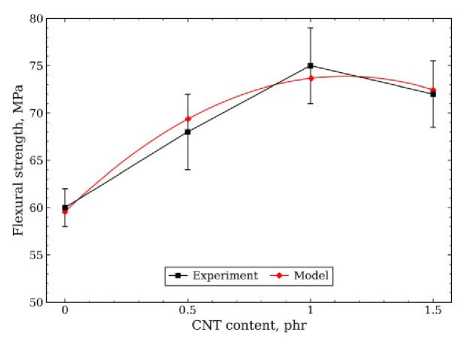
Figure 1. Flexural strength of the unreinforced matrix: experimental mean values and approximating calculated relationship
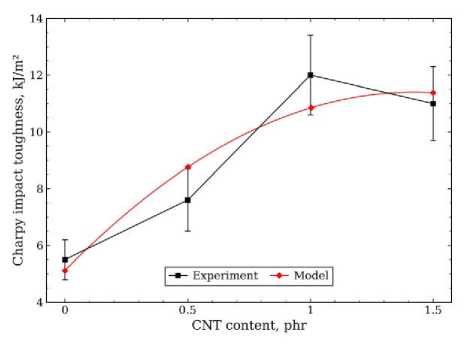
Figure 2. Experimental and calculated values of Charpy impact toughness
Brinell hardness of the unreinforced system varies within a relatively narrow range from 191 ± 7 to 201 ± 7 MPa. This trend indicates that the effect of CNTs on resistance to local indentation is less pronounced than their effect on flexural strength and impact toughness. In other words, matrix modification by nanotubes affects fracture-related characteristics and the energy absorption capacity of the material to a greater extent than its local surface rigidity. At the same time, the gradual increase in hardness with increasing CNT content indicates densification and strengthening of the matrix structure at higher filler concentrations (Fig. 3).
A significant decrease in gravimetric loss under abrasive wear is observed for compositions containing 1.0-1.5 phr CNT. At the same time, the composition containing 0.5 phr exhibits increased scatter. This makes it possible to interpret the initial concentration range as a zone of unstable formation of the reinforcing structure, in which the change in the nature of contact with the abrasive has not yet been fully stabilized (Fig. 4).
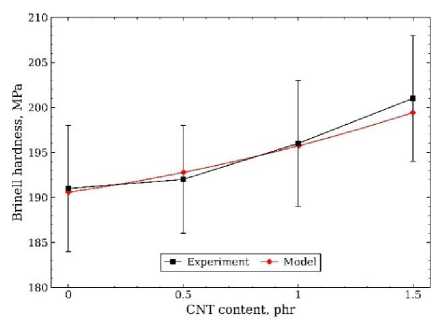
Figure 3. Experimental and calculated values of Brinell hardness
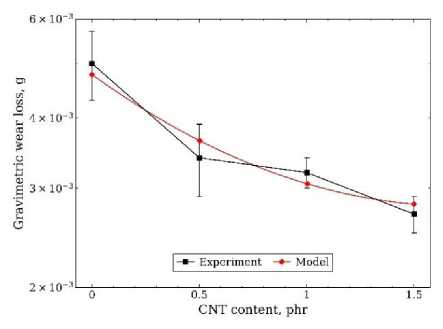
Figure 4. Gravimetric wear loss of the unreinforced matrix
In the reinforced system, the effect of CNTs on flexural strength remains consistently positive over the entire concentration range investigated. In comparison with the unreinforced matrix, the absolute strength level is substantially higher, which reflects the dominant contribution of glass-fabric reinforcement to resistance against flexural failure.
In this case, the introduction of CNTs should be regarded as a factor of additional matrix strengthening within the laminated composite (Fig. 5). At the same time, the maximum energy-absorption capacity of the reinforced material under impact loading is achieved at a CNT content of 1.0 phr (Fig. 6).
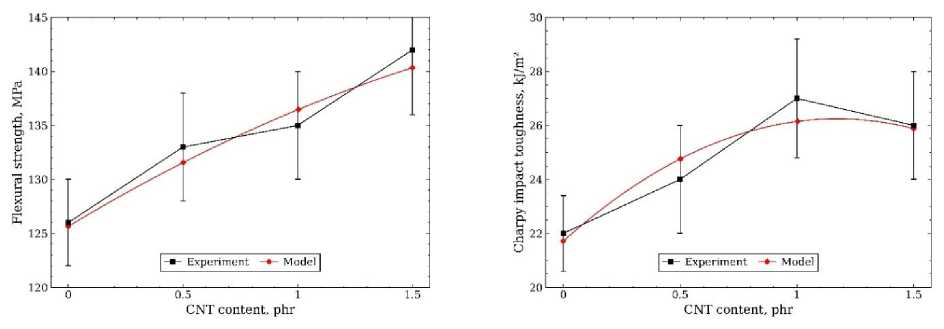
Figure 6. Impact toughness of the glass-fabric-reinforced composite
Figure 5. Flexural strength of the glass-fabric-reinforced composite
Brinell hardness is at a substantially higher level than that of the unreinforced system. As the CNT content increases, hardness exhibits a smooth and almost monotonic rise. This indicates that, in the reinforced material, resistance to local indentation is governed primarily by the presence of the glass-fabric framework, whereas the contribution of CNTs is additional but stable. Compared with impact toughness and flexural strength, the variation in hardness is less pronounced, which points to a more stable sensitivity of this parameter to changes in matrix composition (Fig 7).
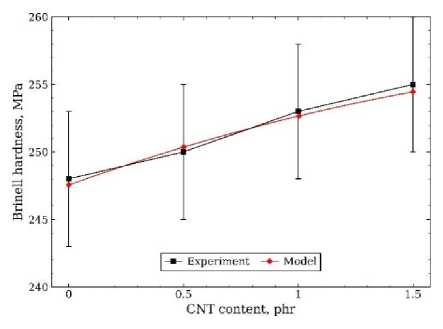
Figure 7. Values of Brinell hardness
For the glass-fabric composite, the agreement between calculated and experimental data proved somewhat poorer for impact toughness (R2 = 0.64) than for flexural strength (R2 = 0.80), which appears natural. In the reinforced system, the scatter of the results is determined not only by the modified matrix, but also by nonuniform binder distribution within the structure of the reinforcing filler, local ply orientation, and impregnation quality. For this reason, transfer relations (11) and (12) should be regarded as an engineering approximation rather than a universal law.
Conclusion
The developed structural-phenomenological model made it possible to relate the composition of the reactive epoxy formulation, the quality of dispersion of multi-walled carbon nanotubes, and the set of performance-relevant material properties within a unified computational framework. The goal was to construct a model intended not for exact reproduction of every individual experimental point, but for an engineering description of the general trends governing changes in the properties of the ED-20/ETAL-45M/CNT system as the nanofiller content varies. The results obtained are consistent with this objective: the model captures the increase in flexural strength and impact toughness in the range of low and moderate CNT concentrations, as well as the reduction in gravimetric wear loss for compositions containing 1.0-1.5 phr filler. The model coefficients were identified for the particular case of a system without additional modifiers.
The scientific novelty of the work lies in the proposed consistent “composition-structure-property” framework, in which a structural parameter characterizing the degree of nanotube distribution is introduced, and the rheological block of the model is integrated with the block describing the mechanical and tribological characteristics of the material. This approach makes it possible to consider processability and service properties not as separate features, but as interrelated characteristics of the same composition. The practical significance of the results lies in the possibility of using the proposed model for the preliminary selection of CNT content and for formulating optimization problems related to the composition of epoxy nanocomposites intended for binders, coatings, and composite materials.
Based on the results obtained, it can be concluded that the introduction of 1.0-1.5 phr CNT into the ED-20/ETAL-45M system provides the most favorable combination of flexural strength, impact toughness, and wear resistance. For the reinforced material, it was established that the introduction of glass fabric is the dominant factor responsible for the improvement of mechanical properties, whereas CNTs provide additional matrix modification and contribute to the increase in flexural strength and impact toughness within the laminated composite.
Acknowledgements
The study was carried out using the scientific and laboratory facilities of the REC TSTU-ISMAN “Solid-Phase Technologies”.
