
Modern Ecomonitoring of Anatidae in Azerbaijan
Journal: Bulletin of Science and Practice @bulletennauki
Section: Естественные науки
Article in issue: 1 т.12, 2026.
Free access
The obtained information significantly supplements the existing materials on the eco-biology of ducks and can be used to adjust hunting parameters in suburban hunting grounds. The data are of practical interest to the Ministry of Environmental Protection of Azerbaijan, as they can be used in the cadastral records of the Absheron Peninsula's forest-park green belt - the green areas of the cities of Baku, Sumgait, and Ganja. The available data on parasite fauna and the incidence of infectious diseases can be used in the work of the Veterinary Department of the Republic of Azerbaijan.
Similar articles in the section Aves (birds)
Short address: https://sciup.org/14135572
IDS: 14135572 | UDC: 598.2/9-15 | DOI: 10.33619/2414-2948/122/07
Современный экомониторинг Anatinae в Азербайджане
Представленные данные значительно дополняют сведения по экобиологии уток в Азербайджане. Материал может быть использован для корректировки параметров охоты на пригородных охотничьих угодьях. Данные представляют практический интерес для Министерства охраны окружающей среды Азербайджана, поскольку могут быть использованы в кадастровых записях лесопарковой зеленой зоны Апшеронского полуострова - зеленых зон городов Баку, Сумгаит и Гянджа. Имеющиеся данные о паразитофауне и распространенности инфекционных заболеваний могут быть использованы в работе Ветеринарного управления Азербайджанской Республики.
Text of the scientific article Modern Ecomonitoring of Anatidae in Azerbaijan
Бюллетень науки и практики / Bulletin of Science and Practice
Conservation of aquatic organisms inhabiting natural water bodies involves identifying their species composition, assessing the impact of the most significant factors, and discovering their ecological characteristics. Under the influence of global climate change, aquatic organisms in water bodies are declining in number, migrating, transforming communities, and increasing the spread of invasive species [1].
Mallards, as a partially synanthropic species, have a more extended pairing period, beginning as early as the third ten-day period of September [2].
During this time, isolated pairs formed during the combined molt, which occurred within the city limits, are observed. In October and November, a fairly large number of pairs (10-40) are already observed on city water bodies: for example, we observed up to 35 pairs on water bodies in Absheron at the end of October. During the winter period (December-February), it is quite difficult to determine the number of pairs in reservoirs, since the population density is high during these months. For example, the average population density in the park from 2020 to 2025 was 0.38±0.07 individuals/m2, while at the pond in Sumgayit during the same years it was 0.84 ± 0.24 individuals/m2. Signs of pair formation and the search for a mate during this period include mating displays, fights between males, and false mating, which in some years is observed from the second half of January (the earliest date is January 27).
Results
According to our data, the mallard has earlier incubation periods and an extended nesting period, so its reproduction rates were analyzed [3].
The territory we are studying includes both natural and natural-anthropogenic and anthropogenic reservoirs, where reproduction parameters may differ from each other and be expressed in differences in the dates of the onset of reproduction, the length of the period itself, and other characteristics [4, 5].
In the second half of April, pairing of dabbling ducks ends, and fights between males are quite rare. In May and June, pairs of ducks are still observed, but in smaller numbers. In July, pairs are quite rare (Table 1).
Table 1
PHENOLOGICAL INDICATORS AND DATA ON THE NUMBER OF MALLARDS FROM 2018 TO 2024 IN THE PARK GREEN BELT OF THE ABSHERON PENINSULA
|
Indicator A group |
2018 |
2019 |
2020 |
2021 |
2022 |
2023 |
2024 |
|
of ducks |
|||||||
|
Date of first egg laying wild |
17.04 |
22.04 |
07.24 |
02.04 |
11.04 |
09.04 |
05.04 |
|
urban |
14.04 |
19.04 |
12.4 |
01.04 |
04.04 |
03.04 |
11.04 |
|
Number of days from a fixed date wild |
29 |
34 |
19 |
14 |
23 |
21 |
17 |
|
(March 20) to the date of laying the urban first egg |
26 |
31 |
24 |
13 |
16 |
15 |
23 |
|
Laying duration (days) wild |
36 |
37 |
36 |
43 |
32 |
65 |
48 |
|
urban |
25 |
25 |
26 |
29 |
45 |
64 |
43 |
|
Number of chicks per female wild |
8.3 |
6.6 |
6.4 |
5.7 |
6.0 |
6.3 |
6.8 |
|
(individuals) urban |
7.4 |
6.1 |
6.2 |
5.1 |
5.9 |
6.3 |
6.0 |
|
Number of registered females with broods (individuals) |
3 |
5 |
24 |
12 |
36 |
43 |
98 |
|
Number of wintering mallards (individuals) |
1255 |
1450 |
1725 |
2009 |
1941 |
2787 |
3746 |
|
Number of wintering female mallards (individuals) |
627 |
725 |
862 |
992 |
933 |
1299 |
1827 |
|
Date of establishment of positive temperatures |
16.04 |
27.04 |
29.04 |
26.04 |
22.04 |
26.04 |
22.04 |
|
The number of days from the date of the onset of positive temperatures from a fixed date in March (March 20) |
28 |
39 |
41 |
38 |
34 |
38 |
34 |
|
Average temperature (0C) 30-40 days before the first egg is laid |
-2.7 |
0 |
-1.2 |
-2.6 |
-1.9 |
0.3 |
-1.1 |
|
The sum of average daily air temperatures for 30-40 days before the start of laying |
-98.8 |
-0.6 |
-43.7 |
-100.8 |
-92.3 |
1.9 |
-43.3 |
Pairs typically disband after the female sits on the eggs. Males and uncaught females then form groups for the molting period [6].
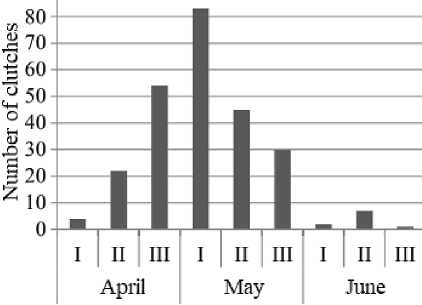
To compare reproduction, we analyzed two main characteristics of the breeding period: the date of laying the first egg and the length of the nesting period for ducks nesting in natural water bodies (wild) and nesting in residential areas (“urban”) (Figure 1, 2).
А
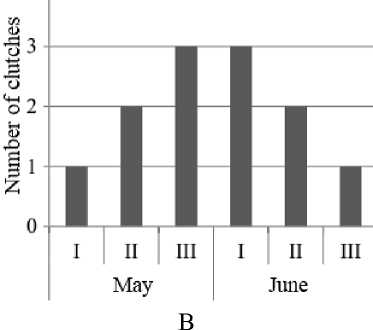
Figure 1. Onset and intensity of nesting of mallard (n=248) (A) and teal (n=12) (B)
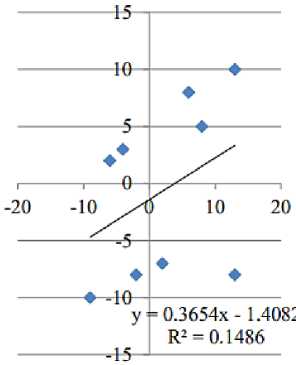
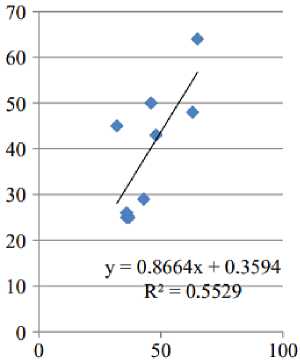
According to our data, the nesting dates for wild and urban ducks do not differ significantly (r=0.39), nor does the length of the breeding season (r=0.74). Based on this, duck breeding parameters can be considered generally for both conventionally separated populations. The number of broods in the forest park green belt has been steadily increasing since 2020, as has the number of wintering mallards; a significant positive correlation has been established between them (r = 0.90). The average annual population growth rate for ducks in the Absheron Peninsula and Ganja forested green belt is 354%, which is consistent with the natural growth rate, which ranges from 300 to 400%. In residential areas of the large cities of Baku and Sumgayit, the mallard population growth rate is low from 20% to 50% while in Ganja, this rate is similar to the natural growth rate. On average, there are 6.4 chicks per pair of mallards, and this value decreases with an increase in the number of females that successfully overwinter and participate in reproduction (r = -0.21).
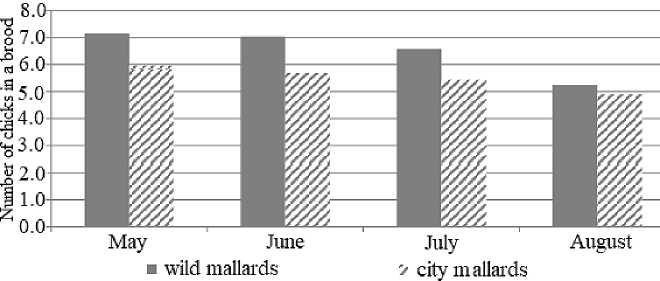
Figure 2. Average number of chicks in broods of wild (n=106) and urban (n=142) mallards
In addition to intraspecific characteristics, spring weather conditions, such as the sum of average daily air temperatures 30-40 days before the start of laying, can also influence clutch size and, consequently, brood size. According to our data, no statistically significant correlation was found between the date of first egg laying and weather conditions 30-40 days before the start of nesting or the date of average daily air temperature crossing 0°C in the study area, whereas this indicator was significant for Baku (r = 0.88). According to our data, the date of first egg laying was associated with an increase in the number of female mallards on wintering grounds (r = 0.57), which directly influences the duration (extension) of the breeding period. The egg-laying period in mallards extends from April to June (Figure 3).
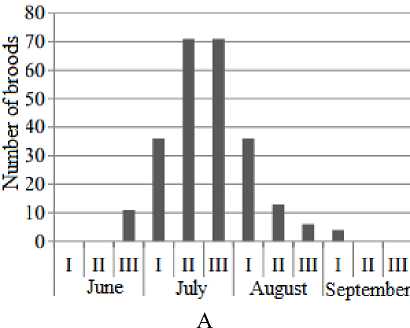
Figure 3. Dynamics of the wing take-off of broods of mallards (A) and teal ducks (B)
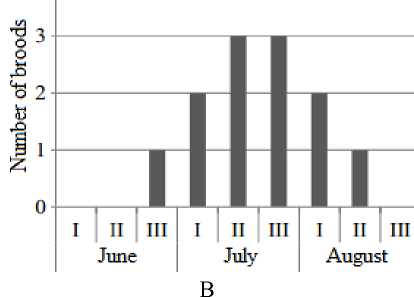
The duration of this period fluctuates across years (on average, 42.3 days) and is proportional to the increase in the number of wintering mallards (r = 0.61). A comparison of the date of first egg laying and the length of the nesting period revealed a correlation such that the nesting period lengthens as the egg-laying date advances (r = -0.22). The duration of the nesting period may also depend on the water content of the breeding grounds, predation, and nest parasitism. A close correlation has been observed between the sum of minimum soil temperatures over the period preceding the onset of nesting. Most of the chicks fledge before the beginning of August, so the last flightless mallard chicks can be seen until September, and the teal chicks until mid-August. Mallard and teal nests were found near bodies of water, where broods were subsequently observed. Finding nests in urban areas was quite difficult. Firstly, ducks camouflage their nests more carefully, and secondly, the areas where broods were subsequently found are located in many private and protected areas. Mallard nests averaged 8.3 eggs (n=47), with a maximum of 14, while teal nests averaged 6-8 to 10 eggs (n=6). Due to the widespread synanthropization of mallards, there are known cases of them nesting in unnatural locations using unusual materials in cities. In Baku, for example, nesting in attics and roofs is already common.
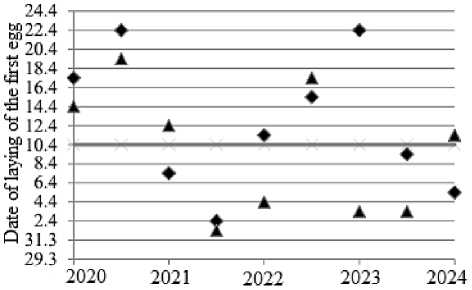
+ date of laying the first egg by wild mallards
A date of laying the first egg by "urban" mallards
-— average long-term date of laying the first egg
B
A
Figure 4. Date of first egg laying by mallards in two groups of water bodies (A) and their correlation analysis (B)
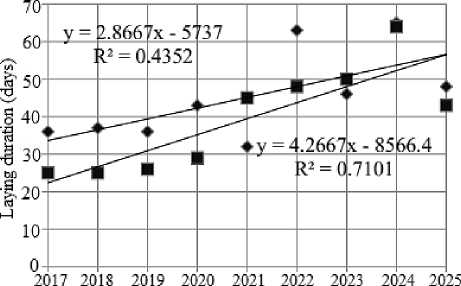
Wild
Linear (wild)
■ "Urban"
--- Linear ("Urban")
B
A
-
Figure 5. Extension of the nesting period of mallards in two groups of water bodies (A) and their correlation analysis (B)
Conclusion
During autumn migrations, injured mallards were frequently observed on the ponds of Absheron Park, some of which remained for the winter. The most common specimens were those with broken wings, missing flight and tail feathers, broken or missing legs, and broken beaks. In November 2021, a female was observed with a broken arrow in her neck. Ducks with torn leggings were also frequently observed, which were subsequently also left for the winter. Our data, in most cases, fill gaps in the existing literature on the migrations of some duck species and complement existing data on the timing and intensity of migration. Specifically, we noted: earlier arrival of mallards on ice-free water bodies on the Absheron Peninsula; in spring, which is most likely due to an increase in the number of wintering birds.
