
Modus operandi as an analytical tool in criminal profiling
Journal: Pravo - teorija i praksa @pravni-fakultet
Section: Articles
Article in issue: 4 vol.42, 2025.
Free access
In contemporary criminology, modus operandi represents one of the key tools for understanding, reconstructing, and predicting criminal behavior. This paper examines modus operandi not only as a technical pattern of crime execution but also as an analytical instrument within the framework of criminal profiling. Special emphasis is placed on the principles and elements of modus operandi, its evolutionary nature, the analysis of modus operandi in investigative practice, the challenges of its application, and the relationship between modus operandi and the offender’s motives. Through qualitative content analysis, case studies, and comparative methodology, the research identifies ways in which modus operandi is used to recognize behavioral patterns, connect multiple criminal acts, and narrow the circle of suspects. The paper also highlights practical challenges in applying modus operandi, including behavioral variability, deliberate deception of investigators, and emphasizes the distinction between the functional modus operandi and the offender’s signature—a unique element that fulfills emotional and psychological needs. The results indicate that modus operandi, when properly interpreted, can have significant analytical and operational value in the process of criminal profiling. It is concluded that integrating modus operandi into forensic and investigative analysis is essential for a deeper understanding of crime dynamics, particularly in the context of serial offenses. At the same time, excessive reliance on modus operandi when analyzing crimes and creating offender profiles should be approached with caution due to the deceptive nature of criminal offenders.
Similar articles in the section Criminology. Criminal sciences. Criminalistics
Short address: https://sciup.org/170211439
IDS: 170211439 | UDC: 343.98:343.95/.971 | DOI: 10.5937/ptp2504018B
Modus operandi kao analitički instrument u kriminalističkom profilisanju
U savremenoj kriminalistici, modus operandi predstavlja jedan od ključnih alata za razumevanje, rekonstrukciju i predikciju kriminalnog ponašanja. Ovaj rad istražuje modus operandi ne samo kao tehnički obrazac izvršenja krivičnog dela, već i kao analitički instrument unutar kriminalističkog profilisanja. Poseban akcenat stavljen je na principe i elemente modus operandi, njegovu evolutivnu prirodu, analizu modusa operandi u radu kriminalističkih istražitelja i izazove njegove upotrebe kao i na odnos između modus operandi i motiva počinioca. Kroz kvalitativnu analizu sadržaja, studije slučaja i komparativnu metodologiju, identifikovani su načini na koje se modus operandi koristi za prepoznavanje obrazaca ponašanja, povezivanje više krivičnih dela, i sužavanje kruga osumnjičenih. Rad takođe osvetljava praktične izazove u primeni modus operandi uključujući promenljivost ponašanja, namerno zavaravanje istrage i naglašava razliku između funkcionalnog modus operandi i potpisa počinioca koji predstavlja njegov lični pečat – element koji zadovoljava emocionalne i psihološke potrebe. Rezultati ukazuju na to da modus operandi, kada se pravilno interpretira, može imati visoku analitičku i operativnu vrednost u procesu kriminalističkog profilisanja. Zaključuje se da je integracija modus operandiu forenzičku i kriminalističku analizu neophodna za dublje razumevanje dinamike krivičnih dela, posebno u kontekstu serijskih zločina. Istovremeno prekomerno oslanjanje na modus operandi prilikom analize zločina i kreiranja profila počinioca, treba uzimati sa rezervom zbog varljivog karaktera počinilaca krivičnih dela.
Text of the scientific article Modus operandi as an analytical tool in criminal profiling
Crime and criminality are words that are overused in everyday discourse. In both print and electronic media, these terms and their synonyms intrigue, attract, and/or repel people. The idealization of mobsters and the creation of criminal myths in popular imagination have been greatly reinforced by the film industry. Individuals often identify with mafia characters from cult films and TV series who leave behind piles of corpses and rivers of blood. Generations are thus unconsciously raised to develop a form of pathological empathy toward criminals, due to the lack of emotional intelligence and the neglect of the importance of understanding security culture (Bjelajac, 2023, p. 27). In this way, society unconsciously participates in the normalization of deviant patterns, further undermining collective resilience and the capacity to recognize and respond to security threats.
The question of how to penetrate the criminal mind has always aroused curiosity and fascination. When we look into the minds of criminals, we can observe characteristic patterns of antisocial behavior, deviant thoughts and actions, impulsivity, disloyalty, selfishness, and lack of empathy; we can thus understand and detect signs of criminal intent and use them in crime prevention. We may even dare to infer the risk factors that have led certain individuals into delinquency (Bjelajac, 2023, p. 19; Bjelajac, 2024a; Bjelajac, 2022). However, such insights require careful interpretation to avoid stereotyping and to ensure that the findings are used solely for the purposes of scientific understanding and the improvement of preventive strategies.
Out of the need to better understand the hidden motives and behavioral patterns underlying criminal acts, the concept of criminal profiling was developed (Bjelajac, 2024b; Bjelajac, 2024c; Bjelajac & Filipović, 2023). This is an interdisciplinary method that integrates psychological expertise, investigative experience, and analytical techniques based on statistical data, with the aim of constructing a psychological profile of an unidentified offender. The essential assumption of this approach is that by analyzing the modus operandi – the method of committing a crime – it is possible to reconstruct the offender’s mindset, thereby increasing the likelihood of anticipating his future actions.
Profiling, therefore, not only assists in identifying and apprehending offenders but also in understanding the social and individual factors that precede crime – thereby paving the way for more effective prevention strategies. The key indicators analyzed in the process of criminal profiling are the modus operandi , or the method of committing the crime, and the so-called signature – the psychological traces left by the perpetrator as expressions of his inner motives and needs.
Many of us have probably heard the terms criminal signature and modus operandi in the news or in detective stories. However, few people know that these two concepts are not the same. Although both describe criminal actions, each has its own unique characteristics. Every crime reflects a specific method of operation and the traits of the criminal who committed it (Chase, 2011). This distinction allows police investigators to more thoroughly analyze the behavioral patterns of offenders and to better understand their motives. In this way, differentiating between modus operandi and criminal signature not only helps in identifying suspects but also in linking separate crimes that may have been committed by the same perpetrator.
Modus operandi represents the practice or routine that criminals regularly use during the commission of a crime. Every offender has an individual modus operandi , which is expressed through specific habits, techniques, and behavioral patterns. These patterns may remain unchanged or evolve over time, depending on the offender’s growing experience and skills (Chase, 2011). In such cases, forensic analysis provides crucial support to investigators in identifying the offender’s behavioral characteristics.Through the analysis of physical evidence, it is possible to determine specific aspects of an offender’s 20
behavior in each case (LawBirdie, 2024). For example, forensic analysis helps investigators recognize with high probability recurring behavioral patterns, such as the time of day most often chosen for committing the crime. Such details may indicate the offender’s habits, as well as how he adapts his actions to favorable circumstances – for instance, choosing periods when detection is less likely due to poor lighting or fewer people in the area.
Modus operandi , which in Latin means method of operation , refers to the specific manner in which an individual acts, particularly in the context of criminal investigations. This term, often abbreviated as modus operandi , describes the characteristic pattern of behavior or actions that an offender uses to successfully commit a crime. Douglas and Olshaker (1998) define modus operandi as what the offender must do in order to carry out the crime.This term is used in police practice to describe how a crime was carried out and what actions the offender took during the act. Within criminal profiling, the modus operandi is analyzed to gain insight into the offender’s thinking and strategies. The focus is on what the individual did to commit the crime, how they attempted to avoid detection, and the method they used to escape the scene. An offender’s modus operandi can assist in identifying, apprehending, or neutralizing the suspect, and it may also be used to determine whether multiple crimes are connected.According to Keppel and colleagues (Keppel, Weis, Brown& Welch, 2005), the term modus operandi first appeared in 1654 in a work titled Zootomia: Because of Their Causes or Their Mode of Operation . However, it did not transition from describing animal behavior to explaining human behavior until the 19th century, when it began to appear in English utilitarian literature (e.g., Mill’s Logic) . In the United States, the same expression was for some time used in patent law to describe the way new machines functioned (Modus Operandi, n.d.).
In the 1890s, detectives of Scotland Yard began maintaining archives on modus operandi in order to track the known behavior of criminals moving from one district to another. Over the years, the record-keeping method adopted by Scotland Yard became the standard in police science.The modus operandi record system sought to document the following key elements, according to the standards established by Scotland Yard (Fosdick, 1916): Category- the type of property targeted; Entry- the point or place of entry; Means- the tools or instruments used; Objective- the type of property stolen; Time- the time of day or any significant feature of the date; Style- whether the offender impersonated someone else to gain entry; Story- any statements the criminal made about themselves; Accomplices- whether the crime was committed with assistance; Transportation- how the offender moved or traveled; Trademark- any unusual or distinctive behavior associated with the crime.
Criminologists have observed that regardless of the area of criminal activity – whether it involves burglary, car theft, pickpocketing, or armed robbery – experienced criminals often remain consistent in their specific method of operation. For example, a thief who begins his career by entering houses through windows will likely continue using this method for as long as possible. Some offenders become so attached to their habitual tactics that they return to the same locations or even target the same victims.This behavior stems from a sense of security, as they believe that adhering to a proven modus operandi reduces the risk of arrest (Bjelajac, 2025, pp. 252–253). Such persistence in using the same method reflects a psychological need for control and predictability in committing crimes. However, this very consistency can become a crucial weakness that investigators exploit to identify and apprehend offenders.
The concept of modus operandi found its place in both applied and theoretical works on criminology, such as Principles of Criminology (Sutherland, 1947), which provides the following definition: “ Modus operandi is the principle suggesting that a criminal is likely to use the same technique repeatedly, and any analysis or record of that technique used in a serious crime may provide a means of identification in a particular case.”This definition emphasizes that modus operandi is not merely a method of committing a crime but a recognizable behavioral pattern that can be detected and tracked over time. By analyzing these patterns, investigators can link cases that may initially appear unrelated and uncover serial offenders based on the similarities in their methods.
Law enforcement officers have historically analyzed crimes by examining offender behavior (Hazelwood & Warren, 2003, p. 588). Traditionally, all behaviors observed at a crime scene were grouped under the category of modus operandi . However, over time, behavioral analysts began identifying the signature aspects of criminal acts.According to Turvey (2008, pp. 310– 311), the collection, storage, and analysis of a criminal’s modus operandi have traditionally been relevant to investigations for the following reasons:
• Linking unsolved cases through similarities in modus operandi;
• Identifying offenders by comparing a known modus operandi with that recorded in unsolved cases;
• Routine comparison of the modus operandi of apprehended individuals with that documented in unsolved cases;
• Developing investigative leads or identifying perpetrators in unsolved cases through the accumulation of modus operandi information;
• Prioritizing or eliminating suspects based on behavioral consistency;
• Solving previously unsolved cases.
2. Methodology3. Principles and Elements of the Modus Operandi
The aim of this research is to examine the modus operandi from both theoretical and practical perspectives and to determine its relevance in contemporary criminal investigations. The focus is on understanding how the modus operandi develops through repeated behavioral patterns and on identifying the elements that make it recognizable in offender analysis. The study explores how these patterns are used in profiling and which functional characteristics enable their application in real investigative contexts. It also aims to identify and systematize the challenges and limitations encountered in its application under real investigative conditions – particularly when the modus operandi undergoes adaptation and evolution as a result of the offender’s experience or deliberate tactics to evade detection. Furthermore, the research explores the relationship between modus operandi and offender motive, with the goal of better understanding the psychological and situational factors that shape criminal behavior. Finally, the study evaluates the significance of modus operandi in enhancing the accuracy of criminal profiling, taking into account the behavioral changes that may reduce its reliability. Based on these objectives, the research poses several key questions addressing the recognizable and fundamental characteristics of modus operandi in investigative practice, its principles and elements within profiling, and the challenges arising during its application in investigations. It also examines the distinction between modus operandi and offender motive, as well as the difficulties in achieving precision in criminal profiling when the modus operandi evolves or adapts. Accordingly, the following hypotheses are formulated: MO contains consistent behavioral patterns that allow its use as a reliable tool in profiling; It possesses a clear structural framework that distinguishes it from other criminological concepts such as motive and “signature behavior”; Its application in practice often faces challenges due to offender adaptation and evolution; There is a significant distinction between MO and offender motive; and Its reliability in creating accurate criminal profiles decreases when the offender changes their method of operation to avoid identification.
This research is based on a qualitative and descriptive-analytical approach , with the aim of thoroughly examining the analytical value of modus operandi within the context of criminal profiling. The study includes a theoretical analysis of relevant literature, a comparison of different approaches, and an examination of specific cases in order to describe modus operandi as a recognizable behavioral pattern and a set of actions used by offenders to carry out criminal acts. Special attention is devoted to defining the fundamental principles and elements of modus operandi , its application in criminal investigations, its connection to offender motivation, as well as the problems and challenges associated with interpreting this concept in operational practice.
The primary research framework encompasses the analysis of professional and academic literature in the fields of criminology, forensic psychology, and investigative methodology. In addition, elements of case study analysis were used to illustrate concrete behavioral patterns of offenders and how these evolve over time. The comparative analysis made it possible to identify reservations and critical perspectives of certain authors regarding the absolute applicability and validity of modus operandi in the process of offender profiling.
The methodological approach in this paper focuses on understanding modus operandi as an indicator of offender behavior, while also examining its practical limitations. Special attention is given to situations in which the offender alters or adapts their methods, either in response to new circumstances or in an effort to conceal evidence and hinder the investigation.
An offender finds a particular technique for committing a crime that proves effective, and by using that technique he carries out his act with the intention of not being caught – therefore there is no reason to change the strategy he employs. In homicide cases where the killer used the same weapon, for example a knife, and the same method of killing, such as stabbing in the back, this indicates that a single perpetrator is likely responsible for those offenses. There is a specific way in which each criminal operates, and that manner is called the modus operandi (Modus Operandi, n.d.). The way an offender operates is shaped by experience, acquired skills, and the ability to adapt to specific circumstances, as well as by their personal goals and motives. Modus operandi encompasses practical procedures – how they gain entry to the scene, how they select victims, which tactics they use to remain undetected, and which methods they employ to remove or reduce traces that might link them to the crime.
Over time, offenders often refine or alter their modus operandi to become more efficient and reduce the risk of detection. For example, a burglar who previously used the same break-in technique may adopt new methods to obscure a consistent pattern and make it harder to link cases. Similarly, a serial killer may sometimes change details of the crime scene -deliberately and strategically – to mislead investigators and hinder the discovery of commonalities among victims.Such changes are not random – they indicate deliberate behavior and a clear understanding of how police investigations function, reflecting a high degree of criminal adaptation and manipulation.
Understanding modus operandi is crucial for criminal profiling because it enables investigators to identify behavioral patterns, link similar cases, and anticipate an offender’s next moves, significantly increasing the chances of apprehension. Here are several examples of an offender’s modus operandi (Chase, 2011): The type of bindings used on the victim, wound patterns, and the kind of fibers found on the bindings; The type of weapon used in the attack, such as a knife, blunt instrument, or firearm; Tape found on the victim used for binding hands or covering the mouth; Tools used to gain entry into the victim’s home; An attack occurring when the victim exits a vehicle or passes through a dark garage; The time of day chosen by the offender to commit the crime, such as nighttime or early morning hours; Absence of fingerprints, indicating the offender wore gloves.
Figure 1. Modus Operandi: Illustration of a Rape Case
Modus Operandi: The Algoa Park Rape Case
In this example, the victim was waiting to get into a taxi when an unknown vehicle stopped beside her. The unidentified driver offered her a ride, explaining that at that late hour there were no taxis available. The victim was then taken to a nearby mountain area, where the perpetrator raped her. After the first assault, the offender forced the victim to go to another location, an open field, where he raped her again. After the crime, the suspect tied the victim’s hands behind her back using a belt and placed her underwear in her mouth. The act of binding the victim after the assault and placing underwear in her mouth represents an example of the modus operandi, but it could also be considered the offender’s signature. In this case, the repetition of specific elements of the modus operandi - such as a man stopping his vehicle late at night near a taxi stand and offering a ride - would constitute characteristic behavioral patterns that investigators should take into consideration.
Source: Watt,Graan & Labuschagne, 2014.
Douglas and Munn point out that an offender’s modus operandi is reflected in the manner in which he acts during the commission of the criminal offense itself. This behavioral pattern develops and becomes reinforced over time because it has proven effective, while simultaneously changing and improving in response to new circumstances. Modus operandi is, therefore, a fluid and adaptable concept. As the offender gains more experience in criminal activities, he typically adjusts and upgrades his modus operandi . For instance, a burglar gradually improves his breaking-and-entering techniques to reduce the likelihood of arrest and increase potential gains. Experience, along with growing confidence, significantly shapes and reshapes the offender’s modus operandi . Punitive experiences, especially among professional offenders, frequently have a strong impact on how the individual will approach future criminal behavior. After serving a sentence, the offender generally modifies his methods based precisely on the mistakes that previously led to his apprehension (Douglas & Munn, 1992). The victim’s reaction can further have a decisive impact on the continued development of the offender’s modus operandi . When a sexual offender encounters difficulties in overpowering the victim, he typically modifies his method of execution to adapt to the resistance. For this purpose, he may bring restraining tools such as adhesive tape, use a weapon, or employ a sudden, rapid attack to incapacitate the victim immediately. If these tactics are also ineffective, the offender may escalate the level of violence and may even kill the victim. In this way, his modus operandi gradually changes in order to align with the circumstances and the specific demands of the criminal act (Douglas & Munn, 1992). Turvey pointed out that modus operandi most often serves (or fails to serve) one or more of three purposes: protecting the offender's identity, ensuring the successful commission of the crime, and facilitating escape (Turvey, 1999, p. 151). This indicates that modus operandi is primarily a functional category 26
whose variability reflects the offender's adaptation to circumstances and level of experience in committing criminal acts.
The dynamism and adaptability of the modus operandi make it difficult to link different cases based on this factor alone. As the offender gains experience, his mode of operation is refined, becoming more sophisticated and secure. On the other hand, under certain circumstances – such as deterioration of mental health or other adverse factors – the modus operandi may become less effective and less precise. Regardless of these changes, modus operandi has a practical function and, as emphasized, generally serves the following purposes (Bjelajac, 2025, pp. 258–259):
-
• Concealing the offender’s identity – The criminal takes steps to remain anonymous and avoid detection;
-
• Effective commission of the crime – The modus operandi helps the offender achieve his objectives as safely and quickly as possible;
-
• Enabling escape – The offender uses methods that make it easier to leave the crime scene without leaving traces or with minimal risk of capture.
These functions indicate that modus operandi is a dynamic and adaptable concept that criminals use as a strategic tool to achieve their aims. Their ability to modify and tailor their methods to changing circumstances and situational demands allows them to circumvent legal obstacles and position themselves tactically with respect to law-enforcement authorities. The flexibility of the modus operandi is a key element in maintaining the operational effectiveness of criminal activity, confirming that the term should not be regarded as a fixed set of actions but as a continuous process of adaptation and innovation in response to external challenges and environmental change. This adaptive capacity of the modus operandi illustrates how complex and unpredictable criminal strategies can be.
Figure 2. MO of Israel Keyes
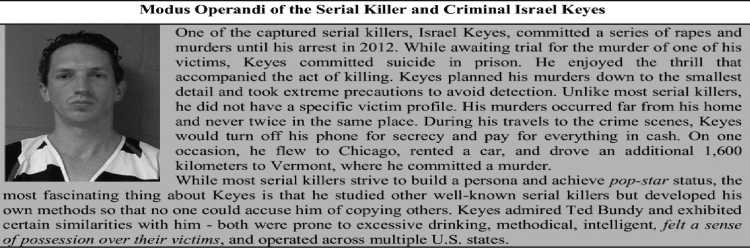
Source: 5 Serial Killers With The Most Bizarre Killing Rituals. Downloaded 2025, May 15 from
The offender’s method of operation refers to the key aspects of his approach to the crime, such as victim selection, place and time of the attack, the type of weapon used, and the manner of entry to the crime scene. This method is important for linking different cases, but it requires careful analysis to avoid misclassification. It is important to understand that the method of operation can change over time. As the offender gains experience and learns how to avoid detection, he adapts his modus operandi . For example, an offender who previously used bare hands for strangulation may switch to using stockings or a pillow to change his tactic. Likewise, he may change the time of attack from night to day or adjust victim choice, moving from female to male, from younger to older, or selecting victims of different races or physical characteristics, such as shifting from blondes to brunettes (Bjelajac, 2025, p. 260). These transformations highlight the variable character of offending tactics and emphasize the importance of detailed analysis of each individual case through the lens of the offender’s current behavioral patterns.
Over time, particularly with more experienced offenders, certain habits and techniques become repetitive and almost routine, which increases their value as forensic evidence. In practice, crimes often reveal a personal imprint of the perpetrator – a specific set of actions that reappears across incidents. This notion is supported by the principle of transfer: any contact between the offender and a person, place, or object can leave tangible traces, enabling investigators to establish a connection between the suspect and the crime scene.
Therefore, the offender leaves evidence at the scene but also often takes something away with him. The specific way the crime was committed and the manner in which the scene was treated frequently develop and stabilize over time and with experience, since this is essentially learned behaviour. However, the offender may appear less competent because of deteriorating mental state, increased substance use, or unforeseen circumstances. In any case, modus operandi is functional in nature and includes, but is not limited to (Petruzzi, 2024, pp. 26–27): Number of offenders; Extent of pre-offence planning; The route the offender took to the crime location; Prior surveillance of the crime scene or the victim; Use of weapons during the crime; The nature and extent of precautionary measures; Location of the crime; Methods of committing the crime; Techniques and instruments used during the crime; Items taken from the crime scene for profit or to prevent identification; Method of escape and the route used to leave the crime scene; Offender’s motive; Mode of transport to and from the crime scene.
4. Analysis of the Use of Modus Operandi in Criminal Investigations and Problems with Its Application
Investigators closely monitor how an offender carries out a crime, because these details can suggest the direction of the investigation and speed up the identification of a suspect. When multiple cases are examined, recurring elements often emerge – the same method of entry, the choice of tools, a characteristic time of day when the offender acts, or a specific means of leaving the crime scene. By recognizing these repeating patterns, investigators can rule out individuals whose methods do not match the documented behavior and concentrate on those who act in a similar manner. This process narrows the pool of suspects and enables more efficient allocation of investigative resources (Bjelajac, 2025, pp. 262–263). This method enables not only more accurate offender profiling but also a reduction in the time required to solve cases.
According to criminal investigative specialists John E. Douglas and Stephen A. Douglas, former head of the FBI Behavioural Science Unit support team, and Corinne Munn, the procedure has a number of shortcomings for investigators who place too much emphasis on it. As they note, the procedure is dynamic and changes with the offender’s experience. For example, a novice burglar may use force to break glass, but, fearing that the noise could alert someone, may quickly enter the premises. The same person, however, after learning from the previous approach, may use quieter breaking-and-entering methods so that the crime appears to be the work of someone else. Imprisonment can also be a reason for a change in method, because the previous method proved unsuccessful. Modus operandi is often regarded as equivalent to the success of the crime . The better the modus operandi , the greater the chances of successful commission, which depends on various factors such as (Modus Operandi, n.d.):
-
• Victim/location selection, method of attack, use of weapons, planning, means of transport;
-
• Stolen valuable items;
-
• Evidence that was left behind.
-
4.1. Modus Operandi and Motive
Modus operandi and motive are two separate concepts with different meanings. Motive represents the reason why an offender commits a particular crime, whether it is for money, anger, revenge, power, or lust. It is a deep internal need or desire that drives them. However, motive is not simply an explanation of why the crime was committed ; it also involves deeper psychological or emotional factors. For example, just as a signature is unique to an individual, an offender also has a unique motive and characteristic behaviour that define them. For instance, a killer in Boston may commit a crime out of anger, while another killer in Chicago may have the same reason, but the way they carry it out will differ, with different signature elements in their actions. Their motive fulfils an internal need, but the motive or signature behaviour should not be equated with the technique they use to commit the crime (Bjelajac, 2025, p. 265). It is emphasized that the term modus operandi denotes the specific techniques and approaches the offender uses during the commission of the crime, with these methods representing operational strategies rather than directly reflecting the motivation behind the act itself.
-
4.2. Modus Operandi and Signature as Two Key Indicators in Criminal Profiling
If greed inspires an offender to commit a robbery, one of his signature behaviours at the scene might include cutting a particular piece of furniture in the house. Perhaps he resents a parent or spouse over that specific piece of furniture and the argument that arose from it, so he might take revenge at each crime scene by damaging that furniture. This signature represents an additional aspect of his original motive: the desire to obtain money through theft. Other burglars in the same city likely would not do the same, so the police, at each scene of this burglar, gain insight into his motivation. However, none of this is part of his modus operandi , because none of it is necessary for committing the robbery. In other words, he does not have to damage that piece of furniture in order to burglarize the house. Anything the offender does 30
not have to do to commit the crime will not be considered part of his modus operandi . Modus operandi refers exclusively to the method used to carry out the crime (Modus Operandi, n.d.), which is not connected to the motive that drives the offender nor to the signature he leaves during the crime, except in cases where those elements coexist with his modus operandi . This distinction is crucial in criminal profiling because it allows investigators to clearly separate the functional aspects of the crime, such as methods of execution, from the emotional and psychological impulses that shape the offender’s behaviour, providing a comprehensive understanding of the nature of the crime and its perpetrator (Bjelajac, 2025, p. 266). This clear formulation of the relationship between modus operandi, motive, and signature enables more precise analysis of criminal acts. Understanding these differences helps investigators more effectively identify and profile offenders by focusing on their operational patterns.
Within forensic psychology and criminal profiling, the concepts of modus operandi and signature behaviour represent two central elements in analysing the behavioural patterns of offenders. However, no precisely determined proportional relationship between these concepts can be established, as they serve different functional purposes and are expressed through distinct forms of behaviour.
In professional literature, numerous studies focus on differentiating between modus operandi and signature behaviour in the context of criminal profiling (e.g., Douglas, Ressler,Burgess & Hartman, 1986; Keppel & Birnes, 1997; Canter & Youngs, 2009). The authors of these studies emphasize that the signature holds a central place in understanding the psychological motives of the offender and in identifying serial crimes, while modus operandi is viewed as an element subject to change according to the practical needs of committing the offense. In contrast, the signature remains stable and consistent, and it is precisely this consistency that allows investigators to reliably recognize behavioural patterns and link seemingly unrelated cases.
|
Figure 3. Comparison of Modus Operandi and Signature |
in Criminal Profiling |
|
|
Modus Operand! Signature |
Proportional |
Practical Estimates |
|
Relationship |
(Not a Rule, but Observations) |
|
|
Definition: A set of |
Definition: The |
In academic and |
- MO is dominant in |
|
behaviours and |
emotional or |
practical literature, |
most cases (e.g., 70 - |
|
actions the offender |
psychological |
there is no clearly |
90% of behaviours). |
|
uses to successfully |
component of the |
defined proportional |
- The signature may |
|
commit the crime and |
crime that serves no |
relationship between |
make up a smaller |
|
avoid identification |
practical purpose but |
MO and signature, as |
portion of behaviour |
|
or capture. |
satisfies the |
they represent |
(e.g., 10-30%) - but |
|
Characteristics: |
offender’s internal |
qualitative (not |
its importance for |
|
Practical and |
needs. |
quantitative) aspects |
profiling is |
|
functional; can |
Characteristics: |
of crime. |
enormous, as it |
|
develop and change |
More stable over |
However: |
reveals motivation |
|
over time (offenders |
time; maintains |
- On average, MO is |
and psychological |
|
learn and adapt). Example: Use of gloves, method of entry, weapon choice. |
fantasies, compulsions, or internal motivations. Example: Positioning of the body, rituals, leaving objects at the crime scene. |
present in 100% of cases (as it is necessary for the commission of the crime). - The signature appears only in certain cases, especially in serial crimes and among offenders with strong psychological drives. |
profile. |
Source: Author’s research, 2025.
As observed within forensic psychology and criminal profiling, no precisely defined or quantitatively expressed relationship can be established between modus operandi and signature behaviour , as they represent psychologically and functionally distinct components of the criminal act. Modus operandi reflects a behavioural pattern focused on the technical aspect of committing the crime and avoiding detection; due to its pragmatic function, it appears in every offence and is subject to change according to experience and circumstances. In contrast, the signature reflects the offender’s deep psychological needs and is characterized by greater consistency across different criminal acts. Although its occurrence is rarer, the signature has significant forensic value, as it can provide insight into the motivational structures and emotional impulses underlying the offence. In the profiling process, the signature often possesses greater diagnostic and identificatory value than the modus operandi .
Figure 4. The case of serial killer Ted Bundy serves as an illustrative example that enables a deeper understanding of the distinction between modus operandi and signature behaviour through the analysis of his criminal patterns
Comparative Analysis of Modus Operandi and Signature Behaviour in the Case of Ted Bundy
Modus Operandi (MO)
Bundy often used deception to approach his victims, for example:
-
- Pretended to be injured (wore a cast, sling, or used crutches).
-
- Asked for help carrying something to his car.
-
- When the victim approached, he incapacitated her with a blow and pushed her into his vehicle.
Signature
Bundy had recurring rituals that were not necessary for committing the crime: - Arranged the body after death - Engaged in necrophilia
-
- Returned to crime scenes to 'relive' the act (and sexually assaulted the corpses)
-
- Took trophies (e.g., pieces of clothing)
-
- In some cases, applied makeup to the victims after death
His MO included:
-
- Approaching the victim through manipulation
-
- Incapacitating the victim with a blow
-
- Taking her to a secluded location
-
- Murder (usually by strangulation or blunt force)
These elements did not contribute to the crime in a practical sense but reflected Bundy’s internal need for control, domination, and sexual gratification. They were part of his signature.
This part is functional - it allows him to coimnit the crime and avoid capture. Over time, he refined these techniques (e.g., learning how to prevent the victim from resisting or how to disappear quickly).
Source: Michaud & Aynesworth, 2000.
The analysis of Ted Bundy’s case clearly illustrates the distinction between *modus operandi and signature behaviour, as well as their significance in the process of criminal profiling. Over time, Bundy’s modus operandi demonstrated a high degree of adaptability and functional flexibility, reflected in his changes of tactics, use of different vehicles, tools, and social deceptions to ensure the crime was carried out successfully and discreetly. On the other hand, his signature behaviour remained consistent and stable, allowing investigators to link seemingly unrelated cases despite geographical and tactical differences. Elements such as the way bodies were left, the presence of sexually motivated acts, and the taking of trophies pointed to a psychological signature structure that was crucial for identifying the offender’s behavioural pattern. Although most of his actions were directed toward the practical execution of the crime and avoiding detection, a relatively smaller portion of behavior – which can be characterized as his signature – played a key role in connecting crimes committed across different states and in understanding his deeper psychodynamic motives. Without the analysis of these stable and emotionally charged elements, many of the cases would likely have remained fragmented and attributed to different perpetrators.
This distinction shows that it is precisely the analysis of the signature that gives criminal profiling its deeper psychological dimension and allows investigators to identify the offender’s stable internal motivation behind changing tactical patterns, with the modus operandi accounting for approximately 70–80% of the behaviour and the signature behavior comprising 20–30%, yet being crucial for linking the cases and understanding Bundy’s motives.
5. Discussion
In contemporary criminal investigations, the use of modus operandi as an analytical instrument represents a significant methodological advancement in understanding patterns of criminal behaviour. Through the analysis of obtained results and insights from relevant literature, it is confirmed that modus operandi , although primarily functional and adaptive, provides more than mere technical information about the manner in which a crime is committed – it reveals the dynamic relationship between behaviour, experience, and offender adaptation.
One of the key findings of this research is the confirmation that modus operandi has high operational value, particularly in the context of identifying and linking serial crimes. Consistency in certain behavioural aspects (e.g., time of offence, method of entry, choice of weapon) enables investigators to establish a pattern of activity which, though not infallible, can significantly narrow the pool of suspects and contribute to the creation of an offender profile. At the same time, this pattern often evolves in accordance with the offender’s experience, confirming the hypothesis that modus operandi should not be viewed as static, but as a dynamic behavioural system adaptable to various conditions and objectives.
However, as the analysis itself shows, excessive reliance on modus operandi carries certain risks, as offenders – especially experienced and intelligent ones – consciously alter or disguise their modus operandi . These changes may be motivated by the desire to avoid detection, but also by internal psychological factors or escalating violence, which further complicates the profiling process. In this sense, modus operandi loses part of its predictive power when used in isolation, without consideration of the broader context
– including motivation, signature behaviour, the offender’s mental state, and other forensic evidence.
It has been observed that modus operandi is often mistakenly equated with motive or signature, which in operational practice can lead to confusion and incorrect conclusions. A clear distinction between these concepts – where modus operandi relates solely to the practical and technical aspects of the crime, while motive and signature are connected to its psychological and emotional components – is of essential importance for accurate criminal analysis. This differentiation not only enables a more precise interpretation of the offender’s behaviour but also helps avoid methodological errors in analysing complex criminal patterns.
An additional challenge identified is the fact that modus operandi may change due to unpredictable factors such as substance use, changes in life circumstances, or the offender’s mental health. In such cases, modus operandi becomes a less reliable indicator, which underscores the need for its interpretation to always be conducted in combination with other forms of analysis, including forensic evidence, witness statements, and digital traces.
The research conducted – based on the analysis of popular crime series with presented findings – may represent a highly valuable and creative approach (Bjelajac & Filipović, 2022a; Bjelajac & Filipović, 2022b). Given that collecting data through modus operandi surveys is often difficult due to the specificity of the topic and the sensitivity of information, an alternative was proposed through the analysis of popular crime shows that depict criminal profiling. 1 Such an analysis provides insight into how modus operandi is portrayed in popular culture, as well as the identification of its key elements and applications in fictional, yet often reality-based, cases. Furthermore, this type of research can contribute to a better understanding of profiling methodology and enable comparison with real investigative practices, thus opening new perspectives for further empirical research and the development of theoretical frameworks in this field.
|
Figure 5. Analysis of Modus Operandi and Criminal Profiling in Popular |
|
|
Crime |
Series |
|
Research Sample |
A total of 30 episodes were analyzed from three popular crime series: “Criminal Minds,” “Mindhunter,” and “CSI: Crime Scene Investigation.” |
|
Methodology |
The episodes were reviewed, and content related to modus operandi and profiling was categorized and compared with theoretical concepts. |
|
Main and Recognizable Features of Modus Operandi |
In 70% of the analyzed episodes, the modus operandi was portrayed as a unique and recognizable behavioural pattern used by offenders to commit the crime. Most often, these were repetitive methods of execution (e.g., a specific way of approaching the victim, the tool used, or the crime scene location). This aligns with theoretical frameworks emphasizing the importance of these elements for offender identification. |
|
Principles and Elements of Modus Operandi in Profiling |
In 75% of cases, the series depict the modus operandi as a fundamental element for creating the offender’s psychological profile. Profiling is often shown through the analysis of recurring patterns, enabling prediction of next moves or identification of motives. |
|
Application and Problems in Using Modus Operandi |
Although the modus operandi is mostly shown as an effective tool, in 40% of episodes problems such as evolution or adaptation of the modus operandi are presented, making it harder to track. Additionally, in 25% of cases, situations are depicted where the modus operandi alone was insufficient to solve the case, indicating limitations in its real-world application. |
|
Correlation Between Modus Operandi and Offender Motives |
In over 60% of episodes, a clear connection is shown between modus operandi and offender motives, where specific methods of execution reflect internal psychological drives, in accordance with theoretical expectations. |
|
Contribution of Modus Operandi to the Accuracy of Criminal Profiling |
In 65% of analyzed cases, modus operandi significantly contributed to forming an accurate profile, but in 35% of cases, changes in modus operandi (due to learned lessons or adaptation) reduced its effectiveness. These findings highlight the practical limitations of using modus operandi in investigations. |
|
Signature Behaviour |
It was characteristic in approximately 25% of the analyzed episodes, indicating that stable elements of signature behaviour played a crucial role in profiling. They enabled investigators to recognize consistent motives behind tactically changing patterns through a psychological lens. While modus operandi accounted for about 75% of behaviours, focusing on technical execution and concealment, signature behaviour—though present in a smaller proportion of about 25%—was key to linking different cases and understanding the killers’ internal motivations. |
Source: Author’s research, 2025.
The analysis of popular crime series and films revealed that portrayals of modus operandi are generally consistent with theoretical concepts but are often simplified for dramatic effect. The series effectively illustrate the importance of modus operandi in profiling and investigation, while also highlighting the challenges of its application – particularly in situations where the modus operandi evolves or adapts. This research confirms that popular culture can be useful in disseminating basic knowledge about investigative techniques, but it also emphasizes the need for a critical approach to such portrayals and caution against fully equating them with real-world practices.
6. Concluding Considerations
Within the case studies and literature reviewed, a clear distinction has been observed between traditional and contemporary approaches to modus operandi in profiling. In earlier investigative approaches, modus operandi was primarily treated as a technical indicator – investigators relied on crimescene traces and repeated behavioral patterns to link an offender to a crime. Today, the analysis extends beyond physical evidence. Methods from forensic psychology, behavioral analytics, and other disciplines are incorporated, allowing for a deeper understanding of offender cognition and more precise profiling.
It is important to emphasize that combining the analysis of modus operandi with the examination of signature behavior has proven to be the most reliable approach within the research framework. While the modus operandi refers to the actions the offender must take in order to commit the crime, the signature reflects the offender’s internal psychological impulses and emotional needs. Integrating these two dimensions provides a more comprehensive picture of the offender and their behavioral pattern. This combined model is particularly valuable in cases of serial offenses, where emotional motives and fantasy-driven elements significantly influence the offender’s actions.
In practical investigative work, analyzing the modus operandi remains a valuable tool for understanding offender behavior, but it cannot serve as the sole basis for profiling. It must be evaluated alongside other available evidence and investigative information. This becomes especially important when the offender intentionally alters their usual method of operation or takes steps to conceal traces and hinder the linking of crimes.
In the final section of the paper, the research questions focused on the role of modus operandi in criminal investigations and offender profiling are addressed. Through the analysis of theoretical sources and practical case material, it was determined that modus operandi comprises a set of recognizable actions and techniques used by the offender during the commission of a crime. Special attention was given to the key principles and elements of this pattern, demonstrating its function in understanding the offender’s behavior and the relationship between the offender, the victim, and the crime scene. Furthermore, the paper presented the ways in which modus operandi is applied in criminal investigations, as well as the problems that arise in its use, particularly under conditions of its evolution or adaptation. Special attention has been devoted to the comparative analysis of modus operandi and offender motives, as well as to distinguishing between modus operandi and signature, which constitute two essential indicators in the process of criminal profiling and enable a deeper understanding of the offender’s psychological structure. This differentiation not only contributes to a more accurate interpretation of criminal behaviour but also illuminates how the practical and tactical aspects of crime intertwine with its internal psychodynamic impulses. Finally, the study also considered the limitations of modus operandi in real investigative contexts and its contribution to the precision of criminal profiling, taking into account the dynamic nature and changes that may occur during the course of an investigation.
Conflict of Interest
The author declares no conflict of interest.
Bjelajac Željko
Univerzitet Privredna akademija u Novom Sadu, Pravni fakultet za privredu i pravosuđe, Novi Sad, Srbija
MODUS OPERANDI KAO ANALITIČKI INSTRUMENT UKRIMINALISTIČKOM PROFILISANJU
APSTRAKT: U savremenoj kriminalistici, modus operandi predstavlja jedan od ključnih alata za razumevanje, rekonstrukciju i predikciju kriminalnog ponašanja. Ovaj rad istražuje modus operandi ne samo kao tehnički obrazac izvršenja krivičnog dela, već i kao analitički instrument unutar kriminalističkog profilisanja. Poseban akcenat stavljen je na principe i elemente modus operandi, njegovu evolutivnu prirodu, analizu modusa operandi u radu kriminalističkih istražitelja i izazove njegove upotrebe kao i na odnos između modus operandi i motiva počinioca. Kroz kvalitativnu analizu sadržaja, studije slučaja i komparativnu metodologiju, identifikovani su načini na koje se modus operandi koristi za prepoznavanje obrazaca ponašanja, povezivanje više krivičnih dela, i sužavanje kruga osumnjičenih. Rad takođe osvetljava praktične izazove u primeni modus operandi uključujući promenljivost ponašanja, namerno zavaravanje istrage i naglašava razliku između funkcionalnog modus operandi i potpisa počinioca koji predstavlja njegov lični pečat – element koji zadovoljava emocionalne i psihološke potrebe. Rezultati ukazuju na to da modus operandi, kada se pravilno interpretira, može imati visoku analitičku i operativnu vrednost u procesu kriminalističkog profilisanja. Zaključuje se da je integracija modus operandiu forenzičku i kriminalističku analizu neophodna za dublje razumevanje dinamike krivičnih dela, posebno u kontekstu serijskih zločina. Istovremeno prekomerno oslanjanje na modus operandi prilikom analize zločina i kreiranja profila počinioca, treba uzimati sa rezervom zbog varljivog karaktera počinilaca krivičnih dela.
Ključne reči : kriminalističko profilisanje, modus operandi, motiv, potpis.
