
Morphological Characteristics of Pollen Grains of Some Fruit Plants Belonging to the Family Rosaceae
Journal: Bulletin of Science and Practice @bulletennauki
Section: Естественные науки
Article in issue: 5 т.12, 2026.
Free access
The present study is devoted to the investigation of morphological characteristics of pollen grains of several fruit plants belonging to the family Rosaceae. Plants of this family bloom in early spring and represent an important source of nectar and pollen for honey bees, thereby playing a significant role in apiculture and in the development of bee colonies. At the same time, pollen is one of the main factors influencing the chemical composition and quality indicators of bee products. The aim of the study was to investigate the palynomorphological characteristics of pollen grains of several fruit plants belonging to the Rosaceae family distributed in the flora of the Nakhchivan Autonomous Republic, to evaluate their taxonomic significance, and to expand existing scientific knowledge. The research material consisted of pollen obtained from cultivated plants grown in the region. Four species that bloom in early spring and are intensively visited by bees were selected: Amygdalus communis, Cerasus vulgaris, Malus orientalis, and Persica vulgaris. Pollen samples were collected during the mass flowering period in the morning at the stage of newly opened flowers. Morphological analyses were carried out using light microscopy. Samples were observed under a Bresser light microscope at forty-times ocular magnification and documented at a resolution of 2048 by 1536 pixels. The results showed that pollen grains of all studied species were monad-type, radially symmetrical, isopolar, and tricolporate. Differences in pollen morphology among species were also identified. Cerasus species were characterized by sharply triangular pollen shape, wider colpi, and clearly expressed striate ornamentation. Malus orientalis pollen grains showed a more rounded contour, relatively narrow colpi, and weak ornamentation. Amygdalus communis pollen exhibited triangular contour and dense ornamentation. Persica vulgaris pollen demonstrated radial arrangement of apertures, colpi extending toward the poles, and a densely wrinkled exine surface. Thus, the obtained results demonstrate that morphological characteristics of pollen grains play an important role in species differentiation and taxonomic evaluation.
Similar articles in the section Systematic botany

Short address: https://sciup.org/14135619
IDS: 14135619 | UDC: 582.734 | DOI: 10.33619/2414-2948/126/04
Морфологические характеристики пыльцевых зерен некоторых плодовых растений семейства Rosaceae
Настоящее исследование посвящено изучению морфологических характеристик пыльцевых зерен нескольких плодовых растений семейства Rosaceae. Растения этого семейства цветут ранней весной и являются важным источником нектара и пыльцы для медоносных пчел, играя тем самым значительную роль в пчеловодстве и развитии пчелиных семей. При этом пыльца является одним из основных факторов, влияющих на химический состав и показатели качества продуктов пчеловодства. Целью исследования было изучение палиноморфологических характеристик пыльцевых зерен нескольких плодовых растений семейства Rosaceae, распространенных во флоре Нахчыванской Автономной Республики, оценка их таксономического значения и расширение существующих научных знаний. Материал исследования состоял из пыльцы, полученной с культурных растений, произрастающих в регионе. Были выбраны четыре вида, цветущие ранней весной и интенсивно посещаемые пчелами: Amygdalus communis, Cerasus vulgaris, Malus orientalis и Persica vulgaris. Образцы пыльцы собирали утром в период массового цветения, на стадии только что распустившихся цветков. Морфологический анализ проводили с использованием световой микроскопии. Образцы наблюдали под световым микроскопом Брессера при сорокакратном увеличении окуляра и документировали с разрешением 2048 × 1536 пикселей. Результаты показали, что пыльцевые зерна всех изученных видов были монадного типа, радиально-симметричными, изополярными и трехбороздчатыми. Также были выявлены различия в морфологии пыльцы между видами. Виды рода Cerasus характеризовались резко треугольной формой пыльцы, более широкими бороздками и четко выраженной полосатой орнаментацией. Пыльцевые зерна Malus orientalis имели более округлый контур, относительно узкие бороздки и слабую орнаментацию. Пыльца Amygdalus communis имела треугольный контур и плотную орнаментацию. Пыльца Persica vulgaris демонстрировала радиальное расположение апертур, бороздки, простирающиеся к полюсам, и плотно морщинистую поверхность экзины. Полученные результаты демонстрируют, что морфологические характеристики пыльцевых зерен играют важную роль в дифференциации видов и таксономической оценке.
Text of the scientific article Morphological Characteristics of Pollen Grains of Some Fruit Plants Belonging to the Family Rosaceae
Бюллетень науки и практики / Bulletin of Science and Practice
The family Rosaceae includes more than three thousand species belonging to approximately one hundred genera. In the flora of the Nakhchivan Autonomous Republic, one hundred fifty-three species belonging to thirty genera of this family have been recorded. The Rosaceae family plays a significant role in the formation of the rich and diverse vegetation cover of the autonomous republic. This family includes trees, shrubs, and herbaceous plants, among which both wild and cultivated fruit plants are of considerable importance. The majority of fruit plants belong to the genera Malus, Pyrus, Prunus, Cerasus, Armeniaca, and Amygdalus, which occupy an important place in human nutrition and are consumed fresh, dried, or processed. Plants belonging to the Rosaceae family are of particular importance for apiculture. Many species bloom in early spring and provide rich nectar and pollen sources for honey bees. Therefore, Rosaceae plants play an important role in the development of bee colonies, especially in supplying food reserves during the spring period. In addition, flower pollen plays an important role in the formation of the chemical composition and quality characteristics of bee products. Pollen-producing plants serve as a source of proteins, amino acids, vitamins, minerals, and phenolic compounds for honey bees. The diversity and quantity of pollen present in bee products depend on the composition and abundance of plants forming the forage base. To determine the botanical origin of bee products, the characteristics of pollen grains from different regions must be known, since pollen grains possess species-specific features. Furthermore, studying the biochemical composition of plant pollen allows prediction of the chemical composition, nutritional value, and pharmacological significance of bee products. Scientific studies on the morphological structure of pollen grains of flowering plants serving as food sources for bees in the Nakhchivan Autonomous Republic are limited [6, 10, 11, 13, 14].
The aim of this research was to evaluate the taxonomic significance of palynomorphological characteristics of pollen-producing plants belonging to the Rosaceae family in the flora of the Nakhchivan Autonomous Republic and to expand existing knowledge in this field.
Materials and Methods
The material for the study consisted of pollen grains of cultivated fruit plants belonging to the Rosaceae family grown in the Nakhchivan Autonomous Republic. Four species that bloom in early spring and are frequently visited by honey bees were selected: Amygdalus communis, Cerasus austera, Malus orientalis, and Persica vulgaris. Pollen samples were collected during the mass flowering period in the morning when flowers had just opened.
The morphological structure of pollen grains was studied using light microscopy. Standard methods described by Gunnar Erdtman for pollen morphology studies were applied. The samples were processed using the acetolysis method according to standard palynological procedures. Microscopic preparations were made using glycerin alcohol solution and fuchsin stain.
Morphological observations were carried out using a light microscope. Pollen grains were examined under forty-times ocular magnification, and images were recorded at a resolution of 2048 by 1536 pixels. Terminology used for morphological descriptions followed the palynological terminology proposed by Kupriyanova and Alyoshina.
Results and Discussion
Pollen morphology was studied using modern palynological approaches. The study of pollen grains allows determination of both geographical and botanical origin of bee products and enables evaluation of their quality. Due to increasing global population and changes in dietary patterns, protein deficiency is predicted in the future. Therefore, increasing the use of high-quality protein-rich foods is recommended. Among such foods, bee pollen occupies a special place. Bee pollen is a valuable food product consisting of flower pollen rich in proteins and amino acids.
The pollen grains of all studied plant species were examined in polar view. According to morphological structure, pollen grains were spherical or subprolate, tricolporate, and characterized by reticulate exine ornamentation. These features correspond to general pollen characteristics of the Rosaceae family. In all studied plant species, pollen grains were examined in polar view. According to their morphological structure, the pollen grains are spherical or subprolate, tricolporate, and the exine exhibits a reticulate ornamentation (Figures 1-4). These morphological characteristics were consistent with the general pollen features of the Rosaceae family. Specific species belonging to the genus Rosa are radially symmetrical, isopolar monads. The pollen grains are tricolpate, rarely tetracolpate. The apertures are well-developed, spherical or elliptical, and are usually located in the central part of the colpus. The exine surface is predominantly striate, and very rarely sparsely striate. [3, 4, 18].
Persica vulgaris Mill., belonging to the genus Persica Mill. of the Rosaceae family, is one of the most valuable fruit plants widely cultivated in the autonomous republic. Its flowering period occurs in March-April [16].
As a plant that provides both nectar and pollen, it is of great importance for the nutrition of bees in early spring. The botanical origin and quality of bee products are primarily determined by flower pollen. The micromorphological characteristics of the flower pollen of Persica vulgaris Mill. were studied using light microscopy. The flower pollen grains of the species Persica vulgaris Mill. are monad-type and have a tricolporate structure in polar view. In polar view, the apertures are radially arranged, extending toward the poles and gradually narrowing at the ends. The pores are slightly protruding, blunt-shaped, and the inner membrane (intine) is clearly observable. A densely wrinkled (scabrate-reticulate) ornamentation was observed on the exine surface. The morphological characteristics of flower pollen of the species Persica vulgaris Mill. cultivated near Belarus were studied by I. N. Golubkova. It was observed that the pollen grains have a triangular shape, a striate exine, and the apertural striations extend toward the center and narrow [8].
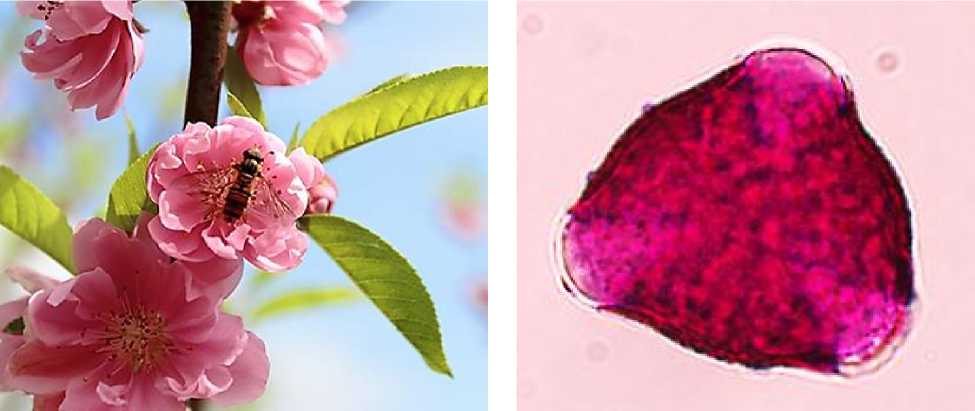
Figure 1. Persica vulgaris Mill. flower pollen
In the Nakhchivan Autonomous Republic, three species of the genus Amygdalus L. of the family Rosaceae Adans. are found (two of which are cultivated). Among these, Amygdalus communis L. is a species widely cultivated by the local population and holds significant importance for the food industry [16]. Almond kernels are widely used in the food industry due to their high protein content and richness in amino acids [17]. Additionally, almond pollen is distinguished by its high content of proteins, lipids, phenolic compounds, vitamins, and minerals. In a study conducted by Huseynova A. et al., the total flavonoid content in the pollen of almond ( Amygdalus communis L.) was determined using spectrophotometric methods to be 10.29±1.16% [9]. Furthermore, the early spring flowering of the almond plant and its active pollination by honeybees indicate that almond pollen is one of the first food sources for bees during the spring season [2].
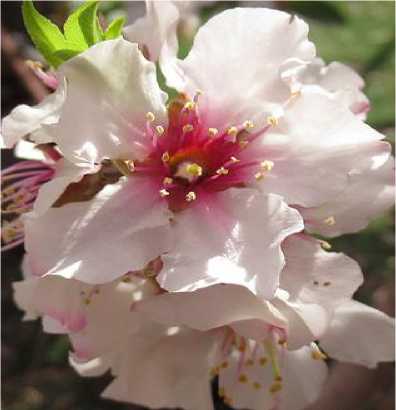
Figure 2. Amygdalus communis L.
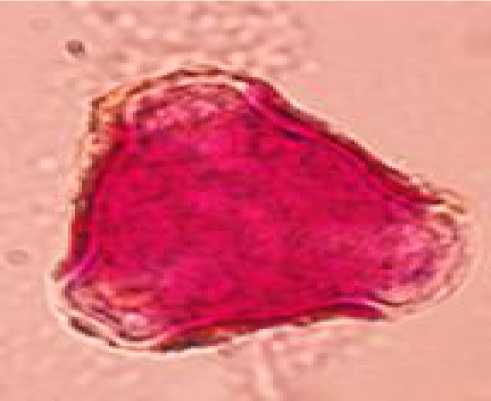
The flower pollen grains of the species Amygdalus communis L. are monad-type and predominantly isopolar in structure. The pollen grains have a tricolporate shape in polar view. The apertures consist of three colpi extending toward the poles, radially arranged, and observed to be not very deep toward the center. The pores located in the center of the colpi appear larger in size, and the intine membrane is clearly distinguishable. Based on light microscope observations, a relatively densely striate ornamentation is observed on the exine surface.
In the Nakhchivan Autonomous Republic, the species Malus orientalis Uglitzk., belonging to the genus Malus Mill. of the family Rosaceae Adans., is found from mid-mountain zones to high mountain areas, on mountain slopes and foothills. Depending on the altitude, it flowers in April-May [1, 15]. Malus orientalis Uglitzk. is a nectar- and pollen-producing plant. The pollen grains of the species Malus orientalis Uglitzk. are monad-type and isopolar in structure. In polar view, the pollen grains belong to the tricolporate type. The colpi are oriented extending toward the poles. It is observed that pores are located in the central part of each colpus, although it can be noted that they are not very wide. The exine wall is clearly visible, and based on light microscope observations, it is determined that the surface has a weakly striate ornamentation (Figure 3).
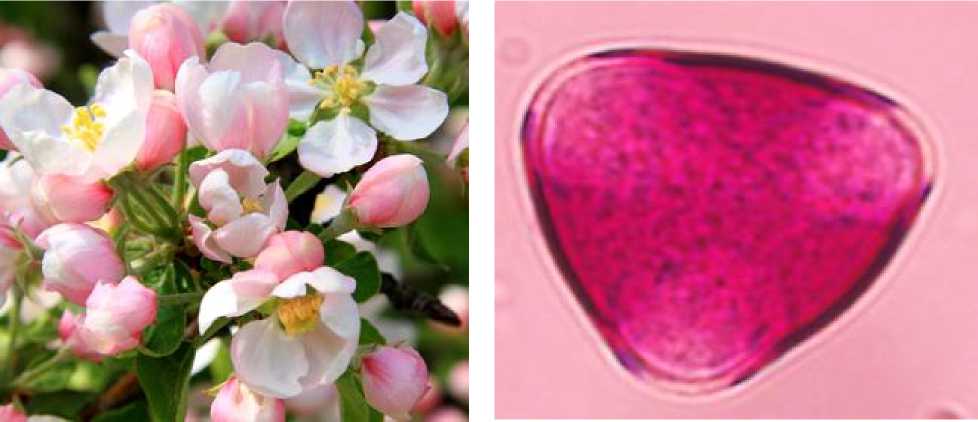
Figure 3. Malus orientalis Uglitzk.
In a study conducted by Dyakova I. N., the pollen morphology of several species belonging to the genus Malus was investigated. Based on the results, it was determined that all pollen grains in the studied species had a tricolporate structure, which is characteristic of the genus Malus . The colpus is deep but ends at the poles, and the poles are rounded. The exine is striate [5].
In the flora of the Nakhchivan Autonomous Republic, two species of the genus Cerasus Mill. — C. vulgaris and C. austera — are cultivated under cultural conditions [1]. C. vulgaris is a valuable fruit tree and is observed to be widely distributed across all districts of the autonomous republic. The flowering period of the plant occurs in March-April or April-May depending on the altitude zone. Its fruit has a sour-sweet taste and is rich in organic acids, vitamins, sugars, anthocyanins, polyphenolic acids, and macro- and microelements [16]. Since its flowers are abundant in pollen and nectar, it holds special importance for beekeeping enterprises [7].
The pollen grains of Cerasus vulgaris L. are monad-type and isopolar in structure. In polar view, the pollen grains have a triangular outline and belong to the tricolpate type. The apertures consist of three colpi, radially arranged, extending toward the poles and narrowing at their ends. The colpus ends are generally acute in shape. The exine wall is clearly distinguishable. Based on light microscope observations, the exine surface is characterized by striate ornamentation.
Momeni and colleagues studied the pollen morphology of different genotypes of sour cherry (Prunus cerasus). Based on the results of the study, it was determined that all pollen grains are isopolar, radially symmetrical, and have a tricolpate structure. Certain differences in the length and width dimensions of pollen grains were recorded among different genotypes. The colpi are symmetrical, extending toward the poles and narrowing. The colpus ends are generally acute and their length constitutes approximately 87.6% of the polar axis (RCLP). The colpus membrane differs from the exine surface and is covered with irregularly shaped granules. Examination of the pollen exine revealed striate ornamentation forms with varying numbers of ridges [12]. The observations conducted indicate that the morphological characteristics of the studied Prunus cerasus pollen are largely consistent with the results obtained by Momeni and colleagues.
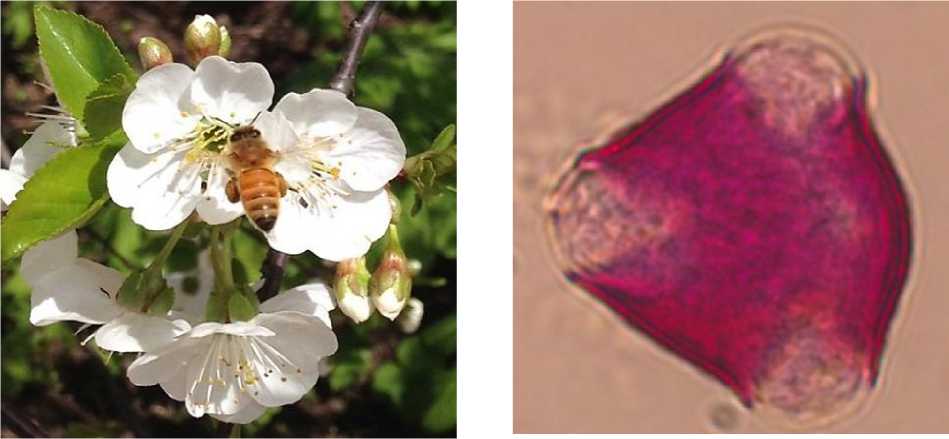
Figure 4. Cerasus vulgaris L.
Pollen types allow for the identification of plant sources used by bees during the production of honey and other beekeeping products. The significance of these studies lies in the fact that they enable the detection of medicinally important and allergenic plant pollen present in the composition of honey and bee pollen, which can affect its quality. In several developed countries, determining the botanical origin of pollen in honey is one of the mandatory requirements included in state standards.
Conclusions
Pollen grains are classified and analyzed using modern palynological methods. However, in our study, we only examined the structure of pollen grains and their exine surface pattern using light microscopy (LM). In the results, we analyzed the similarities and differences in pollen morphology for each species. In these four species, pollen grains are monad-type, radially symmetrical, isopolar, with tricolporate apertures, and have a triangular outline in polar view. As a result of the palynological studies conducted, certain differences in pollen morphology were identified among the species. Cerasus vulgaris pollen has a more sharply triangular shape, distinguished by protruding polar areas and a broader structure of the colpi; striate ornamentation is clearly observed on the exine surface. Malus orientalis pollen, on the other hand, is characterized by a more rounded-triangular shape, smooth contours, relatively narrow colpi, and faint ornamentation. In Amygdalus communis pollen, the triangular contour is clearly visible, the colpi are weakly triangular, and the exine surface is characterized by relatively dense ornamentation. Persica vulgaris pollen is triangular in shape, with apertures radially arranged in polar view. The colpi extend toward the poles and gradually narrow at the ends. The pores are slightly protruding and blunt-shaped. Densely wrinkled
(scabrate-reticulate) ornamentation is observed on the exine surface. In future studies, our aim is to examine pollen structures using Scanning Electron Microscopy (SEM).
