
О НЕОБХОДИМЫХ НОВАЦИЯХ В СОЦИАЛЬНОМ ДИАЛОГЕ ПРИ ПРИНЯТИИ РЕШЕНИЙ О ЗАКЛЮЧЕНИИ И СОДЕРЖАНИИ КОЛЛЕКТИВНОГО ДОГОВОРА
Journal: European and Asian Law Review.
Section: публично-правовые (государственно-правовые науки)
Article in issue: 6 (4), 2023.
Free access
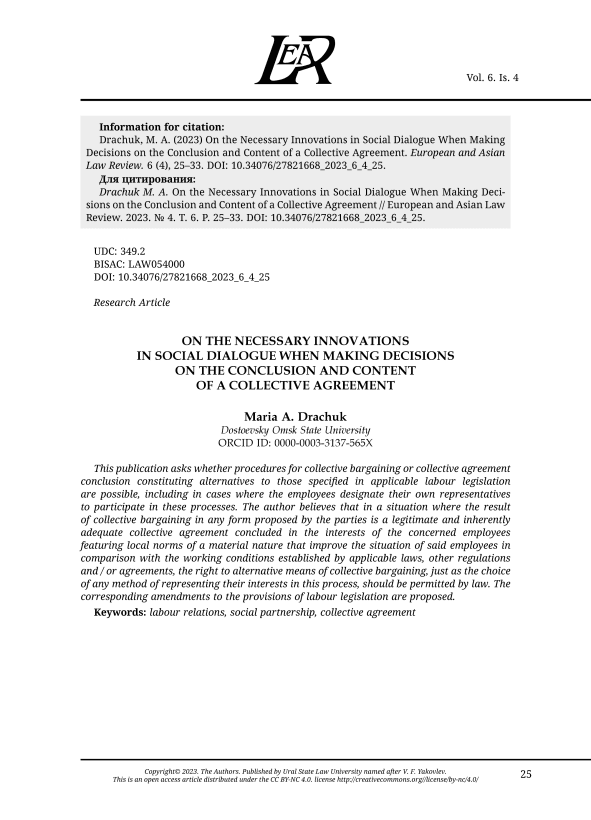
В настоящей публикации ставится вопрос о том, возможны ли процедуры ведения коллективных переговоров или заключения коллективного договора, альтернативные указанным в трудовом законодательстве, в том числе при определении работниками своих представителей для участия в этих процессах. Автор полагает, что в ситуации, когда итогом коллективных переговоров в любой предложенной сторонами форме принят заключенный в интересах работников законный и адекватный своей сути коллективный договор, в котором имеются локальные нормы материального характера, улучшающие положение работников по сравнению с условиями труда, установленными законами, иными нормативными правовыми актами, соглашениями, право альтернативных способов ведения коллективных переговоров, равно как и выбора любого способа представительства своих интересов в данном процессе должно быть допущено законом. Соответствующие изменения положений трудового законодательства предлагаются.
Similar articles in the section Special branches of law. Miscellaneous legal matters
Short address: https://sciup.org/14134907
IDS: 14134907 | UDC: 349.2 | DOI: 10.34076/27821668_2023_6_4_25
Text of the article О НЕОБХОДИМЫХ НОВАЦИЯХ В СОЦИАЛЬНОМ ДИАЛОГЕ ПРИ ПРИНЯТИИ РЕШЕНИЙ О ЗАКЛЮЧЕНИИ И СОДЕРЖАНИИ КОЛЛЕКТИВНОГО ДОГОВОРА
This is an open access article distributed under the CC BY-NC 4.0. license
Pursuant to Articles 36 and 37 of the Labour Code of the Russian Federation No. 197-FZ dated 30.12.2001, for the purposes of preparing, concluding or amending a collective agreement, the representatives of employees and employers have the right to initiate collective bargaining.
To this end, any party to the social dialogue must execute and send the other party a written proposal to start collective bargaining, and the addressee of such a proposal must enter into negotiations within seven calendar days from the date of receipt of the proposal by sending the initiator of collective bargaining a response indicating their representatives and their powers to participate in the work of the collective bargaining commission. In addition, the primary trade union organisation, single representative body or other representative (representative body) representing the employees of the relevant employer entitled to initiate collective bargaining, simultaneously with sending the employer (their representative) a proposal on the start of collective bargaining, is obliged to notify all other primary trade union organisations uniting the employer’s employees to this effect and, within the next five business days, to create, with their consent, a single representative body or include their representatives in the existing single representative body. That said, primary trade union organisations not participating in collective bargaining retain the right to send their representatives to a single representative body within one month from the start date of collective bargaining.
Additionally, if the representative of employees in collective bargaining is a single representative body, the members of this body represent the side of the employees in the collective bargaining commission. Accordingly, the employer must send to such a commission a number of representatives equal to the number of members of the single representative body, or, by agreement therewith, any number of its representatives,

provided that each party to the social dialogue in said commission has one cumulative vote to ensure such a principle of social dialogue as the equality of the parties.
Noteworthy is the fact that the labour legislation of the Russian Federation further proceeds from a certain assumption that employees will de facto agree with everything that the collective bargaining commission determines for them, apparently due to the prohibition against worsening the situation of employees in comparison with the currently existing one. The Labour Code of the Russian Federation does not propose involving employees in a discussion of the text of a collective agreement, forming in a special way the powers of representatives in collective bargaining, or even choosing other representatives if there are entities mentioned in the law that can conduct collective bargaining on behalf of the majority of employees.
Virtually identical rules are contained in the Labour Code of the Kyrgyz Republic No. 106 dated 04.08.2004, which apparently gives rise to enforcement problems similar to those found in domestic labour law.
But, for example, the Labour Code of the Republic of Armenia No. ZR-124 dated 14.12.2004, firstly, specifies an equal number of representatives of the parties to collective bargaining in the organisation’s collective agreement conclusion commission (analogous to the Russian collective agreement); secondly, focuses on a certain minimum number of its substantive conditions and, thirdly, mandates that the draft agreement ultimately adopted by the commission (that is, it is assumed, taking into account the number of commission members, that the employer’s representatives have cast at least one vote ‘for’ the approval of such a draft text; however, in a conventionally-organised management system, one such employer’s ‘for’ vote cannot arise arbitrarily and should not be the only one) be submitted for discussion at a meeting (conference) of employees.
The approved draft shall be signed by representatives of the parties to the local collective agreement, with the one that the employees did not approve serving as the basis for resuming collective bargaining or starting a collective labour dispute. That is, there is a limitation on the competence of employee representatives in the collective bargaining commission, preventing them from overcoming the will of the labour collective as a party to a local collective agreement (contract).
In accordance with Article 156 of the Labour Code of the Republic of Kazakhstan No. 414-V dated 23.11.2015 (Clauses 4–7), to conduct collective bargaining and draft a collective agreement, the parties shall create a commission on a parity basis (the number of members of the commission, its individual composition, the timing of draft development and conclusion of the collective agreement shall be determined by agreement of the parties). If the organisation has multiple employee representatives, they shall create a single representative body to participate in the work of the commission, discuss and sign the collective agreement.
The draft collective agreement prepared by the commission is subject to mandatory discussion by the organisation’s employees. The draft shall be finalised by the commission in view of the comments and suggestions received.
When an agreement is reached between the parties, the collective agreement is drawn up in at least two copies and signed by the representatives of the parties. If there are disagreements between the parties on certain provisions of the collective agreement, the parties must sign the collective agreement on the agreed-upon terms and simultaneously draw up a statement of disagreements within one month of the date of their occurrence. Disagreements arising during collective negotiations may be the subject of further collective bargaining to resolve them when changes and additions are made.
Obviously, it is not entirely clear how the commission is created if a single representative body is created by employee representatives (whether they are all included in it or
not). If we assume that the membership of the commission and the unified representative body coincides, then in this case the creation of a commission by agreement of the parties is a convention, since the employer, in order to organise a collective bargaining commission, must only repeat the number of members of the unified representative body of employees. Yet it is completely justified that once again, the procedure for discussing a draft collective agreement by the organisation’s employees takes place, since the employer is in closer contact with its representatives in the commission than the employees and their representatives – will is formed on a different principle here.
In summary, it must be stated that in Russia, as in most EAEU countries, there are traditional post-Soviet norms on collective agreements that can nonetheless be subjected to some criticism, both within the above brief overview of the legislation of EAEU countries, with which, due to special economic and political connections, Russian labour legislation needs to be harmonised as much as possible, as well as in connection with the latest needs of society and the digitalisation of its economy.
Materials and methods
To achieve the goal of this study, the author used such methods as the method of formal logical analysis, structured system analysis, comparative-legal analysis, the technical legal method and the method of scientific analysis. Based on Russian labour legislation and the practice of its application, as well as the labour legislation of EAEU countries and generalisation of the opinions of researchers specialising in this topic, the author offers certain standalone conclusions and the modeling of selected thematic legal situations.
Results
I would like to start discussing the topic of social dialogue when deciding on the conclusion and content of a collective agreement and its necessary legal formalisation in modern conditions with two examples.
A budgetary healthcare institution has entered into a collective agreement under the following conditions. At the institution’s trade union committee, the employer’s director made a proposal to conclude a collective agreement, which the institution had not accepted for several years prior. After a meeting of the trade union committee, which supported the director’s idea, at the request of the trade union committee (and this is not a typo), the director gave instructions to the institution’s economic department, together with a lawyer providing legal support for the institution’s activities, to develop a draft document and submit it to the trade union committee, which further promised to discuss the draft on its own with the employees of all of the institution’s structural divisions. As a result, a completely informal working group was formed, consisting of a deputy manager and four trade union activists, and the director issued an order wherein several employees, including the aforementioned deputy and one of the members of the trade union committee, were instructed to summarise the collected proposals of employees regarding the draft collective agreement and evaluate them in terms of their legality (with the involvement of the lawyer), then to form a budget for the collective agreement’s costs in consultation with the director and organise a general meeting of employees to vote and determine exactly which employee wishes that the employer could finance would win a majority. Virtually all of the employee wishes not entailing any costs, for example: five-day unpaid annual leave without specifying the reasons for its use (with advance notice to the employer), were accepted. The final version of the collective agreement was sent to the structural divisions in electronic form, and it was proposed to ultimately vote for it at the employee conference with a representation of one out of ten, for which only at the very end of this process were meetings of the structural divisions held to nominate the delegates (the trade union committee proposed the norm of representation and executed it by its decision). As the trade union committee head said at the aforementioned employee conference, the
lawyer of the industry trade union’s territorial organisation additionally studied the text of the draft agreement and also made his own proposals.
And one more example: a trade union committee presented the text of a draft collective agreement with a cover letter attached (incidentally, also at a budgetary institution but with a small staff of roughly 60 people) to the director (as members of the trade union committee explained, a lawyer from a ‘related’ institution developed the text of the document and shared it with them), and the next day, by the director’s verbal order, sent it to all employees by e-mail. Using the same e-mail, the text was discussed, then they organised a meeting of ‘all concerned’ and, as a result, they also voted for the draft by e-mail (one hundred percent, although not unanimously).
That said, pursuant to Articles 36 and 37 of the Labour Code of the Russian Federation, as mentioned above, the procedure for the conclusion of a collective agreement is completely different. The circle of participants in the process does not look like this in relation, first and foremost, to their respective rights and responsibilities.
It is possible that in modern conditions, the previously formed and historically-established procedure for the conclusion of a collective agreement continues to be relevant; however, it should definitely no longer be the only one and it should be meaningfully supplemented and somewhat modified.
First of all, from the content of the provisions of Articles 36–42 of the Labour Code of the Russian Federation, there is an obvious perception of social dialogue in the process of developing the terms and conditions of a collective agreement solely as an in-person contact process incompatible with modern technologies and unresponsive to possible problems of a global scale.
Following the vector of global digitalisation, it is necessary to draw analogies between the electronic form that has become acceptable in personnel document flow and the direct linking of the employer’s local standards to the terms of the employment agreements that it concludes with its employees. Summarising, we get a completely viable statement about the possible existence of an employer’s local regulations and a collective agreement in the form of digital images signed (placed) by the authorised persons, provided that they can be accurately identified and that this form is inconsistent with the procedure currently envisioned for the conclusion of a collective agreement at the organisation.
Looking back at the period of the COVID-19 pandemic, we can assume that the expiration of a collective agreement at such a time would essentially have excluded the possibility of starting collective bargaining to conclude a new collective agreement for force majeure reasons. However, does this correspond to the interests of employees, the goals and objectives of labour legislation, the principles of social partnership and the substance of the given industry’s protective function?
The obvious answer to the aforementioned question means that it is quite permissible in this regard to discuss alternatives in the procedure for drafting a collective agreement and the procedure for its conclusion. For example, in the forms described in the examples above – corporate e-mail, the involvement of outside professional participants in the development of the draft text, communication via the mobile network, chats, etc.
Further. Pursuant to Article 42 of the Labour Code of the Russian Federation, the procedure for drafting and concluding a collective agreement shall be determined by the parties in accordance with this Code and other federal laws. The phrase ‘in accordance with...’ means that:
-
1) the beginning of such draft development should be preceded by the procedures for entering into collective bargaining (such bargaining exists only for the purposes of preparing, concluding or amending a collective agreement or agreement);
-
2) the requirement of employees to organise such bargaining has consequences in the form of the employer’s obligation to start bargaining, the employer’s liability for ignoring collective demands;
-
3) the form of the employer’s response with reference to its representatives in the collective bargaining commission is also established – in writing, while the organisational form of collective bargaining itself is based on member attendance and commission work.
What within this framework could be additionally included in the procedure of social dialogue, given that this procedure must correspond to the specified framework? Should the commission be open or closed? What are the specifics of empowering the representatives of the parties (should rights be full or incomplete when making the final decision)? What is the meeting location? It’s possible, but at the same time not very significant. It should be conceded that any pre-established conditions significantly narrow the freedom of the parties’ behaviour and that they therefore must be objectively predicated on something.
Squarely in connection with the above, it seems that the non-alternative procedure for collective bargaining, clearly focused on a potential conflict in matters of collective bargaining regulation, can only be justified by this very reason – the employer’s behaviour, which indicates the possible commission of the administrative offense stipulated by Article 5.28 of the Code of the Russian Federation on Administrative Offenses No. 195-FZ dated 30.12.2001.
The set of all elements of this offense is clearly focused on the framework of the collective bargaining procedure specified in the Labour Code of the Russian Federation: this set means that the employer or the person representing it evades participating in bargaining on the conclusion, amendment or supplementation of a collective agreement (agreement) or violates the statutory timeframe for bargaining, just as it means a failure to ensure the work of the commission on the conclusion of a collective agreement (agreement) within the timeframe determined by the parties.
The same thing (about a potential social conflict, not a dialogue) is also indicated by the obviously outdated wording of Part Three, Article 39 of the Labour Code of the Russian Federation: employee representatives participating in collective bargaining, during their conduct, may not, without the prior consent of the body authorising them to engage in representation, be subjected to disciplinary punishment, transferred to another job or dismissed at the employer’s initiative, except in cases of the termination of an employment contract for the commission of a misdemeanor for which, in accordance with this Code and / or other federal laws, dismissal from work is stipulated (apparently, misconduct here means the cases specified in the context of the term ‘dismissal’ as defined by Article 192 of the Labour Code of the Russian Federation).
But if we have no concerns about a possible social conflict related to the conclusion of a collective agreement, what then? If the director himself offers such a form of consolidating the corporate preferences proposed thereby for discussion, what then?
It seems that the answer to all of these questions lies in the final formula that defines the very essence and possibility of the existence of a collective agreement: considering the employer’s financial and economic situation, a collective agreement can establish benefits, advantages and working conditions for employees more favourable than the ones established by applicable laws, other regulations and agreements (Part Three, Article 41 of the Labour Code of the Russian Federation).
A continuation of the same idea can be found in the norm of Part 1, Article 3 of the Civil Procedure Code of the Russian Federation No. 138-FZ dated 14.11.2002, which states that a stakeholder has the right, in accordance with the procedure established by legislation on civil proceedings, to seek redress to court for the protection of violated or disputed rights, freedoms or legitimate interests.
That is, if the rights, freedoms or legitimate interests of employees are not violated by a collective agreement adopted in an alternative procedure in the sense of material grants, then the judicial defense of rights should not be provided to persons disputing the inconsistency of the formal points of the process for the conclusion of a collective agreement if it obviously provides benefits for employees.
In the same discourse, I would like to turn once again to the discussion of the ‘trade union lobby’ in collective bargaining, which is enshrined in Article 37 of the Labour Code of the Russian Federation. Pursuant to part four of this article (second sentence), in cases where... the primary trade union organisation is not defined or the employees of this employer are not united in any primary trade union organisations, the general meeting (conference) of employees may elect another representative (representative body) by secret ballot from among the employees and give them the appropriate powers.
In connection with the provisions of parts two and three, it turns out that a collective of employees can only choose their non-union representative if the employer does not have active trade union organisations, one of which or which collectively unite more than half of all employees. Moreover, in this case, employees are counted not by the shares of their wages, but by their physical number.
What could be the reason for such regulation? In addition to the obvious conclusion that it is the trade unions that have the richest experience of social dialogue, as well as a complex structure that allows, subject to the entry of the primary trade union organisation into the trade union, for the use of its legal service, the reason may be associated with an unwillingness to lose some of the influence that has historically been formed. However, the fact that it is ‘employee representatives’ who participate in collective bargaining should ultimately determine the right of the represented person to determine both the representatives themselves as well as the scope and terms of their powers. And, as I. I. Borodin correctly noted, these must necessarily be confirmed [Borodin, 2008] for the possible resolution of subsequent disputes about the legality of their actions, as well as about possible abuses of office.
And if at the highest levels of social partnership it is possible to explain the fact of employee substitution with trade unions as a special subject of social-partnership interaction due to the impossibility of identifying and organising the represented entity (labour resources, as specified in Article 3 of the Labour Code of the Russian Federation), then at the local level it is quite permissible to recognise a collective of employees as an independent subject of law, about which some researchers reasonably write [Kudrin, 2014; Sojfer, 2021], and as a consequence – as a person entitled to designate their representatives, including nonunion ones [Nushtajkina, 2018], and to form the conditions of such representation.
The state’s elevated ‘guardianship’ of employees in many norms of labour legislation, predicated on the fact that a century ago the level of people’s literacy and personal engagement was extremely low, is unlikely to be justified in the same way today. Therefore, the right to alternative means of collective bargaining, as well as the choice of any method of representing one’s interests in this process, should be enshrined in law due to the fact that the result of using any alternative procedure justifying its use should be a legitimate and inherently adequate collective agreement concluded in the interests of employees featuring local norms of a material nature that improves the situation of employees in comparison with the working conditions established by applicable laws, other regulations and agreements.
Conclusion
In view of the foregoing, Article 42 of the Labour Code of the Russian Federation could be reworded to read as follows: ‘The procedure for drafting and concluding a collective agreement shall be determined by the parties in accordance with this Code and other
federal laws. That said, the conduct of collective bargaining and the organisation of work on the conclusion of a collective agreement may be determined by the parties to collective bargaining by their mutual agreement, if this does not prevent the establishment of benefits, advantages and working conditions for employees more favourable than those established by applicable laws, other regulations and agreements’.
Also, in order to both improve Russian labour legislation and harmonise it with the sector-specific legislation of EAEU member states, it would be possible to supplement the current Labour Code of the Russian Federation with an indication of the following:
-
1) upon its creation, the commission for collective bargaining and drafting a collective agreement shall be formed by the parties to collective bargaining on a parity basis;
-
2) at the local level, it is permissible for employees to elect their representatives by their own decision, including multiple representatives and non-union representatives;
-
3) a primary trade union organisation not registered as a legal entity, when vested with powers to conclude a collective agreement by decision of a meeting (conference) of employees, has the right to be such a representative, regardless of which employees are members of this organisation; in this case, it is possible to consider its elected management body as a representative body of employees in a specific named (personal) composition at the time of delegation of the relevant powers (this conclusion is a consequence of the ambiguous legal situation arising from the provisions of Part Two, Article 27 of Federal Law No. 82-FZ dated 19.05.1995 ‘On Public Associations,’ which states that for the achievement of its statutory purposes, a public association that is not a legal entity is entitled (among other things) to represent and defend its rights and the legitimate interests of its members and participants in dealings with the state authorities, local governments and public associations, as well as to exercise other powers in cases of direct reference to such powers in federal laws on certain types of public associations.
It is not entirely clear whether the Labour Code of the Russian Federation is the same federal law that allows (or does not allow) a primary trade union organisation that is not a legal entity to represent employees who are not its members in social-partnership interaction: it is quoted above that the legislator, in the appropriate cases, emphasises the direct indication in the law of the relevant powers. Therefore, in the avoidance of disputes, it would be preferable for the legislator to explicitly indicate the corresponding legal possibility.
Also, provided that employee representatives create a single representative body and further, provided that a commission is formed to discuss the draft collective agreement, it is necessary to determine the composition of this commission by including in it all members of the single representative body of employees and the number of employer representatives corresponding to their number.
The commission, and in its absence – any employee, should be entitled to convene a meeting (conference) of employees to discuss the draft collective agreement, as well as to decide on its necessity and the further conduct (conduct start) of collective bargaining.
In the Labour Code of the Russian Federation, it is also necessary to indicate that:
-
1) the draft collective agreement is subject to mandatory discussion by the organisation’s employees;
-
2) provided that at a meeting (conference) the employees decided to accept (approve) the draft collective agreement in a version other than that previously agreed upon with the employer, the latter is obliged within a certain period of time (for example, seven days for the start of collective bargaining) to sign the collective agreement in the version proposed by the employees at the meeting (conference), or to sign only those conditions that were accepted by the employees and accepted (previously accepted) by the employer,
and with respect to the remaining terms – to prepare a statement of disagreements and submit it to the employee representative. Further in the text of Article 40 of the Labour Code of the Russian Federation ‘Unresolved disagreements may be the subject of further collective bargaining or resolved in accordance with this Code and other federal laws’.
References О НЕОБХОДИМЫХ НОВАЦИЯХ В СОЦИАЛЬНОМ ДИАЛОГЕ ПРИ ПРИНЯТИИ РЕШЕНИЙ О ЗАКЛЮЧЕНИИ И СОДЕРЖАНИИ КОЛЛЕКТИВНОГО ДОГОВОРА
- Бородин И. И. Правоотношения по коллективным переговорам по заключению коллективного договора // Трудовое право. – 2008. – № 7. – С. 12–18.
- Кудрин А. С. О роли субъектов социальной власти в системе социального пар- тнерства стран СНГ: сравнительно-правовой анализ // Вестник Пермского универ- ситета. Юридические науки. – 2014. – № 4 (26).
- Нуштайкина К. В. К вопросу участия непрофсоюзных (альтернативных) пред- ставителей работников в социальном партнерстве в рамках малых форм бизнеса // Пермский юридический альманах. – 2018. – № 1.
- Сойфер В. Г. Производственный совет работников организации как субъект тру- дового права // Законодательство и экономика. – 2012. – № 9. – С. 37–45.
