
On the Study of the Genus Orobanche L.
Journal: Bulletin of Science and Practice @bulletennauki
Section: Естественные науки
Article in issue: 12 т.11, 2025.
Free access
The genus Orobanche L. (Orobanchaceae) is a taxonomically complex group of parasitic flowering plants with significant ecological and agricultural importance. Despite its diversity, systematic studies of Orobanche in the wild flora of Azerbaijan have been limited for over 60 years. This study provides an updated overview of the genus in Azerbaijan, integrating historical taxonomic knowledge with recent findings. A total of 59 species of Orobanche are currently recognized in Azerbaijan, with 29 species preserved in the herbarium of the Institute of Botany, Ministry of Science and Education of the Republic of Azerbaijan. The paper discusses the genus’s systematics, phylogeny, morphological characteristics, and distribution, highlighting the importance of field studies for accurate species identification. The results contribute to a better understanding of the diversity, ecological adaptations, and taxonomic status of Orobanche in the region.
Similar articles in the section Systematic botany
Short address: https://sciup.org/14135513
IDS: 14135513 | UDC: 582.916.26 | DOI: 10.33619/2414-2948/121/11
К изучению рода Orobanche L.
Род Orobanche L. (Orobanchaceae) представляет собой таксономически сложную группу паразитических цветковых растений, имеющих важное экологическое и сельскохозяйственное значение. Систематические исследования Orobanche во флоре Азербайджана проводились на протяжении более 60 лет. Данная работа представляет собой обновленный обзор рода в Азербайджане, объединяющий исторические таксономические знания с недавними открытиями. В настоящее время в Азербайджане известно 59 видов Orobanche, 29 из которых хранятся в гербарии Института ботаники Министерства науки и образования Азербайджанской Республики. Обсуждаются систематика, филогения, морфологические характеристики и распространение рода, подчеркивая важность полевых исследований для точной идентификации видов. Результаты способствуют лучшему пониманию разнообразия, экологических адаптаций и таксономического статуса Orobanche в регионе.
Text of the scientific article On the Study of the Genus Orobanche L.
Бюллетень науки и практики / Bulletin of Science and Practice
For more than 60 years, systematic study of broomrape distributed in the wild flora of Azerbaijan has not been conducted. The systematics, taxonomy, bioecological characteristics, phytocenological adaptations, phylogeny, and specific ranges of the genus Orobanche need to be studied [1, 4].
The family Orobanchaceae, belonging to the order Lamiales, includes 14 genera in the flora of Azerbaijan. Étienne Pierre Ventenat first wrote about broomrapes in "Tableau du regne vegetal". Immediately after collection, color changes in species within the family significantly complicate species identification. Thus, the taxonomic position of this family has always been a subject of debate [1, 2].
The following table shows the results of research conducted by scientists in different years on the family Orobanchaceae, including the number of genera and species (Table).
Table
OROBANCHACEAE, INCLUDING THE NUMBER OF GENERA AND SPECIES
|
Author, year |
Number of genera |
Number of species |
Number of species of the genus |
Source |
|
G.F. Reuter,1847 |
9 |
148 |
93 |
Prodromus systematis naturalis regni vegetablis, pars 14 |
|
E.P. Boissier,1878 |
4 |
80 |
38 |
Flora orientalis, T 4 |
|
G. Beck, 1895 |
12 |
- |
- |
Die naturlichen Pflanzenfamilien, Bd, 4 |
|
G. Beck, 1930 |
14 |
- |
- |
Das pflanzenreich,Bd,4 |
|
İ.V. Novopokrovskiy, N.N. Svilyev,1958. |
15 |
- |
- |
Flora SSSR, T 23 |
|
J. C.Willis, 1966 |
14 |
180 |
140 |
A dictionary of the flowering plants and ferns. |
|
A. L.Taxtacan, 1966 |
13 |
- |
- |
Система и филогения цветковых растений |
|
A. Cronquist,1981 |
17 |
150 |
100 |
An integrated system of classification of flowering plants |
|
E. S. Teryexin, Z. İ. Nikitçieva,1981 |
16 |
212 |
146 |
Family Orobanchaceae. Онтогенез и филогенез |
|
R. F.Thorne, 2000 |
17 |
230 |
- |
The classification and geography of the flowering plants:dicodyledons of the class Angiospermae |
Below is a map (scale 1:1000000) of the global distribution of the genus Orobanche L. In the green areas, species of the genus are naturally distributed, and in the purple areas, species are introduced. In the white areas, species of the genus do not occur.
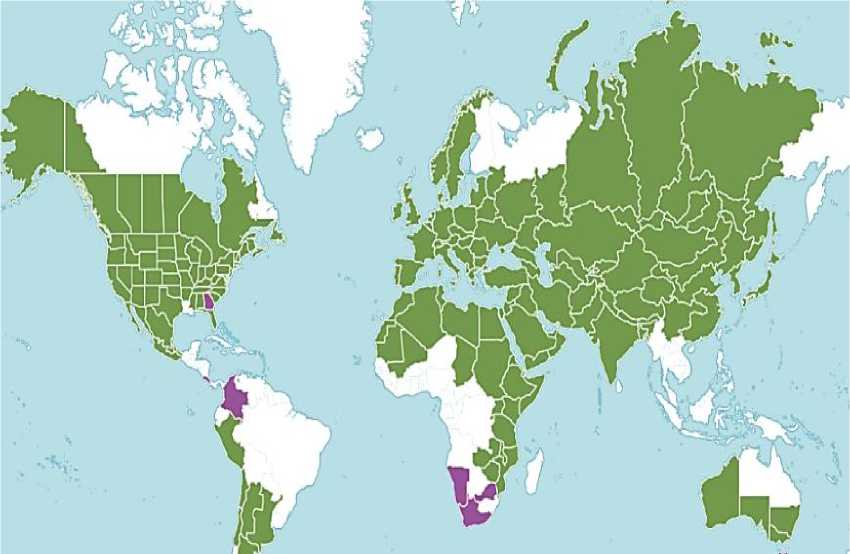
Figure. Range map of family Orobanchaceae
In the first half of the 19th century, several descriptive monographs on the systematics of the family Orobanchaceae were published, which described the morphology and distribution of individual species [6].
In 1852, W. G. Walpers first divided the family into four tribes: Orobancheae, Aeginetiae, Lathraeae, and Hiobancheae. He did this based on characteristics of ovary structure and the number of carpels. The monographer of the broomrape family, G. Beck, in 1895 divided the family into two subfamilies based on the number of carpels — Orobanchaceae bicarpellatae G.Beck and Orobanchaceae tricarpellatae G. Beck. However, subsequent observations showed that this characteristic is not constant [3].
Systematic analysis of the family Orobanchaceae remains relevant to this day, with the main study on this subject being the monograph written by G. Beck in 1930. In his research, the author provided detailed diagnostic characteristics for all species and analyzed nomenclatural references [8].
The genus Orobanche worldwide includes 198 species belonging to the broomrape family and is the genus with the greatest number of species among approximately more than 4000 parasitic plants distributed worldwide [5, 7].
The name "Orobanche" was formed from the combination of the Greek words orobus (a genus of leguminous plant) and anche — to strangle. In many languages of the world, the word Orobanche is called differently. For example, in German "tabacwurger" — tobacco strangler, "hanftog" — death of hemp, "kleeteufel" — clover devil; in Italian "carnifera de la canapa" — executioner of hemp; in Uzbek "шумгия" — greedy plant; in Turkish "orobanş" - monster grass. All this stems from the great damage that broomrape causes to agriculture and from the interest of scientists in this genus from past times.
The name Orobanche was first introduced into science by Tournefort, who included 6 species in the genus ( O. major , O. lusitanica , O. flore minöre , O. subcaeruleo , O. ramosa , O. quasi ); later Linnaeus in the work "Species Plantarum" included 18 species in the genus ( O. major , O. foetida ,
O. caryophyllacea , O. coerulescens , O. elatior , O. purpurea , O. minor , O. alba , O. gracilis , O. americana , O. virginiana , O. uniflora , O. coerulea , O. phelypaea , O. tinctoria , O. cernua , O. ramosa , O. coccinea ).
At the beginning of the 17th century, Wallroth in the work "Orob. Gen. Diask." divided the genus into 4 tribes, which are as follows: Osproleon Wallr. (18 species), Trionychon Wallr (5 species), Anopolon Wallr. (2 species) and Haemodron Wallr. (10 species).
Jean-Pierre-Étienne Vaucher, the author of the first monograph of the genus, divided the genus Orobanche into two tribes named Osproleon and Terionychon .
In 1874, Pomel ( Phelipanche Pomel in Bull. Soc. Sci. Phys. Algérie 11: 102) introduced the genus Phelipanche into science, transferring species belonging to the section Trionychon into the composition of this genus.
In the 1890 work of Günther R. Beck von Mannagetta "Monographie Gattung Orobanche," all species of the genus Orobanche known to science were analyzed in detail. The author divided the 83 species included in the genus Orobanche into 5 sections: Aphyllon Nutt., Myzorrhiza (Philippi) Beck., Kopsiopsis Beck., Trionychon Wallr. and Osproleon Wallr.
For the first time, a comprehensive study of host plants on which the genus parasitizes was conducted.
In our research, Beck's monograph was taken as a basis, with some modifications noted. Kapsiopsis Beck., which was accepted by Beck as a section, was later elevated to the genus level, and some new species were added.
Uhlich and others in 1995 in the book "Die Sommerwurzarten Europas" noted that the genus Orobanche consists of 170 species distributed worldwide and divided the genus into 4 sections: Gymnocaulis Nut., Myzorrhiza (Phil.) Beck., Trionychon Wallr. and Osproleon Wallr.
The most recent studies of the genus Orobanche belong to the Polish scientist R. Piwowarczyk. She apparently comprehensively studied the genus and noted 4 new species distributed in Azerbaijan and belonging to the genus. These are as follows: O. arpica Piwow, Sanchez & Moreno Mor., O. zajaciorum Piwow, O. javakhetica Piwow., O. Sanchez & Moreno Mor., O. mlokosiewiczii Piwow., Ó.Sánchez & Moreno Mor [7-9].
In the flora of Azerbaijan in 1957, N.N. Tzvelev studied the genus, which reported the presence of 49 species. According to modern taxonomic nomenclature, 19 of these species were transferred to other genera (The Euro+Med Plantbase Project, KEW, WFO.). As a result of our current research, noting nomenclatural changes, we can say that the genus is represented in Azerbaijan by 59 species. The herbarium collection of the Institute of Botany of the Ministry of Education and Science of the Republic of Azerbaijan contains herbarium specimens of 29 species of the genus [11-13].
The genus Orobanche is known as a taxonomically very difficult group of plants. Thus, variations in the taxa of the genus within populations are very widespread. For species identification, it is important to collect and study a large number of species from as diverse ranges as possible [8].
Despite the fact that all species of the genus are very similar in appearance, each genus has its own characteristics that distinguish them from others. Herbarium materials are difficult for species determination, so field study is considered more appropriate, since important diagnostic characters disappear when the plant dries. After herbarization, the coloration of the plant, which is very diverse in nature, changes and becomes dark brown, pale, brown, or gray-brown. This is very difficult to determine . Thus, many old herbarium specimens received incorrect identifications. Few studies cover the entire genus from a taxonomic perspective, despite the many problems associated with determining the genus [9].
Conclusion
In conclusion, we can note that the monographer of the family Orobanchaceae, G. Beck, in 1895 divided the family into two subfamilies based on the number of carpels – Orobanchaceae bicarpellatae G.Beck and Orobanchaceae tricarpellatae G. Beck. The systematic analysis of the family Orobanchaceae remains relevant to the present day, with the main study on this subject being the monograph written by G. Beck in 1930. In his research, the author provided detailed diagnostic characteristics for all species and analyzed nomenclatural references. In the flora of Azerbaijan, the genus was studied by N. N. Tzvelev in 1957, who reported that 49 species belong to the genus. According to modern taxonomic nomenclature, 19 of these species have been transferred to other genera . As a result of our current research, noting nomenclatural changes, we can say that the genus is represented in Azerbaijan by 59 species. The herbarium collection of the Institute of Botany of the Ministry of Education and Science of the Republic of Azerbaijan contains herbarium specimens of 29 species of the genus. Currently, in our research, we have taken Beck's monograph as a basis.
