
Optimization of the properties of lightweight ceramic products using statistical methods
Journal: Nanotechnologies in Construction: A Scientific Internet-Journal @nanobuild-en
Section: Construction materials science
Article in issue: 2 Vol.18, 2026.
Free access
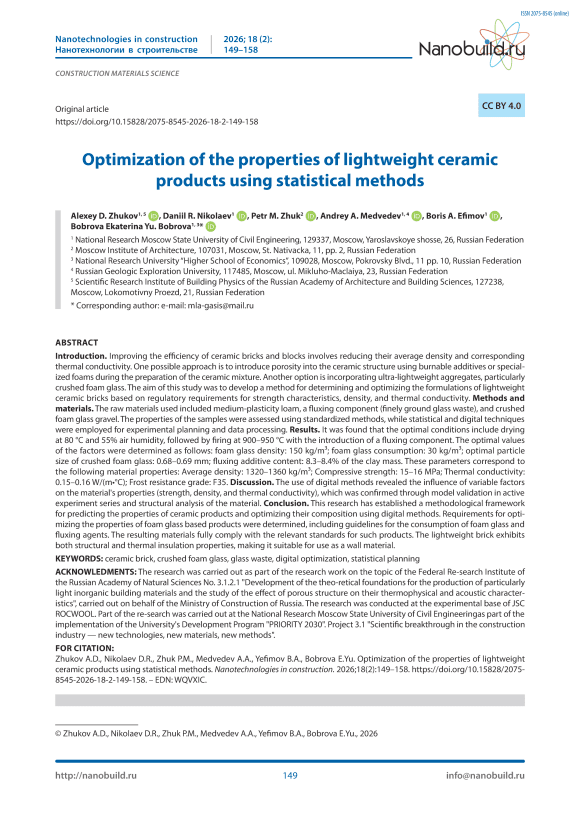
Introduction. Improving the efficiency of ceramic bricks and blocks involves reducing their average density and corresponding thermal conductivity. One possible approach is to introduce porosity into the ceramic structure using burnable additives or specialized foams during the preparation of the ceramic mixture. Another option is incorporating ultra-lightweight aggregates, particularly crushed foam glass. The aim of this study was to develop a method for determining and optimizing the formulations of lightweight ceramic bricks based on regulatory requirements for strength characteristics, density, and thermal conductivity. Methods and materials. The raw materials used included medium-plasticity loam, a fluxing component (finely ground glass waste), and crushed foam glass gravel. The properties of the samples were assessed using standardized methods, while statistical and digital techniques were employed for experimental planning and data processing. Results. It was found that the optimal conditions include drying at 80 °C and 55% air humidity, followed by firing at 900–950 °C with the introduction of a fluxing component. The optimal values of the factors were determined as follows: foam glass density: 150 kg/m³; foam glass consumption: 30 kg/m³; optimal particle size of crushed foam glass: 0.68–0.69 mm; fluxing additive content: 8.3–8.4% of the clay mass. These parameters correspond to the following material properties: Average density: 1320–1360 kg/m³; Compressive strength: 15–16 MPa; Thermal conductivity: 0.15–0.16 W/(m•°C); Frost resistance grade: F35. Discussion. The use of digital methods revealed the influence of variable factors on the material's properties (strength, density, and thermal conductivity), which was confirmed through model validation in active experiment series and structural analysis of the material. Conclusion. This research has established a methodological framework for predicting the properties of ceramic products and optimizing their composition using digital methods. Requirements for optimizing the properties of foam glass based products were determined, including guidelines for the consumption of foam glass and fluxing agents. The resulting materials fully comply with the relevant standards for such products. The lightweight brick exhibits both structural and thermal insulation properties, making it suitable for use as a wall material.
Similar articles in the section Glass industry. Ceramics. Cement and concrete
Short address: https://sciup.org/142247635
IDS: 142247635 | DOI: 10.15828/2075-8545-2026-18-2-149-158
