
Organizatoinal and managerial challenges of sports and media organizations under conditions of digital transformation and market innovation
Journal: Sport Mediji i Biznis @journal-smb
Article in issue: 1 vol.12, 2026.
Free access
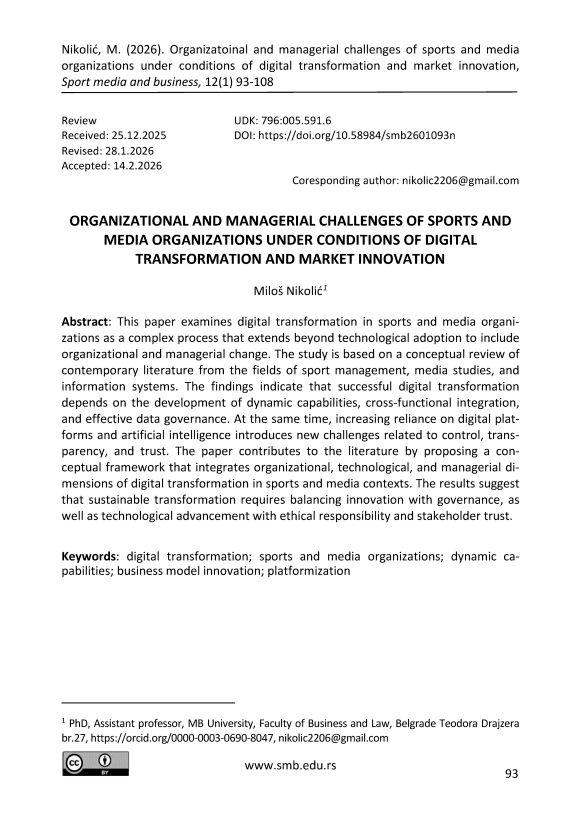
This paper examines digital transformation in sports and media organizations as a complex process that extends beyond technological adoption to include organizational and managerial change. The study is based on a conceptual review of contemporary literature from the fields of sport management, media studies, and information systems. The findings indicate that successful digital transformation depends on the development of dynamic capabilities, cross-functional integration, and effective data governance. At the same time, increasing reliance on digital platforms and artificial intelligence introduces new challenges related to control, transparency, and trust. The paper contributes to the literature by proposing a conceptual framework that integrates organizational, technological, and managerial dimensions of digital transformation in sports and media contexts. The results suggest that sustainable transformation requires balancing innovation with governance, as well as technological advancement with ethical responsibility and stakeholder trust.
Similar articles in the section Sport. Games. Physical exercises
Short address: https://sciup.org/170211691
IDS: 170211691 | UDC: 796:005.591.6 | DOI: 10.58984/smb2601093n
Text of the scientific article Organizatoinal and managerial challenges of sports and media organizations under conditions of digital transformation and market innovation
DOI:
One of the most important structural forces influencing modern sports and media businesses is digital transformation. The creation, distribution, and monetization of sports material, as well as the ways in which viewers, sponsors, and the larger market interact, are all significantly changed by the advancement of digital technologies, platforms, and analytical tools. Networked, platform-based, and data-driven business models are gradually replacing old models based on mass broadcasting and linear value chains in professional sports and sports media, creating new organizational and managerial needs (Zheng & Mason, 2022).
Contemporary literature emphasizes that digital transformation in sport is not merely a technical process, but a profound organizational change requiring adjustments in structures, processes, and governance practices (Anđelić et al., 2017). Technological innovations affect multiple dimensions of sports organizations, including operational efficiency, data-driven decision-making, athlete performance management, and the development of new forms of fan engagement (Dasic, 2018; Ratten, 2020). However, the ability of organizations to convert these technologies into sustainable market innovations depends on managerial competencies, organizational culture, and capacities for learning and adaptation (Kostadinović, Ilievska Kosta-dinović, 2025). Recent studies further highlight that the growing use of generative AI in sports journalism raises important questions related to transparency, credibility, and audience trust. Empirical evidence suggests that the presence of clear AI ethics policies and disclosure practices significantly influences how audiences perceive the trustworthiness and value of AI-generated sports content (Waddell, 2026).
The main obstacles to digital transformation in sports companies, according to empirical study, frequently arise at the administrative and organizational levels rather than at the level of technology accessibility. Significant obstacles to the effective execution of digital initiatives include a lack of digital competences, employee resistance to change, dispersed responsibilities, and challenges in calculating return on investment. (Qi et al., 2024). These challenges are further complicated by the need to preserve sporting integrity, ethical standards, and long-term organizational reputation in conditions of intensive digital data exploitation.
Finally, contemporary studies increasingly link digital transformation to issues of competitiveness and sustainability in sports organizations. Although digital innovations may enhance performance and market positioning, their positive effects are not automatic; they depend on management’s ability to integrate digital resources into organizational strategy, structure, and processes (Wang et al., 2024). For this reason, understanding organizational and managerial challenges under conditions of digital transformation and market innovation represents a crucial starting point for analyzing the contemporary development of sports and media organizations (Kostadinović & Ilievska Kostadinović, 2025).
Literature Review
The digital transformation of sports and media organizations is increasingly recognized in modern scholarship as a multifaceted organizational change that necessitates resource recombination, process redesign, data governance, and reevaluation of relationships with audiences and markets rather than as a singular "IT modernization." One branch of sport management research treats digital technologies as catalysts for change in learning, coordination, and decision-making, emphasizing the development of organizational skills through data analytics and technological tools.. Empirical evidence from elite sport suggests that analytics and advanced technologies can foster learning organization capabilities and enhance performance (Lunić & Ćesarević, 2025), while simultaneously raising managerial dilemmas regarding the integration of analytics teams, process standardization, and the transformation of data into operational knowledge (Olaniyan et al., 2024). Within the dynamic capabilities perspective, recent studies argue that digital environments increase turbulence and exposure to shocks, making resilience contingent upon management’s ability to reconfigure routines, reallocate resources, and accelerate learning during crises. Research from the COVID-19 period highlights capability building as a central leadership task in sports organizations (Marques et al., 2025). These findings imply that a key organizational challenge lies in establishing governance mechanisms for digital transformation, encompassing digital strategy formulation, data ownership, accountability for change, and cross-functional coordination (Trkulja et al., 2025).
A different corpus of research looks at digitalization across a wider range of sports organizations, such as local and volunteer clubs that function with few resources and a variety of skill sets. Typologies of digitalization practices in voluntary sports clubs show differences in managerial mindsets, which result in unequal capacities for innovation and adaptation, as well as in the degree and intent of digital tool adoption, ranging from marketing and membership management to administration and communication. (Ehnold et al., 2023). These findings shift the analytical focus from technology itself to managerial capacity, including knowledge availability, readiness for change, process formalization, and the ability to translate external digital trends into organizationally relevant routines.
Digital transformation is seen in the media and sports media markets as a reconfiguration of industry boundaries through OTT platforms, streaming services, and platform rivalry rather than just a move to new channels. Based on niche theory and uses-and-gratifications approaches, studies comparing traditional television and video-OTT services show that while traditional television still has advantages in terms of information provision and perceived financial value, users are increasingly valuing OTT services for convenience, relaxation, and flexibility. Media companies are under pressure to reevaluate their value propositions and monetization strategies as a result of the increased market competition. (Papathanasopoulos & Va-routas, 2024). Simultaneously, the growth of synchronous digital formats such as social live streaming reshapes sports content production and consumption. Research on co-streaming platforms such as Twitch demonstrates that virtual interactions enhance value co-creation experiences and platform involvement, indirectly increasing viewing intentions; consequently, managerial challenges revolve around designing interactive ecosystems and managing relationships with platform communities (Qian & Seifried, 2023). Organizational attention thus shifts from linear broadcasting to orchestrating networks of actors - platforms, creators, audiences, and brands – requiring new competencies in community management, partnerships, and user data analytics. In addition, recent research emphasizes the importance of adopting a broader ecosystem perspective when analyzing digital transformation in sports contexts. Rather than focusing solely on individual organizations, digital transformation should be understood as a process shaped by interactions among multiple stakeholders, including media organizations, technology providers, platforms, and audiences (Haffner et al., 2025).
Digital transformation further amplifies the role of social media, algorithmic distribution, and culturally aligned content strategies. Analyses of sports fan engagement suggest that culturally aligned content characteristics, such as language expectations, can predict engagement levels on social media, implying the need for more
A particularly dynamic domain concerns digital innovation through Web3 technologies and tokenization. Studies on fan tokens suggest that token-based digital platforms may influence team identification and co-creation mechanisms, with the meanings attributed to tokens mediating the relationship between technology use and behavioral intentions (Vollero et al., 2024). More broadly, research on blockchain in the sports industry highlights the potential for business model transformation and innovation performance improvements among firms adopting blockchain concepts, while also noting institutional barriers, standardization challenges, and measurement limitations (Lv et al., 2022). Managerial challenges therefore extend to regulatory and reputational risk management, the design of sustainable value propositions beyond short-term speculation, and the integration of new digital products into established relationships with fans and sponsors.
Digital transformation in media organizations, particularly in sports journalism, introduces additional layers of complexity related to automation, generative AI, and credibility concerns (Lunić & Ćesarević, 2025). Empirical research on AI-generated content disclosure in (sports) journalism indicates that transparency about content origin can influence perceived credibility, directly affecting editorial policies, verification standards, and communication strategies toward audiences (Rossner et al., 2024). Concurrently, studies on sports journalists’ professional role perceptions in the context of AI reveal tensions between innovation and professional norms - ranging from fears of diminished autonomy and quality to pragmatic acceptance of AI as an efficiency tool - necessitating organizational learning, new ethical protocols, and the redefinition of newsroom workflows (Humayun, 2025). Broader assessments of sports journalism underscore the need to understand sport simultaneously as practice and industry, as editorial, technological, and market logics increasingly intersect, thereby complicating transformation management (Hardin & Billings, 2025).
A shift in the academic focus toward the systemic implications of digitalization is suggested by bibliometric and trend studies, which offer a meta-perspective and demonstrate the increasing scholarly attention to digital change, platforms, and mar- ket pressures in sports journalism research (Hafiar et al., 2025). Digital transformation, sustainability, and innovation are linked in parallel streams in sports business research, suggesting possible relationships between digitalization, "green" innovation, and performance outcomes, subject to the creation of suitable managerial mechanisms to integrate sustainability and technology goals. Roadmap-oriented research emphasizes methodical prioritizing and resource alignment, further conceptualizing digital transformation as an organized change program as opposed to an ad hoc technology endeavor (Magaz-González et al., 2024).
The ethical and normative aspects of digital change in sports are likewise becoming more and more prominent in contemporary writing. The emergence of analytics, wearable technology, and automated decision systems changes the balance between expert judgment and data-driven practice, as well as the power dynamics inside organizations (Kovaňvić, 2023). This poses concerns about appropriate technology integration at the governance level, such as how to define data quality standards, avoid relying too much on algorithmic recommendations, and strike a balance between performance goals, athlete welfare, and competition integrity. While advantages like increased fan experience, injury avoidance, and efficiency improvements are palpable, concerns like privacy invasion, unfair advantage, expert substitution, and organizational resistance are just as important, according to empirical and synthetic results. Consequently, digital transformation is increasingly conceptualized as a strategic change management program rather than a series of isolated technical implementations (Qi et al., 2024).
In sports media, platformization processes further redefine institutional roles and distribution channels, particularly in the context of mega-events, where digital ecosystems have become central infrastructures of visibility and commercialization rather than supplementary media layers (Mlađenović, 2025). Analyses of the digitalization of sports mega-events within the “platform society” framework show that the shift from television to platforms such as YouTube generates new asymmetries in access control, algorithmic visibility, moderation rules, and attention distribution, while simultaneously enabling new forms of co-production and narrative reprogramming by audiences and content creators. From a managerial standpoint, this reinforces the need to develop competencies in managing platform relationships, rights, audience data, and risks stemming from dependence on external digital infrastructures (Ludvigsen & Petersen-Wagner, 2022).
Finally, as generative AI becomes increasingly integrated into news production and distribution, including sports journalism, credibility emerges as a first-order managerial issue. The central question is not only whether to use AI, but how to ensure
Theoretical Framework of Digital Transformation and Innovation in Sports and Media Organizations
Contemporary academic literature largely agrees that digital transformation represents a fundamental organizational change that goes beyond the mere introduction of new technologies. Rather than adopting a technologically deterministic perspective, dominant theoretical approaches conceptualize digital transformation as a process of profound reconfiguration of organizational strategy, structure, processes, and value creation mechanisms (Vial, 2019). In this sense, digital transformation entails a shift in business logic, market relationships, and internal organizational dynamics, a shift particularly evident in sports and media organizations operating within highly dynamic and platformized environments.
Within theoretical models of digital transformation, technology is treated as an enabler or trigger rather than the central driver of change. Vial (2019) defines digital transformation as a process in which digital technologies enable or constrain changes in organizational resources, structures, and practices with the aim of creating new value. Similarly, Verhoef et al. (2021) emphasize that digital transformation is a strategic process requiring the integration of digital technologies across all functional areas of the organization, alongside the redefinition of business models and organizational culture.
Platformization, datafication, and automation are three interconnected phenomena that represent this revolution in sports and media enterprises. The shift from linear value chains to multi-sided platforms that link companies, audiences, sponsors, and content producers is known as "platformization" (Nambisan et al., 2019). Datafica-tion is the methodical gathering, processing, and strategic application of information on audience behavior, market trends, and performance. Work procedures, decisionmaking, and content management techniques are all impacted by automation. The idea that digital transformation is really an organizational challenge is strengthened by the fact that these processes collectively call for new kinds of coordination, governance, and organizational design.
Dynamic Capabilities Theory provides one of the most influential frameworks for understanding how organizations respond to rapid technological and market change. According to Teece (2018), dynamic capabilities encompass the ability to sense opportunities and threats, seize opportunities, and reconfigure resources and routines to sustain long-term competitiveness. In digital environments, these capabilities gain heightened importance, as technologies accelerate change and increase uncertainty. Some scholars (Stanković, 2023; Jeličić, 2024) argue that digital transformation requires the development of specific digital dynamic capabilities, including experimentation, rapid iteration, and the integration of new technologies into existing organizational structures. In sports and media organizations, such capabilities are crucial for balancing the stability of the core product - such as competitive integrity or editorial standards - with the need for continuous innovation in distribution and monetization models.
Beyond adaptability, contemporary research links dynamic capabilities to organizational resilience. Organizations capable of rapidly reconfiguring resources and processes are better equipped to respond to crises, regulatory shifts, and disruptions in media ecosystems (Teece et al., 2016). This perspective is particularly relevant for sports and media organizations operating under high public scrutiny and reputational risk.
Theories of innovation and business models are essential to comprehending digital change. Digital technology, according to Rachinger et al. (2019), allow for new types of business model innovation, such as modifications to value propositions, distribution networks, and client interactions. Such innovations frequently entail a move away from traditional revenue streams like broadcasting rights and advertising and toward digital models centered on platforms, subscriptions, and interactive audience participation in sports and media organizations.
Contemporary theoretical approaches further emphasize the concept of value cocreation, according to which audiences and fans are no longer passive consumers but active participants in value creation through interaction, content production, and community engagement (Vargo & Lusch, 2016). While digital platforms facilitate co-creation, they also introduce managerial challenges related to moderation, control, and the maintenance of relationship quality with audiences.
Nambisan (2017) highlights that digital innovation reshapes the very nature of entrepreneurship and innovation, as organizational boundaries become blurred and innovation increasingly occurs within networks and ecosystems. For sports and media organizations, this implies that innovation management involves orchestrating relationships with platforms, technological partners, and fan communities, rather than relying solely on internal product development.
A cogent analytical framework for studying sports and media organizations in digital environments can be created by combining theories of digital transformation, dynamic capacities, innovation, and business models. According to this theory, managerial choices, organizational capabilities, and market contacts all influence digital transformation, which is defined as an organizational shift made possible by technology. According to Yoo et al. (2010), dynamic capabilities explain how companies adapt to change, while business model and innovation theories explain how these adaptations manifest as new forms of competitiveness and value. In the context of digital transformation and market innovation, this integrated perspective offers a consistent foundation for understanding organizational and managerial difficulties in sports and media businesses as well as for evaluating their strategic answers.
Organizational and Managerial Challenges under Conditions of Digital Transformation: Conceptual Model and Research Propositions
Contemporary research in sport management and media studies increasingly emphasizes that the success of digital transformation depends less on technological solutions themselves and more on the organizational and managerial capabilities to integrate technologies into existing structures, processes, and market relationships. Rather than offering descriptive accounts of technological trends, recent scholarship focuses on identifying the key challenges that shape the outcomes of digital transformation and innovation in sports and media organizations (Bresciani et al., 2018).
One of the central organizational challenges concerns the reconfiguration of structures and processes in conditions of heightened complexity and accelerated change. Digital transformation often requires a shift from rigid hierarchical structures toward more flexible and agile organizational forms that enable rapid coordination and experimentation. However, research shows that sports and media organizations frequently retain traditional hierarchies due to regulatory requirements, public accountability, and the need to preserve the integrity of the sports product, thereby creating tension between agility and control (Hanelt et al., 2021).
Another significant organizational challenge involves the integration of analytics, marketing, and media functions. While digital transformation generates large volumes of data on performance, audience behavior, and market trends, organizations
often lack clearly defined mechanisms for consolidating and leveraging these data in strategic decision-making. Kane et al. (2021) argue that digitally mature organizations develop cross-functional structures and shared analytical platforms, whereas fragmented responsibilities reduce the potential value of data.
In this context, knowledge management and organizational learning emerge as critical success factors. Digital initiatives produce new knowledge, but without systematic learning and institutionalization, innovations remain isolated and short-lived. Research in sport settings suggests that organizations actively fostering knowledgesharing mechanisms and reflective practices are better positioned to translate digital experiments into sustainable organizational routines (Felin et al., 2020).
At the managerial level, a dominant challenge concerns the development of digital and hybrid competencies. Digital transformation requires a combination of technological understanding, strategic thinking, and the capacity to lead people under conditions of uncertainty. Hess et al. (2020) describe managers in digitally transforming organizations as “orchestrators of change” rather than traditional process controllers.
Managing change and employee resistance presents an additional challenge, particularly in organizations with strong professional identities, such as sports clubs and media newsrooms. Digital initiatives may be perceived as threats to autonomy, professional standards, or job security, potentially generating passive or active resistance. According to Vial and Han (2022), successful digital transformation leaders combine formal change management mechanisms with communication, participation, and trust-building practices.
Data-driven decision-making constitutes another complex challenge. Although digital technologies enable sophisticated analytics, the literature warns of risks related to data overload, misinterpretation, and excessive reliance on algorithmic recommendations. Jöhnk et al. (2021) emphasize that the managerial value of analytics depends on the ability to combine quantitative insights with contextual knowledge and professional expertise, a balance particularly crucial in sport and media environments.
An additional layer of complexity arises from ethical, reputational, and regulatory risks associated with artificial intelligence, automation, and emerging digital technologies. Growing concerns regarding algorithmic transparency, data privacy, and accountability for decisions affecting athletes, journalists, and audiences underscore that risk governance must become an integral component of digital transformation strategy (Floridi et al., 2018). Building on these theoretical insights, a conceptual model can be proposed in which digital transformation generates interconnected organizational, managerial, and market-level challenges. The effective management of these challenges mediates the relationship between digital initiatives and innovation or performance outcomes in sports and media organizations.
Conclusion
Digital transformation in sports and media organizations represents a complex and multidimensional process that extends beyond the mere adoption of new technologies. As this study has shown, its success depends on the alignment of technological initiatives with organizational structures, managerial capabilities, and strategic orientation.
The findings highlight that digital transformation is fundamentally shaped by the development of dynamic capabilities, cross-functional integration, and effective data governance. At the same time, increasing reliance on digital platforms and artificial intelligence introduces new challenges related to control, transparency, and trust. These challenges require not only technical solutions but also robust managerial and ethical frameworks.
Furthermore, the study emphasizes that digital transformation should be understood within a broader ecosystem context, where multiple stakeholders - including media organizations, sports entities, technology providers, and audiences - jointly influence value creation processes. In this sense, the transformation of sports media is not only organizational but also structural, affecting the nature of media products, production processes, and audience engagement.
Overall, the paper contributes to the literature by integrating insights from sport management, media studies, and information systems into a unified conceptual framework. It underscores that sustainable digital transformation is contingent upon the ability of organizations to balance innovation with governance, platform strategies with autonomy, and technological advancement with trust and ethical responsibility.
Limitations and Future Research
This study is conceptual and lacks empirical validation of the proposed framework. Additionally, the interdisciplinary nature of the literature introduces heterogeneity, while differences between types of sports and media organizations are not fully addressed. The rapidly evolving nature of digital technologies further limits the temporal stability of the findings.
Future research should empirically test the proposed relationships, adopt a stakeholder and ecosystem perspective, and examine the impact of emerging technologies such as AI on sports media production and trust. Longitudinal and comparative studies are also recommended to better understand contextual and temporal dynamics of digital transformation.
