
Pedophilia as a Category of Sexual Interest: Phenomenological and Clinical Approaches
Journal: Society. Environment. Development (Terra Humana) @terra-humana
Section: Феномены социального развития
Article in issue: 4 (77), 2025.
Free access
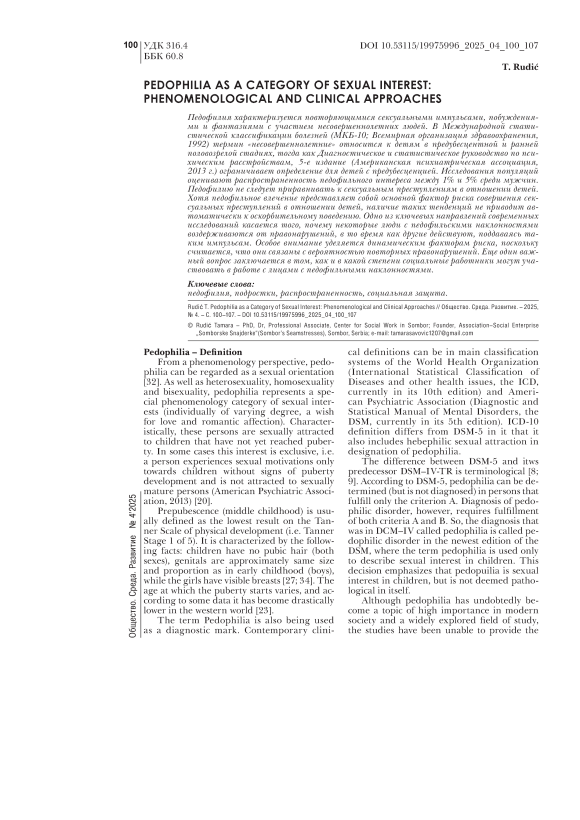
Pedophilia is characterized by recurring sexual impulses, urges, and fantasies involving underage individuals. In the International Statistical Classification of Diseases (ICD‑10; World Health Organization, 1992), the term “underage individuals” refers to children in the prepubescent and early pubescent stages, whereas the Diagnostic and Statistical Manual of Mental Disorders, 5th edition (American Psychiatric Association, 2013), restricts the definition to prepubescent children. Population-based studies estimate the prevalence of pedophilic interest at between 1% and 5% among men. Pedophilia should not be equated with sexual offenses against children. Although pedophilic interest represents the primary risk factor for committing sexual offenses against children, the presence of such tendencies does not automatically result in abusive behavior. A key area of current research concerns why some individuals with pedophilic interests refrain from offending, while others act upon their impulses. Particular attention is given to dynamic risk factors, as these are believed to be linked to the likelihood of repeated offenses. Another important issue is how, and to what extent, social workers can be involved in working with individuals with pedophilic tendencies.
Similar articles in the section Social processes. Social dynamics
Short address: https://sciup.org/140313982
IDS: 140313982 | UDC: 316.4 | DOI: 10.53115/19975996_2025_04_100_107
Педофилия как категория сексуального интереса: феноменологический и клинический подходы
Педофилия характеризуется повторяющимися сексуальными импульсами, побуждениями и фантазиями с участием несовершеннолетних людей. В Международной статистической классификации болезней (МКБ‑10; Всемирная организация здравоохранения, 1992) термин «несовершеннолетние» относится к детям в предубесцентной и ранней половозрелой стадиях, тогда как Диагностическое и статистическое руководство по психическим расстройствам, 5‑е издание (Американская психиатрическая ассоциация, 2013 г.) ограничивает определение для детей с предубесценцией. Исследования популяций оценивают распространенность педофильного интереса между 1% и 5% среди мужчин. Педофилию не следует приравнивать к сексуальным преступлениям в отношении детей. Хотя педофильное влечение представляет собой основной фактор риска совершения сексуальных преступлений в отношении детей, наличие таких тенденций не приводит автоматически к оскорбительному поведению. Одно из ключевых направлений современных исследований касается того, почему некоторые люди с педофильскими наклонностями воздерживаются от правонарушений, в то время как другие действуют, поддаваясь таким импульсам. Особое внимание уделяется динамическим факторам риска, поскольку считается, что они связаны с вероятностью повторных правонарушений. Еще один важный вопрос заключается в том, как и в какой степени социальные работники могут участвовать в работе с лицами с педофильными наклонностями.
Text of the scientific article Pedophilia as a Category of Sexual Interest: Phenomenological and Clinical Approaches
Общество. Среда. Развитие № 4’2025
Pedophilia – Definition
From a phenomenology perspective, pedophilia can be regarded as a sexual orientation [32]. As well as heterosexuality, homosexuality and bisexuality, pedophilia represents a special phenomenology category of sexual interests (individually of varying degree, a wish for love and romantic affection). Characteristically, these persons are sexually attracted to children that have not yet reached puberty. In some cases this interest is exclusive, i.e. a person experiences sexual motivations only towards children without signs of puberty development and is not attracted to sexually mature persons (American Psychiatric Association, 2013) [20].
Prepubescence (middle childhood) is usually defined as the lowest result on the Tanner Scale of physical development (i.e. Tanner Stage 1 of 5). It is characterized by the following facts: children have no pubic hair (both sexes), genitals are approximately same size and proportion as in early childhood (boys), while the girls have visible breasts [27; 34]. The age at which the puberty starts varies, and according to some data it has become drastically lower in the western world [23].
The term Pedophilia is also being used as a diagnostic mark. Contemporary clini- cal definitions can be in main classification systems of the World Health Organization (International Statistical Classification of Diseases and other health issues, the ICD, currently in its 10th edition) and American Psychiatric Association (Diagnostic and Statistical Manual of Mental Disorders, the DSM, currently in its 5th edition). ICD-10 definition differs from DSM-5 in it that it also includes hebephilic sexual attraction in designation of pedophilia.
The difference between DSM-5 and itws predecessor DSM–IV-TR is terminological [8; 9]. According to DSM-5, pedophilia can be determined (but is not diagnosed) in persons that fulfill only the criterion A. Diagnosis of pedo-philic disorder, however, requires fulfillment of both criteria A and B. So, the diagnosis that was in DCM–IV called pedophilia is called pe-dophilic disorder in the newest edition of the DSM, where the term pedophilia is used only to describe sexual interest in children. This decision emphasizes that pedopuilia is sexual interest in children, but is not deemed pathological in itself.
Although pedophilia has undobtedly become a topic of high importance in modern society and a widely explored field of study, the studies have been unable to provide the feeling of cohesion and scientific clarity of understanding this problem [25; 29]. Slowness and diagnostic uncertainty of pedophilia (or pedophilic disorder) has led to problems due to which clinical definitions practically differ or are not even close to being the same [28], jeopardizing result comparability.
Clinical Chartacteristics of Pedophilia
Estimates of sexual interest for children prevalence in male population is usually between 3% and 10%, but most estimates are based only on a small tested sample. The largest population-based studies have so far been conducted with 1312 men [31] and 8780 German men between 18 1nd 89 years of age [14]. A Finnish study found that 3.5% of participants exhibited indicators of sexuality in the form of fantasies or sexual behavior involving individuals under the age of 16; however, the authors did not distinguish between fantasizing and behavior, that is, between pedophilia and hebephilia. In the German study, 4.1% of subjects reported sexual fantasies and 3.2% sexual behavior that includes children under the age of 12. In this group 68% fantasized about girls, 13.3% about boys, and 18.3% about children of both genders. Only 0.1% of subjects in the German sample reported that they have a preferential sexual interest for children (i.e. they have reported that they have more sexual fantasies or experiences involving children, than those involving grownups). However, existence of such fantasies would not suffice for diagnosing a pedophilic disorder. So, these numbers can only provide the top threshold for prevalence of pedophilia among men in clinical sense [32], under assumption that pedophilic fantasies were not reported in sufficient numbers, due to societal desirability, bias, or concern about anonymity. There are considerably fewer studies on sexual interests of women towards children, but findings up to now show that this phenomenon is considerably rarer in women than in men [17].
Start and Stability
To this day there are no longitudinal data that would enable a final conclusion on where the start and stability of pedophilic attraction are. Still, there is some evidence that pedophilia can be compared with homosexual and heterosexual orientation bearing in mind its early beginning and relatively stable course during the whole life. In fact, the majority of persons with pedophilia remember the start of their sexual fantasies, that include children, in adolescence or early adulthood. As a pedophile, sexual attraction shows little to very little reaction to therapeutic intervention, most researchers believe that it is a stable aspect of sexual composition of a person [15; 20; 32].
Etiology of Pedophilia
Currently, little is known about development of heterosexuals, homosexuals, lesbians of bisexuals, i.e. the development of their fantasies and identities. Therefore the origin of pedophilia is not surprising, nor is the fact that it has so far remained unclear to many clinical researches. Although there is a plethora of theories on etiology of pedophilia, these are relatively few in comparison with, for example, number of etiologic theories of sexual offences against children, and neither is supported by convincing evidence [32]. Still, research has uncovered numerous differences between the Primary Violence Prevention group (from correctional facilities) and other group of perpetrators or members of the general population that point to a common neurobiological/genet-ic and ecologic base of pedophilia.
Interestingly, it seemed that “during the 20th century ” majority of researchers supported “non-biological over biological theories in development of pedophilia” [10, p. 565]. Current studies, however, suggest that biological influence plays an important role. Also, differences in biological variables can help to explain why some people that have experienced certain environment are connected with pedophilia, i.e. can develop sexual interest in children while others cannot.
Numerous researchers have suggested that sexual interest in children is hereditary, like other aspects of human sexuality, including sexual orientation towards an adult partner of the same sex. While a recent study of twins showed the existence of hereditary component in development of sexual fantasy that includes people younger than 16 years of age, this component seems relatively week in comparison with rates usually detected for psychopathologies, personality traits and sexual orientation, only 14.6% of variance could be ascribed to heredity. Still, finding this genetic component leads to an evolutionary paradox, since sexual interest in individuals that are too young to reproduce leads to diminishing reproductive success. By natural selection rules, genes that contribute to such interest should have been made extinct generations ago, unless these genes have additional benefits that surpass these disadvantages. In one study tasked with clarifying potential evolutionary advantages for same-sex attraction, female relatives of gay men showed fewer gynecological disorders and less risk from complications during pregnancy than female relatives of heterosexual men [12], which suggests that these women could have
Общество
genetic benefits regarding offspring. Alternatively, genes that predispose humans to develop pedophilic interests can represent a form of attractiveness of the young that in a less extreme form would bring about sexual interest in highly fertile sexual partners.
What’s more, it is determined that pedophilia is connected to indicators of neurode-velopmental deficiencies such as head injuries before the age of 13, but not later. By accumulating results of many individual studies, sexual abusers of children attained lower
Общество. Среда. Развитие № 4’2025
IQ test results than sexual abusers of adults, and lower results than non-sexual offenders [10]. Cantor, Blanchard, et al. (2005) ascribed these differences to the levels of pedophilia, that were probably largest in the group of child abusers. Also, erotic attraction to children was determined, i.e. connected with high rates of left-handedness, “comparable with detected rates in pervasive developmental disorders, such as autism, which points to neurological component for development” of pedophilia [9, p. 447].
Despite progress of neuroimaging in the last two decades, relatively little is known about neurobiology of pedophilia in comparison with, for example, schizophrenia or anxious disorders [11]. This delay can be ascribed to the fact that research so far has not succeed to develop well supported etiological theories of pedophilia that would be needed to conduct a search for relevant areas of the brain [11].
Still, numerous studies of neuroimaging have detected a difference between sexual attitudes of offenders with pedophilia and control group without pedophilia or a criminal background. Some studies have shown pronounced reduction of grey matter in several areas of the brain, including amygdala and similar structures, but it remains unclear whether these findings can be ascribed to pedophilia, general criminology or lowered impulse control. In neuroimaging study where they compared sexual offenders with pedophilia to nonsexual offenders, authors discovered large regions with significantly lower volumes of white matter in comparison with control results in temporal and parietal brain areas, but no difference was observed regarding grey matter of the brain [11]. These results have led authors to suppose that incoherence between certain brain areas that are part of the larger cortical network is a basis for detecting sexually relevant signs that can be biological predecessors of pedophilia, rather than lesions in certain areas [11].
The only powerful environmental factor that is known to predict sexual fantasies and behaviors is sexual abuse in childhood (but bear in mind that most children that were sexually abused neither develop pedophilic fantasies nor perpetrate sexual delicts later in life; Seto, 2012). Observation that Primary Violence Prevention programs report higher rates than expected in child abuse represents the basis of abused-abuser theory, i.e. idea that there is a unique causal connection between being abused in childhood and engaging in similar sexual fantasy and/or activity as an adult [13]. Erotic tendencies towards the age group of children’s bodies as compared with adult bodies, as is evaluated phallometri-cally estimated (i.e. measuring circumference of penis or changes in volume as a response to different stimuli) among children to sexual perpetrators is significantly predicted by (self-reported) sexual abuse in childhood [16]. By using meta-analytical approach, certain researchers have proven that sexual abuse in childhood was connected with sexual criminal acts as an adult. Other participation in sexual activities as a child (for example, “playing doctor” among children of same age) was also suggested in order to explain etiology of pedophilia [31].
Besides speculation, little is known about basic psychopathological ways of connecting sexual abuse or other sexual experiences from childhood to pedophilic fantasies or behaviors later in life [32]. In words of conditioning theory supporters, if an unconditional stimulus (for example: children) is linked with positive emotional reactions (sexual pleasure) during sexual experiences in childhood or masturbation, conditioning that predisposes an individual to get aroused occurs. Still, this theory is unsuitable for explanation of pedophilia by itself, as many children have their first sexual experiences with peers that are of same age [32]. Other as of yet unknown variables, such as genetic differences that lead to increased suggestibility of conditioning [31], explain why children rarely develop pedophilia while growing up.
Sexual Delicts Against Children
World Health Organization and International Society for Prevention of Child Abuse and Neglect (2006) define sexual abuse of children and criminal acts of child pornography as “involving a child in a sexual activity that he or she do not fully understand, that they are unable to give informed consent or for a child that is not developmentally prepared” or that, in a way that hasn’t been specified further, “laws or social taboos are being violated”. Acts of sexual abuse can mean, for example, showing pornographic materials to a child, sexual talk with a child, kissing a child’s tongue, mas- turbating in front of a child, stroking a child’s genitals (or encouraging a child to touch genitals of a grownup). Sexual abuse doesn’t have to include violence or threats and can be done by adults and other children. Around 1% of boys and 5% of girls have experienced some form of sexual abuse that includes direct physical contact (for example touching the perpetrator or being touched by perpetrator in a sexual way, intercourse), younger than 14 years in Germany (N = 11.428) [7]. In this study it is determined that sexual abuse led to numerous psychological problems later in life, but due to the presence of confusing variables, causality cannot be safely assumed.
As one other important area of sexual exploitation of children, criminal acts of child pornography have gained public and scientific interest [24; 32]. Although the use of pornography, i.e. pornographic images does not harm the children directly, obtaining pornographic images “can create a demand for their production” and bring about further anxiety of the victim “due to knowledge that recording of their sexual abuse was published and remains still accessible” (Berliner Institut für Sexualwissenschaft und Sexual-medizin, 2013, p. 14). The German criminal law not only forbids distribution, possession and obtaining of images of children’s genital and sexual acts between children and adults, but also any sexually explicit fictional material (i. e. written texts or computer animations) that include children. This law also pertains to pornographic material that includes adolescents. According to recent estimates based on a large survey, around 2,2% of German men have used child pornography [14].
Risk Factors for (repeated) Sexual Offences Against Children
For primary prevention of sexual delicts against children, it is important to know what factors can predict or determine such behavior. There is a large number of theories that try to explain first offences (for overview see [32]). Four factorial models were clarified, for example: (1) emotional congruence with children (i.e. emotional desire to be close to children), (2) sexual arousal caused by children, (3) blockage (i.e. failure to find alternative ways of fulfilling sexual or emotional needs) or (4) disinhibition (for example, being intoxicated or other factors that lead to failure to control harmful urges) can cause sexual abuse of children. Still, theoretical works like these have “over-collected information, yet there is little empirical data that would single out the most important risk factors, and/or how they in interaction produce sexual abuse of chil- dren”. What’s more, as most studies of risk factors focuses on convicted perpetrators, the current literature does not provide insight in predictive factors for first offence.
In risk factor research, there is a usual difference between static and dynamic risk factors for sexual offences. Static risk factors are fixed factors that are connected to higher risk, but cannot be changed (such as age or aspects of past offences like number or gender of victim children; according to Hanson & Thornton [21]), while dynamic risk factors are susceptible to change during intervention (for example, self-respect and self-control skills;
Acute risk factors represent very temporary conditions that change quickly (for example, negative emotions) or events (for example, interpersonal conflict) that can signalize situations when there is likelihood of first or repeated offence [26].
Recently, the dichotomy between stable and acute risk factors was largely criticized, or rather, lack of empiric support for difference and sometimes unclear relation between static risk factors (for example, offence against children that are not related to perpetrators as opposed to children that are) and recidivism [26]. In order to solve these conceptual problems, it was suggested to conceptualize risk factors as lasting “individual proclivities [similar to characteristics], that may or may not manifest at any given time period [of condition]” [26, p. 194]. According to this understanding, unfavorable living conditions or personal circumstances (for example, using disinhibiting substances or socializing with delinquents) are less important than presumed lasting tendencies of an individual to gravitate towards or create such conditions and circumstances (for example, attitudes or impulsivity of lifestyle).
Treating Persons with Pedophilia as Primary Prevention
It is often stated that pedophilia is experienced as ego-syntonic, meaning that the person doesn’t suffer fantasies, but sees them as a part of their normal identity [19]. According to that, a person with pedophilia that seeks treatment perhaps won’t notice sexual interest for children as problematic, especially if a person is capable of controlling certain urges that can lead to criminal behavior. In
Общество
this case, a person wouldn’t be diagnosed with pedophilic disorder, and would not have any therapeutic goal regarding prevention of sexual abuse.
Общество. Среда. Развитие № 4’2025
Still, out of all therapeutic goals that a person with pedophilia can have, the goal to have them refrain from criminal sexual behavior involving children is what interests therapists and researchers the most.
Therapeutic approaches for attaining this goal can be categorized in two wide domains:
-
(1) a change in, or diminishing of pedo-philic attraction (for example, aversion therapy, saturation or masturbation renewal), and
-
(2) a change in the way that a person handles this attraction (for example, increased motivation and control in order to help a person refrain from sexual relations with children).
Pharmacologic treatments are also available and are widely used for reduction of pe-dophilic attraction. Medicaments prescribed include anti-hormonal substances and certain selective serotonin inhibitors known to reduce sex drive. Still, professional literature also shows that certain androgenic medicaments have serious undesired effects, such as worsening of heart disease, anemia and depressive moods 22]. Also, while generally reducing the patient’s sexual drive, the pharmacological treatment doesn’t change their need for sex. Ultimately, the goal is to develop a cure that selectively reduces deviancy of sexual attraction, without disrupting non-deviant sexuality [22, p. 408]. Attitude that “treatment is more likely to be effective if it focuses on self-regulation skills (in order to manage pedophilic urges, thoughts, etc.) than trying to change sexual preferences” [32, p. 234–235) recently gained popularity among researchers and therapists alike. Berlin prevention project Dunkelfeld aims at Primary Violence Prevention program participants who are worried that they might perpetrate sexual delicts against children (for the first time or again) and decide to continue therapy, but are currently under no legal obligation to do so.
The program is based on cognitive behavioral therapy (CBT) principles and reminds of relapse programs that are based on prevention for persons with addiction disorders. The treatment includes interventions for “increasing motivation, improving self-efficiency and self-control”, “reducing sexual excitement and sexualized confrontation by increasing adequate strategies of confrontation, emotional and sexual self-regulation, increase social functioning, decrease attitudes that support child abuse and similar behaviors” and to “increase empathic reaction to children involved in sexual activities with an adult or showed in
CP [Child Pornography], finally developing appropriate anti-relapse strategies and prevention goals” (Berliner Institut für Sexual-wissenschaft und Sexualmedizin, 2013, p. 22). During the course, the patients learn that, while they are not responsible for their sexual interests, they are responsible for controlling their behavior and interests.
It was discovered that the treatment decreases emotional loneliness, confrontation is oriented towards emotions and attitudes that support increase of empathy for the victim (among other variables) [6]. Contrary to expectations of authors, the treated Primary Violence Prevention program participants also showed significant loss of self-respect, while Primary Violence Prevention program participants from control group did not change in regard to this variable [6]. Regarding the perpetration risk, 20% of those that perpetrated a sexual offence against children persisted with sexual offences against children during the one year the program lasted, while none of the persons that did not commit any sexual offences against children started with such a behavior. Among users of child pornography, 90% persisted with their offensive behavior, while 24% of those that have not used child pornography earlier started using it.
Sociodemographic Characteristics of Offenders and The Role of Social Work in the Republic of Serbia
Social work, a profession represented in Republic of Serbia since the 1950’s, in its scope of work also deals with perpetrators of criminal acts. Since work with perpetrators of criminal acts requires specific professional knowledge and skills, for many years there has been a need for a special institute to deal with those that broke the law. In connection with this, special importance is given to social works in work with perpetrators of criminal acts, such as pedophilia.
A large number of researches report that the majority of child abuse cases that take place in an institution or an organization tasked with supervision and care of children remain undetected. Still, it seems that researches about sexual abuse of children in an institutionalized environment are scarce and current research attempts are primarily focused on case reports. It was suggested that sexual abusers of children (CSA) form a heterogeneous group regarding different psychological and criminological characteristics. However, in majority of previous studies, sexual abusers of children who work with children (CSA-V) were usually put in a group of extra-familial child abusers and were not studied separately. Still, different stable and dynamic characteristics that differentiate CSA-V from CSA-E and intra-familial CSA (CSA-I). First of all, hierarchical relation between CSA-V and victim(s), established and provided by an institution involving both perpetrator and victim, differentiate CSA-V from other CSAs. In this context, demographic and psychiatric characteristics and characteristics of CSA-V were compared with characteristics of CSA-E and CSA-I. Similar to previous researches, results showed that CSA-V had significantly higher IQs, they were highly educated and significantly older than both CSA-E and CSA-I. CSA-V also abused more children in life, their victims were more often male, and victims were older when the abuse started. In that context, previous researches showed that existence of a large number of victim children, as well as predominantly male victims, is largely connected to pedophilic sexual interests. What’s more, it was discovered that CSA-V show higher level of emotional over-identification with children and that there is a higher likelihood that the abuser shall have attitudes of blaming the victims compared with CSA-I and CSA-E.
Data on researches and pedophiles in Republic of Serbia is very scarce, almost limited. Bearing in mind that violent criminal acts such as murder, rape and sexual intercourse with a child are marked by severe consequences, significant vulnerability of women and children, a large dark figure, as well as complex and under-investigated etiology, goal of this paper is to analyze, interpret and evaluate sociodemographic characteristics in order to determine who the perpetrators of criminal acts in the Republic of Serbia are and what the role of social worker(s) is in that case.
Violence is one of leading causes of death among the population between 15 and 44 years of age. According to estimates of World Health Organization (WHO), 1.6 million people die every year from consequences of violence. A significantly larger number are injured and suffer consequences of the assault as physical, psychical, sexual or health problems. Violent crimes are present in every society. The violence is result of intricate mutual relationship between large numbers of factors. Existence of real or imaginary conflict between two sides with opposing motives spurs violence. Interaction between potential perpetrator and victim in given conflict situation influences whether the criminal act shall be committed or not, as well as possible means, instruments and consequences of it. Many different types of experts, such as lawyers, psychologists, criminologists, criminalists, sociologists, philosophers etc. have researched the violence phenomenon. We are currently witnessing a rise in violence in schools, violence against emotional partners and children, violent sport spectators etc. Based on daily reports on different forms of violence such as fights, murders, domestic violence given in the press and some news programs, it seems that violence happens ever more often. The literature offers many different approaches to defining the violent criminal act phenomenon that fundamentally differ in classification of criminal acts belonging to this type. Their common ground is a standpoint that those are criminal acts where an example of interpersonal violence is manifested, characterized by brutal and aggressive treatment of a victim or some other object. Studying sociodemographic characteristics of violent criminal act perpetrators, committing criminal acts such as murder, rape or sexual intercourse with a child, represents the affirmation of approaching this criminalistics phenomenon as a complex one, arising from interaction of numerous societal and personal factors [4; 5].
Previous sociodemographic characteristics researches of violent crimes perpetrators in Serbia focused mostly on murderers and rapists, but not on perpetrators of sexual intercourse with a child, except those convicted for child pornography, Article 185 of Serbian Criminal Law [3]. This research focused on determining the most important sociodemographic characteristics of those involved with child pornography, as well as details of the criminal act perpetration. The work included 62 male adults, aged between 18 and 72. The results showed that those who committed child pornography are exclusively men averagely aged 36.6 years, with different professions, holding various employments, as well as students and pensioners. Regarding other sociodemographic characteristics, the results show that most perpetrators have finished secondary education, that there are employed and unemployed ones, unmarried, are usually form urban environments and that they do not have a criminal record.
Sexual exploitation of children by travelers and tourists has become a widely debated subject among many child protection agencies, charitable organizations, etc., after Global UN Study on Sexual Exploitation of Children in Travel and Tourism was published. The study has become the most comprehensive overview of the current state of things. Affordable travel and new technologies that enable easy access to information are seen as the main reasons for
Общество
expansion of sexual exploitation worldwide. The offenders do not have prototype pedophile profiles; they exist in all walks in life and are not considered serial pedophiles. What they do have in common is a very small chance of being discovered, arrested and convicted. They choose countries with the weakest laws, where there is no rule of law. In northern Afri- ca and the Middle East, numerous factors such as temporary marriages, wars and low status of women contribute to pedophilia. Due to inefficient law enforcement, pedophilic tourism has flourished in the poor countries of south Asia and Latin America. Bearing in mind that violent criminal acts such as murder, rape and sexual intercourse with a child are marked by severe consequences, significant vulnerability of women and children, a large dark figure, as well as complex and under-investigated etiology, goal of this paper is to analyze, interpret and evaluate sociodemographic characteristics in order to determine who the perpetrators of criminal acts in the Republic of Serbia are, specifying their common sociodemographic characteristics.
According to results by Stojanović-Anđelić i Nikolić (2019) the majority of perpetrators of violent crimes in Serbia are between 20 and 30 years of age (27%), then between 31 and 40 years of age (26%) and between 41 and 50 years of age (25%). Somewhat lower percentage (13%) are aged between 51 and 50, and between 61 and 70 (6%). In order to determine sociodemographic profiles of perpetrators of rape, murder and sexual act with a child, and enable more precise perpetrator identification, this paper shows modality of their most important sociodemographic characteristics. Researches that tested demographic profiles of murderers, rapists and pedophiles in Serbia (Gajić et al., 2016; Baić, Kolarević, Ranković, 2018; Baić, Ivanović, Oljača, 2019) point to the fact that, phenomenologically speaking, population is heterogeneous and differs in certain sociodemographic features.
Conclusion
Research findings support the view that perpetrators of criminal acts – murderers, rapists, and pedophiles – differ in terms of age distribution. The majority of murderers are aged between 14 and 50, rapists between 20 and 50, and pedophiles between 20 and 30. Regarding other sociodemographic characteristics, studies indicate that murderers, rapists, and pedophiles were typically born and reside in urban areas, have completed secondary education, were unemployed prior to serving their sentences, are technicians of various profiles, unmarried, and represent diverse socioeconomic backgrounds. In terms of criminal history, murderers and rapists – unlike pedophiles – were often previously convicted for property crimes, violent offenses, and drug-related crimes. Summarizing their social status, it is apparent that it was generally unfavorable, as the majority were unemployed and of lower socioeconomic status. Penal records predominantly show that pedophiles had no prior convictions, in contrast to murderers and rapists who had previous offenses for property crimes and violence. However, the absence of information regarding previous criminal activity among pedophiles may not be entirely reliable. This paper represents an initial exploration of this field of study, and a more detailed investigation on this topic is planned for future research.
Общество. Среда. Развитие № 4’2025
