
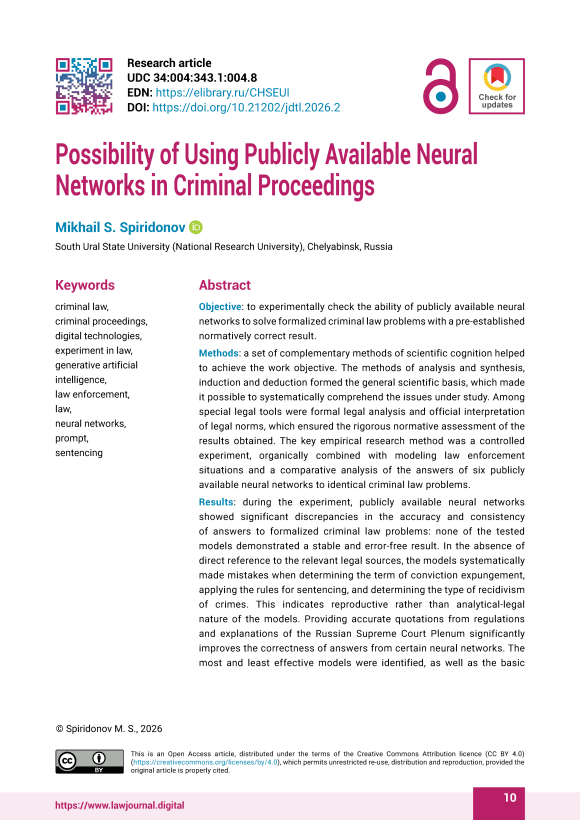
Possibility of Using Publicly Available Neural Networks in Criminal Proceedings
Journal: Journal of Digital Technologies and Law @lawjournal-digital
Article in issue: 4 (1), 2026.
Free access
Objective: to experimentally check the ability of publicly available neural networks to solve formalized criminal law problems with a pre-established normatively correct result. Methods: a set of complementary methods of scientific cognition helped to achieve the work objective. The methods of analysis and synthesis, induction and deduction formed the general scientific basis, which made it possible to systematically comprehend the issues under study. Among special legal tools were formal legal analysis and official interpretation of legal norms, which ensured the rigorous normative assessment of the results obtained. The key empirical research method was a controlled experiment, organically combined with modeling law enforcement situations and a comparative analysis of the answers of six publicly available neural networks to identical criminal law problems. Results: during the experiment, publicly available neural networks showed significant discrepancies in the accuracy and consistency of answers to formalized criminal law problems: none of the tested models demonstrated a stable and error-free result. In the absence of direct reference to the relevant legal sources, the models systematically made mistakes when determining the term of conviction expungement, applying the rules for sentencing, and determining the type of recidivism of crimes. This indicates reproductive rather than analytical-legal nature of the models. Providing accurate quotations from regulations and explanations of the Russian Supreme Court Plenum significantly improves the correctness of answers from certain neural networks. The most and least effective models were identified, as well as the basic requirements for drafting a legally correct query in the field of criminal proceedings. Scientific novelty: the study is an attempt to experimentally check the capabilities of publicly available neural networks in relation to specific criminal law problems with a pre-established normatively correct answer. The results obtained made it possible to propose the typology of errors made by neural networks, reveal their procedural causes, and identify the fundamental limitations of using generative artificial intelligence in law enforcement. Practical significance: the results can be used in law enforcement and education: to determine the acceptable limits of using publicly available neural networks in criminal proceedings; to develop methodological recommendations for making legally correct queries to generative artificial intelligence systems; and to prevent typical errors when using neural networks in professional legal activity.
Similar articles in the section Law. Jurisprudence
Short address: https://sciup.org/14135028
IDS: 14135028 | UDC: 34:004:343.1:004.8 | DOI: 10.21202/jdtl.2026.2
