
Public expenditure on higher education in India: A time-series regression analysis of budget trends, utilisation, and policy implications
Journal: International Journal of Management Trends: Key Concepts and Research @journal-ijmt
Article in issue: 1 vol.5, 2026.
Free access
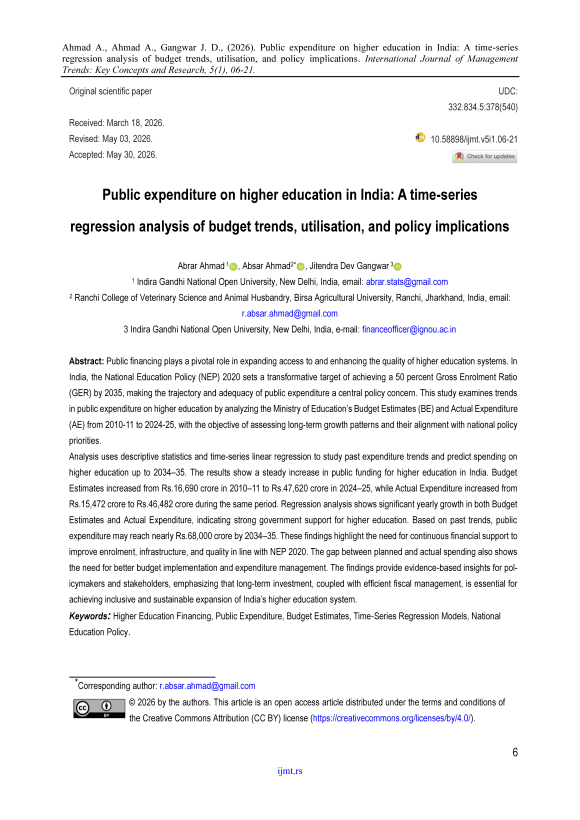
Public financing plays a pivotal role in expanding access to and enhancing the quality of higher education systems. In India, the National Education Policy (NEP) 2020 sets a transformative target of achieving a 50 percent Gross Enrolment Ratio (GER) by 2035, making the trajectory and adequacy of public expenditure a central policy concern. This study examines trends in public expenditure on higher education by analyzing the Ministry of Education’s Budget Estimates (BE) and Actual Expenditure (AE) from 2010-11 to 2024-25, with the objective of assessing long-term growth patterns and their alignment with national policy priorities. Analysis uses descriptive statistics and time-series linear regression to study past expenditure trends and predict spending on higher education up to 2034–35. The results show a steady increase in public funding for higher education in India. Budget Estimates increased from Rs.16,690 crore in 2010–11 to Rs.47,620 crore in 2024–25, while Actual Expenditure increased from Rs.15,472 crore to Rs.46,482 crore during the same period. Regression analysis shows significant yearly growth in both Budget Estimates and Actual Expenditure, indicating strong government support for higher education. Based on past trends, public expenditure may reach nearly Rs.68,000 crore by 2034–35. These findings highlight the need for continuous financial support to improve enrolment, infrastructure, and quality in line with NEP 2020. The gap between planned and actual spending also shows the need for better budget implementation and expenditure management. The findings provide evidence-based insights for policymakers and stakeholders, emphasizing that long-term investment, coupled with efficient fiscal management, is essential for achieving inclusive and sustainable expansion of India’s higher education system.
Similar articles in the section Economics of housing
Short address: https://sciup.org/170213187
IDS: 170213187 | UDC: 332.834.5:378(540) | DOI: 10.58898/ijmt.v5i1.06-21
Text of the scientific article Public expenditure on higher education in India: A time-series regression analysis of budget trends, utilisation, and policy implications
© 2026 by the authors. This article is an open access article distributed under the terms and conditions of the Creative Commons Attribution (CC BY) license .
Higher education constitutes a foundational pillar of national development by strengthening human capital formation, fostering innovation, and promoting socio-economic mobility (Becker, 1993; Varghese, 2018). In India, where demographic dynamics continue to favor a youthful population, the expansion and effective financing of higher education are critical for sustaining long-term economic growth and advancing inclusive development. Public expenditure plays a central role in this process, particularly in the context of the National Education Policy (NEP) 2020, which articulates the ambitious objective of achieving a Gross Enrolment Ratio (GER) of 50 percent by 2035, in alignment with Sustainable Development Goal 4(MHRD 2020).
Over the past decade and a half, India’s higher education system has experienced steady expansion in terms of institutions, enrolments, and program diversity. Correspondingly, fiscal allocations by the Ministry of Education, as reflected in Budget Estimates (BE) and Actual Expenditure (AE), have shown a consistent upward trajectory. This growth signals a sustained policy commitment to higher education development. At the same time, observed variations between planned allocations and realized spending across fiscal years highlight the importance of examining expenditure execution and utilization patterns. A systematic understanding of these dynamics is essential for ensuring efficient resource allocation, fiscal predictability, and alignment with national policy priorities emphasizing access, quality, and equity (Varghese, 2018).
-
• Budget Estimates (BE): Planned financial allocations for higher education at central and state levels, based on policy objectives such as NEP 2020.
-
• Actual Expenditure (AE): Realized spending, reflecting administrative efficiency, fund utilization, and execution gaps.
-
• Outcomes: Resulting indicators of higher education performance, including GER, quality measures (faculty-student ratios, infrastructure, research output), and equity (regional balance, access for underrepresented groups).
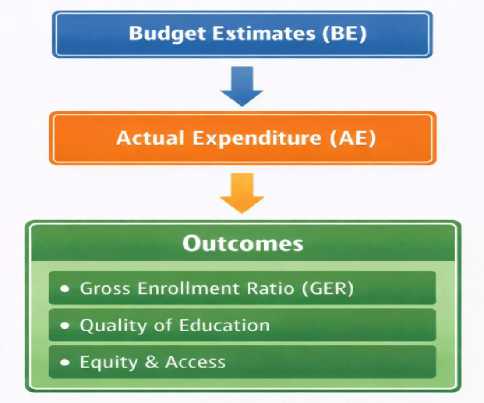
Fig 1: Conceptual Framework: Public Expenditure in Higher Education
Figure 1 presents a conceptual framework linking Budget Estimates (BE) to Actual Expenditure (AE) and resultant higher education outcomes such as GER, quality, and equity. This framework highlights the importance of both allocation planning and efficient fund utilization in achieving policy objectives.
Despite a growing body of literature on higher education financing in India, much of the existing research remains largely descriptive or cross-sectional in nature. Limited attention has been given to integrating formal time-series methods that quantify expenditure growth, assess fiscal predictability, and generate forward-looking projections linked explicitly to policy targets (Agarwal, 2009). As a result, empirical evidence connecting historical expenditure trends with future financing requirements under NEP 2020 remains insufficient. Addressing this gap is particularly important given the scale of investment required to support expanded enrolment and institutional capacity over the coming decade.
This study responds to these limitations by analyzing trends in Budget Estimates and Actual Expenditure on higher education from 2010-11 to 2024-25 and by generating anchored expenditure forecasts up to 2034-35. Using a combination of descriptive analysis and time-series linear regression model, the study evaluates growth patterns, utilization efficiency, and fiscal predictability, thereby providing a comprehensive and policy-relevant assessment of public financing in Indian higher education.
Globally, public expenditure on higher education has expanded in response to demographic pressures, evolving labor market requirements, and policy commitments to inclusive and equitable access. Many countries have increasingly relied on evidence-based planning and forecasting models to ensure that fiscal allocations remain aligned with long-term educational objectives. In this context, trendbased and regression-driven analyses have emerged as essential tools for evaluating sustainability and guiding policy interventions.
In India, public financing for higher education has increased steadily, reflecting national priorities articulated through NEP 2020 and broader developmental visions. Nevertheless, ensuring that financial growth translates into effective outcomes requires close attention to utilization efficiency and expenditure execution. Forecasting models grounded in historical data provide valuable insights into whether current fiscal trajectories are adequate to meet future policy goals, particularly the target of achieving a 50 percent GER by 2035.
Existing studies on public expenditure in Indian higher education predominantly focus on aggregate allocations and descriptive trend analysis, with limited systematic comparison between Budget Estimates and Actual Expenditure. Consequently, empirical understanding of utilization efficiency, execution dynamics, and fiscal realism remains underdeveloped. Moreover, relatively few studies employ formal time-series regression techniques to estimate growth parameters, test statistical significance, or assess fiscal predictability over an extended period.
Another notable gap lies in the limited integration of expenditure analysis with contemporary policy frameworks, including the National Education Policy 2020 and long-term national development objectives. In particular, there is a lack of forward-looking assessments that examine whether observed and projected public financing trends are consistent with achieving a GER of 50 percent by 2035. Forecast-based analyses that connect historical expenditure patterns with future funding requirements are therefore both timely and necessary.
The purpose of this study is to address these gaps by providing a rigorous, data-driven examination of public expenditure on higher education in India from 2010-11 to 2024-25. By employing time-series linear regression models and anchored forecasting techniques, the study offers an empirically grounded evaluation of expenditure trends, utilization efficiency, and future financing needs within the policy context of NEP 2020.
The primary objective of this study is to analyze public expenditure on higher education in India over the period 2010-11 to 2024-25 using time-series linear regression techniques. The specific objectives are: i. To examine historical trends and growth patterns in public expenditure on higher education, as reflected in Budget Estimates and Actual Expenditure.
-
ii. To assess the extent of budget utilization by comparing Budget Estimates with Actual Expenditure and analyzing variations in utilization efficiency over time.
-
iii. To estimate and interpret linear regression models for Budget Estimates and Actual Expenditure, identifying the magnitude and statistical significance of expenditure growth.
-
iv. To evaluate the predictability and stability of higher education financing using regression diagnostics, including slope coefficients (p i ) and coefficients of determination (R2).
-
v. To generate anchored forecasts of public expenditure on higher education for the period 202526 to 2034-35 in alignment with NEP 2020.
-
vi. To assess the policy implications of observed and projected expenditure trends in relation to achieving a Gross Enrolment Ratio of 50 percent by 2035.
Public expenditure plays a critical role in shaping higher education systems, promoting national development, equity, and socio-economic mobility. The literature consistently emphasizes that sustained financial investment in higher education contributes to increased enrolment, enhanced quality, and institutional competitiveness. Theoretical frameworks such as human capital, endogenous growth, and merit goods underpin the rationale for government spending in this sector. Globally, studies show that predictable, outcome-linked expenditure correlates with improved institutional performance and socioeconomic outcomes.
In India, higher education financing has become increasingly significant due to rapid population growth, rising demand for tertiary education, and the country’s commitment to achieving Sustainable Development Goals, particularly SDG 4 on quality education. Policy frameworks such as the National Education Policy (NEP) 2020 stress not only the expansion of access but also the equitable and efficient allocation of financial resources to achieve a projected Gross Enrolment Ratio (GER) of 50% by 2035(NITI Aayog 2021). Despite these policy priorities, studies reveal challenges in the optimal utilization of allocated funds, regional disparities, and limited empirical assessments of the relationship between Budget Estimates (BE) and Actual Expenditure (AE).
Time-series regression analysis remains underutilized, with prior research often limited to descriptive studies or short-term analyses. Key methodological discussions include the distinction between nominal and inflation-adjusted expenditure, and the integration of performance indicators into fiscal analysis. Significant evidence gaps exist in quantifying growth parameters, testing statistical significance, and linking expenditure trends to policy outcomes. Addressing these gaps is essential for evidence-based financial planning and to support inclusive higher education expansion under NEP 2020.
Time-series linear regression models provide a rigorous framework for examining expenditure trends, estimating key growth parameters (p i ), and evaluating fiscal predictability through measures such as R². Regression-based forecasting integrates historical allocations with expenditure utilization patterns, offering empirical evidence to support forward-looking budget planning. This combined descriptive, analytical, and predictive approach forms the conceptual basis for evaluating higher education expenditure trends in India.
Global higher education expenditure has expanded steadily across advanced and emerging economies, driven by rising enrollment demand and public commitment priorities. Organisation for Economic Co-operation and Development (OECD) data indicate consistent per-student spending growth, averaging USD 18,100 at tertiary level across member countries in 2020 despite pandemic disruptions (OECD, 2021, 2023).
Empirical studies reveal persistent execution challenges, Fan and Rao (2003) demonstrate that structural adjustment programs increased total public spending but reduced education's share through sectoral reprioritization in Asia and Latin America. World Bank (2026) projects demographic transitions creating 0.6% of GDP fiscal space for education reinvestment by 2050 in South Asia (0.14% for tertiary), though political barriers limit realization.
Fiscal frameworks significantly influence outcomes, OECD (2025) finds multi-year budgeting binding 3–5-year expenditure ceilings adopted by 96% of implementing countries enhances spending stability. Zatonatska et al. (2019) identify three dominant higher education financing models bureaucratic (state-controlled), collegial (shared governance), and market (private sources) concluding the market model proves most effective and adaptable for leading global HEIs through diversified funding (bonds, private equity, donations) managed via endowment funds, securitization, and asset management as optimal financial sustainability frameworks. Marginson (2018) analyzes the United Kingdom's higher education shifted from public funding to mixed tuition loans, achieving 50% per-student funding growth (2000-2015) while favoring research-intensive universities through performance assessments; part-time enrollment collapsed and loan sustainability is uncertain.
In India, the empirical literature consistently identifies a divergence between Budget Estimates and Actual Expenditure, reflecting variations in utilization efficiency of public funds and administrative processes. Studies by Udayakumar et al. (2024) indicate that overall education expenditure has increased but remains below the 6% GDP target, with higher education declining relative to elementary levels despite state-level dominance. Karthika (2026) further highlights post-NEP 2020 shifts toward higher education and digital infrastructure, yet persistent Budget Estimate-Actual Expenditure gaps underscore utilization inefficiencies.
The empirical evidence converges on three key insights: sustained growth in higher education expenditure, the importance of fiscal predictability, and the central role of efficient utilization in translating allocations into measurable outcomes. These patterns provide a coherent analytical foundation for examining budget trends, utilization dynamics and policy implications in India’s higher education landscape.
Despite growing scholarship, several methodological and conceptual debates persist. First, there is limited integration of descriptive expenditure trends with regression-based analyses, restricting predictive policy insights. Many studies report aggregate growth without quantifying annual growth rates, slopes (p i ), or statistical significance, reducing their applicability for strategic resource planning. Second, few studies forecast expenditure requirements aligned with national policy targets such as NEP 2020 or the GER 50%, leaving a critical gap in evidence-based planning. Third, while global literature emphasizes efficiency, equity, and productivity in expenditure analysis, Indian studies rarely combine utilization percentages with regression-based forecasts to evaluate both execution efficiency and policy-relevant growth.
Methodologically, prior research often relies on descriptive statistics, historical trends, or crosssectional surveys (UGC, 2023; Ministry of Education, 2010-25). Time-series regression offers a more robust alternative, allowing quantification of annual growth, assessment of variance, and forward-looking expenditure forecasting. Linear regression models with error terms (ε) facilitate estimation of expenditure increases and evaluation of model fit (R²), providing insights into fiscal predictability and informing strategic financial planning aligned with policy imperatives such as GER 50% and sustainable higher education financing .
Materials and methods
This study employs a quantitative, longitudinal research design to examine trends in public expenditure on higher education in India over the period 2010-11 to 2024-25. A descriptive analytical approach is adopted to assess both Budget Estimates (BE) and Actual Expenditure (AE), enabling a systematic evaluation of fiscal planning and expenditure execution over time. To quantify long-term growth patterns and assess fiscal predictability, the analysis applies time-series linear regression models. This integrated framework combines descriptive trend analysis with inferential statistical modeling, providing a robust basis for evidence-based interpretation and policy-relevant inference.
The study relies on secondary data drawn from authoritative and publicly available government sources, including Union Budget documents, annual reports of the Ministry of Education, and publications by PRS Legislative Research. The dataset comprises annual Budget Estimates and Actual Expenditure on higher education, expressed in Indian rupees (Rs. crore), covering a 15- year period from 2010-11 to 2024-25. This time span allows for a comprehensive assessment of historical expenditure trends and supports forward-looking projections consistent with the National Education Policy (NEP) 2020 and Gross Enrolment Ratio (GER) targets.
As the analysis is based exclusively on publicly accessible official data, no ethical concerns arise in relation to data collection. To enhance reliability, expenditure figures were cross-verified across multiple sources, and standard statistical protocols were followed throughout the analytical process.
Public expenditure on higher education constitutes the dependent variable, measured separately as Budget Estimates (BE) and Actual Expenditure (AE). The independent variable is time, represented by a sequential fiscal year index coded (from 1 for 2010-11 to 15 for 2024-25) and treated as a continuous variable to capture temporal trends.
The relationship between expenditure and time is specified using a standard linear regression model of the form:
Y t = β 0 + β 1 × X t + ε t
Where;
Y t = dependent variable which is public expenditure (BE or AE), t (in year) and (Rs. in crore)
X t = independent variable representing time index (fiscal year)
-
β 0 = intercept, indicating baseline expenditure at the beginning of the study period
-
β 1 = slope coefficient, capturing the average annual rate of change in expenditure
-
ϵ = stochastic error term capturing deviations from the fitted trend
Separate regression models are estimated for BE and AE to distinguish between planned allocations and realized spending, allowing for a comparative assessment of fiscal intent and execution.
Model parameters are estimated using the Ordinary Least Squares (OLS) method. Statistical inference is based on estimated coefficients, standard errors, t-statistics, and corresponding p-values to assess significance levels. The coefficient of determination (R²) is reported to evaluate model fit and the extent to which temporal trends explain variations in expenditure.
To ensure the validity of regression results, standard diagnostic checks are conducted, including assessments of linearity, independence of residuals, homoscedasticity, and normality. Where diagnostic evidence suggests potential deviations from classical assumptions, appropriate corrective considerations are incorporated to maintain the robustness and interpretability of the estimates.
Results
This section analyzes trends in public expenditure on higher education in India over the period 201011 to 2024-25 using descriptive statistics, graphical examination, and regression-based growth modeling. Public expenditure is examined separately for Budget Estimates (BE) and Actual Expenditure (AE) to distinguish between fiscal planning and expenditure realization. Based on estimated trends, the analysis also provides a basis for projecting potential expenditure expansion through 2034-35.
Public expenditure on higher education in India has demonstrated a sustained long-term increase. Budget Estimates (BE) rose from Rs.16,690 crore in 2010-11 to Rs.47,620 crore in 2024-25, corresponding to an average annual growth of approximately 11–12 percent. Actual Expenditure (AE) followed a similar upward trajectory, increasing from Rs.15,472 crore to Rs.46,482 crore over the same period (Rana et al,2025). This indicates a strong alignment between planned allocations and realized spending, while also highlighting year-to-year variations in expenditure patterns.
Annual Growth Rate (AGR): The AGR measures the year-on-year percentage change in expenditure and is calculated as:
AGR (%) =
Value for the year — Value for previous year
Value for previous year
|
Table-1 Comparison of BE, AE, Utilization rates and Annual Growth rates |
|||||
|
Public Expenditure |
Annual Growth Rate |
||||
|
Fiscal Year |
Budget Estimate (BE) |
(in Rs. crore) Actual Expenditure (AE) |
Utilisation % (Actu-als/BE%) |
AGR (%) BE |
AGR (%) AE |
|
2010-11 |
16,690 |
15,472 |
92.7 |
- |
- |
|
2011-12 |
21,912 |
19,505 |
89.0 |
31.29 |
26.07 |
|
2012-13 |
25,275 |
20,423 |
80.8 |
15.35 |
4.71 |
|
2013-14 |
26,750 |
24,465 |
91.5 |
5.84 |
19.79 |
|
2014-15 |
27,656 |
23,152 |
83.7 |
3.39 |
-5.37 |
|
2015-16 |
26,855 |
25,439 |
94.7 |
-2.90 |
9.88 |
|
2016-17 |
28,840 |
29,026 |
100.6 |
7.39 |
14.10 |
|
2017-18 |
33,330 |
33,614 |
100.9 |
15.57 |
15.81 |
|
2018-19 |
35,010 |
31,904 |
91.1 |
5.04 |
-5.09 |
|
2019-20 |
38,317 |
36,916 |
96.3 |
9.45 |
15.71 |
|
2020-21 |
39,467 |
32,378 |
82.0 |
3.00 |
-12.29 |
|
2021-22 |
38,351 |
33,531 |
87.4 |
-2.83 |
3.56 |
|
2022-23 |
40,828 |
38,557 |
94.4 |
6.46 |
14.99 |
|
2023-24 |
44,095 |
55,393 |
125.6 |
8.00 |
43.67 |
|
2024-25 |
47,620 |
*46,482 |
97.6 |
7.99 |
-16.09 |
|
Note: BE-– |
Budget Estimate. *AE for 2024–25 is Revised Estimate |
||||
|
Sources: Govt. of India Union Budgets (2010-25); PRS data. |
|||||
Utilization rates, measured as the ratio of AE to BE, exhibit variability across the study period, ranging from 80.8% in 2012-13 to 125.6% in 2023-24. Years with utilization above 100%, such as 2016-17, 201718, and 2023-24, indicate responsive adjustments in expenditure to meet emerging priorities, while periods below 100% reflect the timing of fund releases and expenditure execution.
Annual Growth Rates further illustrate the dynamics of expenditure patterns. BE growth was particularly strong in 2011-12 (31.29%) due to policy expansion, whereas AE growth peaked in 2023-24 (43.67%) reflecting accelerated fund utilization in response to sectoral needs. Fluctuations in growth rates across years indicate the natural adjustment processes in budgetary planning and execution.
Overall, these descriptive trends highlight the progressive expansion of higher education funding in India and the alignment between planning and expenditure execution. The observed patterns provide a robust foundation for subsequent econometric and policy analyses, offering insights into fiscal planning, fund utilization, and sectoral investment priorities.
The line graphs depicting Budget Estimates and Actual Expenditure illustrate a clear and persistent upward movement in higher education spending over the fifteen-year period. Both series move closely together, indicating a high degree of consistency between budget formulation and expenditure realization, with deviations occurring primarily in specific fiscal years.
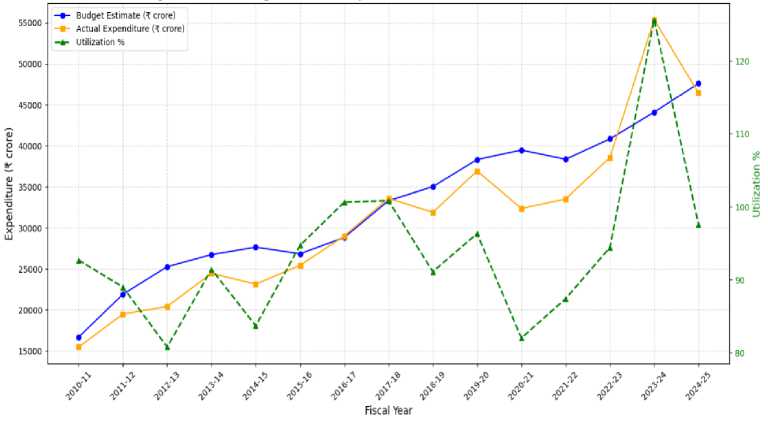
Fig 2: Higher Education Budget and Actual Expenditure with Utilization % (2010-11 to 2024-25)
Periods of divergence between BE and AE are evident in 2012-13 and 2020-21, while 2023-24 records expenditure exceeding initial allocations. The utilization trend line complements this observation by illustrating fluctuations in expenditure realization around a generally stable long-term mean. Notably, post-2015-16 data show closer convergence between BE and AE, suggesting improved alignment between planned allocations and actual spending.
From an analytical perspective, the graphical evidence supports the presence of a stable growth trajectory alongside moderate short-term variability. The relatively smooth progression of Budget Estimates reflects fiscal predictability, while fluctuations in Actual Expenditure highlight the influence of implementation dynamics and contextual factors. Collectively, the visual trends provide an intuitive basis for regression-based estimation and forward-looking projections.
To quantify long-term growth trends, time-series linear regression models were estimated for both Budget Estimates and Actual Expenditure over the period 2010-11 to 2024-25. In each model, time (coded sequentially from 1 to 15) serves as the independent variable, while expenditure (in Rs. crore) is treated as the dependent variable. The general model specification is given by:
Yt = β0 + β1 × Xt + εt where Yt denotes public expenditure (in Rs. crore), Xt represents time, and εt is the stochastic error term.
The estimated regression equation for budget estimates is:
BE t = 17,352.95 + 1,922.51 × X t + ε t
The slope coefficient is positive and statistically significant at the 1 percent level (p < 0.001), indicating an average annual increase of approximately Rs.1,922 crore in budgeted higher education expenditure. The coefficient of determination (R² = 0.97) indicates that nearly all variation in budget estimates is explained by the time trend, reflecting strong predictability and consistency in fiscal planning.
The regression equation for actual expenditure is:
AE t = 13,574.03 + 2,188.72 × X t + ε t
The estimated slope coefficient is also positive and statistically significant at the 1 percent level (p < 0.001), with an average annual increase of approximately Rs.2,189 crore. The lower R² value (0.86), compared to the BE model, indicates greater variability in realized spending, consistent with year-to-year fluctuations observed in utilization rates.
A comparative assessment of the two models highlights a clear distinction between fiscal intent and execution. While Budget Estimates exhibit stronger predictability, Actual Expenditure demonstrates relatively higher growth intensity accompanied by moderate variability.
The reliability of the estimated regression models is supported by standard statistical diagnostics. In both models, the slope coefficients are positive and statistically significant at the 1 percent level, confirming a systematic upward trend in higher education expenditure over time. High F-statistics with corresponding p-values below 0.001 further establish the overall significance of the models.
The BE model explains approximately 97 percent of the variation in expenditure, indicating strong goodness of fit, while the AE model explains 86 percent of the variation, reflecting the influence of implementation-related factors. Residual diagnostics show no systematic patterns, with residuals centered around zero and approximately normally distributed. Minor deviations in selected years are attributable to contextual fluctuations rather than model misspecification.
Table 2 presents the results of the time-series linear regression models for Budget Estimates (BE) and Actual Expenditure (AE) on higher education in India from 2010-11 to 2024-25. The models quantify the average annual growth, baseline expenditure, and statistical significance of the estimated parameters, providing a robust framework for evaluating fiscal predictability and planning future allocations.
The combined descriptive, graphical, and regression-based evidence confirms a sustained expansion of public investment in higher education in India over the period. The estimated growth rates approximately Rs.1,922 crore per year for Budget Estimates and Rs.2,189 crore per year for Actual
Expenditure indicate steady fiscal momentum, with improving alignment between planned allocations and realized spending in recent years.
The findings suggest that while fiscal planning has remained highly predictable, strengthening expenditure execution will further enhance the effectiveness of public investment. Maintaining the observed growth trajectory, while minimizing short-term variability in actual spending, will be critical for supporting the objectives of the National Education Policy 2020 and achieving the targeted Gross Enrolment Ratio of 50 percent by 2035.
Anchored forecasts of public expenditure on higher education are generated for the period 2025-26 to 2034-35 using the estimated time-series regression models. The projections are anchored to the base year 2024-25 and extend statistically significant historical growth trends forward, ensuring consistency with national policy, particularly the National Education Policy (NEP) 2020 and the target of achieving a Gross Enrolment Ratio (GER) of 50 percent by 2035.
The forecasting framework applies regression-estimated annual growth rates (p i ) to base-year expenditure levels, following the specification
Y(2024-25+k) = Y2024-25 + в 1 ^к where k =1,...,10.
The base-year values are Rs.47,620 crore for Budget Estimates and Rs.46,482 crore for Actual Expenditure, with corresponding annual growth parameters (P i ) of Rs.1,922.51 crore and Rs.2,188.72 crore, respectively. The projections incorporate the regression error structure to account for natural variation in expenditure realization.
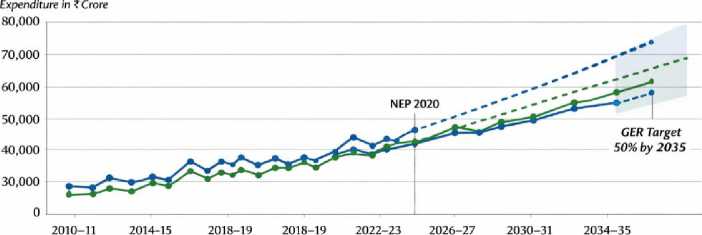
The forecast results indicate a steady expansion in public financing for higher education over the next decade. Budget Estimates are projected to increase from Rs.49,543 crore in 2025-26 to Rs.66,845 crore by 2034-35. Actual Expenditure is expected to grow at a slightly faster pace, reaching about Rs.68,369 crore by the end of the forecast horizon. This pattern is consistent with historical trends in which realized spending has marginally exceeded initial budget allocations during periods of system expansion.
Table 3 presents the year-wise forecasted values of Budget Estimates and Actual Expenditure for the period 2025-26 to 2034-35.
Table 3 Forecasted Expenditure from 2025-26 to 2034-35 (Rs. crore)
|
Fiscal Year |
k (years after 2024-25) |
Forecasted Budget Estimate (Rs. crore) |
Forecasted Actual Expenditure (Rs. crore) |
|
2025-26 |
1 |
49,543 |
48,671 |
|
2026-27 |
2 |
51,465 |
50,859 |
|
2027-28 |
3 |
53,388 |
53,048 |
|
2028-29 |
4 |
55,310 |
55,237 |
|
2029-30 |
5 |
57,233 |
57,426 |
|
2030-31 |
6 |
59,155 |
59,614 |
|
2031-32 |
7 |
61,078 |
61,803 |
|
2032-33 |
8 |
63,000 |
63,992 |
|
2033-34 |
9 |
64,923 |
66,180 |
|
2034-35 |
10 |
66,845 |
68,369 |
The projected convergence between Budget Estimates and Actual Expenditure reflects improving alignment between fiscal planning and execution. The post-2016 trend, extended through the forecast period, suggests strengthening absorptive capacity and more realistic budget formulation. These projections provide a forward-looking fiscal benchmark against which policymakers can assess the adequacy of planned allocations and anticipate required adjustments to support enrolment growth, infrastructure development, and quality enhancement.
From a policy perspective, the anchored forecasts indicate that sustained increases in public expenditure are essential to support the scale of expansion envisaged under NEP 2020. However, the projections also highlight that expenditure growth alone must be complemented by effective utilization mechanisms to ensure that financial inputs translate into measurable educational outcomes. Strengthening budget execution, monitoring, and institutional capacity will therefore remain central to achieving the GER target by 2035.
Overall, the anchored forecasting exercise offers an empirically grounded financing pathway for higher education in India over the coming decade. By linking historical expenditure dynamics with future policy goals, the projections support strategic fiscal planning and reinforce the role of predictable, efficiently deployed public investment in advancing long-term higher education development.
Table 4 Linear Regression Analysis of Budget Estimate and Actual Expenditure Over Time
|
Expenditure Type |
Intercept (в о ) ₹ crore |
Slope (в 1 ) ? crore/year |
Standard Er ror (в 1 ) |
t-value (в 1 ) |
p-value (в 1 ) |
R² |
Regression Equation |
|
Budget Esti- |
17,352.9 |
0.9 |
Y = 17,352.95 + |
||||
|
mate (BE) |
5 |
1,922.51 |
115.27 |
16.67 |
<0.001 |
7 |
1,922.51X + ε |
|
Actual Expendi- |
13,574.0 |
0.8 |
Y = 13,574.03 + |
||||
|
ture |
3 |
2,188.72 |
184.42 |
11.87 |
<0.001 |
6 |
2,188.72X + ε |
Year
—•— BE (Observed) —•— Actual Expenditure (Observed) — — — BE (Forecast) —> — Actual Expenditure (Forecast)
—•— BE (Forecast)
Fig 3: Trends and Forecast of Higher Education Expenditure (2010-11 to 2034-35)
Figure 3 above illustrates a clear and sustained upward trajectory in both Budget Estimates and Actual Expenditure over the forecast horizon, reflecting a continued policy commitment to higher education financing in India. Actual Expenditure consistently grows at a marginally faster pace than 17
Budget Estimates, indicating adaptive fiscal responses to expanding system requirements. The widening but controlled gap between planned and realized spending suggests improving absorptive capacity and execution efficiency. Overall, the projected trend is consistent with NEP 2020 and supports the financing pathway required to achieve a Gross Enrolment Ratio (GER) of 50 percent by 2035, provided that expenditure efficiency and institutional capacity continue to strengthen .
Discussions
The analysis reveals a sustained and statistically significant increase in public expenditure on higher education in India over the period 2010-11 to 2024-25. Both Budget Estimates (BE) and Actual Expenditure (AE) exhibits consistent upward trajectories, indicating a strong and enduring policy commitment to the sector. Time-series regression results confirm robust annual growth rates of approximately Rs.1,922 crore for BE and Rs.2,189 crore for Actual Expenditure, highlighting the expanding fiscal priority accorded to higher education.
Graphical analysis and utilization indicators further demonstrate that while aggregate funding has increased steadily, deviations between planned allocations and realized spending persist across selected years. Periods of lower utilization, such as 2012-13 and 2020-21, reflect temporary constraints in expenditure execution, whereas instances of higher utilization in recent years suggest adaptive fiscal responses to evolving policy initiatives and institutional requirements. Overall, these patterns highlight the dynamic interaction between budget planning and implementation within a growing higher education system.
The regression slope coefficient (p i ) emerges as a policy-relevant indicator, representing the average annual increase in expenditure required to sustain system-wide expansion. High coefficients of determination (R² = 0.97 for BE and 0.86 for Actual Expenditure) indicate strong fiscal predictability over the period, although modest variability in realized spending reflects operational adjustments and implementation dynamics. These findings suggest that while budgetary planning has been largely consistent, effective execution remains a key determinant of expenditure outcomes.
From a policy perspective, the observed expenditure growth aligns closely with the objectives of the National Education Policy (NEP) 2020, particularly the target of achieving a Gross Enrolment Ratio (GER) of 50 percent by 2035. The slightly higher growth rate in Actual Expenditure relative to Budget Estimates indicates a degree of administrative responsiveness in meeting emerging sectoral needs. Sustained increases in public funding are essential for expanding access, strengthening institutional capacity, and supporting inclusive participation across regions and social groups.
Consistent investment in higher education also carries important social implications, as it supports equity, regional balance, and gender parity in enrolment. Effective utilization of funds is therefore critical to translating fiscal growth into tangible educational outcomes.
Earlier studies on higher education financing in India have predominantly relied on descriptive trend analysis or short-term comparisons. This study extends the literature by integrating time-series regression, statistical significance testing, and anchored forecasting within a unified analytical framework. The convergence between Budget Estimate and Actual Expenditure observed in the post-2016 period represents a notable improvement in fiscal execution relative to earlier patterns, offering new empirical insights into budgetary alignment and predictability.
Multiple factors contribute to the observed expenditure trends, including policy reforms, expanded central allocations, and evolving institutional requirements. Initiatives aligned with NEP 2020 have played a significant role in shaping expenditure priorities, while administrative mechanisms and contingency provisions have influenced actual spending patterns. Although the regression models are univariate, they effectively capture the dominant temporal and policy-driven influences on expenditure growth.
A key strength of this study lies in its integration of descriptive analysis, inferential statistics, and forward-looking forecasts. The use of regression-based modeling provides a transparent and replicable framework for evaluating fiscal trends and informing policy benchmarks. At the same time, the analysis acknowledges inherent limitations related to the univariate structure of the models, nominal expenditure measurement, and the exclusion of macroeconomic and state-level variables. Despite these constraints, the high explanatory power of the models supports the reliability of the findings for strategic fiscal planning.
The findings carry several important implications for higher education financing in India. Predictable and sustained growth in allocations remains essential for meeting NEP 2020 objectives and GER targets. Strengthening administrative and institutional capacity can further enhance fund absorption and reduce execution gaps. Integrating performance-oriented budgeting and outcome-linked monitoring mechanisms may improve efficiency and accountability, ensuring that increased expenditure translates into measurable gains in access, quality, and inclusion. Anchored forecasting can serve as a valuable tool for aligning annual budget decisions with long-term strategic goals.
Conclusions
This study provides a comprehensive assessment of public expenditure on higher education in India 15 years period from 2010-11 to 2024-25 by integrating descriptive trends, time-series regression analysis, and anchored expenditure forecasts. The results demonstrate a sustained and statistically significant increase in both Budget Estimates and Actual Expenditure, with annual growth rates of approximately Rs.1,922 crore and Rs.2,189 crore, respectively. High R² values indicate that fiscal trends are largely predictable, while observed deviations reflect implementation dynamics rather than structural instability.
The analysis highlights the central role of the regression slope parameter (P i ) as a policy benchmark for assessing the adequacy of annual expenditure growth in relation to long-term objectives. Forecasts suggest that achieving the NEP 2020 target of a 50 percent GER by 2035 is feasible, provided that fiscal expansion is accompanied by efficient utilization, streamlined administrative processes, and outcome-oriented budgeting.
Methodologically, the present study contributes to the literature by employing time-series regression analysis to deliver a statistically robust and policy-relevant evaluation of higher education financing, extending beyond conventional descriptive approaches. While the model is primarily trend-based and univariate relying on time as the key explanatory variable and does not incorporate additional macroeconomic or demographic variables, inflationary pressures, state-level determinants, or outcome measures, the framework establishes a solid foundation for evidence-based fiscal planning and trendbased expenditure forecasting.
Future research should extend this analysis through multivariate and inflation-adjusted models, explore state-level and institution-type variations, and examine the direct relationship between expenditure and educational outcomes. Overall, the findings affirm that sustained and effectively managed public expenditure is essential for advancing inclusive, high-quality higher education in India and for supporting broader national development objectives.
Conflict of interests
The authors declare no conflict of interest.
