
Raptorial Birds as Taphonomic Agents for Small Mammal Remains in Pleistocene Deposits at Tsagaan Agui Cave, Mongolia
Journal: Archaeology, Ethnology & Anthropology of Eurasia @journal-aeae-en
Section: Paleoenvironment, the stone age
Article in issue: 4 т.52, 2024.
Free access
Short address: https://sciup.org/145147480
IDS: 145147480 | DOI: 10.17746/1563-0110.2024.52.4.029-038
Text of the article Raptorial Birds as Taphonomic Agents for Small Mammal Remains in Pleistocene Deposits at Tsagaan Agui Cave, Mongolia
The taphocoenosis of Tsagaan Agui Cave is a unique source of paleontological data for the reconstruction of animal and human behavior, the evolution of vertebrate species, and changes within the faunal complex of the Gobi Altai during the Pleistocene. The cave has 13 layers in the Entrance Grotto, and 14 layers in the Main Chamber and the Entrance Terrace. The sediments in the Main Chamber contain archaeological material dating to the Upper (layers 2.1–3) and Middle (layers 4–14) Paleolithic. The remains of small mammals from this site have not previously been the subject of detailed study. This paper examines the concentrations of rodent and lagomorph bones associated with the activities of raptorial birds, revealed through analysis of spatial distribution and the application of statistical methods. Such phenomena are rare in cave records owing to the specificity of sediment accumulation, so avian predators have rarely been studied as the agents of cave taphocoenoses, that is, the animals that influence the accumulation, preservation, and integrity of taphonomic remains (Lyman, 2002; Wolverton, Nagaoka, 2018). The most easily identifiable eagle-owl niches (Ovodov, Martynovich, Nadakhovsky, 1998) are found around Tsagaan Agui Cave in modern times (Martynovich, 2002). Eagle-owls inhabit mostly small rock shelters and grottoes, but in Austria Bubo Bubo and representatives of the eagle family were the agents of Pleistocene taphocoenoses in several caves (Fladerer et al., 2023). The accumulation of the remains of hares and pikas is associated with their activities. In Portugal, bearded vulture ( Gypaetus barbatus ) coprolites were found in the sediments of Lagar Velho rock shelter, which is interpreted as a breeding site of this raptor ca. 29,000 cal BP (Sanz et al., 2023). The bones from their pellets and coprolites point to the consumption of small to mediumsized ungulates.
In most cases, the study of birds in caves is limited to their taxonomy, without reconstructing their influence on the formation of taphocoenoses. The latter is important for understanding the role of various agents—raptorial birds, mammalian predators (e.g., hyenas, wolves, foxes, sables, and felids), and humans—in the accumulation of bones and their possible modification at cave sites. Another important aspect is the reconstruction of the composition of small mammal faunas in the microregion studied, since avian predators were collectors of fauna from quite extensive areas around caves.
We assume that raptorial birds had nests in the chimney in the ceiling of Tsagaan Agui Cave. These nests began functioning at the time of accumulation of layers 4–5.1 in excavation pit 2 in the Main Chamber. The principal accumulation of the remains of small mammals in these stratigraphic units is a consequence of the pellets they left behind. During the formation of layer 3, the inflow of water and sedimentary material from the chimney intensified, which is demonstrated by the thickness of the associated sediments. Obviously, for that reason, no more nests were built there. The area below the chimney is identified in sedimentary layers as a compact concentration of bones of mainly hares and rodents, including those from the gastrointestinal tract (hereinafter, GIT), without any coprolites. Such a diet is characteristic of raptorial birds smaller than vultures—large scavengers, whose menu includes medium-sized ungulates (Ibid.). The hare remains in the cave are probably also associated with the activities of foxes and humans. Here, we demonstrate the presence of avian nests in the chimney at Tsagaan Agui Cave by explaining the specificity of the accumulation of faunal remains using analysis of spatial distribution and mathematical statistics. The taxonomic identification of small mammals and amphibians has made it possible to create a preliminary reconstruction of paleogeographic conditions that prevailed in the vicinity of the cave.
Material and methods
Tsagaan Agui Cave is located in Bayankhongor aimag , 42 km northeast of the Bayanlig sum center (44°42ʹ53.3ʹʹ N, 101°10ʹ13.4ʹʹ E), in the Tsagaan Tsakhir limestone massif, which is a part of the Gobi Altai mountain system, southwest of the Baga Bogd Uul range (Fig. 1). This area in southern Mongolia borders northwest China. It is currently inhabited by desert and semi-desert faunas and is characterized by severe changes in the diurnal-nocturnal temperature regime. The cave was initially studied in 1987–1989 and 1995–2000 (Derevianko, Petrin, 1995; Derevianko et al., 2000). In 2021–2023, we investigated the sedimentary sequence in excavation pit 2 of the cave’s Main Chamber over an area of 4 m2 (sq. A′18, B′18, A′19, B′19), which yielded the principal material analyzed here. Judging by the profile of the adjacent longitudinal section of the cave, the stratigraphy of the excavation pit includes 13 layers and sublayers, but the sediments have been excavated only down to layer 8 thus far. An important factor influencing the formation of the taphocoenosis in this part of the cave was the chimney in the ceiling of the cave, extending to the surface of the limestone massif (Fig. 2). The formation of such features is attributed to various karstic processes (Ford, Williams, 2007: 41; James, Banner, Hardt, 2014; Lavrova, 2020). We identified traces of presumed avian nesting behavior in Middle Paleolithic layers 4 and 5.1–5.3, which incorporate a considerable hiatus in the sedimentation cycle. The fourth layer is the lowest in the aeolian stack of layers 2.1–4.
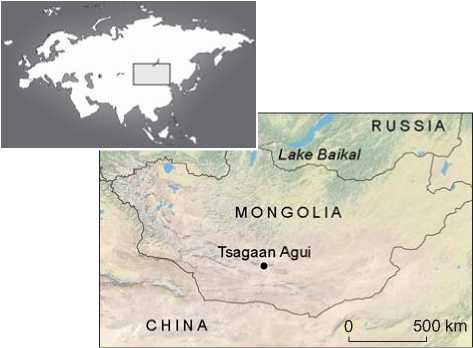
Fig. 1. Location of Tsagaan Agui Cave, Mongolia.
It was buried very quickly, as is evidenced by the bones of an equid found in correct anatomical position, as well as by the pattern of lithic artifact deposition. In sq. A′18 and B′18, the period of accumulation of layers 2.1–4 was a time of active water and sediment influx through the chimney. The sediments are bright orange in color because of the high content of incoming limestone erosion products, densely cemented, include large carbonate concretions, and are devoid of archaeological and paleontological remains. The boundary of these sediments with the undisturbed layers is marked by a manganese lens that can be traced both horizontally and vertically.
During the 2022 and 2023 field seasons, layer 5 in excavation pit 2 was divided into three separate lithologic structures—5.1, 5.2, and 5.3. The uppermost layer in this sedimentary unit was subjected to erosion unrelated to the chimney. The opening in the cave’s ceiling already existed during the formation of layers 5.1–5.3; however, the inflow through it was insignificant, and terra rossa from the weathered surface of the massif is absent. The boundary between layers 4 and 5.1 is indistinct despite their different genesis: there are lenses visible in plan view, but they are not apparent in vertical profiles. They may indicate the erosion of later sediments prior to the accumulation of layer 4.
In the undisturbed layers of excavation pit 2 in Tsagaan Agui Cave, in addition to skeletal remains, there are hyena coprolites and bones processed in the GITs of hyenas and raptorial birds. The paleontological analysis of bones from GITs, as well as the type of erosion noted on the surfaces of the bone fragments, allowed us to categorize them into those digested by the hyenas, and those by raptorial birds. The diet of hyenas consisted of large and, less often, mediumsized ungulates. The bones of horses, mountain goats, woolly rhinoceros, and an undetermined bovid have been identified. Large raptorial birds also inhabited the cave and its vicinity. The rostrum of a presumed member of the Accipitridae was recovered in layer 3. At present, accipitrids do not permanently inhabit the cave, but some small birds nest in the chimney, and the remains of their life activities fall on sq. B′19 and are scattered to neighboring areas. To track the modern Tsagaan Agui fauna, we installed a camera trap. It recorded visits to the cave by a kestrel (a small falconiform raptor), Strigidae (owl), tolai hare, and pika (Fig. 3).
To test our hypothesis as to the existence of bird nests in the chimney above sq. B′19, we studied the small mammalian fauna from our 2021 and 2022 excavations of sq. B′18 (layer 4) and sq. A′19 and B′19 (layers 5.1–5.3). To recover faunal remains, all the excavated sediment was first dry-sieved, then washed
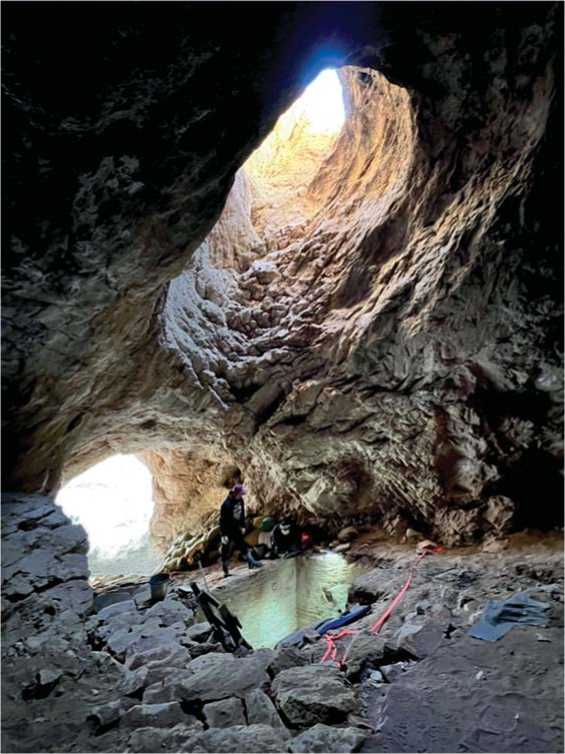
Fig. 2. East-west view of excavation pit 2 and the chimney above it in the Main Chamber of Tsagaan Agui Cave.
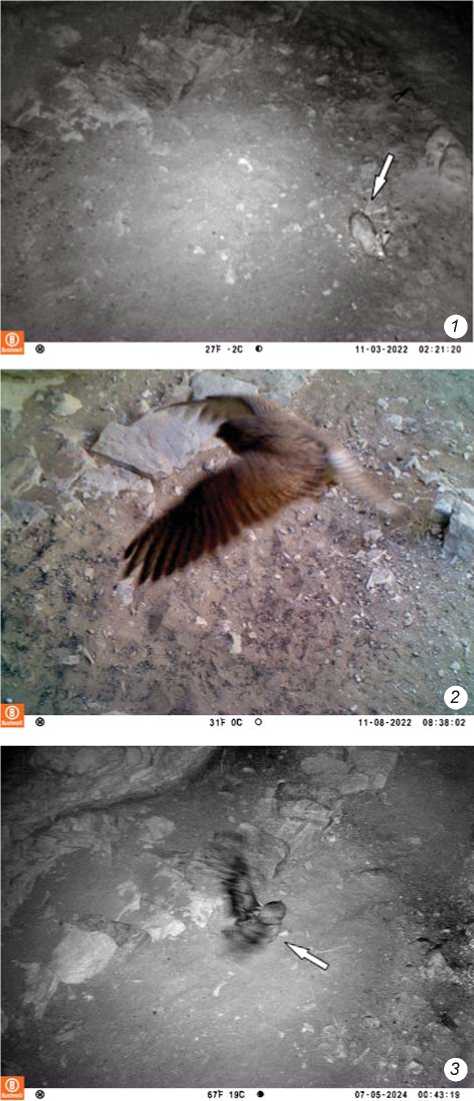
Fig. 3. Images taken between 2022 and 2023 by a camera trap installed in the cave’s Entrance Terrace.
1 – tolai hare Lepus tolai ; 2 – female kestrel Falco sp. (F. tinnunculus?); 3 – Strigidae (owl).
through screens with a 1.4 mm mesh, and dried. The resulting concentrate was sorted in the field using a Nikon binocular microscope. Additionally, rodent teeth were cleaned in the laboratory in a PSB-Gals ultrasonic bath. Further taphonomic and morphologic studies of
faunal materials were carried out using a Leica MZ16 stereomicroscope (with coupled AxioCam ERc 5s digital camera). The taxonomic affiliation of 368 specimens, mostly teeth and jaws of small mammals and frogs, was identified to three orders—Anura, Lagomorpha, and Rodentia (see Table ). The fossil bone assemblage was highly fragmented and consisted mainly of isolated teeth. Therefore, special attention was paid to the recording of postmortem changes of the bone and dental surfaces (Andrews, 1990: 1–22, 45–88; Fernández-Jalvo, Andrews, 1992; López, Chiavazza, 2019; Royer et al., 2019).
Postcranial bones of hares, pikas, jerboas, and hamsters from sq. B′19 and A′19 were identified and counted separately as part of the zooarchaeological analysis of all mammalian remains from Tsagaan Agui Cave. These are absent from the accompanying table but are included in the database for the construction of artifact density maps. Some hare bones were excavated individually, but most were recovered from sediment sieving operations. In the upper part of the section (layers 1–3), these finds were individual finds. Most of the identified hare bones were recovered from layers 4 ( n =933) and 5.1–5.3 ( n =612). In the underlying layers 6 and 7 such remains were an order of magnitude scarcer ( n =66 and 21, respectively). The concentration of bones in sq. B′19 was located at the boundary of layers 4 and 5.1, resting on limestone cobbles whose coordinates were recorded during excavation, allowing us to trace their outlines on both plan and profile views (Fig. 4, a , b ).
To study the pattern of distribution of hare bones in the cave sediments, we plotted all coordinates of the sieved soil where hare bones had been identified on the profile (Fig. 4, a ) and plan (Fig. 4, b ) views. We also plotted the points where hare bones were recovered separately. This enabled us to obtain a general idea of the distribution of these finds. Each excavated square meter was divided into four sub-squares, each having received an additional distinct numerical designation (Fig. 4, b ). Thus, the soil subjected to sieving was collected from an area of 0.25 m2.
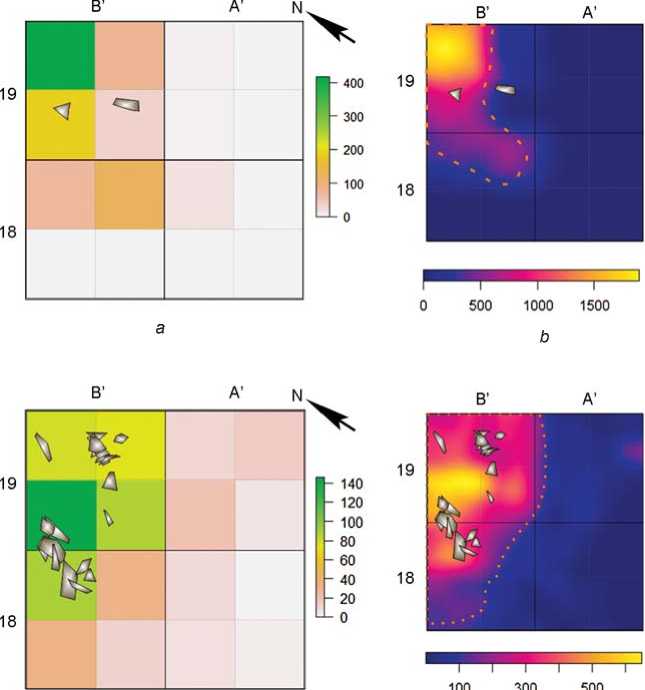
The distribution of hare bones in layers 4 and 5.1– 5.3 was plotted by constructing bone density maps and by using kernel density estimation statistics (Beardah, Baxter, 1996; Larionova, 2019: 49; Spagnolo et al., 2020). Since most hare bones derived from soil sieving operations, estimating their number per unit area (0.5 × 0.5 m subsquare) was deemed a valid approach. The coordinates of finds within each sub-square were set randomly by the Excel function RANDBETWEEN. Based on this dataset, density maps were constructed and kernel density calculated with a scale of 0.25 m2. These calculations were carried out in the R software environment, using the spatstat package (R Core Team, 2023; Baddeley, Turner, 2005).
Species composition of small mammals and amphibians, based on dentition recovered from Layers 4 and 5.1–5.3 at Tsagaan Agui Cave
|
Taxonomy |
Layer 4 |
Layers 5.1–5.3 |
|||
|
Sq. B′18 |
Sq. A′19 |
Sq. B′19 |
Sq. A′19 |
Sq. B′19 |
|
|
Ranidae – true frogs |
– |
1 |
– |
– |
2 |
|
Lepus sp. L. – hares |
– |
– |
– |
– |
2 |
|
Lepus cf. tolai Pall. – tolai hare |
– |
– |
– |
– |
3 |
|
Ochotona sp. Link – pikas |
– |
3 |
16 |
2 |
55 |
|
Ochotona cf. daurica Pall. – Daurian pika |
– |
– |
– |
5 |
2 |
|
Ochotona daurica Pall. – Daurian pika |
– |
– |
– |
– |
8 |
|
Spermophilus sp. F. Cuv. – ground squirrels |
– |
– |
– |
– |
5 |
|
Dipodidae – jerboas |
– |
– |
– |
– |
13 |
|
Allactaga sp. F. Cuv – five-toed jerboas |
– |
2 |
10 |
– |
15 |
|
Allactaga cf. sibirica Forst. – Mongolian five-toed jerboa |
– |
– |
4 |
– |
7 |
|
Allactaga cf. bullata Allen – Gobi jerboa |
– |
1 |
2 |
– |
18 |
|
Dipodinae – three-toed jerboas |
– |
1 |
– |
– |
– |
|
Dipus sp. Gmel. – northern three-toed jerboas |
– |
1 |
4 |
– |
19 |
|
Dipus sagitta Pall. – northern three-toed jerboa |
– |
– |
13 |
– |
– |
|
Cricetidae – hamsters, voles, lemmings, etc. |
– |
– |
2 |
– |
9 |
|
Cricetulus sp. Milne-Edw. – grey dwarf hamsters |
3 |
1 |
15 |
– |
39 |
|
Cricetulus cf. migratorius Pall. – grey dwarf hamster |
– |
– |
– |
– |
5 |
|
Allocricetulus sp. Argyr. – hamsters |
– |
1 |
– |
– |
– |
|
Ellobius cf. tancrei Pall. – northern mole vole |
– |
– |
– |
– |
1 |
|
Meriones sp. Ill. – gerbils |
– |
– |
– |
– |
1 |
|
Alticola sp. Blanf. – mountain voles |
– |
3 |
3 |
1 |
16 |
|
Alticola cf. argentatus Severtz. – silver mountain vole |
– |
– |
– |
– |
3 |
|
Alticola cf. barakshin Bannikov – Gobi Altai mountain vole |
– |
– |
– |
– |
1 |
|
Eolagurus sp. Argyr – yellow steppe lemmings |
– |
1 |
1 |
– |
16 |
|
Eolagurus luteus Eversm. – yellow steppe lemming |
– |
3 |
7 |
– |
9 |
|
Eolagurus przewalskii Büchner – Przewalski’s steppe lemming |
– |
– |
– |
– |
6 |
|
Eolagurus cf. simplicidens – fossil steppe lemmings |
– |
– |
– |
– |
2 |
|
Microtus sp. Schrank – common field voles |
– |
– |
– |
1 |
6 |
|
Total |
3 |
18 |
77 |
9 |
263 |
Results
Layer 4, that presumably includes avian pellets from nests, dates to ca. 45,000 cal BP. The chronology of the accumulation of the underlying layer 5 remains unclear but, most likely, it is much older. Studies undertaken in 1995–2000 yielded a date of 227 ± 57 ka BP for this layer through the application of an experimental radiothermoluminescence (RTL) method (Derevianko et al., 2000). The archaeological assemblages found in these layers are also heterochronous. The lithic materials from layer 4 belong to the Final Middle Paleolithic, whereas the underlying assemblages exhibit a more archaic appearance, including bipolar flaking and early forms of the Levallois reduction technique (Khatsenovich et al., 2022).
The bones from the studied sediments are highly fragmented. Some teeth of hares and rodents of the jerboa and hamster families have remained in place in fragmentary mandibles. The rest occurred as isolates. No complete skulls were recovered. The color of the bones is heterogeneous, ranging from yellow-brown to ashbrown. Some bones exhibit mineral formations in the form of black spots. The taxonomic identification of small mammals to species, and the differentiation of Upper and Middle Pleistocene forms, are still difficult because of
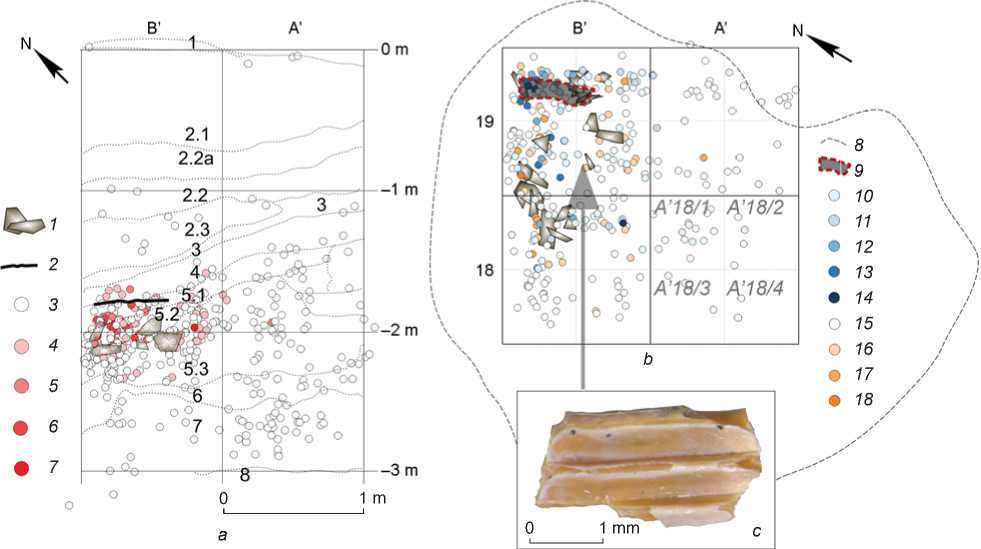
Fig. 4. Stratigraphic profile of the eastern wall ( a ), and plan ( b ) of excavation pit 2, with a projection of captured points of sieved soil and an indication of the number of hare bones; small mammal tooth with traces of digestive enzymes on the enamel ( c ).
1 – large stones; 2 – upper contour of the concentration of pellets in the profile; 3–7 – number of hare bones in the sieved soil: 3 – 1–4, 4 – 5–15, 5 – 16–32, 6 – 33–68, 7 – 69–117; 8 – projection of the opening of the chimney; 9 – upper contour of the concentration of pellets on the plan; 10–14 – number of hare bones, layer 4: 10 – 1–4, 11 – 5–11, 12 – 12–32, 13 – 33–52, 14 – 53–117; 15–18 – number of hare bones, layers 5.1–5.3: 15 – 1–4, 16 – 5–13; 17 – 14–40, 18 – 41–68.
the small sample size and limitations of the comparative osteological collection currently available.
Importantly, most teeth demonstrate changes in their enamel surfaces because of stomach acid of carnivorous mammals or raptorial birds (Fig. 4, c ). These specimens exhibit partially dissolved enamel, rough surfaces, and partially rounded morphologies. This indicates that the fossil remains of rodents in sq. A′19 and B′19 accumulated as the result of predator activity.
The vertebrate remains are unevenly distributed throughout the excavations. The largest number was recovered from layers 5.1–5.3 in sq. B′19. A significant number of jerboas and pikas were identified from this square: 27 % and 24 % of the faunal assemblages, respectively. These species likely comprised a significant component of the diet of both avian and quadrupedal predators. The large amount of jerboa and pika remains also attests to the abundance of these mammals.
The distribution of hare bones in layers 4 and 5.1– 5.3 differs considerably, despite the common genesis of these fossil remains, associated with the pellets of raptorial birds. Their concentration is highest in layer 4, and an absolute majority of them was recorded in Subsquare B′19/1 (Fig. 5, a, b). In layers 5.1–5.3, the hare concentration remains present, but the center of its distribution is shifted to the west (sq. B′19/3), and it contains almost three times fewer bones than the center of the concentration in layer 4 (see Fig. 5, a and c, b and d). Furthermore, in layers 5.1–5.3, these remains occur throughout almost the entire excavation area (Fig. 5, c).
Judging by the results obtained, the concentration of avian pellets in layer 4 is the best preserved. The opening of the chimney led to the bedding of “empty” red sediments in sq. B′18, which probably explains its shape (Fig. 5, a , b ). In layers 5.1–5.3, which were formed under aquatic conditions, the moist environment accelerated the erosion of the concentration of small mammal remains and their areal distribution. The presence of large stones at the base of the concentration prevented its complete destruction, but a small number of hare bones fell outside the accumulation (sq. B′18/2–4, A′19, A′18/1, and A′18/3), probably owing to the shifting of sediments.
Discussion
Comparison of the highest concentrations of hare bones and the accumulation of stones in layers 5.1–5.3
Fig. 5 . Results of the analysis of density distribution of hare bones in layers 4 ( a , b ) and 5.1–5.3 ( c , d ).
-
a , c – density maps for 0.5 × 0.5 m subsquares;
-
b , d – kernel density estimation.
allows us to propose the following reconstruction (Fig. 6, a ). Most avian nests were located above the B′19/1 and B′19/3 subsquares, where most of the bones of small animals were concentrated. The clearest boundary of the zone of their concentration was recorded during excavations on the southeastern side of the units (sq. B′19/1 and B′19/3) where a concentration of stones remained. The southwestern part of this zone in layer 4 appeared to be cut off, apparently related to inflow from the chimney that introduced cemented bright orange sediments in sq. B′18 (Fig. 6, a ). The contents of the lower part of the concentration of pellets, extending into the moister layers 5.1–5.3, were dispersed over a larger area. This possibly explains the relatively low proportion of hare bones in the concentration and
cd
• v°
; o'
o<’ •
° О
° °.°‘ t
о •
—%--^
•8
О 9
b
Fig. 6. Reconstruction of the locations of nests above excavation pit 2 and concentrations of small mammal remains in layers 4 and 5.1–5.3 ( a ); plan of distribution of hare bones in layer 6 ( b ).
1 – large stones; 2 – upper contour of the concentration of pellets; 3 – projection of the opening of the chimney; 4 – sediments delivered through the chimney into layer 4; 5 , 6 – boundaries of concentrations in layers 4 and 5.1–5.3, respectively; 7 – reconstruction of the location of avian nests above excavation pit 2; 8 – lithic artifacts in layer 6; 9 – hare bones in sieved soil (1–4 spec.).
beyond. Based upon the slope of the sediments, erosion of pellet contents may have occurred both towards the cave entrance and the cave walls. Another factor in the dispersion of bone concentrations across the area of excavation pit 2 may have been the activity of foxes, whose remains increased in layers 5.1–5.3.
Our analysis suggests several explanations for the formation of the studied accumulation of small mammal remains in Tsagaan Agui. Most likely, their accumulation may be correlated with the presence of raptorial bird nests during the accumulation of layers 4 and 5.1–5.3. Thus, the concentrations of hare bones in layers 4 and 5.1–5.3 are the result of the same mechanism and the differences in their distribution are associated with post-depositional changes that affected layer 4 to a lesser extent.
Perhaps the large concentration of stones in layers 5.1–5.3 combined with moister conditions led to the deformation of underlying sandy layer 6, which is recorded not only in the stratigraphic profile but also in the distribution of finds. All these materials, including hare bones, are displaced towards the central axis of the cave, leaving the line of the B′ squares nearly empty (Fig. 6, b ). Notably, one hare bone bears possible traces of anthropogenic butchering.
Our analysis of small mammal remains has yielded preliminary paleogeographic reconstructions for the time of accumulation of layers 4 and 5.1–5.3. As we know, rodents and hares, owing to their biological and ecological features (especially their relatively short lifecycle, ability to reach high population sizes, and respond to environmental changes), provide convincing material to characterize their living conditions (Erbaeva, 1970: 27–28).
The general appearance of the fossil rodent and hare fauna in the vicinity of Tsagaan Agui Cave is similar to the modern one. The ratio of small mammalian species suggests that in the Middle to Upper Pleistocene in central Mongolia, most species were preferential inhabitants of open semi-desert landscapes or dry steppes with exposed rock formations.
In Mongolia, jerboas inhabit steppes and semideserts of various types, avoiding areas with dense grass. In places where semi-desert turns into desert, Siberian jerboas stick to steppe areas and completely disappear in the true desert (Bannikov, 1954: 205) but continue to occur in clay and rubble desert conditions (Mlekopitayushchiye Kazakhstana, 1978: 250–251). The five-toed jerboas also inhabit rocky, saltwort, and shrub deserts, avoiding sandy areas (Bannikov, 1954: 224). The feather-footed jerboas are typical inhabitants of barchan sand dunes. They settle not only in bare barchans but also in shrubby sands (Vinogradov, 1937: 155). The Daurian pika is a typical inhabitant of open semi-desert landscapes. They inhabit a variety of steppe biomes, being most abundant in grassland steppes and in feather-grass and Artemisia steppes. The presence of sagebrush in Mongolia determines, to some extent, the relative abundance of Daurian pikas (Bannikov, 1954: 184).
The remains of the yellow steppe lemming are noteworthy, since they were clearly abundant in the vicinity of the cave during the Late Middle Pleistocene. A mandible from the Middle Pleistocene species Eolagurus cf. simplicidens was recovered in layer 5.3. E. simplicidens differs from modern Eolagurus luteus by exhibiting widely consolidated triangles in the base of the paraconid of the first molar. At present, the yellow steppe lemming is only sporadically found in sandy areas of the Gobi Desert, north to Lake Uvs Nuur (Ibid.: 296), although in the 20th century this species was common in the Pre-Caspian and Kazakhstan deserts and semi-deserts. In the second half of the 19th century, the yellow steppe lemming became extinct in most parts of Kazakhstan. Today, its main area of distribution is in Xinjiang in northwest China (Gromov, Erbaeva, 1995: 428–429). The yellow steppe lemming is known to be sensitive to climatic changes. Its reproduction and activities depend directly on average annual temperatures and precipitation (An et al., 2023). In northern Xinjiang, the yellow steppe lemming is a key desert-steppe species. Current climatic conditions in Mongolia are not favorable for the distribution of this species.
Mountain voles, whose remains were recovered from Tsagaan Agui Cave, usually inhabit mountains and hummocky terrain, and necessarily with exposed rocky cliffs. They live in rock crevices and rarely dig burrows (Mlekopitayushchiye Kazakhstana, 1978: 209). The recovered remains of true frogs indicate the presence of a body of water nearby the cave. The remaining identified small vertebrate taxa—ground squirrels, hamsters, and hares—provide evidence of the existence of open, dry landscapes.
Conclusions
The materials studied from layers 4 and 5.1–5.3 in sq. A′19 and B′19 in Tsagaan Agui Cave testify to the similarity in composition of small mammalian faunas in the Final Upper Pleistocene and at present. Most of the identified genera and species currently inhabit the vicinity of the cave. The diversity of small mammals attracted various raptorial birds which settled in nearby rocky niches and shelters, as well as in the chimney of the cave itself. These raptorial birds greatly influenced the cave’s taphocoenosis.
Our findings indicate that large avian predators played a pivotal role in the accumulation of small mammal remains in layers 4 and 5.1–5.3 of excavation pit 2. Since the bones of various species are concentrated in one area (sq. B′19), we assume that these are not related to the activities of these animals in the cave, but originate mainly from the pellets of large raptorial birds that nested in the chimney above excavation pit 2. Some of the bones recovered from layers 5.1–5.3 may also have been brought in or scattered by foxes, since the number of their remains increases here. Interestingly, the concentration of avian pellets was not disturbed by hyenas or humans that inhabited the cave at about the same time.
The taxonomic composition of the mammals suggests relatively stable paleoclimatic conditions during the accumulation of layers 4 and 5.1–5.3 despite a considerable hiatus in the sedimentation cycle. At that time, dry rubble lithophylous semi-deserts prevailed, with small perennial water bodies capable of supporting frog populations. The current climate in the vicinity of the Tsagaan Tsakhir massif is drier, there are no water bodies present, small mammalian species are less diverse, and amphibians are absent.
Acknowledgements
This study was supported by the Russian Science Foundation, Project No. 19-78-10112.
