
Research Work in the Educational and Cognitive Activities of School Students
Journal: International Journal of Cognitive Research in Science, Engineering and Education @ijcrsee
Section: Articles
Article in issue: 1 vol.14, 2026.
Free access
The increasing complexity of the modern educational environment requires schools to develop students’ ability to independently identify problems, find solutions, and reflect on their own learning experiences. In this context, students’ research activities are considered as the most important component of educational and cognitive activities that contribute to personal and intellectual development. The purpose of this study is to substantiate the theoretical foundations and test the model of the organization of scientific research work of schoolchildren at different stages of general secondary education The study used a longitudinal pedagogical experiment conducted in a natural school environment, which involved students in grades 1-11 and teachers involved in the learning process. The research project combines qualitative and quantitative methods, including observations, surveys, diagnostic tests, and expert assessments. The experimental work was carried out in four stages: information-evaluation, fragmentary-technological, sequential-technological and creative-technological. The results show a positive trend in the development of students’ research activities at all levels of secondary education, manifested in increased motivation, independence and reflective skills. The presented model has proven its effectiveness in creating conditions for the gradual development of research competence and students’ readiness for independent cognitive activity. The results obtained confirm the educational potential of research activities as a means of improving the quality of education and supporting students’ self-development.
Similar articles in the section Science and knowledge in general. Organization of intellectual work
Short address: https://sciup.org/170212431
IDS: 170212431 | UDC: 001.891-057.875 | DOI: 10.23947/2334-8496-2026-14-1-077-085
Text of the scientific article Research Work in the Educational and Cognitive Activities of School Students
Socio-economic changes in modern society place high demands on graduates for an education system capable of independent decision-making, a creative approach to problem solving and continuous self-development. The rapid growth of information flows makes it difficult for students to navigate knowledge, understand scientific achievements and meaningfully apply what they have learned. In this context, one of the main goals of general secondary education is to develop students’ ability to identify problems and find non-standard solutions, which requires a purposeful organization of research activities in the educational process.
In pedagogical theory and practice ( Shchukina, 1986 ), concepts such as research-based learning, research-based teaching methods, and student research activities are widely used. However, these notions are often interpreted inconsistently, which limits their practical effectiveness. At the same time, the predominance of reproductive teaching methods continues to limit the development potential of school education.
Despite the recognition of the importance of research activities, a number of contradictions remain: between the increased demand for research training and insufficient theoretical justification of its educational potential; between teachers’ understanding of the need to organize research activities and the lack of methodological ( Ukropova, 2023 )support for its implementation; and between attempts to introduce research activities at different school stages and the absence of a systematic approach to their organization.
The analysis of existing re search ( Tyaglova,2003 ; Slastenin, et all, 2004 ; Xonnazarova, 2023 )

-
© 2026 by the authors. This article is an open access article distributed under the terms and conditions of the Creative Commons Attribution (CC BY) license ( https://creativecommons.org/licenses/by/4.0/ ).
demonstrates that, although theoretical prerequisites have been created for organizing students’ research work, the educational potential of such activities and the principles of their systematic implementation at all levels of school education have not yet been sufficiently studied. In this regard, the subject of this study is defined as research work in the educational and cognitive activities of schoolchildren.
The purpose of the article is to develop the theoretical foundations and experimental substantiation of the model of organizing scientific and research activities of students in the school system.
Theoretical background
The research activity of students is considered as a specific form of educational and cognitive activity aimed at the independent search for subjective new knowledge. Unlike scientific research aimed at achieving new objective results, students’ research activities are aimed at developing a research position in relation to the world around them, other people and themselves. In this sense, research activity acts as a universal way of cognizing reality and as a means of personal development in a dynamically changing educational environment.
Theoretical analysis ( Obukhov, 2004 ; Fethiye, 2009 ; Rahmouni and Aleid, 2020 ) allows us to interpret research activities not only as a process that contributes to the acquisition of knowledge, but also to the formation of students’ experience in identifying problems, building hypotheses, predicting results, analyzing results, and reflecting about their actions. This practice includes cognitive, practical, creative, and communicative components that form the basis of students’ individual and personal development.
Functions of Students’ Research Activity. In the learning process, research activities perform several interrelated functions that determine their educational potential.
The reflexive function is manifested in students’ understanding of acquired experiences, including cognitive, practical, creative, and interpersonal ones. Reflection allows students to evaluate their actions, regulate their behavior and review their previous experiences when they encounter problems. Within the framework of research activities, reflection becomes a mechanism for understanding successes and failures, personal achievements and ways of self-development.
The motivational function determines the nature of students’ learning motivation and supports their orientation towards self-development and self-improvement. Research activities increase intrinsic motivation to learn, stimulate intellectual initiative, and stimulate the development of high-level thinking skills. The interaction of cognitive interest and generalized research skills contributes to the sustainable development of motivation and learning effectiveness.
The function of the worldview is related to the formation of a holistic scientific picture of the world and the integration of moral values and principles into the personal experience of students. Through research activities, students move from sensory perception of reality to abstract conceptual thinking, and then to a deeper understanding of social, natural, and cultural phenomena. This function supports the development of stable beliefs, value orientations, and conscious approaches to knowledge.
The cognitive function of research activity ( Lamanauskas, et al., 2020 ; Cao, et al., 2017 ) is manifested in the independent assimilation of new knowledge, the activation of mental activity, and the updating of existing knowledge. Research activities contribute to the development of cognitive interests, creativity, and critical thinking, allowing students to analyze information, summarize results, and evaluate their significance in personal and educational growth.
The orientation function provides students with the ability to set goals, plan actions, evaluate results, and regulate their activities. By participating ( Ramnarain, 2014 ; Ekici and Erdem, 2020 ; Kurbanova, 2023 ) in the research, students develop an understanding of the relationship between goals, available resources, and expected results, which contributes to the formation of self-regulation, responsibility, and readiness for future professional and social life.
The Structure of Research Activities. The structure of students’ research activities is understood as an interconnected system of components, the interaction of which ensures the realization of its educational potential ( Alipina, et al.,2025 ).
The value-objective component reflects students’ motivation to engage in research and their ability to set meaningful goals. This component determines the direction of research actions and the conscious perception of research goals.
The intellectual and creative component characterizes the ability of students to work with information, apply their knowledge, and form new ideas. It manifests itself in the flexibility of thinking, originality of solutions, and the ability to adapt knowledge to new conditions.
The operational component is related to the formation of research skills, including analysis, comparison, generalization, identification of cause-effect relationships, planning of research procedures. These skills enable students to act independently and purposefully in various research contexts.
The assessment component of academic performance is related to the ability of students to assess the conformity of research procedures and results, reflect on their actions and make necessary adjustments. Evaluation and monitoring functions support self-criticism, objectivity and awareness of personal progress.
The interaction of all four components ensures the integrity of the research activity and supports its leading function – reflection. Changing one component affects the development of others and forms a dynamic system aimed at personal and educational growth.
Age-Related Features of Research Activities. The age characteristics of students at various levels of general secondary education determine the content, forms and methods of organizing research activities. Although research activities at all stages contribute to the development of similar personal qualities, the degree of independence, the complexity of tasks, and the scope of application vary depending on the age and level of knowledge of students.
Table 1. Content and Forms of Students’ Research Activities at Different Stages of General Secondary Education
Age level Content of research activities
Primary school
Topics of students’ works are selected from the content of academic subjects or close to them. The problem of a project or research that provides motivation for inclusion in independent work should be in the area of the student’s cognitive interests, located in the zone of proximal development. It is advisable to limit the duration of the project or research to 1-2 weeks in the mode of regular and extracurricular classes or 1-2 double lessons. Along with the formation of skills for individual elements of project and research activities, students in traditional classes, starting from the 2nd grade (such as goal setting, question formulation, reflection, action planning, and so on), it is possible to conduct one project or research in the 3rd grade in the 2nd half of the year, and two projects or research in the 4th.
Main Topics of children’s works are selected from the subject and secondary intersubject content areas, problems are close to understanding school and exciting teenagers in terms of personal, social, and collective relationships. The result should be practically significant. In accordance with age specifics, the goals of developing of communication skills come to the fore.
Pre-profile- Topics of students’ works are selected from the non-subject content oriented area, problems are close to understanding and concern teenagers school in terms of personal, social, collective and relationships. The result should be socially and practically significant. It is advisable to present the research results at a school conference. In accordance with age specifics, the goals of developing communication skills come to the fore in the foreground of the teenager.
Profile- Topics and problems of project and research work are selected oriented in accordance with the personal preferences of each student and school should be in the area of their self-determination. The formation of an appropriate level of research activity (i.e. independent practical knowledge of research technology) should be completed by the end of the 10th grade. In high secondary school, it is advisable to perform work on the basis of profile-oriented scientific institutions, universities with the involvement of specialists.
Form of research activity
For primary school students, the dominant activity at this stage is a mini-project: a short-term introductory activity within a single subject with direct pedagogical guidance - tasks for developing thinking (within a single field of knowledge), but with a well-thought-out structure and clearly defined goals.
Students of 5-7 grades are involved in practice-oriented activities with direct, but flexible coordination of actions on the part of the teacher - a single project (in related subjects: biology and ecology)
Students of the pre-profile-oriented stage master the work on an interdisciplinary project, engaging in creative activities. The nature of project coordination on the part of the teacher is implicit, imitating the project participant.
For senior school students, research work becomes relevant. The teacher provides educational assistance in the form of support. Individual or mini-group forms of work are preferred. Wide use of various forms of project and research activities is promising: expeditions, conferences.
At the initial level, research activities are closely related to the content of the discipline and are characterized by short-term projects carried out under the guidance of a teacher. In junior high school, research tasks become practice-oriented and interdisciplinary, with an emphasis on communication and col- laboration (Tukiyo et al., 2024; Kong, 2025). At the pre-professional and profile-oriented stages, research activity acquires greater independence, social significance, and professional orientation, culminating in the preparation of students for independent research work.
The age-related features of students` research activities are summarized in Table 1.
Thus, research activity serves as a systemic educational phenomenon that combines the cognitive, motivational, value-oriented and operational aspects of students and underlies their self-realization and lifelong learning.
Methods and Materials
The study used a longitudinal pedagogical experiment conducted in the context of natural education in the general secondary education system. The design of the study is aimed at substantiating and verifying the model of organizing research work of students at various stages of school education, combining theoretical analysis with empirical methods. The experiment was conducted for three years and included successive stages reflecting the gradual development of the students’ research activities.
The study participants were students in grades 1-11 and teachers involved in the learning process. The study covered all levels of general secondary education: primary, incomplete secondary, pre-profession-al and specialized. Teachers working in the respective classrooms acted as specialists in diagnostic procedures. Based on a sequence of expert assessments, a representative sample of students was developed.
The experimental work was organized into four interrelated stages:
-
1. Information and Evaluation Stage – aimed at identifying the current state of research activities in the school system, understanding its role by the participants, and the desire to implement it.
-
2. Fragmentary-Technological Stage – aimed at structuring existing elements of research activities into a single system and developing partially search and research skills.
-
3. Sequental-Technological Stage – aimed at forming students’ readiness for independent research work through the systematic introduction of a research approach in teaching.
-
4. Creative-Technological Stage – aimed at the creative application and improvement of research technologies, as well as increasing the independence and self-regulation of students in research activities.
To ensure the reliability and validity of the results, a set of qualitative and quantitative methods was used: • pedagogical observation;
-
• questionnaires for teachers, students, and parents;
-
• conversation and interview;
-
• analysis of school documentation;
-
• standardized diagnostic methods, including tests measuring motivation, rationality, cognitive needs, and emotional-volitional characteristics;
-
• graphical tests aimed at identifying students’ needs for activity and self-regulation.
The diagnosis of students’ research activities was carried out on the basis of a system of criteria and indicators corresponding to the structural components of research activities: value-oriented, intellectual-creative, operational and performance assessment. The diagnostic complex included an expert assessment, psychological and pedagogical tests, and repeated observations conducted at the beginning and at the end of the experimental work.
The diagnose the improvement of students` research activities, we have identified the following criteria and indicators (table 2)
|
Table 2. Criteria and Indicators for Assessing Students’ Research Activity |
||
|
Component |
Criteria |
Indicator |
|
Target |
Motive |
Interest in the problem Interest in practical benefits Interest in social benefits Attending meetings of the scientific society of students |
|
Need |
Freedom of choice Problem pushing Construction of an oral report (message) on the work done |
|
|
Skill |
Finding information Structuring of information |
|
|
Intellectual and creative |
Academic performance |
Organization of the workplace, selection of the necessary equipment, algorithm Introspection Quality of knowledge Putting forward an idea (brainstorming) |
|
Flexibility |
Finding a compromise Interact within a group Availability of the research model and its level of stability |
|
|
Validity |
Awareness of the significance of objective regularities Stable, conscious attitude to the material being studied |
|
|
Performance and evaluation |
The level of claims |
Objectivity and adequacy of evaluation of research results Formation of ideological ideals in the form of «Self-image» as an individual model The desire to defend own conclusions Giving objective patterns of personal meanings |
|
Self-criticism |
Availability of knowledge about the mechanisms of individual influence aimed at transforming the surrounding reality |
|
|
Methodological knowledge of the world Adaptive manifestations (variability of behavior depending on the situation) |
||
|
Self-government |
Ability to exercise self-control and self-regulation Striving for recognition of own significance |
|
|
Operational |
Independence |
Setting research objectives Formulation of the problem, the setting of the hypotheses The understanding of the results Sociability |
|
Constructiveness |
Find consensus Ability to listen and understand others Formulation of an assumption (hypothesis) |
|
|
Prognostication |
Question statement (search for a hypothesis) Planning of the activities |
|
|
The diagnostic tools applied at different stages of the study are shown in Table 3. Table 3. Diagnostic |
|
|
Tools Used to Identify Levels of Students’ Research Activity |
|
|
Research activity component |
Diagnostics |
|
Value-purpose approach |
Observation Analysis of school documents Graphic test “Determining the need for activity” Lusher’s Test |
|
Intellectual-creative |
Observation Method “Measurement of rationality” The method of “Diagnostics of social and psychological installations of the personality in motivational-requirement sphere.” Conversation |
|
Operational |
Observation Method “Motivation for success and fear of failure” Method of “Dimension of rationality” Conversation |
|
Performance and evaluation |
Observation Method “Motivation for success and fear of failure” Graphic test “Determining the need for activity” Conversation |
The collected data was processed using comparative analysis, which made it possible to identify changes in the levels of research activity of students at different stages of school education. Quantitative indicators were analyzed in dynamics, and qualitative data were interpreted to identify trends in the development of motivation, independence, and reflective skills.
Results
The experimental study was conducted at all levels of general secondary education for three years. The results show changes in the levels of students’ research activity, identified by diagnostic procedures used at the beginning and at the end of the experiment.
At the initial stage, the diagnosis revealed the predominance of a low level of research work among students of all levels of education. In primary school, 81% of students showed a low level of research, 13% - average, 6%-high. Among students in grades 5-7, low levels were observed in 66% of cases, while 16% demonstrated average and 18% demonstrated high levels. In profile-oriented classes, 42% of students were low, 28% were average, and 30% were high. In the profile-oriented classes, 25% of students showed a low level of research work, 32%-average, 43% - high.
After the implementation of the phased model of the organization of research activities, positive quantitative changes were recorded. In primary schools, the proportion of students with low research activity decreased to 76%, while the average level rose to 18%; the proportion of students with higher academic achievement remained stable at 6%. The share of low-level indicators decreased to 46% among students in grades 5-7, the average level increased to 36%, and the stability of the high level increased to 18%. In the preliminary profile estimates, the low-level indicators decreased to 22%, while the medium and high levels increased to 38% and 40%, respectively. In specialized classes, the proportion of low-level students decreased to 10%, while the average level increased to 40%, and the high level remained at 40%; an additional group of students (10%) showed an excellent level of research work.
The dynamics of changes in students’ research activity levels before and after the experiment are illustrated in Figure 1.
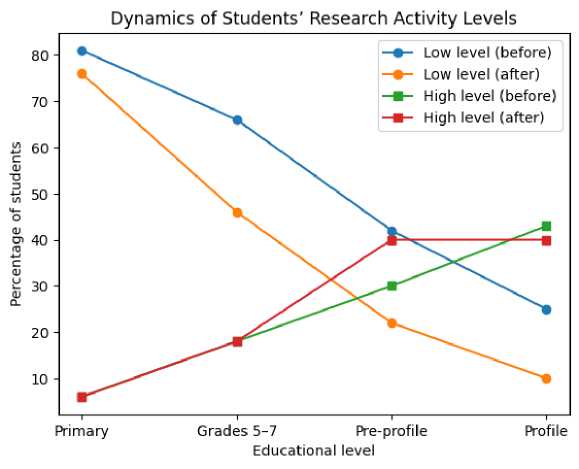
Figure 1. Dynamics of students’ research activity levels before and after the experiment
Diagnostics based on the structural components of research activity-value-purpose, intellectualcreative, operational, and performance-evaluation-indicated consistent positive changes in motivation, independence, reflexive abilities, and research skills in all age groups. Monitoring, expert assessment and standardized diagnostic tools have confirmed the reliability of the recorded dynamics.
The results obtained indicate the effectiveness of the proposed model in ensuring the gradual development of students’ research activities and increasing their readiness for independent educational and cognitive activities at various stages of general secondary education.
Discussion
The results obtained during the longitudinal pedagogical experiment confirm the effectiveness of the step-by-step model of organizing students’ research work in the general secondary education system. The positive dynamics observed at all levels of education indicates that research activities with systematic integration into the educational process can function as a sustainable mechanism for the development of cognitive independence, motivation and reflective abilities of students.
The decrease in the proportion of students with low research activity and, consequently, an increase in the average and high levels show that the gradual complication of research tasks plays a crucial role in the formation of research competencies. The results of this study are consistent with modern research showing the importance of students’ independent and search-oriented activities for the development of their cognitive activity, reflexive skills and learning independence. Recent research highlights that structured research tasks are gradually combined with supports, contributing to students’ willingness to learn independently and solve problems in various educational contexts ( Uiterwijk-Luijk, et al., 2019 ; Hmelo- Silver, et al., 2007 ). In particular, data from multilingual educational institutions show that independent and scientifically based learning activities enhance students’ ability to work with complex content and promote the development of higher-level thinking skills ( Junussova et al., 2024 ). These results confirm the idea that research activities serve as an effective mechanism for academic and personal development when they are systematically organized and adapted to the age characteristics of students.
The effectiveness of the proposed model can be explained by its correspondence to the age characteristics and developmental needs of students. At the initial level, structural and managerial research tasks supported the formation of skills and motivation for initial research. The introduction of partial search and interdisciplinary tasks in the lower middle and pre-professional periods contributed to the development of communication skills, independence, and responsibility. The increased independence of students during the profile-oriented period and the participation of external experts contributed to the transition to more advanced types of research activities and professional self-determination.
The results also indicate the role of students’ research activities in strengthening their motivation to learn and their orientation towards self-development. Improving the skills of reflexive and self-regulation indicates that research activities contribute not only to academic results, but also to the formation of broader personal qualities necessary for successful adaptation in a rapidly changing social and educational environment ( Amri and Ekaningsih, 2018 ).
Despite the positive results, several limitations of the study should be recognized. The study was conducted in a specific educational context, which may limit the generalization of the results. Thus, Qatar’s reliance on expert assessments and observation methods, while justified by research objectives, may introduce a degree of subjectivity. Future research may expand the sample size, cover multiple areas, and use additional digital tools to further validate the proposed model.
In general, the discussion of the conclusions indicates that the systematic organization of students’ research activities, based on a well-defined theoretical basis and carried out through successive stages, is an effective way to increase the educational and developmental potential of the educational process at school.
Conclusion
The purpose of this study was to substantiate the theoretical foundations and test the model of organizing students’ research activities in the general secondary education system. The results confirm that students’ research activities serve as an integral component of educational and cognitive activities that promote the development of cognitive independence, creativity, reflection and motivation to learn.
The study shows that the educational potential of research activities is realized through the interaction of motivational, cognitive, ideological, reflexive, and orientation mechanisms that support the personal and intellectual development of students. The proposed model, implemented in successive stages, creates conditions for the gradual formation of research competencies and the willingness of students to independently solve problems at various levels of school education.
The practical significance of the research lies in the possibility of applying a model developed to improve the effectiveness of the educational process in general education schools. The systematic organization of research activities and the gradual complication of research tasks contribute to improving the effectiveness of education and prepare students to solve complex, non-standard educational and life situations. Future research may focus on expanding the empirical base and adapting the model to different educational contexts.
Conflict of interests
The authors declare no conflict of interest.
Author Contributions
Conceptualization, J.S. ; methodology, Zh.K. ; software, J.R. ; formal analysis J.S. and Zh.K. ; writingoriginal draft preparation A.D. ; writing-review and editing, J.S. , Zh.K. , A.D. ; Data curation A.D. ; Formal analysis J.S. and A.D. ; Funding acquisition J.S. and Zh.K. ; Investigation J.R. and M.A. ; Project adminis-tra-tion Zh.K. and J.R. ; Resources M.A. ; Supervision Zh.K. , A.D. and M.A. ; Validation J.S. ; Visualization J.R.
All authors have read and agreed to the published version of the manuscript.
Funding
This research was conducted on the basis of the Abai University Rector`s grant, Order No. 0504/329 dated 14.05.2024 under the financing of the project No. 0124RKI0392 “Development of research skills of students on the basis of botanical local history”.
Data Availability Statement
The data supporting the findings of this study are available from the corresponding author upon reasonable request.
