
Russia in the Mirror of Western European Rock: A Comparative Study of English- and Finnish-Language Songs
Бесплатный доступ
Introduction. Amid the intensification of geopolitical tensions and the confrontation between competing narratives of national identity, the study of foreign-language representations of culture has acquired particular relevance. The construction of the image of a nation has moved beyond specialised text types and increasingly draws on genres of popular culture, including popular music. Rock music, which has historically served as a platform for political debate and cultural exchange, provides unique material for the study of cross-cultural representation. To date, research on rock music has focused primarily on nations’ self-representation, while paying little attention to the portrayal of other cultures. The present study addresses this gap by analysing representations of Russia in English- and Finnish-language rock music. The aim of the study is to identify similarities and differences in the construction of the country’s image within two linguocultural environments that differ considerably in terms of geographical proximity, the intensity of cultural ties, and ideological positioning towards Russia. Materials and Methods. The material consisted of a bilingual comparative corpus of 30 rock songs, with 15 songs in each of the English- and Finnish-language subcorpora. The material was analysed using a corpus-oriented discourse analysis aimed at identifying discourse markers at the micro level, including xenonyms, proper names, intertexts and tropes, and at the macro level, including the themes of war, cold, culture, freedom and emotion. This analysis was supplemented by quantitative distributional analysis, interlinguocultural analysis of the techniques used to introduce Russianisms, multimodal discourse analysis of the interaction between semiotic codes, and intertextual analysis of cultural references. Results and Discussion. It has been established that, despite the shared use of semiotic techniques and thematic repertoires, representations of Russia differ substantially across the two subcorpora. Anglophone rock places greater emphasis on political themes, activated through Cold War metaphors and the antinomy of “Russia versus the West”, thereby constructing a more ideologised and conflict-oriented image. Finnish-language rock draws on a rich range of cultural references, from literature and music to cuisine, and creates a more balanced image that combines universal human meanings with culturally specific elements. Both forms of discourse are characterised by a multimodal strategy of meaning construction; however, they differ in the frequency of xenonyms, the preferred techniques used to introduce them, their strategies of intertextuality, and their geographical framing. The identified differences reflect the ideological orientations of the respective discursive communities: geopolitical rivalry in the Anglophone context and geographical proximity combined with historical interconnectedness in the Finnish-language context. The study demonstrates that popular music can function not only as a means of cultural representation, but also as an instrument for constructing and reinterpreting national images across translingual and transcultural dimensions. Conclusion. The findings contribute to the theoretical understanding of how national images are discursively constructed through the systematic selection and foregrounding of culturally specific markers; methodologically, they confirm the value of integrating corpus-based, interlinguocultural, and multimodal approaches in cross-cultural discourse analysis. The study opens up further avenues for investigating how popular music genres represent other nations and how these representations relate to broader media images and public opinion.
Короткий адрес: https://sciup.org/147254983
IDS: 147254983 | УДК: 811.511.11:811.111:398.8(470+571):001.8 | DOI: 10.15507/2076-2577.26183.312-333
Россия в зеркале западноевропейского рока: сопоставительное исследование англо- и финноязычных песен
Введение. В условиях обострения геополитических противоречий и столкновения конкурирующих нарративов о национальной идентичности исследование иноязычной репрезентации культуры приобретает особую актуальность. Конструирование образа нации вышло за рамки специализированных типов текстов и все чаще обращается к жанрам массовой культуры, включая популярную музыку. Рок-музыка, исторически служившая ареной политических дискуссий и культурного обмена, дает уникальный материал для изучения кросс-культурной репрезентации. До сих пор исследования рока фокусировались на саморепрезентации наций, оставляя без внимания изображение внешних культур. Настоящее исследование восполняет этот пробел, анализируя репрезентацию России в англо- и финноязычной рок-музыке. Цель исследования – выявление сходств и различий в конструировании образа страны в двух лингвокультурных средах, существенно различающихся по географической близости, тесноте культурных связей и идеологическому позиционированию по отношению к России. Материалы и методы. Материалом послужил двуязычный сравнительный корпус из 30 рок-песен (по 15 в англо- и финноязычном подкорпусах). К материалу применен корпусно-ориентированный дискурсивный анализ, направленный на идентификацию маркеров дискурса на микроуровне (ксенонимы, имена собственные, интертексты, тропы) и на макроуровне (темы: война, холод, культура, свобода и эмоция), дополненный количественным распределительным анализом, интерлингвокультурологическим анализом приемов введения русизмов, мультимодальным дискурсивным анализом взаимодействия семиотических кодов и интертекстуальным анализом культурных отсылок. Результаты исследования и их обсуждение. Установлено, что, несмотря на общность семиотических приемов и тематических репертуаров, образы России в двух подкорпусах существенно различаются. Англоязычный рок акцентирует внимание на политической теме, актуализируемой метафорикой холодной войны и антиномией «Россия – Запад», и формирует более идеологизированный и конфликтный образ. Финноязычный рок задействует богатый набор культурных отсылок (от литературы и музыки до кулинарии) и создает сбалансированный образ, соединяющий общечеловеческое и культурно-специфическое. Оба варианта дискурса отличает мультимодальная стратегия конструирования смысла, однако они контрастируют по частотности ксенонимов, предпочтительным приемам их введения, стратегиям интертекстуальности и географическому фреймингу. Выявленные различия отражают идеологические установки дискурсивных сообществ: геополитическое соперничество в англоязычном контексте и географическую близость с исторической взаимосвязанностью в финноязычном. Исследование демонстрирует, что популярная музыка способна выступать не только средством культурной репрезентации, но и инструментом формирования и переосмысления национальных образов в трансъязыковом и транскультурном измерениях. Заключение. Полученные результаты вносят вклад в теоретическое осмысление того, как национальные образы конструируются дискурсивно через систематический отбор и акцентуацию культурно-специфических маркеров; методологически они подтверждают продуктивность интеграции корпусно-ориентированного, интерлингвокультурологического и мультимодального подходов для кросс-культурного дискурсивного анализа. Исследование открывает перспективы для дальнейшего изучения того, как жанры популярной музыки репрезентируют другие нации и как эти репрезентации соотносятся с более глобальными медийными образами и с общественным мнением.
Текст научной статьи Russia in the Mirror of Western European Rock: A Comparative Study of English- and Finnish-Language Songs
St. Petersburg, Russian Federation,
Российский государственный педагогический университет им. А. И. Герцена, г. Санкт-Петербург, Российская Федерация, н
To quote J. Kerouac, “the only truth is music”1, yet, to quote J. Lotman, “a work of art... must be intuitively recognized as an analogue of a certain object, that is, it must be ʻsimilar᾿ and ʻdissimilarʼ at the same time” [1, p. 250], which presupposes that a work of art is by its very nature distortive, at least to some extent.
As a mode of art, music is a multi-layered secondary modeling system, “characterized by an extremely large capacity for an economical storage of very complex information” [1, p. 268]. But music is not only a means of modeling reality; it is itself a significant part of this reality2, densely intertwined with fashion, on the one hand; ideology and politics, on the other; and culture, from whichever perspective one chooses to look at it. Music is, in essence, part of a network or, rather, a tangle of relationships, from which we can only try to isolate several, crucial for our further narrative.
The relation between music and culture is usually approached in the light of national music reflecting national culture and social order [2]. Being a seemingly universal means of communication [3], music is still inextricably linked to the cultural and ideological context it originated from. Yet, as R. Elbourne concludes in his in-depth review of the subject, “music does not just ʻreflectʼ social structure. It helps create it”3. So, it follows, that music serves to reflect, promote, and shape the national culture underlying it.
At the same time, shifting our focus onto rock music, one cannot but observe that being a product of the globalization era, i.e. the era of diffused borders, music evolves to reflect not culture, but subculture or counterculture. The connection between rock and political dissent seems to be common ground in the history of music. P. Scaruf-fi observes: “The fusion of music and politics that occurred in the early 1960s had lasting effects on the very nature and purpose of rock music. Rock music became a primary vehicle for expressing dissent within the Establishment, and therefore one of the most relevant aspects of the ʻcountercultureʼ. Even when the political element was not predominant, rock music came to adopt a stance that was ʻcounterculturalʼ in nature. <…> There was a tradition that made rock music an ʻundergroundʼ phenomenon by nature”4.
On the other hand, J. Mullin notes, that apart from being naturally radical, or at least dissenting, rock also tends towards escapism [4].
These two qualities – leftism and escapism – explain how and why rock turns towards the Soviet/Russian theme, which is the object of our research. In contrast to the traditional approach to music as a reflection of national culture the present study aims to explore how national music reflects an exoculture – a culture, which is external to it. More specifically, this investigation is guided by the following research objectives: first, to examine how the image of Russia is constructed by rock music and to identify which elements of Russian culture are selected as the keystones of that construct; second, to assess the degree of precision and completeness of this constructed image; and third, to compare the images of Russia produced within different national musical traditions, characterized by contrasting geographical, linguatypological and linguacultural distance from the object culture, namely Anglo-American rock and Finnish rock.
Literature Review
The research rests on three theoretical cornerstones:
-
1. Interlinguaculturology , research program founded by V. V. Kabakchi7, and focused on the mechanisms and principles of communicating a unique culture across the language barrier. The present research rests to the following fundamental assumptions drawn from interlinguaculturology:
– Although a language is deeply rooted in the culture of its native speakers, its intrinsic flexibility allows it to be used to express any culture. At that, this cultural reorientation entails changes in the language, adapting it to the new referential domain: to be able to describe an external culture, the language will need to adopt or develop an adequate set of expressive means – xenonyms.
– Xenonyms can be introduced into the language by means of a spectrum of linguistic techniques, varying in the degree of precision and accessibility. The choice of the technique depends on a number of factors, including the communicative situation, the parameters of the addressee, the genre, etc.
– Foreign language Russia-centred discourse is, in a way, a translation of the Russian culture into another tongue, based on a careful selection of representatives of this culture. This selection, too, depends on a variety of factors, in particular the pragmatic goals pursued by the speaker.
-
2. Theory of discourse . Provided that the term discourse allows for various interpretations within different national schools of linguistics, its usage in the present paper requires clarification. Following the European school of discourse analysis, which views discourse in complex relations with not only language, but also knowledge and ideology8, we understand discourse to be a specific use of language reflected in texts serving to manifest (verbalize) a certain field of knowledge and social practice and sharing certain conceptual and structural features9 [5]. The Russia-centred discourse, the focus of our attention, can be defined as the language used to reflect Russia and the Russian culture, taking shape in a particular discursive community under the influence of the factors of cultural and ideological distance.
-
3. Theory of multimodality . Multimodal Studies is an “archipelago of diverse research that takes multimodality as its main subject of investigation” [7, p. 733]. Yet, unlike social semiotics, which views language as neither necessarily the main resource, nor paradigmatic of all semiosis, we take care to preserve the emphasis on the verbal code, while complementing the analysis to reveal the intersemiotic nature of the discourse under study. Two reservations need to be stipulated in regards to the multimodal discourse analysis application in the present research.
Several points need to be elaborated in relation to discourse.
Firstly, the production of texts within discourse is predetermined by a certain ideology it manifests and certain formation rules it follows. This will be much more visible in institutionalized types of discourse, where institutional “actors think and speak on the basis of internalized rules, norms and frames”10. Yet, even in such a creative type of discourse as rock music we, hypothetically, expect to identify the effects of national ideologies and of the genre conventions.
Secondly, the Foucaltian theory of discourse allows the researcher “to step over the ever finite forms of verbal production that can be directly perceived through our senses – including oral communication, texts by one or many authors, belonging at that to various epochs, – and to present them as a unity with certain commonalities, which are seldom identified in this dynamic ever changing space” [6, p. 67]. We hope to eventually draw conclusions relevant to Russia-centred rock as a genre of the discourse under study and English and Finnish-language varieties of the Russia-centred rock discourse.
Thirdly, as R. Walser suggests, the notion of discourse is applicable not just to verbal matter, but to music as well, whereby it “enables us to pursue an integrated investigation of musical and social aspects of popular music”11, identifying not only formal characteristics of musical genres, but also notions and ideas, cementing the discursive community of musicians and fans. Yet, McKerrel and Way, departing from the thesis by L. Zbikowski “musical meaning is on the whole much less precise than linguistic meaning”12, conclude: “we consider musical experience to be almost always a multimodal experience anyway, and that, as analysts, it is worth understanding the ways in which musical sound interacts with other modes and because a multimodal approach can bear rich insights into the socio-cultural understanding and significance of human communication”13.
Firstly, departing from I. Shchirova and her co-authors’ definition of multimodal text as “a multicomponent semantic and functional unity, the constituents of which can be introduced both explicitly and implicitly; while information is passed via verbal, visual, or prosodic channels with the help of various semiotic codes”14, we intentionally narrow down the focus to the explicit intersemiotic interplay in order to avoid subjectivity and hyperinterpretation of the “much less precise”, as defined above, musical code.
The problem of culture and identity representation in popular culture, rock in particular, has been widely targeted by researchers. Yet, the “by default” focus is the national culture and national identity as reflected in the national music. Thus T. Skaniakos explores the “Finnishness” of Finnish rock18; R.-L.Valijärvi19 and I. Malmberg20 study Finland’s self-image as represented in the Finnish popular music; J. Jaakkola21 and H. Soini [9] dedicated their researches to exploring the roots and influences that helped shape Finnish rock as a national cultural phenomenon. L. van Elderen explains the attempt to study Finnish music by a “foreigner outsider” claiming that “studying popular music is a good door way, even a strategic road, to understanding and grasping a society”22. Similar foci are to be observed in the field of British23 and American24 rock studies. The volume dedicated to positioning popular music “between the Global and the Local” opens with the statement that “despite the premature announcements of its demise”25, the nation remains crucial to understanding cultural texts and practices, music in particular. Taking into account the global aim and reach of modern popular music, there appears to be an unjustified bias in studying it in connection with only the “internal culture”, while its goals and interests have from the very emergence of rock pushed it beyond those narrow boundaries of national interests and identities.
The present research, while aligned with several well-established trends in the study of discourse, is intended to fill a “blind spot” of rock discourse studies, addressing the problems of external cultures’ representation in it. Apart from that, the comparative approach is expected to gain added heuristics, allowing to identify the culture- and language-specific aspects against the background of common practices. The object of our research – rock songs about Russia – can be defined as an intersemiotically constructed genre of the Russia-centred discourse, shaped in the process of secondary cultural orientation of the language in use, featuring common discourse- and genre-specific properties, yet varying across languages, cultures, and ideologies [10]. This research focus, new to the rock discourse studies, is a significant contribution not only to the exploration of the nature of rock, but to the study of language secondary cultural orientation as well, since it allows to investigate
® ФИННО-УГОРСКИЙ МИР. Том 18, № 3. 2026 »»fcw»»^ the connection and interdependence between the national worldview, encoded into the language, and the representation of external culture by means of this language within a highly specific cultural and subcultural phenomenon of rock.
Materials and Methods
Empirically, the research rests on two subcorpora of rock songs thematically oriented onto Russia: Anglophone and Finnish ones, 15 songs each. The corpus approach has been chosen in the attempt to overcome the subjective bias of a researcher dealing with discursive construal of sensitive ideological and cultural issues.
Although we intended to aim specifically at rock music, we must admit that its borders are not really clear-cut. Departing from the following observation by Scaruffi, “Traditionally, books on the history of rock music begin by defining rock music as the meeting of country music and rhythmʼnʼblues. <…> In fact, it would be more accurate to define todayʼs rock music as the meeting of avantgarde music and popular music”26, one cannot but accept that, firstly, rock was initially a mixture of other styles and, secondly, it has been changing its loyalties over time, establishing closer ties with different trends within music at different stages of its evolution. Therefore, in selecting the texts for the subcorpora we were relying on the following criteria:
-
– the performer identifies as rock musician or is affiliated by musical databases with the rock tradition;
-
– the song is originally composed in, respectively, the English or Finnish language (songs translated from Russian were filtered out);
-
– the performers are the native speakers of the Finnish and English language, respectively.
In terms of method, the research rests on an already well attested combination of discourse analysis and corpus linguistics – corpus-assisted discourse studies (CADS)27.
A bilingual comparable corpus of rock songs being a genre of the Russia-centred discourse was compiled and subject to manual annotation in accordance with the set of pre-identified [10] parameters. The two subcorpora are roughly comparable in terms of chronology, covering the period 1968–2012 (English) and 1977–2018 (Finnish), yet the English-language material is mostly concentrated in the 20th century, since more recent songs shift away from rock.
Following T. van Dijk, who views discourse as an interplay of superstructure, or the surface level, and macrostructure, or the semantic or knowledge level, that is “the possible forms in which topics or themes can be inserted”28, these parameters are designed to encompass discourse markers on these two levels. The superstructure markers are the forms that the discourse employs specifically for expressing the ideas and concepts that it emerged to express. Being on the surface, these serve as markers making the discourse readily recognizable; and, as indicated by a previous study [11], are mostly represented by culture-bound lexicon, as well as culture-specific tropes and expressive means. The macrostructure is the deep, cognitive level of a discourse, consisting of a network of themes or concepts, among which we focus on dominant ones that were identified by categorizing frequency lists and keyword lists. The corpus annotation is targeted at various means of rhetorical focusing or foregrounding29, ascribing value to certain elements of discourse, and the key semantic fields.
The manual annotation of the corpus involves a complex methodology, incorporating the identification of the conceptual dominants to establish the core themes of the discourse variants, as well as the interlinguaculturological analysis, aimed at evaluating the precision and comprehensibility of the exocultural elements of the discourse.
While employing the corpus manager tools for certain statistical correlations in other parts of our project, we fear the song genre might prove to be misleading in respect to quantitative estimations due to such genre-specific feature as repetitiveness. Therefore, the present research does not take lexemic frequencies into account. Similarly, we cannot rely on automatically identified keywords. Quantitative estimations here are restricted to the results of manual annotation of song texts and are aimed at identifying the super- and macrostructure markers of the discourse being described.
Results and Discussion
Superstructure markers of the Russia-centred discourse. As a genre of the Russia-centred discourse, rock songs are characterized by the discourse-specific formal features, resulting from the secondary cultural orientation of the language in use. These features are xenonyms, powerful means of pragmatic focusing due to their exocultural nature. The corpus analysis yielded the following datasets of the described culture representants.
Dataset 1.1 encompasses the identity names for Russia and its people (Table 1).
The resultant lists are comparable in that they refer only to the recent history of the country: rock music does not address earlier historical periods, therefore there is no mention of the Russian Empire or the Muscovy Principality, while they were relatively prominent in the pilot corpus [11].
The contrasting feature is the preference given to the abbreviated nomination of the Soviet Union in the English-language discourse against the full nomination in the Finnish one. A possible explanation for this choice can be found in the passage from the song by The Beatles : “Back in the US, back in the US / Back in the USSR”30 .
Clearly, the song exploits partial homonymy of the abbreviated names of the 20th-century-world’s main geopolitical opponents. Indeed, as we are going to see in some of the other datasets, this opposition is truly crucial for the discourse under study.
The Finnish language also has abbreviated variants for USSR, and even more than one. Yet, the most frequent by far is the non-abbreviated statonym Neuvostoliitto ʻSoviet Unionʼ – 29,070 instances in the FNAA Corpus31.
Another important aspect to look into is the linguistic techniques employed to introduce xenonyms, varying in the degree of their precision and comprehensibility, comprising Dataset 1.2. (Table 2). Precision is achieved in case of formal borrowing, allowing to preserve the easy correlation between the xenonym and its Russian prototype. Comprehensibility is less reliable in the task of precisely pinpointing a cultural phenomenon, yet is more readily understandable by the addressee with a different linguacultural background, possibly very little acquainted with the Russian culture.
T a b l e 1. Identity names for Russia and its people in the Rossica-rock corpora
|
Russia’s identity names in the Rossica-rock-Eng corpus |
Russia’s identity names in the Rossica-rock-Fi corpus |
|
Russia |
Venäjä ʻRussiaʼ |
|
Russian |
venäläinen ʻRussianʼ |
|
Russians U.S.S.R. USSR Soviets |
Neuvostoliitto ʻSoviet Unionʼ |
Source: Hereinafter in the article, all tables are compiled by the author.
® ФИННО-УГОРСКИЙ МИР. Том 18, № 3. 2026 »»fcw»»^
T a b l e 2. Culture-specific xenonyms denoting Russian realities in rock songs
|
Linguistic technique |
Russian culture xenonyms in the Rossica-rock-Eng corpus |
Russian culture xenonyms in the Rossica-rock-Fi corpus |
|
2.1. Formally |
balalaikas |
Tupoleviin |
|
borrowed |
cossack, Kazachok |
Aeroflotin |
|
xenonyms |
glasnost KGB Perestroika tsar |
KGB miliisi Filjovskaja Koltsevaja Butovskaja Kreml duma jerunda Sovetskii sojuz Vostok brežneviläiset ʻbrezhneviansʼ Stolitshnaja Baltika taiga Pravda Belomorkanal maatuska (originally, transliterated from Rus. матушка ) |
|
2.2. Semantically borrowed xenonyms |
Red Square comrade pancakes and mushrooms free Moscow |
Punaiselle torille ʻRed Squareʼ |
The data retrieved indicates a preference for formally introduced xenonyms, characteristic of both English and Finnish Russia-centred discourse. Yet, the Finnish one is much more radical in this preference, which indicates that the Russianisms’ comprehensibility is not seen by the authors as a problem. And, taking the geographical and historical considerations into account, one will naturally admit objective prerequisites for a greater degree of cultural awareness of Russia on the part of the Finns.
Apart from that, xenonyms appear to be twice as frequent in the Finnish subcorpus (20 in Rossica-rock-Fi against 10 in the Rossica-rock-Eng).
Qualitatively, the lists are also disparate: there is but one match in each part of the list: KGB in Dataset 2.1 and Red Square in Dataset 2.2. We shall have a closer look at the conceptual domains the xenonyms belong to in the second part of our overview, but no in-depth analysis is required to see disparity in this respect as well.
Another significant focus of our research is intertextuality of the studied discourse, giving an insight into the verbal culture being described. Dataset 1.3 (Table 3) encompasses markers of intertextuality.
T a b l e 3. Intertextual references in the Rossica-rock corpora
|
Intertextual references in the Rossica-rock-Eng corpus |
Intertextual references in the Rossica-rock-Fi corpus |
|
We will bury you We will protect you Queen of the ball <…> Margarita |
Pähkinänsärkijän tanssiin ʻTo the Nutcracker danceʼ Miljoona ruusua ʻMillion rosesʼ Seitsemän päivää ja seitsemän yötä ʻSeven days and seven nightsʼ Kommunismiin tiemme johtaa ʻOur road leads to communismʼ Hyvää päivää, astukaa sisään ʻGood day, come on inʼ Saavumme hetken kuluttua päätepysäkille! ʻWe will arrive at the final stop in a moment!ʼ Kiitoksia kaikille matkustajille, että valitsitte juuri meidän yhtiömme trollibussin ʻThanks to all passengers for having chosen our companyʼs trolley busʼ |
The Anglophone subcorpus features several cases of straightforward citations, quoting both literary (M. Bulgakov’s Master and Margarita ) and historical pretexts. Noteworthily, the two historical quotes “Mister Krushchev said, ʻWe will bury youʼ / “Mister Reagan says ʻWe will protect youʼ” form a clear opposition, the one we have already noted when analyzing Dataset 1.1: contrastive semantics (threat / promise to save) and source (Krushchev / Reagan, the leaders of opposing political camps) is brought into relief by syntactic parallelism. At that both The Beatles and The Sting , while building this contrast, representing the world’s split, also highlight the similarity – formally in the case of US/USSR partial homonymy or semantically, when stating “We share the same biology”32.
Finnish rock songs exploit intertextual dialogue in a different way – most of the identified cases refer the listener not to a particular text, but rather to situational frames: e.g. Saavumme hetken kuluttua päätepysäkille ! (ʻWe will arrive at the final stop in a moment!ʼ) and Kiitoksia kaikille matkustajille, että valitsitte juuri meidän yhtiömme trollibussin (ʻThanks to all passengers for having chosen our companyʼs trolley busʼ) are loan translations of public transport announcements.
The corpus data illustrated in Table 3 need to be augmented by paratextual material.
Firstly, in several cases the text of the song is accompanied by voiceover. To illustrate, the lead-in for the song Russians is a snippet of the Soviet news program Vremya highly recognizable due to the voice of its famous broadcaster I. L. Kirillov saying “...премьер охарактеризовал переговоры с главой делегации Михаилом Сергеевичем Горбачевым…” (...The British Prime Minister described the talks with the head of the delegation, Mikhail Sergeyevich Gorbachev...). And in the background, one can discern communications from the Apollo–Soyuz mission. These intexts refer the audience to two milestones in the US – USSR relationships: Gorbachev’s late 1984 meeting with Margaret Thatcher, following which in the December 17, 1984 interview for BBC the British PM admitted: “I like Mr Gorbachev. We can do business together”33; the Apollo – Soyuz Test Project – the first international space mission that included three American astronauts and two Soviet cosmonauts, carried out in July 1975.
Another culture-specific class of discourse data is culture-specific imagery – metaphors and similes, presented in Dataset 1.4 (Table 4).
® ФИННО-УГОРСКИЙ МИР. Том 18, № 3. 2026 »»fcw»»^
T a b l e 4. Metaphor-based imagery of Russia in English- and Finnish-language rock songs
|
Culture-specific imagery in the Rossica-rock-Eng corpus |
Culture-specific imagery in the Rossica-rock-Fi corpus |
|
Mother Russia mother’s son red: ̴ blood, air glowing ̴, yellow ̴s, ̴ Army, ̴ Square Steely Russia; steely Russian skies cold war child of sacrifice, ̴ of war |
käydä kuumana kuin samovaari ʻgo as hot as a samovarʼ pääkonttorin toverit ʻcomrades from headquartersʼ Punainen lokakuu ʻRed Octoberʼ Punaisen lokakuun metsästys ʻThe Hunt for Red Octoberʼ punainen linja ʻRed Channelʼ punaisen junan punainen vaunu numero 8 ʻred car number 8 of the red trainʼ Moskovan verilöylyn punatähti ʻThe red star of the Moscow massacreʼ rautainen punatähti ʻiron red starʼ korkeat punaiset muurit ʻhigh red wallsʼ |
Pervading the discourse in general, culture-specific images are strikingly non-original and seem to be comprised of a canonical set of metaphors – red , cold , iron/steel . Some freshness might come from unexpected collocations (e.g. air glowing red in the English subcorpus) and from pleonastic expressions (e.g. punaisen junan punainen vaunu numero 8 ʻred car number 8 of the red trainʼ in the Finnish material).
A notable element in this category is the mother – son metaphorical dichotomy, to be found in three texts – Night Train to Moscow by Brazzaville , Mother Russia by Renaissance , and Mother Russia by Iron Maiden . The mother metaphor is not exactly common for English: firstly, the father metaphor is older; secondly, when choosing between motherland , fatherland and homeland , it is the latter that is most frequent36. At that, it is exactly Mother Russia that the author of the dictionary entry gives as an example of a culture preferring the mother metaphor: “The people of some countries have historically personified their country in feminine ways. To them, their home country is (in translation) the motherland . For example, a common personification of Russia is Mother Russia ( Matushka Rossiya )”37.
Therefore, we can conclude that the songs refer their audience to the Russian culture-specific metaphorical frame native country = mother ; citizen = son.
Another way of creating a culture-specific image is represented by the case of käydä kuuma-na kuin samovaari ʻgo as hot as a samovarʼ from Rossica-rock-Fi, parallels to which, although absent in the English-language rock songs corpus, can be found in the fiction genre [12], which allows one to talk of a technique, specific to the exoculture-centred discourse.
Apart from the verbal metaphors retrieved from the corpus, there is a notable presence of multimodal and visual metaphors, which might be seen as a genre-specific feature. Songs are often accompanied by videos, visualizing recognizable locations (the Kremlin) and symbols (the red flag, the red star), serving as pictorial metaphors of Russia. The video for Sting’s The Russians features an image of an elderly severe man dressed in a military jacket, visualizing a collective image of a Soviet leader; while Frankie Goes to Hollywood show the images of Reagan and Chernenko, whose boxing coup is a metaphor for the war in the verbal component.
Yet, another type of data we need to examine is the names of people. Proper names are a somewhat problematic class of words, which tend to be pushed outside the lexical stock proper [13]. Yet, they are truly crucial for this research, being, as C. Nord puts it, culture markers [14]. Anthroponyms featured in the research corpora comprise Dataset 1.5 (Table 5).
i»«&wob«i^^^ FINNO-UGRIC WORLD. Vol. 18, no. 3. 2026 ©
T a b l e 5. Anthroponyms as linguacultural markers in the Rossica-rock corpora
|
Culture-specific anthroponyms in the Rossica-rock-Eng corpus |
Culture-specific anthroponyms in the Rossica-rock-Fi corpus |
|
Comrade Gorbachev |
Aivazovski |
|
Comrade Schevardnadze |
Alla Pugatšova |
|
Mister Krushchev |
Brezhnev |
|
Lenin |
Brodsky Gorbatshov Hrushtshov Igor Jeltsin Junaemäntä Julia ʻtrain hostess Juliaʼ Lenin Mikhalkov olgat “Olgas” (plural and noncapitalized Russian personal name) Vaganova Pietari Pushkin Putin Sofia-rouva ʻMrs Sofiaʼ Stalin Tolstoj/Tolstoi Tshaikovski Turgenev Vysotski |
The lists of anthroponyms obtained from our subcorpora are in stark contrast. Firstly, the Finnish one is much more representative. Secondly, while English material only features politics-related names, the Finnish subcorpus is rather rich in cultural references: to music ( Alla Pugatšova ), art ( Aivazovski ), literature ( Turgenev ), cinema ( Mikhalkov ), ballet ( Vaganova ). Thirdly, anthroponyms in the English-language rock songs appear to form dichotomies indicative of the political opposition USSR / US ( Mister Krushchev / Mister Reagan ), which is not traceable in the Finnish material.
So, if proper names are seen as representatives of the cultures their bearers belong to, they amount to very different portraits of Russia.
Place names are also to be seen as culture markers, though they represent another aspect of it. Geographical names, toponyms, comprise Dataset 1.6 (Table 6).
The lists of toponyms are more similar – they are comparable quantitatively and structurally, in that they evidently fall into two categories: place names in Russia and other place names, contributing to the image of Russia by positioning it in a network of relationships, contrasts and parallels [15]. In their first part, the lists partially overlap, naming the two main cities of Russia and reflecting the change of name from Leningrad to St. Petersburg . Yet, the Finnish songs tend to focus more on the North-Western part of Russia ( Karjala , Leningrad , Pietari , Murmansk ), Siperia Siberia being a notable exception [16]. In contrast, the English songs cover the country’s territory more fully, as it stretches from Leningrad in the West to Vladivostok in the East.
In their second part, the lists predictably contain references to places in the countries native for the performers. It appears, that the Anglophone world is represented by locations in the USA ( US , America , New York ) and in Great Britain ( London ); as well as in other parts of Europe ( Berlin ). Collectively they are referred to as the West and are contrasted to Russia . Finnish songs tend to focus on the relationships between Russia and Scandinavia, which is represented by Helsinki , Tukholma ʻStockholmʼ and Ruotsi ʻSwedenʼ, as well as Finnish towns of Kuusankoski , Lahti , Rautalampi . Some of the non-Finnish place names are exonyms, loosely associable with their endonymic forms (e.g. Tukholma ʻStockholmʼ, Pietari ʻ St. Petersburg ʼ).
T a b l e 6. Toponyms as linguaculture markers in the Rossica-rock corpora
|
Toponym’s origin |
Culture-specific toponyms in the Rossica-rock-Eng corpus |
Culture-specific toponyms in the Rossica-rock-Fi corpus |
|
Russian |
Leningrad |
Karjala ʻKareliaʼ |
|
geographical |
Moscow |
Leningrad |
|
names |
Orel Smolensk Stalingrad [St] Petersburg Viasma Vladivostok |
Moskova Murmansk Pietari ʻSt. Petersburgʼ Siperia Volga |
|
Non-Russian |
America |
Berliini |
|
geographical |
Afghanistan |
Helsinki |
|
names |
Berlin Georgia Europe Levittown London Miamy Beach New York Times square US the West |
Ibiza Kuusankoski Lahti Mallorca Rautalampi Rhodos Ruotsi Tukholma ʻ Stockholm ʼ Pariisi |
So, on the surface level we have identified various proper names, xenonyms, intertexts, and tropes as markers of the Russia-centred discourse, and have seen that they are indeed characteristic of it in both English- and Finnish-language varieties. Yet, there could be observed some rather drastic contrasts in respect to the markers concentration and the choice of particular representants. The discourse varieties also differ in their preferred techniques of introducing xenonyms, with Finnish demonstrating a greater concern for precision, while English favouring comprehensibility.
Macrostructure markers of the Russia-centred discourse. Depictions of other cultures are often stereotype-driven [17]. So are the dominant themes in the Russia-centred discourse. The corpus analysis yielded certain semantic fields that appear to be prominent in the discourse under study. We are going to look into them as the focal points, or the dominant themes of the Russia-centered discourse.
Dataset 2.1 (Table 7) encompasses verbalizations of the war theme.
The war theme is present in both subcorpora, yet in the English-language material it is much more prominent. This observation is rather predictable in the light of the pacifistic sentiment which has been underlying rock music starting from the 1970-ies’ anti-Vietnam movement in the USA.
The anti-war sentiment is paramount for such songs as Two Tribes and The Russians , and can best be summed up by Sting’s “there’s no such thing as a winnable war”. H. Johnson explains the song Two Tribes to be about conflict exemplified by the conflict between Russia and America, yet largely about all kinds of conflict: “ Two Tribes didn’t just go on about whether the Russians were bad or the Americans were bad. It made the point that throwing bombs at the other side is going to achieve absolutely nothing”38. At the same time, some of our material seems to be focused on war as part of the glorious history of Russia (e.g. Roads to Moscow by Al Stewart), ennobling the war.
The Finnish rock appears to be systematically construing the stereotype of militaristic Russia, making numerous mentions of types of firearms and armed forces. At that, the war theme is often intertwined with the culture theme , generating the idea of a militaristic culture, where aggression goes hand in hand with spirituality.
i»«&wob«i^^^ FINNO-UGRIC WORLD. Vol. 18, no. 3. 2026 ©
T a b l e 7. Verbal representations of the war theme in the Rossica-rock corpora
|
War theme in the Rossica-rock-Eng corpus |
War theme in the Rossica-rock-Fi corpus |
|
war |
Makarovin |
|
blow up the world |
Kalashnikov |
|
the curtain |
Omon |
|
the front |
AK-rynkyn ʻAK rifleʼ |
|
the gunfire |
poikkeustila ʻstate of emergencyʼ |
|
the partisans |
miliisit vartoivat ʻmilitia was on guardʼ |
|
the political fence |
Puna-armeija ʻRed Armyʼ |
|
the war is over |
tankit ja ohjukset ʻtanks and missilesʼ |
|
guerrillas |
Se saa heti takuulla kuonoonsa |
|
cold war |
ʻhe will definitely get punched in the faceʼ |
|
bomb fire gun Oppenheimer ʼ s deadly toy air raid drill avenger behind their lines Bang! Bang! You ʼ re dead! broken Tigers taken prisoner destroyed disinformation fell fightin ʼ go off to war hid in the shelters underground keep on fighting missiles outposts peace Red Army shield tanks threats we won the war winnable war your walls come tumbling down |
ministeri bunkkerissa ʻminister in the bunkerʼ |
Another prominent focal point is the theme of coldness, verbalizations of which are presented in Dataset 2.2 (Table 8).
Russia is a Northern country, most of its regions characterized by climate varying from temperate to severe. That fully justifies the perception of Russia as a cold place, with coldness being a pervasive theme in the Russia-centred discourse in both English and Finnish. Yet, the Finnish authors, living in even more severe weather conditions, pay less attention to this aspect of the image of Russia. For the anglophone authors, though, the cold climate seems to resonate with other aspects of the image of Russia, such as the harsh national character and turbulent history; so, they tend to identify Russia with its coldest parts.
Despite the noted disproportion, the coldness theme is represented in our subcorpora by a comparable set of representatives that includes:
-
– words and phrases, nominating the cold season ( winter / talvi );
– words and phrases, describing the unpleasant weather conditions ( cold , damp , frozen , viileä ʻcoolʼ, kylmä ʻcoldʼ);
– words and phrases, describing the northern scenery ( snow-peaked mountains , lumivalkoiset huiput ʻsnow-white peaksʼ);
– words and phrases, nominating the manifestations of cold ( frozen to the snow , wind is ice , viileä tuuli ʻcool windʼ, jäätyy maa ʻthe ground freezesʼ);
– words and phrases, nominating the hardships of surviving in the cold climate ( stagger through the winter ).
The image of coldness is further enhanced by tropes: sky filled with snow , steely Russian skies , like ghosts in the snow , lumikukkasien valo ʻsnowflake lightʼ.
Although the theme is present in both subcorpora, its representation in the Finnish-language discourse has a specific feature: the high concentration of the theme representatives is followed by a contrast. For example, Kun talvi saa/ ja jäätyy maa ja / lumi sataa kaupunkiin, / sulakseen taas ʻWhen winter comes / and the ground freezes and / snow falls in the city, / only to melt againʼ.
The theme of money and richness is yet another one to be focalized by the Russia-centred discourse (Table 9, Dataset 2.3).
As can be seen, the theme of money is not a dominant one in the English-language rock. This is because Russia was in the center of the performers’ attention in the Cold War and Perestroika times, and these epochs were marked by relatively low standard of living and limited purchasing power in the USSR; while the Finnish rock discourse retained its interest in Russia and registers a change in the general financial situation of its citizens, as well as a change in their values.
As can be seen, the English-language subcorpus only features one marker of the money theme : black gas is a reference to the growing oil prices and the whole world’s economy dependency on this one commodity. This is in stark contrast to the Finnish material, which focuses more on personal finances and in a more straightforward way.
Another constant in the discourse about Russia is the food-and-drink theme (Table 10, Dataset 2.4).
T a b l e 8. Verbal representations of the coldness theme in the Rossica-rock corpora
|
Coldness theme in the Rossica-rock-Eng corpus |
Coldness theme in the Rossica-rock-Fi corpus |
|
snow-peaked mountains |
kylmän rakkaus ʻcold loveʼ |
|
frozen days |
lumikukkasien valo ʻsnowflake lightʼ |
|
cold as ice |
valkoisten verhojen takana ʻbehind the white curtainsʼ |
|
white snow |
viileä tuuli ʻcool windʼ |
|
frozen to the snow |
lumivalkoiset huiput ʻsnow-white peaksʼ |
|
frozen rivers |
talvi ʻwinterʼ |
|
so cold |
jäätyy maa ʻthe ground freezesʼ |
|
winter sky filled with snow stagger through the winter cold and damp the snow will soon be coming steely Russian skies cold winds blow the snowflakes drifting ghosts in the snow wind is ice half-light of winter afternoons frost on your windows |
lumi sataa kaupunkiin ʻit is snowing in the cityʼ |
T a b l e 9. Verbal representations of the money and material wealth theme in the Rossica-rock corpora
T a b l e 10. Verbal representations of the gastronomy theme in the Rossica-rock corpora
|
Theme subtype |
Gastronomy theme in the Rossica-rock-Eng corpus |
Gastronomy theme in the Rossica-rock-Fi corpus |
|
Food |
pancakes and mushrooms |
kaviaaria ʻcaviarʼ soljanka pelmeni ogurtsy solonye yha borshtsh kotlety po-Kievski piirakoita ʻpeasʼ ravintolavaunun säilötyt herneet ʻcanned peas from the restaurant trolleyʼ kappale kuivaa leipää ʻa piece of dry breadʼ |
|
Drink |
flowers and champagne drank his vodka straight tea with the hookers at dawn |
vodka votkalasit ʻ vodka glasses ʼ kapakka ʻ tavern ʼ sata grammaa Stolitshnajaa ʻa hundred grams of Stolichnayaʼ iso Baltika-tuopillinen ʻBig Baltika pintʼ huurteista olutta ʻfrosted beerʼ hakee uuden ryypyn ʻpicks up a new drinkʼ ottaa ryypyn ʻtakes a drinkʼ juo päälle ʻdrink moreʼ puolikas pullo votkaa ʻhalf a bottle of vodkaʼ myrkkyviinaa ʻpoisoned liquorʼ |
The gastronomy theme is another example of disparity between the subcorpora under study. The English language material features just one Russian culinary xe-nonym. References to the drinking culture are also scarce, despite a noticeable place alcohol consumption occupies in the general stereotype of the Russians prevalent in the English mentality39. At that, the Finnish discourse gives a rather detailed portrait of the Russian culinary preferences, including a variety of traditional dishes, drink types, brands and dosages. It is noteworthy, that English language discourse has the Russianism блины calqued into the target language, while Finnish gives preference to transliterated loans, among which even the long-ago assimilated piirakka (from rus. пирог ) revives its Russian fleur.
A consideration of culture representation would naturally be incomplete without analyzing the culture theme (Table 11, Dataset 2.5).
The cultural portrait of Russia drawn by the Finnish rock discourse is once again more accurate and detailed than the English one.
The English language subcorpus features only a few xenonyms proper referring to particular elements of the Russian culture ( balalaikas , cossack , Tsar , Radio Free Moscow ) and in a number of cases resorts to polyonyms, naming phenomena attributable to multiple cultures ( dance , sing , poetry ).
The Finnish rock addresses both traditional and modern mass culture of Russia. The Russianisms Maatuska/Matrjoshka from the dataset 2.5 require an explanation. Maatuska is an approximate transcription of the Russian матушка , which in the course of semantic development came to coalesce in its meaning with the transliterated Russianism Matrjoshka . This makes the two Russianisms synonyms, the co-presence of which in the corpus indicates relative importance of the realium they refer to.
Another interesting in being not entirely predictable focal point is the freedom theme (Table 12, Dataset 2.6)
T a b l e 11. Verbal representations of the culture theme in the Rossica-rock corpora
|
Culture theme in the Rossica-rock-Eng corpus |
Culture theme in the Rossica-rock-Fi corpus |
|
balalaikas cossack (contextually, refers to the dance kazachok ) Radio Free Moscow Mother Russia poetry majestic dance of the Tsar people dancing children singing |
Mausoleum maatuska/matrjoshka samovar banja Shevtshuk Kino (refers to the band Kino ) Alisa (refers to the band Alisa ) Splin (refers to the band Splin ) Tekily (refers to the band Tequila-Jazz ) Leningrad (refers to the band Leningrad ) |
T a b l e 12. Verbal representations of the freedom theme in the Rossica-rock corpora
|
Freedom theme in the Rossica-rock-Eng corpus |
Freedom theme in the Rossica-rock-Fi corpus |
|
Radio Free Moscow Symbol of the free freedom's overdue Punished for his written thoughts / Number for a name taken prisoner Freedom at last Now your people are free |
täytyy hakea vapautta ʻneeds to get freedomʼ mo nesta pahasta valitsevat kurjat kansalaiset ʻmiserable citizens choose from many evilsʼ vankeja ʻprisonersʼ pyrkii pakoon kattoluukusta ʻtrying to escape through the sunroofʼ Varoitus! Ovet sulkeutuvat, eivätkä ne aukea enää koskaan! ʻWarning! The doors are closing and will never open again!ʼ |
The freedom theme is present in both language varieties of the Russia-centred discourse, and appears quite comparable, focused on the contrast freedom / lack of freedom and on obtaining freedom, liberation. At that, Russia itself can be seen as a place of freedom, at least for the Finnish singers.
Finally, there is an extremely complex and prominent emotion theme (Table 13, Dataset 2.7), since every aspect or theme identified above is perceived and rendered enveloped in some emotional package.
Contrary to the stereotype, Russia seems to evoke a wide spectrum of emotions, both negative and positive; and both discourse varieties reflect it. Yet, a closer look allows to differentiate these cases on the basis of the sentiment target: negative emotions tend to be
T a b l e 13. Verbal representations of the emotion theme in the Rossica-rock corpora
The markers of the Russia-centred discourse have been identified on both surface and deep levels. We have observed that songs are multimodal texts, built of several semiotic components. So far, we have been mostly concerned with the verbal mode, largely ignoring the visual and musical ones.
At this point, passing in our exploration from analysis to synthesis, we need to take into account the wider context in which the texts under analysis take their form and acquire their function, including:
-
– the interaction between markers, identified at different levels of discourse and ascribed to different cognitive domains;
-
– the intersemiotic relations the texts under study enter.
The central concept cementing the discourse in focus is Russia . It is built out of a complex interaction of the various features and markers we have already pinpointed in the verbal component of the texts, yet it is also identifiable in visual and musical modes.
Choreography being one of the strategic assets of the USSR40 the image of a dancing girl in the video, accompanying the Russians by Sting, might be interpreted as a marker of the culture theme , as well as the musical quotation from op. 60 (Lieutenant Kijé Suite) by S. Prokofiev inserted into Sting’s own musical text. The usage of Russian melos in their texts has also been admitted by the authors of the song Two Tribes . W. Johnson of Frankie Goes to Hollywood characterizes the music of the band as having two elements - “an American funk line and a Russian line”41.
It is noteworthy, in this context, that the Finnish performers also introduce references to musical heritage of Russia – in particular, the smash hit by A. Pugachyova Million alykh roz and Nutcracker by P. Tchaikovsky.
The concept of Russia manifests itself in the people and places, which are seen as its best representatives. And once again, we have an interaction of verbal and visual modes to this effect. Frankie Goes to Hollywood refrain from calling names, instead they show what they mean to deliver – the verbally narrated story of conflict is intensified by the visual metaphor of a boxing bout between lookalikes of Reagan and Chernenko – the then leaders of their countries, representing their states.
Another highly prominent representative of the concept of Russia is its language. And we have witnessed heavy exploitation of code mixing in our material. The Russian code can be introduced in various forms:
-
– as a background for the main text;
-
– as inserted Russianisms, where the borrowings vary from cultural terms proper, contributing essential cognitive information (e.g. glasnost ) to discourse markers (e.g. da ), merely evoking the image of Russianness, devoid of any particular cognitive meaning;
-
– as stretches of text within the text in the language of narration (e.g. a whole stanza in Russian in the song Turbulence by W. Zevon);
-
– as the language of the whole of the song, which is the case of the song Jerunda by the Finnish band Volkswagen. The text is an enumeration of elements of the stereotype of Russia, which are all declared jerunda , i.e. nonsense, totally irrelevant to the reality.
So, we can conclude here that the techniques employed to construe the concept of Russia are similar in both varieties of Russia-centred discourse. Yet, if we turn to the structure of this concept, we cannot but observe considerable disparity.
The selection of representatives for various categories of markers and their concentration have been summed up in table 14.
The themes we have identified are, for the most part, shared by both discourse varieties; yet they often vary in prominence. The theme composition is summed up in figures 1 and 2.
As can be seen, the Finnish image of Russia is more balanced, while the Anglophone discourse emphasizes the themes of war and coldness .
T a b l e 14. Comparative overview of markers categories
Rossica-rock-Eng
Russianisms are relatively few, with political domain being the dominant one.
Proper names refer to political leaders of Russia and what is collectively identified as “the West”; at that, the two parties are in a consistent opposition.
Geographical names build on the same relation USSR (Russia) V. “the West”, with just a few other locations.
Verbal intexts are few, all relating to the political domain. Additionally, intertextual links form the paratextual framing for the text.
Rossica-rock-Fi
Borrowed Russianisms much more frequent and encompass a variety of everyday life spheres, with minimal presence of political issues.
Apart from political leaders, the Finnish discourse has a considerable emphasis on cultural personae, both past and present.
Geographical names build on the relation USSR (Russia) AND Scandinavia, with a few other locations.
Verbal intexts are more numerous, relating to popular culture (music, literature) and everyday discourse.
Verbal metaphors are few and unoriginal. Yet, the genre is characterized by extensive use of multimodal and visual metaphors.
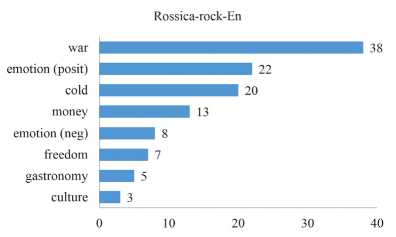
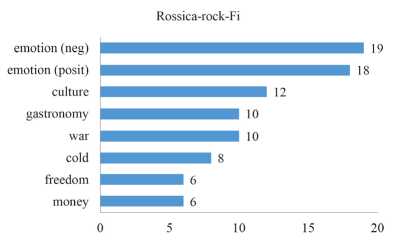
F i g. 1. Theme composition of the F i g. 2. Theme composition of the Finnish-language
English-language Russia-centred discourse Russia-centred discourse
Source: the figures were created by the author.
Conclusion
The research allows for several conclusions.
Firstly, it can be stated that belonging to the same cultural phenomenon – rock music, and addressing a common object – Russia, the textual material we are focusing on forms a rather specific variety of the Russia-centred discourse. It actively exploits several semiotic modes, so, the message is generated by a complex of interactions both within the text – between its semiotic components, as well as between the texts and their pretexts, largely belonging to the same discourse. The result is a multi-dimensional and very intricate image of Russia.
Thirdly, despite the political bias, accountable for the negative sentiment, the Russia-centred rock discourse also features an array of positive emotions, emphasizing positive changes, attractive features in Russian people, and shared values and shared human nature.
