
Shape memory polymer rods for improving crack resistance in reinforced concrete beams
Journal: Construction of Unique Buildings and Structures @unistroy
Article in issue: 1 (121), 2026.
Free access
The object of research is reinforced concrete beams with combined reinforcement. The improvement of their crack resistance is essential because crack propagation reduces the durability of structures, and conventional methods of crack closure are not always effective. Method. The study employs an experimental method involving four-point bending tests on specimens with additional heat-activated polycaprolactone rods. Results. The study found that after heat activation, the crack width in the modified beams was more than halved compared to control specimens, and the deflection value decreased by 16%. These results demonstrate the potential of using shape memory polymer elements to control the deformation state of reinforced concrete structures and improve their performance.
Similar articles in the section Building (construction) trade. Building materials. Building practice and procedure

Short address: https://sciup.org/143185708
IDS: 143185708 | UDC: 69 | DOI: 10.4123/CUBS.121.2
Полимерные стержни с эффектом памяти формы для повышения трещиностойкости железобетонных балок
Объектом исследования являются железобетонные балки с комбинированным армированием. Повышение их трещиностойкости имеет важное значение, поскольку распространение трещин снижает долговечность конструкций, а традиционные методы закрытия трещин не всегда эффективны. Методика. В исследовании используется экспериментальный метод, включающий четырехточечные испытания на изгиб образцов с дополнительными термоактивированными поликапролактоновыми стержнями. Результаты. Исследование показало, что после термоактивации ширина трещин в модифицированных балках уменьшилась более чем вдвое по сравнению с контрольными образцами, а значение прогиба снизилось на 16%. Эти результаты демонстрируют потенциал использования элементов из полимеров с эффектом памяти формы для контроля деформационного состояния железобетонных конструкций и повышения их характеристик.
Text of the scientific article Shape memory polymer rods for improving crack resistance in reinforced concrete beams
Reinforced concrete structures continue to be the backbone of the construction industry due to their combination of high strength, durability, accessibility of raw materials, and broad technological capabilities. Their widespread use spans across residential, industrial, and infrastructure construction – from residential buildings to bridges, tunnels, and dams. While reinforced concrete offers numerous advantages, it also has a notable drawback – low crack resistance due to its weak tensile strength.
Despite the use of various measures to improve crack resistance, such as reinforcement prestressing [4], fiber-reinforced concrete aimed at improving durability and crack control [2], as well as self-healing technologies, including chemical-based approaches [5] and bacteria-based systems enabling autonomous crack repair [1], reinforced concrete structures are still vulnerable to crack propagation during both construction and operation [6]. Causes include shrinkage deformations, temperature and humidity fluctuations, overloads, and damage from external mechanical or natural impacts. Cracks represent a localized reduction in the load-bearing capacity and a high-risk area for structural durability in general. They allow moisture, chlorides, carbon dioxide, and other aggressive agents to penetrate the concrete, leading to accelerated corrosion of the reinforcement [7] and deterioration of the protective layer depending on crack width, concrete quality, and cover depth [8]. In addition, corrosion processes may further induce internal stresses and cracking in concrete [9]. All this leads to crack propagation, which significantly reduces the durability of structures and increases maintenance and repair costs [3].
Therefore, finding effective solutions to improve the crack resistance and "healing" capacity of reinforced concrete elements has become a pressing task in construction science.
Among the most common approaches are the improvement of concrete mix compositions (using mineral and chemical additives), the use of fiber reinforcement, and the prestressing of reinforcement. A promising area is the introduction of self-healing concrete, for example, using bacterial additives. This method involves integrating bacterial spores, such as Bacillus subtilis, into the concrete matrix. These bacteria are capable of precipitating calcium carbonate on the crack surface, thereby ‘healing’ it. Despite its high efficiency, this technology has a significant limitation: it can only "heal" cracks up to 0.5 mm in size.
For large cracks, a promising area is the use of shape memory materials, primarily polymeric and metallic materials that can restore their original shape under the influence of external stimuli such as temperature [11], humidity [10], electric fields [12], solvents [13], pH [14], or magnetic fields [15].
Shape memory materials can return to their original geometry after being deformed, which can be used to create active recovery mechanisms in reinforced concrete structures. Shape memory alloys (e.g., NiTi) have been investigated for improving the crack resistance and deformability of concrete elements [19]. Additionally, they can be employed in seismically active regions for energy dissipation and the restoration of cracks [17]. Although research on NiTi alloys began in the early 1990s, optimization of their manufacturing processes and enhancement of their properties remain active areas of study [16]. Concurrently, shape memory polymers (SMPs) have been developed. SMPs demonstrate a wide spectrum of applications, ranging from aerospace engineering [22] to civil engineering, where they can be used for structural reinforcement [20] or as advanced “smart” sealants [21]. These materials can be incorporated into concrete to implement various crack resistance strategies, such as closing cracks or creating post-stressed elements that compensate for tensile stresses.
Studies have shown that the incorporation of shape memory fibers into a concrete matrix can slow crack propagation [23] and even completely close them after heating to an activation temperature [24]. Such materials can be used as reinforcements [25], shells [26], or fibers activated by changes in ambient temperature or targeted heating [27].
This study selected polycaprolactone (PCL) as a shape memory polymer offering a number of technological advantages. Unlike other SMPs, which require complex manufacturing conditions, PCL has several advantages, including its availability, low activation temperature (~70 °C), and ability to be easily formed into various shapes using 3D printing. These features make PCL particularly attractive for experimental applications when studying the applicability of SMP materials to improve the crack resistance of reinforced concrete structures.
Studies in the use of shape memory materials in reinforced concrete structures are primarily carried out at the level of laboratory specimens and are experimental in nature [28]. However, issues related to calculation approaches [29], scaling of results, the interaction of SMP with the concrete matrix [30], and activation conditions in real structures, are still insufficiently studied. The potential for using SMP materials in reinforced concrete structures should be analyzed using analytical calculation models, as well as numerical analysis and experimental observations.
This paper studies the mechanical properties of shape memory PCL rods under tension and heating and presents the results of testing reinforced concrete beams with the inclusion of PCL rods. The material PCL was chosen due to its ability to be shaped using 3D printing [31], which helped to overcome technological difficulties associated with the lack of conventional methods for shape memory polymers manufacture in the Russian Federation. The research object is PCL, a 3D-printable shape memory polymer, and the research subject is its mechanical behavior under activation (heating) for potential integration into reinforced concrete structures. Using 3D printing enabled the rapid fabrication of rods with the desired shape and diameter. [32], as well as the experimental testing of various reinforcement options and the evaluation of the effectiveness of shape memory polymer reinforcement in reinforced concrete structures [33].
The aim of this study is to assess the feasibility of improving the crack resistance of reinforced concrete beams through the inclusion of PCL shape memory rods. To achieve this aim, the following objectives were defined: (1) to investigate the mechanical properties of PCL rods with different diameters, and (2) to examine the influence of PCL rods on crack width and deflection in reinforced concrete beams. The results of this research are expected to provide insights into the potential of shape memory polymer rods as an innovative reinforcement solution for concrete structures.
-
2 Materials and Methods
Modified PCL reinforcement samples were 3D printed longitudinally, with diameters of 1, 4, 6, 8, and 10mm, three samples for each diameter. The rod lengths were approximately 150mm. Figure 1 shows the 3D printing process and the appearance of a resulting specimen.
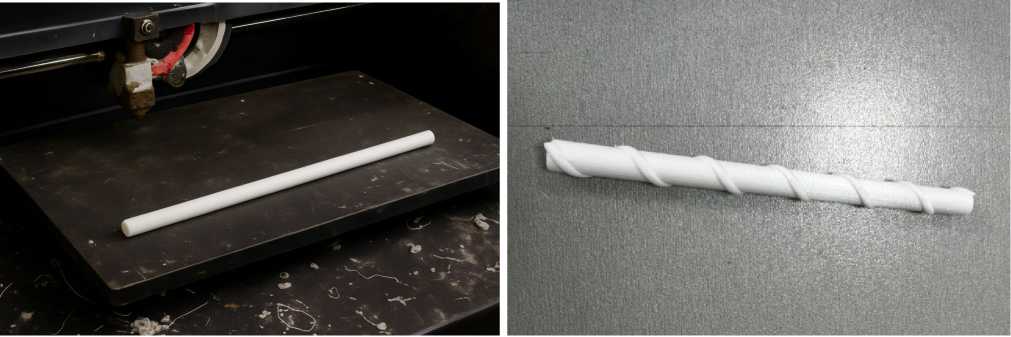
Fig. 1 - 3D printing process and the appearance of a resulting specimen
Shape memory reinforcing rods were tested on a specialized facility with two vertically oriented crossheads, one fixed and the other movable. The reinforcement specimens were clamped between the crossheads and subjected to a stretch of approximately 15%. After reaching the specified deformation, the load was released and the stretched specimen was fixed. The shape memory rod was then uniformly heated to a temperature corresponding to the onset of shape recovery (~70°C).
Since both crossheads remained fixed, the shape recovery of the specimen increased the force in the system. The increasing force recorded during heating was interpreted as the "Shape recovery load."
Tensile testing of polymer reinforcement was conducted on a Tinius Olsen H100KU test facility (Horsham PA, USA). Shape recovery was initiated by heating with infrared heaters, while the surface temperature of the rods was monitored using pyrometers.
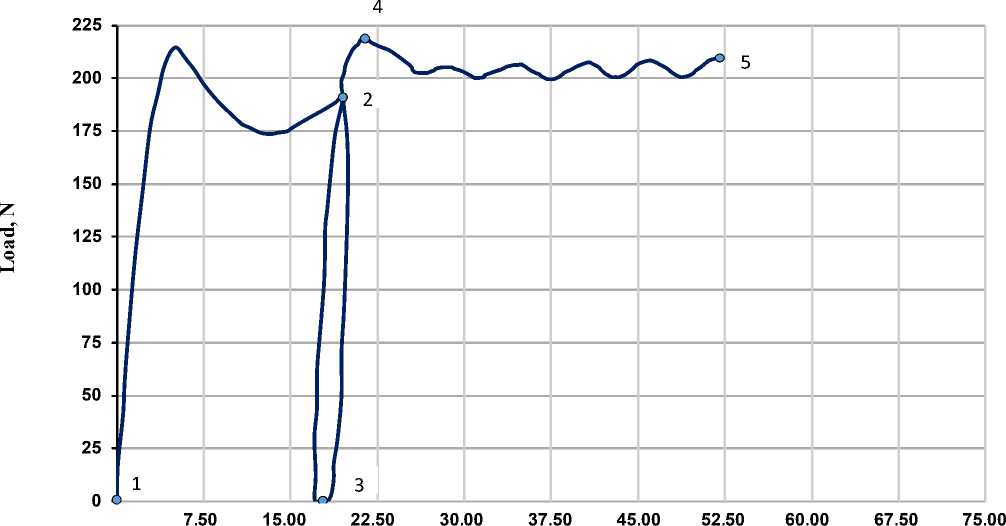
Figures 2 and 3 illustrate the test schedule and test process, respectively.
Position, mm
Fig. 2 - Shape memory rod test schedule
(Sections "1–2" – specimen extension; "2–3" – load removal; "3–4" – heating; "4–5" – extension to failure)
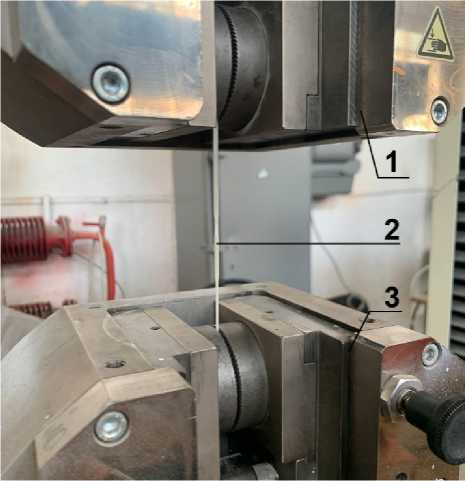
Fig. 3 - Tensile testing of PCL rod
(1 – movable crosshead; 2 – PCL rod; 3 – fixed crosshead)
In the design experiment, rods with an average diameter of ~3mm were selected based on preliminary calculations using numerical analysis. A simplified calculation was performed to compare the load during shape recovery and the force required to close a crack for the selected materials.
To evaluate the basic interaction under the influence of "self-healing" on bending properties, nine beam specimens with nominal dimensions of 1400×80×160mm were manufactured from a concrete mix with a compressive strength rating of B25. All the four specimens were reinforced with A500C steel rods with a diameter of 6mm, and two specimens were additionally reinforced with PCL polymer rods with a diameter of 3mm. Figure 4 illustrates the reinforcement diagram.
Steel reinforcement 06mm
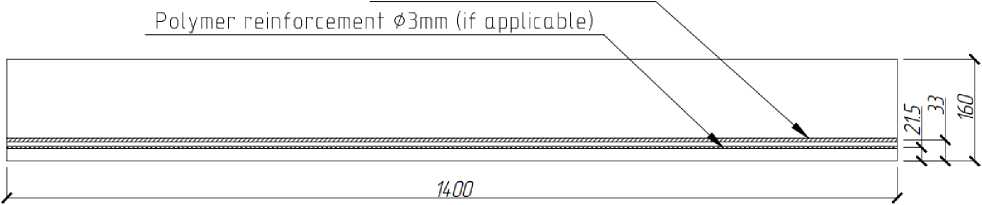
Steel reinforcement 06mm

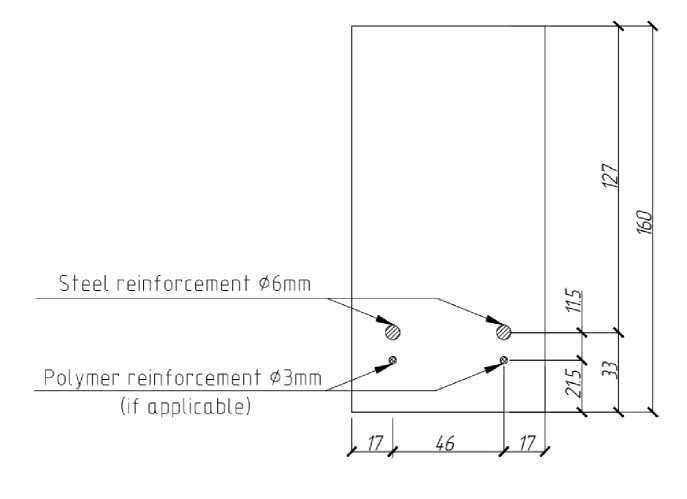
Fig. 4 - Specimen reinforcement diagram
The compressive strength of the concrete at the grade age was determined using cube specimens to be 32.3MPa. Beam bending tests were performed with loads applied according to a four-point bending diagram (Figure 5).
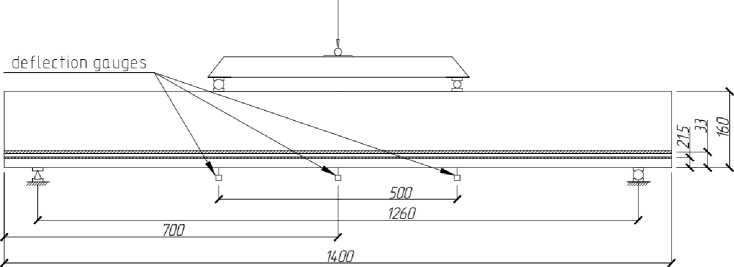
Fig. 5 - Four-point bending test diagram
The test was conducted on a material testing facility (Figure 6). The span length was 1260mm. The failure load (without the influence of SMP rods) was 2.9MPa. During the test, load and deflection values were recorded at the midpoint of the span and opposite the load application points.
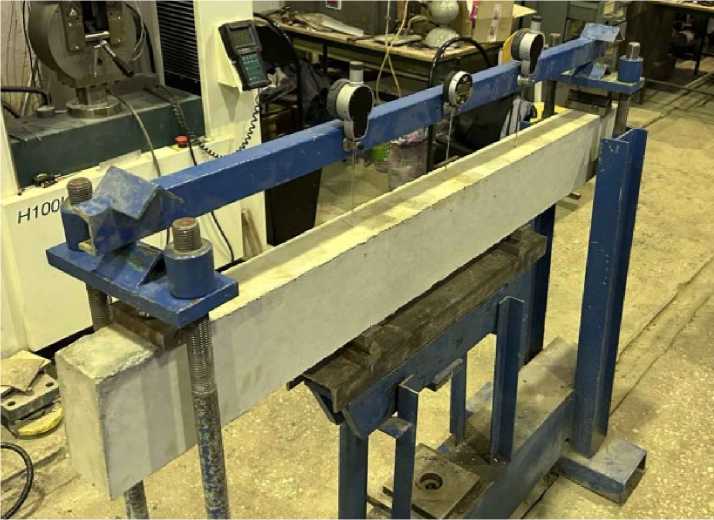
Fig. 6 - Testing
Considering regulatory documents for testing reinforced concrete structures, the testing plan consisted of four stages:
-
1) Loading the specimen incrementally by 10% of the failure load, with a 30-minute hold at each stage until a crack width of 0.20 mm was achieved, followed by another 30-minute hold;
-
2) Removing the load and holding for at least 60 minutes;
-
3) Heating the specimen to 60±2ºC, recording changes in crack width, deflection, and load (Figure 7).
-
4) Cooling the specimen to 20±2ºC, recording changes in crack width, deflection, and load.
The crack width was measured using a hand-held optical microscope with a 0.01mm division value.
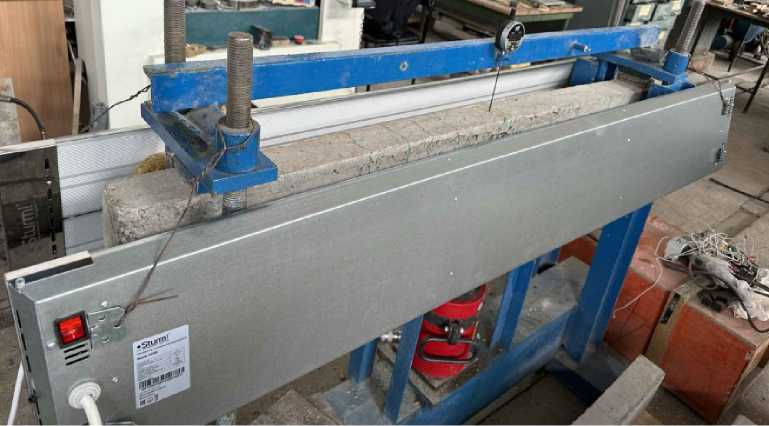
Fig. 7 - Heating with infrared heaters
The test results for PCL reinforcement rods are listed in Table 1.
The DeepSeek neural network was used to translate some parts of the text from Russian into English, with the resulting translation being carefully checked.
3 Results and Discussion
The test results for PCL reinforcement rods are listed in Table 1.
Table 1. Test results for PCL reinforcement rods*
|
Average diameter d, mm |
Average nominal crosssectional area A, mm2 |
Average ultimate stress at shape recovery, MPa |
Average ultimate tensile strength σ, MPa |
|
1 |
0.79 |
2.97 |
18.60 |
|
4 |
11.54 |
3.46 |
19.98 |
|
6 |
27.64 |
3.32 |
19.18 |
* each series consisted of three reinforcement rod specimens of the same diameter Test results for beam specimens are presented in Table 2.
Table 2. Test results for beam specimens
|
Pressure (pressure gauge readings), MPa |
Load, kgf |
Test results for beam specimens * |
|||||
|
with additional polymer reinforcement |
without additional reinforcement |
||||||
|
Deflection (average), mm |
Maximum number of cracks per specimen, pcs. |
Maximum crack width, mm |
Deflection (average), mm |
Maximum number of cracks per specimen, pcs. |
Maximum crack width, mm |
||
|
0.3 |
0 |
0 |
0 |
no |
0 |
0 |
no |
|
0.8 |
375 |
0.113 |
0 |
no |
0.218 |
0 |
no |
|
1.3 |
750 |
0.333 |
3 |
less than 0.05 |
0.576 |
2 |
less than 0.05 |
|
1.8 |
1.125 |
1.392 |
4 |
0.12 |
1.498 |
6 |
0.11 |
|
2.3 |
1.500 |
2.504 |
7 |
0.23 |
2.474 |
7 |
0.24 |
|
Load removal |
|||||||
|
0 1 |
0 1 |
0.726 |
3 1 |
0.12 |
0.714 |
3 1 |
0.13 |
|
Heating |
|||||||
|
0 |
0 |
0.610 |
3 |
0.05 |
0.718 |
3 |
0.14 |
|
Cooling |
|||||||
|
0 |
0 |
0.658 |
3 |
0.05 |
0.735 |
3 |
0.13 |
-
* each series consisted of three beam specimens
Under initial loading, the specimens with and without additional reinforcement showed similar behavior, while under maximum loading, the number and width of cracks varied within the statistical error. After removing the load, the deflection in both types of specimens decreased equally, and residual deformations also remained similar in values. The residual crack width, regardless of additional reinforcement, was slightly over 0.1mm.
After heating, the deflection in the additionally reinforced specimens decreased by 16%, and the crack width decreased to 0.05mm, while heating did not change these characteristics in the unreinforced specimens.
After cooling, these values remained unchanged, indicating stabilization of deformations.
According to regulatory requirements, the crack width in reinforced concrete structures should remain within acceptable limits in order to ensure their durability and operational reliability. Thus, regulatory documentation, in particular EN 1992-1-1 and the Russian National Code of Practice (SP 63.13330.2012 "Concrete and reinforced concrete structures. General provisions") [34], recommend controlling the crack width at the level of 0.1–0.4mm for normal-grade reinforced concrete elements, depending on the type of reinforcement, service environment, and structure type.
A decrease in the crack width to 0.05mm using additional reinforcement with shape memory polymer rods demonstrates that this approach is viable and effective for maintaining acceptable levels of cracks and increasing the durability and strength of reinforced concrete elements.
4 Conclusions
-
1. Thus, during testing of reinforced concrete beam specimens with additional PCL rod reinforcement, we observed a decrease in the crack width and deflection after the activation of shape memory polymers through heating. Specifically, the activation of the shape memory polymers resulted in a 16% decrease in deflection and a reduction in crack width to 0.05 mm. In contrast, thermal treatment
-
2. However, the results show that the crack width and deflection did not return to their initial values, with residual values of 0.05 mm and 0.610 mm respectively, which may indicate insufficient poststressing in the tension zone.
-
3. The obtained results suggest that even a small amount of polymer rod reinforcement can improve the crack resistance and overall performance of reinforced concrete structures.
of the unreinforced control specimens produced no measurable changes in these structural characteristics.
Further research in this area should focus on developing computational and analytical methods for determining the optimal amount of additional shape memory reinforcement in a reinforced concrete element, as well as exploring possible process engineering solutions for anchoring and more efficient integration of PCL rods. Another promising avenue for further development of this research is the combination of mechanical and chemical-biological methods for ensuring the durability of structures. By creating stress in the polymer reinforcement, crack width can be reduced to a level sufficient for normal structural operation, while bacterial additives will ensure final crack healing and protect the steel reinforcement from corrosion.
-
5 Conflict of Interests
The authors declare no conflict of interest.
