
Сlassification of chemical elements according to the electronic structure of their atoms
Journal: Nanotechnologies in Construction: A Scientific Internet-Journal @nanobuild-en
Section: The results of the specialists’ and scientists’ researches
Article in issue: 4 Vol.18, 2026.
Free access
It is widely acknowledged that the development of chemistry, both historically and in the present day, is fundamentally rooted in D.I. Mendeleev's discovery and the Periodic Table of Chemical Elements, which has been in use for over 150 years. This study proposes a novel conceptualization of chemical elements structured as a three-dimensional matrix. This approach enables the prediction of new elements, including the determination of their nuclear masses and electron shell configurations. New regularities concerning the cyclic and block structures of horizontal periods have been formulated, while the structure of vertical groups and their physical interpretation have been refined. The findings indicate that the Periodic Law fundamentally relies on the system of two equations. According to these equations, block energy increases cyclically, approaching near-zero values from negative ones in the “8s” block. The authors propose that the existence of chemical elements in nature culminates with the “8s” block. Thus, the total number of chemical elements that can exist in nature is evidently 120.
Short address: https://sciup.org/142248517
IDS: 142248517 | DOI: 10.15828/2075-8545-2026-18-4-537-544
Text of the scientific article Сlassification of chemical elements according to the electronic structure of their atoms
Original article
Структурирование химических элементов по электронному строению атомов
Борис Владимирович Гусев* ©, Александр Сергеевич Тертерян
Российская инженерная академия, 125009, Москва, Газетный пер., 9, стр. 4, Российская Федерация
-
* Автор, ответственный за переписку: e-mail: info-rae@mail.ru
AННОТАЦИЯ
Как известно, химия развивалаcь и развивается, прежде всего, благодаря открытию Д.И. Менделеева и существующей уже более 150 лет Периодической таблице химических элементов. Рассматривается новое видение структурирования химических элементов в виде объемной матрицы. Это позволяет прогнозировать новые элементы с обозначением ядерных масс и электронным строением оболочек. Сформулированы новые закономерности по цикличности и блочности строения горизонтальных рядов, уточнено строение вертикальных групп и их физическое осмысливание. Из представленного материала следует, что в Периодическом законе важным является система двух уравнений. Согласно этим уравнениям, энергия блоков возрастает, циклически приближаясь от отрицательных значений к значениям, близким к нулю в блоке под названием «8s».
Nanotechnologies in construction 2026; 18 (4):
Нанотехнологии в строительстве 537–544
THE RESULTS OF THE SPECIALISTS’ AND SCIENTISTS’ RESEARCHES
Nanob

Гусев Б.В., Тертерян А.С. Структурирование химических элементов по электронному строению атомов. Нанотехнологии в строительстве. 2026;18(4):537–544. – EDN: PMJDVU.
The theory of the electronic structure of atoms was developed by N. Bohr and W. Pauli [1, 2].
Tables 1 and 2 present energy sequences of atomic orbitals, where:
-
n is the principal quantum number, which reflects the distance of the electron from the nucleus;
l is the orbital quantum number, which determines the orbital angular momentum of the electron’s momentum and the energy state of the electrons in the atom;
-
s , p, d, f are the atomic orbitals for the following states:
l = 0 – one orbital;
l = 1 – three orbitals;
l = 2 – five orbitals;
l = 3 – seven orbitals.
According to the authors, the energy of the levels for the most fundamental element in nature, the hydrogen atom, and for other atoms as well, is determined by the formula [1, 2]:
E = –13.6 eV / n ²,
where n is the period number and the corresponding number of the level boundary ( n = 1, 2, 3, 4, 5, 6, 7, 8). Thus:
E0 = –13.6–13.6 = –27.2 eV
E1 = –13.6/12 = –13.6/1 = –13.6 eV
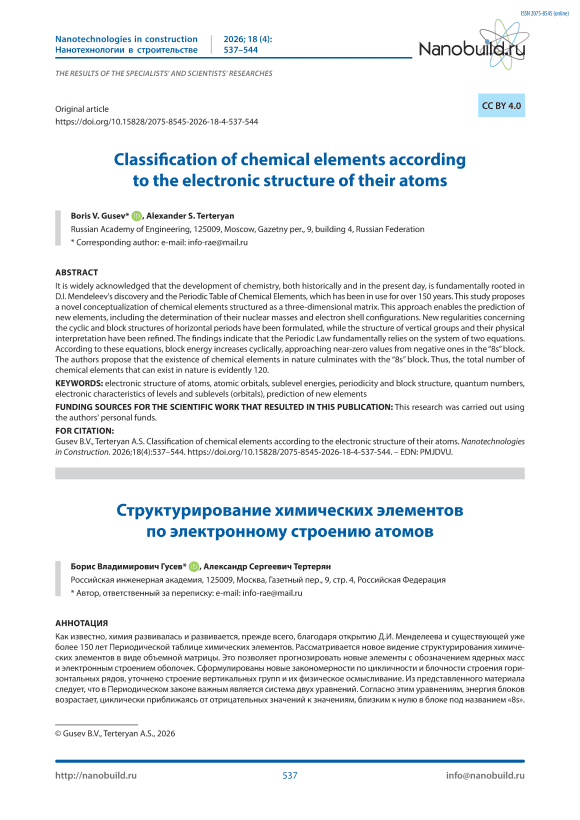
E2 = –13.6/22 = –13.6/4 = –3.4 eV
E3 = –13.6/32 = –13.6/9 = –1.51 eV
E4 = –13.6/42 = –13.6/16 = –0.85 eV
E5 = –13.6/52 = –13.6/25 = –0.54 eV
E6 = –13.6/62 = –13.6/36 = –0.38 eV
E7 = –13.6/72 = –13.6/49 = –0.28 eV
E8 = –13.6/82 = –13.6/64 = –0.21 eV
Energy sequence of orbitals in isolated atoms [2]:
The energies of the level boundaries are represented by thick lines in Figures 1, 2, and 3.
Each level can be divided into sublevels with energies determined by the formula [4]:
p = (2 l –1) / L ², (2)
where l is the sublevel number ( l = 1 (s), l = 2 (p), l = 3 (d), l = 4 (f)), and L is the total number of sublevels.
The number of orbitals in the sublevels of the 1st, 2nd, 3rd, and 4th levels are in the ratio of 1; 1:3; 1:3:5; and 1:3:5:7, respectively. For the sublevels of the 5th, 6th, 7th, and 8th levels, the ratio is reversed: 7:5:3:1; 5:3:1; 3:1; and 1.
The proportions of sublevels at each level are as follows:
for the 1st level – 1;
for the 2nd level – 0.25, 0.75;
for the 3rd level – 0.111, 0.333, 0.555;
for the 4th level – 0.0625, 0.1875, 0.3125, 0.4375;
for the 5th level – 0.0625, 0.1875, 0.3125, 0.4375;
for the 6th level – 0.111, 0.333, 0.555;
for the 7th level – 0.25, 0.75;
for the 8th level – 1.
Thus, the total number of blocks (1s, 2s, 2p, 3s, 3p, 3d, 4s, …, 8s) is 20.
Nanotechnologies in construction 2026; 18 (4):
Нанотехнологии в строительстве 537–544
THE RESULTS OF THE SPECIALISTS’ AND SCIENTISTS’ RESEARCHES
Nanob
Table 1
|
Period Number |
Quantum Numbers |
Orbital Quantum Number |
Atom orbitals |
|
|
(n+1) |
n |
1 |
||
|
1 |
1 |
0 |
1s} I period |
|
|
2 |
2 |
0 |
2s ' |
- II period |
|
3 |
2 |
1 |
2p 3s ~ |
|
|
и |
~ Ill period |
|||
|
4 |
3 |
1 |
3p- 4s |
|
|
и |
IV period |
|||
|
5 |
3 4 r |
2 1 |
3d 4p 5s " |
|
|
Э |
и |
_ V period |
||
|
6 |
4 5 6 |
2 1 0 |
4d 5P' 6s" |
|
|
7 |
4 5 6 “7 |
3 2 1 |
4f 5d 6p 7s П |
VI period |
|
и |
VII period |
|||
|
5 |
3 |
5f |
||
|
О |
6 |
2 |
6d |
|
|
о |
7 8 |
1 0 |
7p 8s |
[ VIII period |
Table 2
|
Principle quantum number n |
Orbital quantum number l |
Atom orbitals |
|
1 |
0 |
1 s |
|
2 |
0, 1 |
2 s , 2 p |
|
3 |
0, 1, 2 |
3 s , 3 p , 3 d |
|
4 |
0, 1, 2, 3 |
4 s , 4 p , 4 d , 4 f |
Nanotechnologies in construction
Нанотехнологии в строительстве
2026; 18 (4): 537–544
Nanob

THE RESULTS OF THE SPECIALISTS’ AND SCIENTISTS’ RESEARCHES
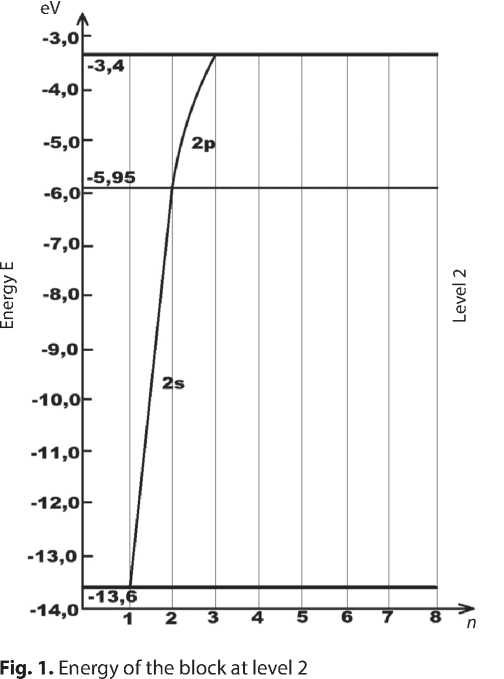
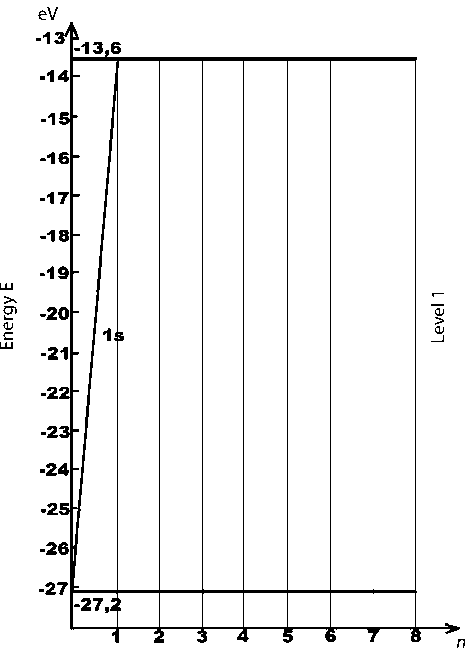
Fig. 2. Energy of the block at level 1
Nanotechnologies in construction 2026; 18 (4):
Нанотехнологии в строительстве 537–544
THE RESULTS OF THE SPECIALISTS’ AND SCIENTISTS’ RESEARCHES
Nanob
The energies of the sublevels according to formula (2) will be as follows:
-
• for the 1st level, all the energy is at 1s sublevel: e1s= –13.6 eV ;
-
• for the 2nd level, the distribution of energy between 2s and 2p sublevels will be as follows:
e2p = [–13.6–(–3.4)]×0.25 = (–13.6+3.4)×0.25 = –10.2×0.25 = –2.55 eV e2p = –2.55 eV, e2sp = [–13.6–(–3.4)]×0.75 = (–13.6+3.4)×0.75= –10.2×0.75 = –7.65 eV e2sp = –7.65 eV;
-
• for the 3rd level, the distribution of energy between 3s, 3p, and 3d sublevels will be as follows:
e3d= [–3.4–(–1.51)]×0.111 = –1.89×0.111 = –0.21 eV e3d= –0.21 eV e3p= [–3.4–(–1.51)]×0.333 = –1.89×0.333 = –0.63 eV e3p= –0.63 eV e3sp= [–3.4–(–1.51)]×0.555 = –1.89×0.555 = –1.049 eV e3sp= –1.049 eV;
-
• for the 4th level, the distribution of energy between 4f, 4d, 4p, and 4s sublevels will be as follows: e4f= [–1.51–(–0.85)]×0.0625 = –0.66×0.0625 = –0.04 eV e4f= –0.04 eV,
e4d= [–1.51–(–0.85)]×0.1875 = –0.66×0.1875 = –0.124 eV e4d= –0.124 eV,
e4p= [–1.51–(–0.85)]×0.3125 = –0.66×0.3125 = –0.206 eV e4p= –0.206 eV,
e4ps = [–1.51–(–0.85)]×0.4375 = –0.66×0.4375 = –0.29 eV e4sp= –0.29 eV;
-
• for the 5th level, the distribution of energy between 5f, 5d, 5p, and 5s sublevels will be as follows: e5f= [–0.85–(–0.54)]×0.0625 = –0.31×0.0625 = –0.02 eV e5f= –0.02 eV,
e5d= [–0.85–(–0.54)]×0.1875 = –0.31×0.1875 = –0.06 eV e5d= –0.06 eV,
e5p= [–0.85–(–0.54)×0.3125 = –0.31×0.3125 = –0.097 eV e5p= –0.097 eV,
e5sp = [–0.85–(–0.54)×0.4375 = –0.31×0.4375 = –0.1356 eV e5sp= –0.1356 eV;
-
• for the 6th level, the distribution of energy between 6d, 6p, and 6s sublevels will be as follows:
e6d= [–0.54–(–0.38)]×0.1111 = –0.16×0.1111 = –0.018 eV e6d= –0.018 eV, e6p= [–0.54–(–0.38)]×0.3333 = –0.16×0.3333 = –0.051 eV e6p= –0.051 eV, e6sp= [–0.54–(–0.38)]×0.5555 = –0.16×0.5555 = –0.089 eV e6sp= –0.089 eV;
-
• for the 7th level, the distribution of energy between the 7p and 7s sublevels will be as follows:
e7p= [–0.38–(–0.28)]×0.25 = –0.1×0.25 = –0.025 eV e7p= –0.025 eV, e7sp= [–0.38–(–0.28)]×0.75 = –0.1×0.75 = –0.075 eV e7sp= –0.075 eV,
-
• for the 8th level, all the energy will be at the 8s sublevel:
e8s= [–0.28–(–0.21)]×1 = –0.07×1 = –0.07 eV e8s= –0.07 eV.
The sublevel boundaries (in Figures 1, 2, and 3) are represented in thin lines and are as follows:
E2p= –13.6–(–7.65) = –5.95
E3sp= –3.4–(–1.049) = –2.35
E3p= –2.35–(–0.63) = –1.72
E4sp= –1.51–(–0.29) = –1.22
E4p= –1.22–(–0.206) = –1.014
E4pd= –1.014–(–0.124) = –0.89
E5s= –0.85–(–0.1356) = –0.7144
E5p= –0.7144–(–0.097) = –0.6174
E5pd= –0.6174–(–0.06) = –0.5574
E6s= –0.54–(–0.089) = –0.45
E6p= –0.45–(–0.053) = –0.398
E7sp= –0.38–(–0.075) = –0.305.
As can be seen from the calculations presented above, the sequence of energy values of the formed blocks: 1s, 2s, 2p, 3s, 3p, 3d, 4s, 4p, 4d, 4f, 5s, 5p, 5d, 5f, 6s, 6p, 6d, 7s, 7p, 8s coincides with the experimentally determined sequence (Table 3).
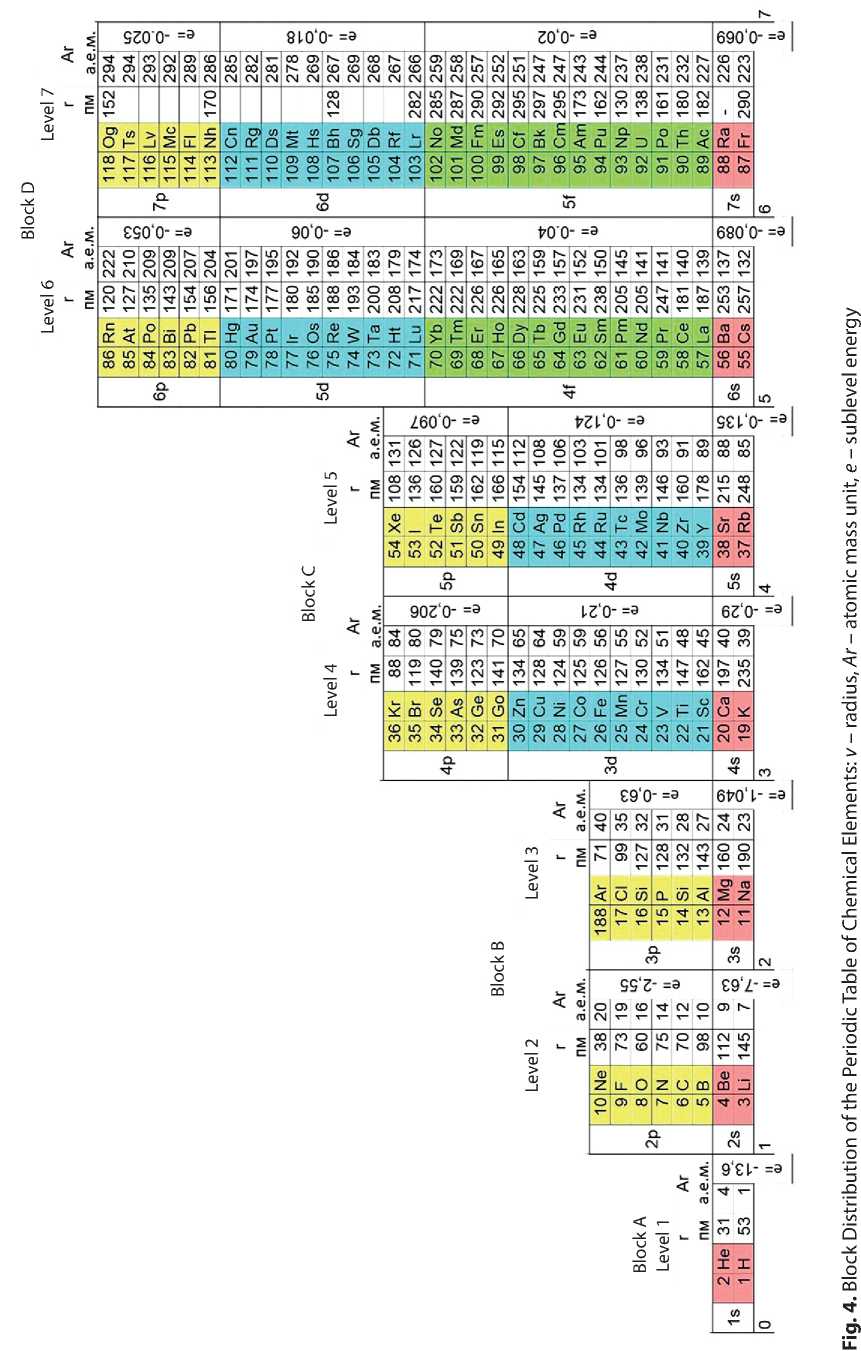
Figure 4 presents a block-type distribution table of chemical elements [3].
Table [3, 4] offers a number of advantages:
-
• It is visually well-structured;
-
• Each level begins with an alkali metal and ends with a noble gas;
-
• Elements are arranged sequentially according to their atomic numbers;
-
• Element blocks (1s, 2s, 2p, 3s, 3p, …, 7p, 8s) follow one another in sequence [1].
Nanotechnologies in construction 2026; 18 (4):
Нанотехнологии в строительстве 537–544
THE RESULTS OF THE SPECIALISTS’ AND SCIENTISTS’ RESEARCHES
Nanob
Table 3. Block numbers (N), blocks, block energy, atomic mass of the block, and number of elements in the block
|
N |
1 |
2 |
3 |
4 |
5 |
6 |
7 |
8 |
9 |
10 |
|
nl |
1s |
2s |
2p |
3s |
3p |
4s |
3d |
4p |
5s |
4d |
|
eV |
–13.6 |
–7.65 |
–2.55 |
–1.05 |
–0.63 |
–0.29 |
–0.21 |
–0.21 |
–0.14 |
–0.12 |
|
Ar. atomic mass unit |
2.5 |
8.0 |
15.33 |
23.6 |
32.2 |
39.6 |
55.3 |
76.1 |
86.55 |
99.8 |
|
Z (elements number) |
1;2 |
3;4 |
5–10 |
11;12 |
13–18 |
19;20 |
21–30 |
31–36 |
37;38 |
39–48 |
|
N |
11 |
12 |
13 |
14 |
15 |
16 |
17 |
18 |
19 |
20 |
|
nl |
5p |
5s |
4f |
5d |
6p |
7s |
5f |
6d |
7p |
8s |
|
eV |
–0.1 |
–0.09 |
–0.04 |
–0.06 |
–0.05 |
–0.08 |
–0.02 |
–0.018 |
–0.025 |
–0.07 |
|
Ar. atomic mass unit |
123.5 |
135.1 |
153.8 |
188 |
210 |
224.5 |
246 |
273 |
292 |
– |
|
Z (elements number) |
49–54 |
55;56 |
57–70 |
71–80 |
81–86 |
87;88 |
89–102 |
103–112 |
113–118 |
119;120 |
Thus, the Periodic Law of Chemical Elements Distribution can be formulated as follows:
“ The periodic and cyclic variation in the properties of chemical elements is dependent on the distribution of sublevel energies l (l = s, p, d, f) across the energy levels n (n = 1, 2, 3, …, 8). ”
The energies of the level boundaries ( En ) are determined by the formula:
En = –13.6/ n ².
The distribution of sublevel energies (pl) across all levels n is determined by the formula:
pnl = (2l – 1) / L², where: l = 1 (s), l = 2 (p), l = 3 (d), l = 4 (f); and Ln is the total number of sublevels at level n.
It follows from the presented material that a system of two equations is central to the Periodic Law. According to these equations, the block energy increases, cyclically transitioning from negative values to values approaching zero in the 8s block. It is our view that the existence of chemical elements in nature concludes with block 8s.
Therefore, the total number of elements existing in nature is evidently 120.
Nanotechnologies in construction 2026; 18 (4):
Нанотехнологии в строительстве 537–544
Nanob
THE RESULTS OF THE SPECIALISTS’ AND SCIENTISTS’ RESEARCHES
Nanotechnologies in construction Нанотехнологии в строительстве
2026; 18 (4): 537–544
THE RESULTS OF THE SPECIALISTS’ AND SCIENTISTS’ RESEARCHES
