
Слово в тексте лирического стихотворения. A word in the text of a lyrical poem
Опубликовал: Мой Псевдоним
Журнал: Сибирский филологический журнал. — 2025. — № 1. — С. 137–150. Sibirskii Filologicheskii Zhurnal [Siberian Journal of Philology], 2025, no. 1, pp. 137–150. (in Russ.). 2025г. №1
Бесплатный доступ
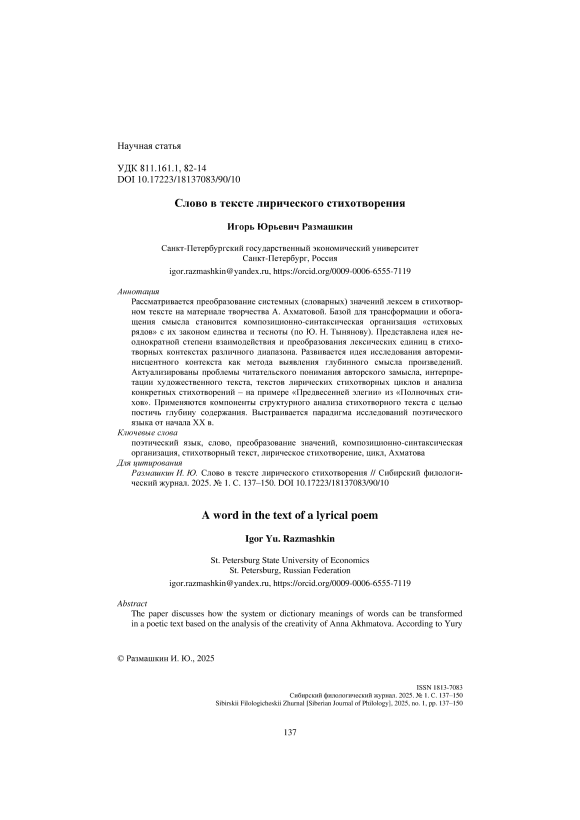
Рассматривается преобразование системных (словарных) значений лексем в стихотворном тексте на материале творчества А. Ахматовой. Базой для трансформации и обогащения смысла становится композиционно-синтаксическая организация «стиховых рядов» с их законом единства и тесноты (по Ю. Н. Тынянову). Представлена идея неоднократной степени взаимодействия и преобразования лексических единиц в стихотворных контекстах различного диапазона. Развивается идея исследования автореминисцентного контекста как метода выявления глубинного смысла произведений. Актуализированы проблемы читательского понимания авторского замысла, интерпретации художественного текста, текстов лирических стихотворных циклов и анализа конкретных стихотворений – на примере «Предвесенней элегии» из «Полночных стихов». Применяются компоненты структурного анализа стихотворного текста с целью постичь глубину содержания. Выстраивается парадигма исследований поэтического языка от начала ХХ в. Ключевые слова: поэтический язык, слово, преобразование значений, композиционно-синтаксическая организация, стихотворный текст, лирическое стихотворение, цикл, Ахматова. Для цитирования: Размашкин И. Ю. Слово в тексте лирического стихотворения // Сибирский филологи-ческий журнал. 2025. № 1. С. 137–150. DOI 10.17223/18137083/90/10. A word in the text of a lyrical poem. Abstract: The paper discusses how the system or dictionary meanings of words can be transformed in a poetic text based on the analysis of the creativity of Anna Akhmatova. According to Yury Tynyanov, the transformation and enrichment of meaning rely on the composition and syntax of “verse rows” and their principle of unity and coherence. This study introduces the concept of repeated degrees of interaction and transformation of lexical units in various poetic contexts. The author puts forward the idea of studying the context of autoreminiscences as a tool to understand the profound meaning of works. Additionally, the challenges of understanding the author’s ideas and interpreting literary texts are actualized by examining the “Pre-Spring Elegy” from “Midnight Poems.” It is suggested that the reader can engage in creative conjectures (their cocreation) when interpreting the text, but the interpretation must always align with the author’s original intent. A meticulous examination of linguistic methods employed to convey the “author’s persona” and inclusive consideration of broad contexts geared towards the discerning reader can allow one to extract the utmost conceptual information and comprehensively interpret the text of a lyrical poem. The study aims to comprehend the profound depths of meaning within a poetic text by employing the structural analysis methodology. Finally, the author develops the paradigm of poetic language research from the beginning of the twentieth century. Keywords: poetic language, word, transformation of meanings, compositional-syntactic organization, verses text, lyrical poem, cycle, Akhmatova. For citation: Razmashkin I. Yu. A word in the text of a lyrical poem. Sibirskii Filologicheskii Zhurnal [Siberian Journal of Philology], 2025, no. 1, pp. 137–150. (in Russ.) DOI 10.17223/1813 7083/ 90/10
Похожие статьи в разделе Русский язык
Короткий адрес: https://sciup.org/11012375
IDS: 11012375 | УДК: 811.161.1, 82-14 | DOI: 10.17223/18137083/90/10
