
Specifics of the Humanitarian Aspect of Türkiye’s Foreign Policy in Latin America and the Caribbean
Section: Большие амбиции региональных лидеров
Article in issue: 2 т.31, 2026.
Free access
Introduction. This article is devoted to identifying the specifi c features of Türkiye’s humanitarian policy in Latin America and the Caribbean. Despite the fact that Türkiye’s humanitarian policy in LAC is insignifi cant, it has been growing in recent years. The growing presence of Türkiye in Latin America and the Caribbean fi ts into the model of the country’s multi-vector foreign policy. Methods. The authors determine the dynamics of offi cial development assistance of Türkiye in Latin America and the Caribbean and Mexico in the period 2015–2021 and construct a matrix of the activities of the main institutions of the humanitarian infl uence of Türkiye in Latin America and the Caribbean (Argentina, Mexico, Colombia, and Venezuela). Analysis. The authors conclude that the specifi city of Türkiye’s humanitarian policy in Latin America and the Caribbean is the combination of cultural and humanitarian instruments (work with Muslim minorities and the promotion of Turkish culture and language) with socio-economic (primarily socially oriented and infrastructure) projects. The Turkish Cooperation and Coordination Agency (TIKA) is the key executor of humanitarian projects in Latin American countries, while other institutions of the humanitarian policy operate in the background of its activities. The main target audience in LAC is the most vulnerable categories of the population (children, women, elderly people, and people with disabilities); victims of natural disasters; and categories of people associated with Ottoman and Turkish culture, as well as Muslim minorities of various ethnic origins. Türkiye’s humanitarian policy in Latin America and the Caribbean is based on aid and support to communities that have, fi rst of all, cultural and religious affi nity, as well as a need for assistance. Authors’ contribution. Yu.A. Belous developed the theoretical and methodological basis and methodological design of the study; identifi ed the basic characteristics of the phenomenon of Turkish humanitarian policy and development assistance policy; analyzed the Turkish understanding of humanitarian policy; summarized the results of the work; and formulated conclusions. E.Yu. Kosevich participated in the refi nement of the general methodology and design of the study and revealed the key specifi cs of relations between Latin American countries and Türkiye in the context of development assistance. N.S. Kuliyeva collected and analyzed empirical and statistical data on Türkiye’s offi cial development assistance to the countries of Latin America and the Caribbean; worked with Turkish-language sources; compiled the matrix of the activities of Turkish humanitarian institutions in the region; and contributed to the interpretation of the results. The authors jointly prepared the content and results of the study.
Short address: https://sciup.org/149151486
IDS: 149151486 | UDC: 323:327 | DOI: 10.15688/jvolsu4.2026.2.8
Специфика гуманитарного аспекта внешней политики Турции в странах Латинской Америки и Карибского бассейна
Введение. Статья посвящена выявлению особенностей гуманитарной политики Турции, реализуемой Анкарой на современном этапе в странах Латинской Америки и Карибского бассейна. Авторы отмечают, что несмотря на то что гуманитарное присутствие Турции в странах Латинской Америки и Карибского бассейна незначительно, в последние годы оно все же растет, что вписывается в модель многовекторной внешней политики страны. Методы. Авторы определяют динамику официальной помощи развитию Турции в странах Латинской Америки и Карибского бассейна и Мексики в период 2015–2021 гг. и составляют матрицу деятельности основных институтов гуманитарного влияния Турции в странах Латинской Америки и Карибского бассейна (на примерах Аргентины, Мексики, Колумбии, Венесуэлы). Анализ. Авторы приходят к выводу о том, что специфика гуманитарной политики Турции в странах Латинской Америки и Карибского бассейна заключается в комбинации культурно-гуманитарных инструментов (работа с мусульманским меньшинством, продвижение турецкой культуры и языка) с социально-экономическими (прежде всего социально-ориентированные и инфраструктурные проекты). Ключевым исполнителем гуманитарных проектов в латиноамериканских странах стало Турецкое агентство по сотрудничеству и координации (TIKA). При этом остальные институты гуманитарной политики функционируют «на фоне» его деятельности. Основная целевая аудитория в латиноамериканских странах –наиболее уязвимые категории населения (дети, женщины, пожилые люди, люди с ограниченными возможностями здоровья), жертвы стихийных бедствий, категории лиц, связанные с османской и турецкой культурой, а также мусульманские меньшинства различного этнического происхождения. Таким образом, гуманитарная политика Турции в странах Латинской Америки и Карибского бассейна основана на помощи и поддержке сообществ, имеющих в первую очередь культурную и религиозную близость, а также необходимость в помощи. Вклад авторов. Ю.А. Белоус разработала теоретико-методологическую базу и методический дизайн исследования, выделила базовые характеристики феномена турецкой гуманитарной политики и политики помощи развитию; проанализировала турецкое понимание гуманитарной политики; обобщила результаты работы и сформулировала выводы. Е.Ю. Косевич приняла участие в доработке общей методологии и разработке дизайна исследования, выявила основную специфику отношений стран Латинской Америки и Турции в контексте помощи развития. Н.С. Кулиева занималась сбором и анализом эмпирических и статистических данных по официальной помощи развитию Турции странам Латинской Америки и Карибского бассейна, работала с источниками на турецком языке, составила матрицу деятельности турецких гуманитарных институтов в регионе, а также внесла вклад в интерпретацию полученных результатов. Авторы совместно подготовили содержание и результаты исследования.
Text of the scientific article Specifics of the Humanitarian Aspect of Türkiye’s Foreign Policy in Latin America and the Caribbean
DOI:
Abstract. Introduction. This article is devoted to identifying the specific features of Türkiye’s humanitarian policy in Latin America and the Caribbean. Despite the fact that Türkiye’s humanitarian policy in LAC is insignificant, it has been growing in recent years. The growing presence of Türkiye in Latin America and the Caribbean fits into the model of the country’s multi-vector foreign policy. Methods. The authors determine the dynamics of official development assistance of Türkiye in Latin America and the Caribbean and Mexico in the period 2015–2021 and construct a matrix of the activities of the main institutions of the humanitarian influence of Türkiye in Latin America and the Caribbean (Argentina, Mexico, Colombia, and Venezuela). Analysis. The authors conclude that the specificity of Türkiye’s humanitarian policy in Latin America and the Caribbean is the combination of cultural and humanitarian instruments (work with Muslim minorities and the promotion of Turkish culture and language) with socio-economic (primarily socially oriented and infrastructure) projects. The Turkish Cooperation and Coordination Agency (TIKA) is the key executor of humanitarian projects in Latin American countries, while other institutions of the humanitarian policy operate in the background of its activities. The main target audience in LAC is the most vulnerable categories of the population (children, women, elderly people, and people with disabilities); victims of natural disasters; and categories of people associated with Ottoman and Turkish culture, as well as Muslim minorities of various ethnic origins. Türkiye’s humanitarian policy in Latin America and the Caribbean is based on aid and support to communities that have, first of all, cultural and religious affinity, as well as a need for assistance. Authors’ contribution. Yu.A. Belous developed the theoretical and methodological basis and methodological design of the study; identified the basic characteristics of the phenomenon of Turkish humanitarian policy and development assistance policy; analyzed the Turkish understanding of humanitarian policy; summarized the results of the work; and formulated conclusions. E.Yu. Kosevich participated in the refinement of the general methodology and design of the study and revealed the key specifics of relations between Latin American countries and Türkiye in the context of development assistance. N.S. Kuliyeva collected and analyzed empirical and statistical data on Türkiye’s official development assistance to the countries of Latin America and the Caribbean; worked with Turkish-language sources; compiled the matrix of the activities of Turkish humanitarian institutions in the region; and contributed to the interpretation of the results. The authors jointly prepared the content and results of the study. Funding. The study was funded by the Russian Science Foundation grant No. 22-78-10014 .
Citation. Belous Yu.A., Kosevich E.Yu., Kuliyeva N.S. Specifics of the Humanitarian Aspect of Türkiye’s Foreign Policy in Latin America and the Caribbean. Vestnik Volgogradskogo gosudarstvennogo universiteta. Seriya 4. Istoriya. Regionovedenie. Mezhdunarodnye otnosheniya [Science Journal of Volgograd State University. History. Area Studies. International Relations], 2026, vol. 31, no. 2, pp. 87-99. DOI:
Аннотация. Введение. Статья посвящена выявлению особенностей гуманитарной политики Турции, реализуемой Анкарой на современном этапе в странах Латинской Америки и Карибского бассейна. Авторы отмечают, что несмотря на то что гуманитарное присутствие Турции в странах Латинской Америки и Карибского бассейна незначительно, в последние годы оно все же растет, что вписывается в модель многовекторной внешней политики страны. Методы. Авторы определяют динамику официальной помощи развитию Турции в странах Латинской Америки и Карибского бассейна и Мексики в период 2015–2021 гг. и составляют матрицу деятельности основных институтов гуманитарного влияния Турции в странах Латинской Америки и Карибского бассейна (на примерах Аргентины, Мексики, Колумбии, Венесуэлы). Анализ. Авторы приходят к выводу о том, что специфика гуманитарной политики Турции в странах Латинской Америки и Карибского бассейна заключается в комбинации культурно-гуманитарных инструментов (работа с мусульманским меньшинством, продвижение турецкой культуры и языка) с социально-экономическими (прежде всего социально-ориентированные и инфраструктурные проекты). Ключевым исполнителем гуманитарных проектов в латиноамериканских странах стало Турецкое агентство по сотрудничеству и координации (TIKA). При этом остальные институты гуманитарной политики функционируют «на фоне» его деятельности. Основная целевая аудитория в латиноамериканских странах – наиболее уязвимые категории населения (дети, женщины, пожилые люди, люди с ограниченными возможностями здоровья), жертвы стихийных бедствий, категории лиц, связанные с османской и турецкой культурой, а также мусульманские меньшинства различного этнического происхождения. Таким образом, гуманитарная политика Турции в странах Латинской Америки и Карибского бассейна основана на помощи и поддержке сообществ, имеющих в первую очередь культурную и религиозную близость, а также необходимость в помощи. Вклад авторов. Ю.А. Белоус разработала теоретико-методологическую базу и методический дизайн исследования, выделила базовые характеристики феномена турецкой гуманитарной политики и политики помощи развитию; проанализировала турецкое понимание гуманитарной политики; обобщила результаты работы и сформулировала выводы. Е.Ю. Косевич приняла участие в доработке общей методологии и разработке дизайна исследования, выявила основную специфику отношений стран Латинской Америки и Турции в контексте помощи развития. Н.С. Кулиева занималась сбором и анализом эмпирических и статистических данных по официальной помощи развитию Турции странам Латинской Америки и Карибского бассейна, работала с источниками на турецком языке, составила матрицу деятельности турецких гуманитарных институтов в регионе, а также внесла вклад в интерпретацию полученных результатов. Авторы совместно подготовили содержание и результаты исследования. Финансирование. Исследование выполнено за счет гранта Российского научного фонда № 22-78-10014 .
Цитирование. Белоус Ю. А., Косевич Е. Ю., Кулиева Н. С. Специфика гуманитарного аспекта внешней политики Турции в странах Латинской Америки и Карибского бассейна // Вестник Волгоградского государственного университета. Серия 4, История. Регионоведение. Международные отношения. – 2026. – Т. 31, № 2. – С. 87–99. – (На англ. яз.). – DOI:
Introduction. Traditionally the countries of Latin America and the Caribbean (LAC) have occupied only a peripheral place in Türkiye’s foreign policy [20, p. 237], and relations were limited to rare diplomatic contacts. At the end of the 20th and the beginning of the 21st centuries, Türkiye’s interaction with the region began to intensify in three directions – economic, political, and humanitarian – while 2006 was symbolically declared the year of Latin America and the Caribbean. Therefore, we consider Türkiye’s humanitarian policy in the LAC as an extra-regional player.
This article identifies the peculiarities of the humanitarian aspect of the Republic of Türkiye’s foreign policy towards Latin America and the Caribbean while the Justice and Development Party (AKP) was in power. To achieve this goal, the main recipients of Turkish humanitarian aid in the region are identified, the main mechanisms of its implementation are examined, the unique features inherent in the Turkish approach are substantiated, and the most striking cases are discussed. Among the methods used are auxiliary methods of statistical analysis (e.g., the dynamics of official development assistance of Türkiye in the LAC). A matrix of activities of the main institutions of Türkiye’s humanitarian influence in Latin America and the Caribbean (using the examples of Argentina, Mexico, Colombia, and Venezuela) is made.
The growth of the Turkish humanitarian presence in the LAC is driven by two main factors. Firstly, AKP’s rise to power in 2002 and, as a consequence, the implementation of a new multidimensional foreign policy model. Secondly, Türkiye considers the strengthening of its presence in certain regions as a way to enhance its foreign policy autonomy.
Turkish understanding of humanitarian policy has its own specificity, which distinguishes the Turkish approach from the interpretation of Western authors [6, p. 119]. In a broad sense at the state level, Türkiye’s humanitarian policy is interpreted as a policy that is people-centered and contributes to the improvement of their living conditions primarily in terms of security [4, p. 105]. In a narrow sense, Türkiye’s humanitarian policy includes humanitarian assistance designed for a rapid response in times of need and development assistance, which is permanent and structural.
Davutoğlu equated the humanitarian aspect of Türkiye’s foreign policy with “humanitarian diplomacy,” defining it as something more than just humanitarian aid [9]. In this case, humanitarian diplomacy has three main dimensions: 1) the policy aimed at facilitating the lives of Turkish citizens and representatives of kinship communities ethnically close to Türkiye inside and outside the country [4, p. 102]; 2) Ankara’s policy towards crisis regions of the world and providing them with humanitarian assistance with a focus on helping victims of natural disasters and conflicts [28, p. 163]; 3) the realization of international humanitarian responsibilities within the framework of multilateral mechanisms and promotion of the interests of populations in need of assistance [25, p. 184].
The current doctrinal basis of the foreign policy course of Türkiye was laid down in the concept of “strategic depth” by former Prime Minister Davutoglu [9, p. 125]. According to this concept, Türkiye’s foreign policy should be based on the use of humanitarian or “soft power”1 instruments. This implies broadening the foreign policy instruments and strengthening its humanitarian dimension. In the later period, the concept of the “proactive and humanitarian” foreign policy [31, p. 125] of the Turkish Foreign Ministry is becoming more popular, according to which humanitarian foreign policy is foreign policy in general, and humanitarian diplomacy is emphasized as an instrument of soft power on a par with cultural diplomacy.
Türkiye’s ambitions were successfully “imposed” with the sharp change in the ideological landscape of LAC states, which since the late 1990s has been altered by the “left turn.” In this context, LAC sought to form new models of foreign policy and maximize the diversification of their foreign relations through rapprochement with extra-regional powers, including Türkiye.
In its cooperation with LAC countries, due to Türkiye’s more modest economic and military-political resources, it is not perceived as a potential hegemon or threat compared to, for example, the US. In such conditions, the entry barrier for Turkish companies or actors in education, culture, science, and so on is relatively lower than that of other extra-regional actors.
Today, Türkiye’s humanitarian policy is the most effective and successful direction of its foreign policies. The success of the Turkish humanitarian policy model is linked to its complex nature, which includes complementary elements of cultural, educational, and religious policy on the one hand and official development assistance and international development assistance on the other.
The basis of Türkiye’s humanitarian policy is a combination of work with Turkicspeaking people (educational and religious politics, tourism, the unification of the “Turkic world”), support of Islam, and the promotion of Turkish culture. The provision of economic and humanitarian assistance to partner countries through various channels plays a great role: in recent years, Türkiye has maintained one of the leading positions in the world in terms of the ratio of humanitarian assistance to GNP (0.96% as of 2021) and its absolute volume ($8.4 billion in 2021) [40].
Until recently, in Russian academic literature no significant attention has been paid to Türkiye’s activities as an extra-regional actor in Latin America and the Caribbean. There are few works on Türkiye’s policy in this region, and all of them describe it fragmentarily. Materials about the characteristics and instruments of the humanitarian component of Türkiye’s foreign policy in Latin America are rare in the literature.
In the 2010s, there was an increase in the number of publications on Türkiye’s relations with Latin America. However, there have been only a few studies by foreign researchers that examine the nature of Türkiye’s relations with the LAC, for instance, at the level of diplomatic contacts. The intensification of contacts and activities in the LAC of Turkish foreign policy was seen as part of Türkiye’s increasing attention to the countries of the Global South [29, p. 194].
A special place within the framework of Turkish-LAC cooperation was given to economic cooperation (South-South line) as a driver of Turkish policy in the region [11, p. 102]. In general, Türkiye’s policy towards LAC has been characterized as a tool to strengthen Türkiye’s international status, which seeks to implement an autonomous multidimensional foreign policy during the term of the AKP. At the present stage, the formation of an institutional foundation for cooperation with countries in the region (opening of diplomatic missions, the coordination offices of specialized state institutions, and the launch of their projects) [43, p. 169].
Nowadays, there is increasing interest in the socio-economic, military, political, and humanitarian aspects of the interaction between Türkiye and the LAC. The literature in Turkish includes works on the issue of Türkiye’s humanitarian diplomacy in the region. The forming of a sustainable model of interaction with LAC used to be focused on economic and political relations [32, p. 125], while today, humanitarian diplomacy is one of the most important foreign policy instruments to strengthen Türkiye’s position in the region.
The role of TIKA as the leader in a group of institutions that carry out humanitarian activities in the region. The several groups can be identified as the main target audience of Turkish humanitarian diplomacy: 1) structures and institutions representing Ottoman and Turkish culture; 2) victims of natural disasters; 3) people in need (children, women, elderly people, and people with disabilities); 4) Muslim minorities of different ethnic origin. Thus, Türkiye’s humanitarian diplomacy activities in the region are based on helping those in need, nourished by historical roots, as well as those in difficult life situations.
The activity of TIKA as the main one among the institutions responsible for the realization of the humanitarian aspect of Türkiye’s foreign policy has become a separate subject of study [5; 28]. There are numerous articles devoted to the most illustrative country and regional examples, including Afghanistan [27], African countries [3; 10], and Turkic republics [26]. Despite the fact that the authors emphasize the provision of official development assistance as the main function of TIKA, its area of responsibility is not limited to this and also includes elements of public diplomacy [9] and, in a broader sense, soft power [7].
One of the unique elements of Turkish humanitarian policy in the region is the religious dimension. This direction is one of the most promising foreign policy tools, given the growing Muslim population in the LAC and the lack of support from other Muslim countries [21, p. 226].
Some authors also focus on country studies on bilateral interaction between Türkiye and particular LAC states, including Mexico [23], Venezuela [15], Cuba [2], and Brazil [17]. Among the factors of interaction between Türkiye and
Venezuela, economic ones (economic crises, sanctions) [24, p. 132] are highlighted. Among the factors that helped in the development of economic ties, for example, between Türkiye and Cuba, the authors highlighted the contribution of institutions and organizations working in the field of public and/or people’s diplomacy [22, p. 14]. The general interaction of LAC with extra-regional players, including the Turkish case, has also been studied [16].
In recent years, the focus has been mainly on the political and trade-economic aspects of Türkiye’s bilateral interaction with LAC, while the humanitarian aspects of this interaction did not attract significant attention. This study fills this gap in the understanding of the specific features of the humanitarian aspect of Türkiye’s foreign policy during the AKP rule in LAC.
Methods and materials. This article analyzes statistical data that identify the dynamics of changes in the volume of Türkiye’s assistance to LAC countries from 2015 to 2021 on the basis of quantitative indicators (the volume of official development assistance). A matrix of the activities of the main institutions of Türkiye’s humanitarian influence in LAC (Argentina, Mexico, Colombia, and Venezuela) is made. The main actors and target audience of Türkiye’s humanitarian policy in LAC are identified. Sources used: 1) official documents of the Turkish foreign policy agencies; 2) statistical data of Turkish foreign policy institutions (e.g., TIKA reports); 3) secondary sources devoted to the analysis of Türkiye’s relations with LAC countries.
Analysis. The volume and scale of offi cial development assistance from Türkiye to Latin American and Caribbean countries.
The regional distribution of official bilateral development assistance from Türkiye to the American region, comprising North, Central, and South America, is small compared to other regions (about 0.3% in 2021). Moreover, the countries of Latin America and the Caribbean are not among the top 20 recipients of Turkish bilateral aid.
Nevertheless, after 2021, there was a slight but overall increase in the amount of aid provided by Türkiye to countries in the region (Argentina, Ecuador, Haiti, and Mexico) (Table 1). Factors that influenced the increase in aid were economic crises (Argentina and Venezuela), sanctions pressure (Venezuela), and the COVID-19 pandemic (in all cases).
At the same time, it is worth highlighting a number of features in the definition of official development assistance to Türkiye. Bartenev and Glazunova [30, p. 162] note that Türkiye is an OECD member with an observer status in the Development Assistance Committee (DAC). In other words, such countries are guided by the OECD DAC and rely on the model of “traditional” donors when forming national development assistance systems.
Türkiye reports to DAC according to its methodology, so the data in Table 1 and Figure 1 are similar to those provided by the OECD [18; 19]. The categories of aid that can be taken into account in reporting vary from minor supplies (stationery for children, medical masks, etc.) and equipment to larger infrastructure projects (construction of schools, hospitals, etc.) [35, p. 3].
Depending on the specifics of the country and individual territory where the project is being implemented, the scale may vary. For example, the construction of a school for 100 people or a mosque for 250 people does not always require large sums of money. The highest costs are observed in countries where the actual presence of TIKA is established in the form of coordination offices (Mexico and Colombia), which have larger-scale projects, including construction projects.
The main actors of Türkiye’s humanitarian policy in Latin America and the Caribbean.
The Turkish humanitarian policy is based on a wide network of organizations, among which the main ones are the Turkish Agency for Cooperation and Coordination (TIKA), the Yunis Emre Institute, and the Maarif Foundation (Table 2). However, in all of Türkiye’s involvement in humanitarian projects, TIKA has become the key organization providing development assistance in LAC.
For example, since 2014, TIKA has implemented 172 projects in such areas as education (support for schools), health (supply of medical equipment, and construction of health centers), agriculture (construction of farms and supply of equipment), infrastructure (construction of new schools), and women’s employment and entrepreneurship (small and medium-sized enterprises) in LAC [34]. To accelerate its activities, TIKA has had coordination offices in LAC since 2014.
Table 1. Official development assistance of Türkiye to South America, Central America, the
Caribbean, and Mexico 2 for the period 2015–2021 3, million USD
|
2015 |
2016 |
2017 |
2018 |
2019 |
2020 |
2021 |
2022 |
|
|
Belize |
– |
0,02 |
– |
– |
– |
– |
– |
0,006 |
|
Cuba |
0,25 |
0,05 |
0,06 |
0,02 |
0,09 |
0,02 |
0,01 |
0,236 |
|
Dominican Republic |
– |
0,03 |
0,07 |
– |
0,04 |
0,02 |
0,01 |
0,002 |
|
Haiti |
– |
0,32 |
0,52 |
– |
0,16 |
0,14 |
0,55 |
0,036 |
|
Jamaica |
– |
– |
0,02 |
– |
0,01 |
– |
0,01 |
0,003 |
|
Saint Lucia |
– |
– |
– |
– |
– |
– |
0,001 |
0,002 |
|
Saint Vincent and the Grenadines |
– |
0,01 |
– |
– |
– |
– |
0,02 |
– |
|
Costa Rica |
– |
0,01 |
0,04 |
– |
0,01 |
0,04 |
0,04 |
0,145 |
|
El Salvador |
– |
– |
0,02 |
– |
0,01 |
0,51 |
0,02 |
0,199 |
|
Guatemala |
– |
0,01 |
0,09 |
– |
– |
0,08 |
0,01 |
0,107 |
|
Honduras |
– |
0,03 |
0,08 |
– |
0,01 |
0,03 |
0,01 |
0,007 |
|
Mexico |
0,09 |
0,56 |
0,55 |
0,91 |
1,57 |
0,45 |
0,63 |
0,612 |
|
Panama |
0,13 |
– |
– |
– |
– |
– |
– |
0,104 |
|
Nicaragua |
– |
– |
– |
– |
– |
0,03 |
– |
0,007 |
|
Argentina |
0,02 |
0,01 |
0,09 |
0,04 |
0,10 |
0,21 |
0,063 |
|
|
Bolivia |
0,01 |
0,07 |
0,02 |
0,06 |
0,03 |
0,042 |
||
|
Brazil |
0,15 |
0,23 |
0,38 |
0,13 |
0,03 |
0,06 |
0,03 |
0,084 |
|
Chile |
0,4 |
0,04 |
1,02 |
– |
– |
– |
– |
– |
|
Colombia |
0,34 |
1,14 |
2,62 |
0,61 |
1,12 |
1,45 |
1,30 |
0,566 |
|
Ecuador |
0,05 |
0,33 |
0,08 |
0,02 |
0,12 |
0,09 |
0,21 |
0,111 |
|
Guyana |
– |
– |
– |
0,05 |
– |
0,06 |
0,02 |
0,016 |
|
Paraguay |
– |
0,05 |
0,04 |
0,08 |
0,15 |
0,30 |
0,05 |
0,077 |
|
Peru |
0,12 |
0,09 |
0,34 |
– |
0,03 |
0,26 |
0,17 |
0,183 |
|
Uruguay |
– |
0,01 |
0,02 |
– |
– |
– |
– |
– |
|
Suriname |
0,3 |
– |
0,03 |
– |
0,01 |
– |
0,01 |
0,020 |
|
Venezuela |
– |
0,06 |
0,14 |
0,6 |
0,08 |
0,67 |
0,30 |
0,254 |
|
Dominica |
– |
– |
– |
– |
– |
– |
– |
0,002 |
|
Bahamas |
– |
– |
– |
– |
– |
– |
– |
– |
|
Saint Kitts and Nevis |
– |
– |
– |
– |
– |
– |
– |
– |
|
Antigua and Barbuda |
– |
– |
– |
– |
– |
– |
– |
– |
|
Grenada |
– |
– |
– |
– |
– |
– |
– |
– |
|
Trinidad and Tobago |
– |
– |
– |
– |
– |
– |
– |
– |
|
Total |
1,85 |
3,01 |
6,19 |
2,51 |
3,5 |
4,37 |
3,641 |
2,884 |
Note. Source: Compiled by the authors based on TIKA annual reports 4–5.
Table 2. Activities of the main institutions of humanitarian influence of Türkiye in Latin America and the Caribbean
|
TIKA Coordination Offices |
Cultural Centers of the Yunis Emre Institute |
Activities of the Maarif Foundation |
|
|
Argentina |
– |
Cultural center in Buenos Aires (2021) |
– |
|
Mexico |
Mexico City Coordination Center (2014) |
Cultural Center in Mexico City (2018) |
– |
|
Colombia |
Coordination Center in Bogotá (2015) |
– |
– |
|
Venezuela |
– |
– |
9 educational institutions (2021) |
Note. Source: Compiled by the authors based on reports by TIKA, Yunis Emre Institute, and Maarif Foundation 7.
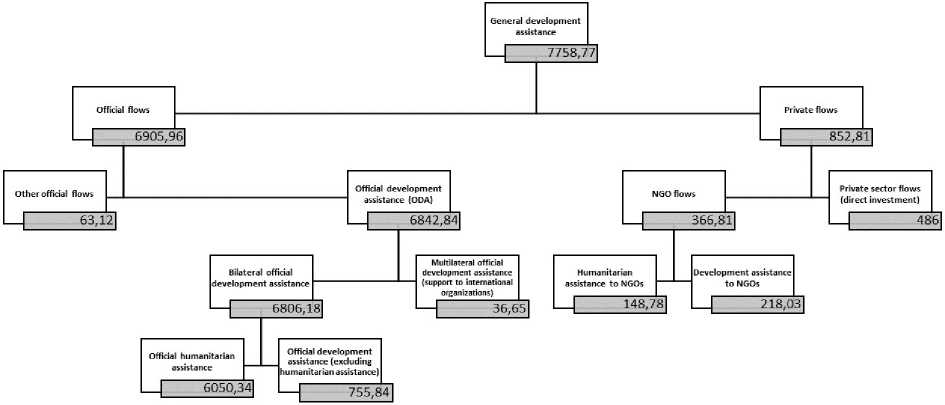
Fig 1. Structure of Turkish development assistance as of 2023, million USD
Note. Source: Compiled by the authors based on the TIKA report 6.
Among the projects of TIKA and its coordination offices in LAC are the construction of a school in 2018 in Antioquia, Colombia [8]; the delivery of medical equipment and ambulances to Colombia; the opening of a neonatal intensive care unit at the hospital of Tijuana in Mexico; the construction of a health center in the city of El Espinal, Oaxaca, Mexico [34]; support to the Association of Women on the Road to Development (ACWV) in the poultry industry in Linares, Chile; the supply of textile equipment for women entrepreneurs in Pueblo Nuevo and Ореón in Medellin, Colombia; the supply of equipment for the Association of Quinoa Producers, created by local residents to help the indigenous Quechua and Aymara peoples in Bolivia in 2018 [34]; the construction of an alpaca farm called “Friendship Ranch Peru-Türkiye” in Peru in 2024; and participation in the reconstruction of a historical school in Brazil in 2024 (equipping additional facilities – laboratory, library, cafeteria, and outdoor recreation areas) [35].
TIKA does not have regulations on the procedure and principles concerning the definition, implementation, completion, and follow-up of projects implemented by the institute. Nevertheless, the development of such a regulation is among the strategic objectives of the TIKA development until 2028 [36].
TIKA does not provide publicly available information on the cost of projects and the conditions under which they are implemented. TIKA’s reporting documents for the Latin American region provide information on the total amount of aid and the amount allocated for development assistance.
TIKA’s activities are usually financed from the organization’s budget. However, this does not exclude cooperation with local partners, such as the Alpaca Producers Association in Peru or individual organizations and agencies in Türkiye, such as the Disaster and Emergency Management Authority (AFAD).
Cooperation is mainly implemented at the level of local government and through international organizations. The intensity of cooperation at the level of local government is higher than at the level of international organizations.
The assistance provided by Türkiye to countries in LAC [32] is directed, first of all, at the most vulnerable groups (women, children, elderly people, and people with disabilities). For example, representatives of Turkish humanitarian organizations provided food aid to victims of the earthquake in Haiti and helped women who lost their jobs after the COVID-19 pandemic in Colombia [32].
TIKA also has educational initiatives aimed at increasing the literacy level of the population of developing countries in the region. Among the TIKA projects are the organization of digital literacy courses for students in rural areas of Argentina and the creation of carpentry training centers for unemployed youth. TIKA projects in LAC countries also support sustainable development goals, particularly environmental ones. For example, at the Amazon Rescue Center in Peru, a veterinary clinic to care for endangered animals has been set up [40].
In addition to TIKA, the Yunus Emre Institute and the Maarif Foundation are also active in LAC. Although the Institute has been focusing on countries in the Middle East and North Africa, as well as the Balkan states, for many years, there are also two offices in Mexico and Argentina. Representatives of the Yunis Emre Institute and cultural centers conduct activities aimed at spreading the Turkish language and culture in the region.
The projects implemented by the institute in Latin America and the Caribbean are mainly educational and allow the local population to learn about Turkish culture (events for the International Day of Turkish Coffee, a “Let’s get acquainted” meeting within the framework of Turkish language courses, and the exhibition “Traces of Turkish Culture” in Buenos Aires) [44].
Since 2016, the Maarif Foundation has carried out the promotion of Turkish education abroad. The Maarif Foundation operates in 67 countries, including 9 secular educational institutions in Venezuela, where education is conducted in English, Turkish, and Spanish [41]. As noted in one of the speeches of the Foundation’s representative in Venezuela, Maarif provides education to more than 700 students in the country [42]. The main tasks of the foundation included opening educational institutions and dormitories and realizing all activities related to education outside Türkiye, working closely with Turkish embassies and other institutions to promote Turkish education abroad [1, p. 64].
The activities of the Presidency for Turks Abroad and Related Communities (YTB), which aims to strengthen ties between Türkiye, its diaspora, and related communities abroad, with a focus on the younger part of the community, are also worth mentioning.
In 2022, YTB announced the launch of the Academic Research Support Program “El Turco Migration to Latin America.” El Turco are descendants of Ottoman natives who migrated to LAC at the turn of the 19th and 20th centuries, mostly from the Arab territories of the Ottoman Empire (present-day Lebanon, Palestine, Egypt, and Syria). The representatives of this population category are not only or not so much ethnic Turks (mainly Arabs) or Muslims (mainly representatives of various Christian movements, including Maronites).
According to YTB, the program supports projects that meet such objectives as restoring the El Turco community’s ties to Türkiye, strengthening the individual and collective memory of the El Turco community, identifying the historical, social, cultural, demographic, and political ties of the El Turco community to its historical homeland and roots and creating success stories of individuals/ families of the El Turco community and their ties to their historical homeland and roots. Other tasks include determining the El Turco community’s attitudes towards Turks/Ottomans, including in literary and artistic works, and mapping El Turco community areas.
It is mandatory for the projects supported by YTB to carry out field research in LAC, including work with local archives and interviewing representatives of the El Turco community.
Recently, more and more information has been published about the El Turco affiliation of famous representatives of LAC countries, including politicians (e.g., President of El Salvador Nayib Bukele, former President of Paraguay Mario Abdo Benítez, and President of the Dominican Republic Luis Abinader).
Another Turkish institute of humanitarian policy in the region is the Turkish Office for Religious Affairs (Diyanet İşleri Başkanlığı), as well as the Turkish Religious Foundation (Türkiye Diyanet Vakfı). These institutions ensure the maintenance of relations with the Muslim population of LAC. The fund provides food aid to the Muslim population of the region, including organizing iftars during the Muslim holy month of Ramadan and food distribution on the occasion of the Eid al-Adha holiday. The fund also provides assistance to the Muslim population in disaster-affected areas.
A number of the Foundation’s activities, such as distribution of food and aid to children, are carried out with a high level of consistency. The countries of the region became participants of the large-scale social assistance project “Erenler Sofrasi” organized by TIKA [33], which provides food aid during the Muslim holy month of Ramadan to the needy in 87 countries (including Argentina, Chile, and Colombia).
More narrowly focused and specialized projects on Latin American countries are implemented infrequently and spontaneously and do not have a systemic nature. Among them, we can note such projects as, for example, the construction of a school in 2010 in Haiti for children deprived of the opportunity to receive an education after the earthquake or sending several students to Turkish universities to obtain higher education [12].
In 2014, the presidency supported the Summit of Muslim Religious Leaders of Latin America in Istanbul, which was attended by representatives of 40 countries (including Brazil, Argentina, Venezuela, Colombia, Belize, and Barbados). The event identified the main problems faced by the Muslim minority in the countries of the region, which, according to the special report of the Foundation on South America, include 1) providing ritual services and organizing cemeteries in accordance with Islamic regulations; 2) insufficient number of mosques outside the areas of compact Muslim settlement;
-
3) religious educational institutions; 4) religious literature in Spanish and Portuguese; 5) religious leaders who speak Spanish and Portuguese.
A fundamental element of Turkish religious policy is the construction of mosques. Thus, in 2016, Diyanet built the Bukman Bukhara Mosque in Haiti, the first mosque in the country with a minaret with a capacity of 250 people [13]. In 2016–2018, TIKA helped rebuild the Al-Salam Mosque in the capital of Chile in 2016 [39]. For other countries in the region, intentions to build a mosque in Cuba [38] and Venezuela [37] have been discussed since 2014.
Target audience of the humanitarian policy of Türkiye in Latin America and the Caribbean.
Turkish humanitarian policy in Latin America and the Caribbean targets several categories of population: firstly, the most vulnerable segments of society (children, women, the elderly, and people with disabilities) and victims of natural disasters and emergencies [14]; secondly, foreign students and people who want to learn the Turkish language and culture and, in the future, visit and/or move to study, work, and live in Türkiye; thirdly, members of the Muslim minority of different ethnic origin in the region, migrants from countries with a Muslim majority, or representatives of local ethnic groups converted to Islam; fourthly, so-called “El Turcos” [10] (this category fits into a group of related communities, which refers to representatives of peoples, not always of Turkic origin, who have a historical, cultural, ethnic, or linguistic connection with Türkiye or the Ottoman Empire); and finally, in the countries of Latin America and the Caribbean, these are, although to a lesser extent, representatives of the Turkish diaspora, consisting of Turkish expats permanently residing in the countries of the region and having local citizenship, as well as Turkish citizens temporarily staying in the region.
Results. Thus, over the past decade, Türkiye has established an extensive network of aid and development institutions in Latin America and the Caribbean. Aid and development institutions are increasingly playing a key role in the foreign policy of various regional centers that lack resources comparable to the world’s largest economies. The most obvious example has been Türkiye, which has rapidly expanded its official development assistance efforts around the world. Turkish organizations are among the world’s top ten providers of development cooperation, an integral aspect of its foreign policy.
A distinctive feature is that Türkiye is optimizing and systematizing its humanitarian policy in Latin America. In particular, since 2014 Türkiye has consistently opened a number of TIKA coordination offices, cultural centers of the Yunus Emre Institute, and educational institutions of the Maarif Foundation in Latin America and the Caribbean. The comprehensive nature of Türkiye’s humanitarian initiatives in Latin American countries fits into Türkiye’s model of multi-vector foreign policy.
NOTES
-
1 This term is deliberately used in quotation marks, since the original interpretation proposed by Joseph S. Nye is rather misleading regarding the tools of the Turkish policy of humanitarian influence. In practice, it is more correct to talk specifically about a comprehensive humanitarian policy, understood as an integral instrument of foreign policy and inextricably combining both cultural-humanitarian (ideological) and social-humanitarian (aid) components.
-
2 According to TIKA reports, the term “American region” includes 2 groups of countries – North and Central America and South America – but the reports also use the definition of Latin America and the Caribbean. For a number of countries in the region, data are presented only for some years or not presented at all (Bahamas, St. Kitts and Nevis, Antigua and Barbuda, Grenada, and Trinidad and Tobago).
-
3 The chosen time period is due to the availability of publicly available TIKA data.
-
4 Turkish Cooperation and Coordination Agency (TİKA) is a subordinate/ministry-affiliated institution that is responsible for organizing Turkish official development assistance and is subordinate to the Ministry of Culture and Tourism and has a dedicated budget (Turkish Presidential Decree No. 4 dated 15.07.2018 on the Structure of Institutions and Organizations Subordinate, Related, and Affiliated to Ministries and Other Institutions and Organizations). URL: https://tika.gov.tr/kurumumuz/mevzuat/teskilat-kanunu/
-
5 Compiled by the authors based on: Türkiye Kalkınma Yardımları Raporları. Türk İşbirliği ve Koordinasyon Ajansı Başkanlığı . URL: https:// tika.gov.tr/basin-odasi/yayinlar/turkiye-kalkinma-yardimlari-raporlari/
-
6 Compiled by the authors based on: 2023 Yili Türkiye Toplam Kalkinma Yardimlari. Türk İşbirliği ve Koordinasyon Ajansı Başkanlığı . URL: https://tika . gov.tr/wp-content/uploads/2024/12/TR-Kalkinma-Yardimlari-Istatistikleri-Ozet-Tablo-2023.pdf
-
7 Compiled by the authors based on: Türkiye Kalkinma Yardimlari Raporu 2015. Türk İşbirliği ve Koordinasyon Ajansı Başkanlığı . URL: https://tika.gov . tr/wp-content/uploads/2017/YAYINLAR/TKYR%20 2015/TKYR_2015%20(1).pdf; Yunus Emre Enstitüsü 2021 Faaliyet Raporu. Yunus Emre Enstitüsü . URL: https:// www.yee.org.tr/tr/yayin/2021-yillik-faaliyet-raporu Yunus Emre Enstitüsü 2018 Faaliyet Raporu. Yunus Emre Enstitüsü . URL: https://www.yee.org.tr/tr/yayin/2018-faaliyet-raporu ; Dünyada Maarif. Türkiye Maarif Vakfi . URL: https://turkiyemaarif.org/dunyada-maarif
