
Study of Mitigation: Matrix of Mitigation Means, Two-Steps Analysis and Ethnocultural Profile Composing
Journal: Bulletin of Volgograd State University. Series 2: Linguistics @jvolsu-linguistics
Section: Межкультурная коммуникация и сопоставительное изучение языков
Article in issue: 3 т.25, 2026.
Free access
The article proposes an original approach to the analysis of mitigation means in political discourse. The main goals of the study are: to present the matrix of mitigation means in the English and German languages; to propose a two-level framework for analysing mitigation, covering the formal and pragmatic dimensions of the communicative situation; and to establish a link between the speech, its mitigating elements, and the communication patterns specific to an ethnic culture under scrunity. The need for a pragmatic analysis of every communicative situation is reasoned by the facts that the same language marker can act as both a mitigation and a non-mitigation device depending on the context. The relevance of the research lies in the fact that the ethnocultural factors of communication (more specifically, the mitigation) are understudied. The examination was completed on the basis of the House of Commons' and the Bundestag's transcripts of sessions devoted to the COVID-19 pandemics. The choice of material ensures comparability across two languages and cultures. The methods applied were analysis and synthesis; full-text sampling; intention analysis; content analysis; corpus analysis using AntConc software to search for mitigation means for proposition and deictic mitigation; quantitative estimation. The research could be further developed to be used for other ethnicities, cultures and languages; a matrix of mitigation in other languages can be constructed.
Short address: https://sciup.org/149151953
IDS: 149151953 | UDC: 81’42:398.32:811.511.151 | DOI: 10.15688/jvolsu2.2026.3.6
Исследование коммуникативного смягчения: матрица митигативных средств, двухэтапный анализ и создание этнокультурного профиля
В статье предлагается авторский подход к анализу митигативных средств политического дискурса. Цели исследования заключаются в построении матрицы митигативных средств английского и немецкого языков, представлении двухэтапного анализа митигативных средств в коммуникативной ситуа ции, включающего формальный и прагматический анализ, градуированной шкалы митигативных средств обоих языков, подтверждении взаимосвязи митигативных средств, используемых носителями языка в политическом дискурсе, с этнокультурными особенностями их коммуникативного стиля. Актуальность работы состоит в недостаточной изученности этнокультурных предпосылок коммуникативного смягчения в политическом дискурсе англичан и немцев. Материалами исследования послужили официальные транскрипты заседаний палаты общин Великобритании и бундестага Германии в период до и после введения локдаунов по причине пандемии коронавируса. Достижению целей способствовало применение следующих методов: анализ и синтез, контент-анализ, корпусный анализ с помощью программы AntConc для создания собственных корпусов и поиска в них митигативных средств согласно выстроенным матрицам коммуникативного смягчения на уровне пропозиции и дейксиса. Перспективы дальнейшего исследования лежат в расширении изучаемых лингвокультурных общностей и языков, построении матриц митигативных средств других языков и культур.
Text of the scientific article Study of Mitigation: Matrix of Mitigation Means, Two-Steps Analysis and Ethnocultural Profile Composing
Ж®
DOI:
Researchers began focusing on the problem of communicative consciousness early in the 20th century. A number of disciplines have shown interest in this phenomenon, including linguoculturology, ethnography, and cross-cultural communication. I.A. Sternin introduced the term communicative consciousness and defined it as the set of communicative mechanisms, attitudes, and categories that ensure the full extent of human communicative activity [Popova, Sternin, 2007].
Linguistics traditionally defines communicative categories as groups of linguistic elements united by some common feature [Bulygina, Krylov, 1990, p. 215]. Nevertheless, there is no consensus on the ontological status of communicative categories, regardless of extensive research into various aspects of existing concepts. The lack of consensus is reflected in the diversity of terms and differences in the phenomena studied, such as the categories of implication, identity, friendship, politeness, and others. Studies show that the term communicative category can be used without a clear definition of its categorical status [Takhtarova, 2017, pp. 190-191].
The communicative category of mitigation is of particular interest in this study. The term here is understood as a communicative category that includes prescriptions, attitudes and rules determined by politeness maxims and intended to minimize communication risks in interaction, achieved through mitigative strategies and tactics influenced by ethnocultural factors [Takhtarova, 2009]. Thus, the following can be assumed: both the ethnocultural characteristics of this phenomenon and the speakers’ communicative consciousness directly determine the mitigation means used by people of different nations.
A number of scholars, notably anthropologists, sociologists, and linguists, have studied the ethnocultural factors of communication used by representatives of different cultures.
The German linguocultural community was of interest to A. Wierzbicka, L.V. Kulikova, R.A. Gazizov, T.G. Kovaleva, and others. Two cultural dominants inherent to Germans, Ordnung and Verboten (order and prohibition), are revealed in the papers of Polish linguist A. Wierzbicka. They indicate the Germans’ need for discipline and the large number of prohibitions and prohibitive signs typical of their society [Wierzbicka, 2001, pp. 166, 170, 185, 191]. R.A. Gazizov refers to Brown-Levinson’s theory of politeness to note the strategies of positive and negative politeness common to Germans [Gazizov, 2009, p. 417; Gazizov, Muryasov, 2020, pp. 257-258]. L.V. Kulikova conducts a comparative analysis of German academic and political discourse, which, according to her, is characterized, among other things, by explicitness, self-centred communication, extensive use of instructive and regulatory speech acts, and the manifestation of formal politeness in communication [Kulikova, 2006, pp. 330-334]. T.G. Kovaleva compared the ethnocultural characteristics of political discourse in Germany and Russia and upon therein emphasizes the features common to both linguistic and cultural communities, namely, the evaluative and emotional nature of statements [Kovaleva, 2007, p. 31].
The ethnocultural style of communication of the English people has been studied by many scholars. A. Wierzbicka in her works describes their intrinsic scripts of unobtrusiveness, emotional restraint, personal space inviolability, equality and democracy in communication, avoidance of open confrontation [Wierzbicka, 1997; 2003; 2006]. T.V. Larina, having introduced the term ethnocultural style of communication in Russian communicative linguistics [Larina, 2013, p. 196] , states that the English are distant, non-impressive, personality-oriented, etc. [Larina, 2013, p. 198; 2015, pp. 211-212]. I.A. Sternin characterizes the English style of communication as veiled, implicit, and states that they are actively demonstrating friendliness and unobtrusiveness, etc. [Sternin, Larina, Sternina, 2003, pp. 169-173]. I.A. Vasilenko analyzes English communication specifically in the context of political discourse, noting that it is characterized by detachment, politeness, conservatism, and firmness [Vasilenko, 2006].
The political discourse and political communication are inherently conflict-prone domains and thus require the use of mitigation strategies. Here, mitigation means adjusting the conversation to fit social norms, lowering the level of categorical statements and communicative threats, and avoiding open confrontation. Studies on the communicative category of mitigation offer different classifications of mitigation types. This study is based on the division of mitigation types into propositional, illocutionary, and deictic [Takhtarova, 2009], which must be analyzed from the standpoint of ethnic and cultural manifestations in different linguistic and cultural communities.
Domestic and foreign studies have so far described mitigation in terms of its manifestations within a single culture (e.g., German [Karakulova, 2016], Russian [Trukhanova, 2019; Tunyan, 2022], English [Romanovskaya, Sunagatullina, 2017]). Mitigation has also been studied in the context of a comparison between Russian and German cultures [Takhtarova, 2009]. However, until now, research data in the field of mitigation has not been analyzed and described through a comparative analysis of the ethno-cultural factors of its manifestation in English and German political discourse, thus justifying the relevance and novelty of the present study.
Material and methods
For the purpose of this study, a dedicated corpus of political texts was complied. The corpus features statements delivered by members of the British Parliament, specifically, members of the House of Commons, and the German Bundestag. Selection of material was based on the relevance of the content to the goals of the study. Six parliamentary sessions relating to key moments at the beginning and end of the three lockdowns in the UK and Germany in 2020–2021 were selected for this study. The total size of the English-language text corpus was estimated to be 502 thousand words, and the total size of the German-language text corpus was 543 thousand words. The sizes of the corpora are approximately equal and relevant to the objectives set.
The methods used in the study are based on a linguistic-and-pragmatic approach to political discourse analysis. The main focus here is directed to speech strategies aimed at mitigating or neutralizing politically charged statements that could potentially cause conflict. The adopted approach offers a way to investigate how mitigative strategies are motivated pragmatically and how they operate specifically within institutional communication – a type of discourse that is characterised by pronounced social and cultural marking.
The corpora were analyzed with AntConc – a software that allows the user to build their own corpora from a limited set of documents selected by subject and time period and further work with it.
Using the continuous sampling method, we have selected communicative situations containing elements corresponding to the created matrices of linguistic mitigation markers in each of the corpora. To perform the sampling, an Advanced Search program script was run, which allowed markers of mitigation selected according to the matrices to be entered into the Search Query List. The sampling was performed with the Word option disabled, thus allowing the search to be conducted at both the full-word level and the morpheme level within words.
The processed data containing research units were then classified according to the mitigation strategies and tactics they reflected, corresponding to mitigation markers respectively.
Results and discussion
The initial step of the analysis involved creating a matrix of linguistic markers of mitigation, and a graded model that reflects how these markers correlate in terms of their pragmatic function. The present study adopts a combined approach, integrating quantitative and qualitative methods of analysis. This combined approach allows us to record the frequency and distribution of relevant linguistic units by groups and to identify their pragmatic functions given the empirical material taken.
In order to guarantee a reliable understanding of the data, the authors have created matrices of linguistic mitigation markers based on the unconnected finding of earlier researchers. Separate matrices were established for English and for German. Each matrix distinguishes two types of communicative mitigation: propositional and deictic.
This study focuses on propositional and deictic mitigation, and not on the illocutionary force, as these types can be clearly and formally identified at the level of linguistic units. Mitigation in terms of propositions and deixis can be searched for automatically using a given algorithm with the help of corpora methods (for example, using the AntConc programme that was used for this study) and then quantitatively compared.
Mitigation in the German language was under research by a number of scholars, including S.S. Takhtarova [Takhtarova, 2009], S.Sh. Karakulova [Karakulova, 2016], G.R. Vlyasan [Vlyasan, Petrova, 2021], M.Kh. Alimkhanova [Alimkhanova, 2022], and N.A. Sineokaya [Sineokaya, 2023]. Having examined research data, the authors proposed a matrix of propositional and deictic means of mitigation for the German language. Fundamental to this was the work by [Takhtarova, 2009], which unified the base of the matrix. Mitigation in English discourse has been studied by various scholars from multiple perspectives, including its lexical markers, pragmatic functions, and communicative effects [Demir, Yagiz, 2014; Romanovskaya, Sunagatullina, 2017; Kashirina, 2018; Shusharina, 2018; Samigullina, 2018]. The equivalent matrix of mitigative means was composed by the authors for the English language in the framework of markers corresponding to the German language matrix with the equivalent mitigative means. The matrix of mitigation means for the English and German languages in a compiled form for both languages is shown in Table.
The matrix includes mitigative units of various linguistic levels, such as, for instance, individual words (adverbs and particles), verbs (modal verbs and performative verbs), morphological markers (diminutives, conditional forms), syntactic constructions (impersonal and passive). They differ in complexity and implicitness, as some are explicitly mitigative regardless of context, while others have mitigative functions only in certain communicative situations, which will also be proven shortly. This variation reflects that mitigation is not an integral part of a certain word or construction, but rather a function that those units might have, and which emerges from the intercorrelation of form, context and intention of the speaker.
Since the existing research on mitigation is predominantly language-specific, it does not provide comparable inventories, hence, the initial list of mitigative units which were previously specific for English and German was incomplete and asymmetrical. In order to enable comparison, the matrix of means of mitigation was deliberately expanded by adding units that were identified as functional equivalents in English or German, respectively. The equivalence of those units was determined according to the online German dictionary and Thesaurus by Merriam-Webster , a reference and lexicographical dictionary developed by the publishing company, for the English language. All additions were further verified against the corpus material, Bundestag’s and House of Commons’ sessions transcripts, before their final inclusion.
The distinction between propositional and deictic mitigation is based on the following: Propositional mitigation modifies the truth value or the semantic content of the proposition itself, either through foregrounding the speaker’s subjectivity or through semantic operators that blur the precision of terms or predicates [Takhtarova, 2009, p. 117], whereas deictic mitigation does not alter the propositional content, but instead shifts unwanted elements out of the communicative focus into the implication, referring to what is implied rather than explicitly stated [Takhtarova, 2009, pp. 125-126].
Deictic mitigation operates through a shift in the deictic center and functions as a reference to the implied, allowing the speaker to avoid communicative risks without modifying the factual claim itself. The difference between those two types of mitigation can also be described on several levels. Semantically, propositional mitigation affects the truth-conditional status of the speech, while deictic mitigation affects the referential anchoring. Pragmatically, propositional mitigation reduces the speaker’s accountability for the content of the speech, whereas deictic reduces interpersonal vulnerability via distancing from the addressee or the described event. Syntactically, propositional mitigation is expressed through qualifiers of the predicate (e. g., hedges,
Matrix of means of mitigation of English and German languages
|
Mitigative markers |
Mitigation units (German language) |
Mitigation units (English language) |
|
|
Й .© Й .© © Си © |
Mitigators of the mode of assertion |
Ich glaube / Ich denke / Ich meine / Ich finde / Ich halte / Ich vermute / Ich nehme … an / Ich gehe (da)von aus / Ich sehe / meiner Meinung nach / aus meiner Sicht |
I think / I believe / I hope / I know / I would say / I suppose / I guess / I consider / I feel / I imagine |
|
Mitigators of the mode of possibility |
Vielleicht / wahrscheinlich / allenfalls / möglicherweise / eventuell / gegebenenfalls / womöglich |
Probably / perhaps / likely / maybe / presumably / possibly / slightly / virtually / apparently / practically |
|
|
Mitigative euphemisms |
Sache / Ding |
Thing |
|
|
Diminutives |
-chen / -lein |
-er / -est / -ie / -y / -let / -kin / -ule / - ock / -ette |
|
|
Semantic operators |
Etwa / etwas / irgendwie / irgendwann / ein bisschen / ein wenig |
Enough / a little / a bit / kind of / sort of / rather / somewhat / relatively / pretty / fairly |
|
|
Means of approximation |
Ungefähr / rund / circa / zirka / knapp / ziemlich / relativ |
About / something like / nearly / probably closer to / more or less / quite / approximately / a couple of |
|
|
Mitigative understatement |
Nicht so / nicht ganz / kaum / nicht viel (anders) |
Not very / not quite / not a bit / not so / somehow / just / in a way |
|
|
Performative verbs and phrases indicating guilt |
Anerkennen / begehen / verschulden / verursachen / Fehler haben / Schuld haben / haftbar sein / schuldig sein / verantwortlich sein / Verbindlichkeit eingehen |
Apologise / confess |
|
|
Apologies and/or expressions of regret |
Entschuldigung / Entschuldigen (Sie) (bitte) / es tut leid / es ist unangenehm / bedauern / bedauerlicherweise / Bedauern äußern / Schade / leider |
Mind (if you don’t mind) / sorry / excuse / hope / apologise |
|
|
Modal verbs |
Können / müssen / sollen / wollen / dürfen / mögen |
May / might / can / could / would / should |
|
|
Й .© '5 П |
Deictic reference to the implied meaning |
so was / etwas / so etwas / irgendwas / irgendetwas |
One / any / some / something |
|
Structures of omission of potentially negatively percieved information |
Sie wissen schon / das heißt |
In fact / what are called / (as) you see / (as) you know / it was known / they say / the fact is that / you say / when it comes to / all I know |
|
|
Parentheses |
Sozusagen / wie man sagt / sagen wir / wie gesagt / bitte |
What you would call / as the saying goes / if they will / say / let us say / is said / is believed / is considered (to be) / please / it seems that |
|
|
Detachment from subject deictics |
Einige / jemand / irgendwer / irgendjemand / wir / wer / manche / niemand / man / andere / unser |
Other / people / places / who / what / that / those / all / whatever / whoever / one of / we all |
modals, etc.), it is attached to the predicate or the clause as a whole, while deictic mitigation is expressed through reconfiguration of the subject (e. g., impersonal or passive constructions that displace the speaker).
From the prospective of political discourse, the presented matrix demonstrates strategic nature of political communication. The distinction between propositional and deictic mitigation is highly relevant in political discourse as communication there is stipulated by public accountability, high reputation risks and political competitiveness. Speakers oftentimes avoid entirely categorical statements, because excessive directness may increase responsibility for the outcome or provoke conflicts. Therefore, mitigation serves as a vital tool for finding balance between authority and communicative risks.
Propositional mitigation in political discourse primarily serves to reduce the responsibility of the speaker and to maintain strategic ambiguity. It is directed at the proposition itself, which is the semantic content of an utterance after removing its illocutionary force, encompassing both its predicate and the relations between its terms.
Means such as mitigators of the mode of assertion ( I think , I believe , ich glaube , ich denke ) allow politicians to frame potentially controversial claims as personal assessments rather than objective facts. Such forms preserve interpretative flexibility and create opportunities for subsequent revision or reinterpretation of positions without direct contradiction.
Mitigators of the mode of possibility perform an especially important function in political communication because they permit the construction of uncertainty while maintaining persuasive force. Expressions such as perhaps , probably , möglicherweise , or eventuell enable politicians to discuss future developments, political forecasts, or controversial decisions without fully committing themselves to the truth value of propositions. In this way, mitigation contributes to strategic risk management and protects speakers from reputational consequences in conditions of uncertainty.
Semantic operators, approximators, and understatement markers are also highly productive in political discourse because they mitigate evaluations and reduce confrontation. Through expressions indicating approximation, political actors can avoid categorical judgments, minimize criticism, and maintain cooperative interaction. Such devices are especially characteristic of parliamentary debate, where direct accusation or excessive certainty may threaten institutional norms of interaction.
The inclusion of performative verbs indicating guilt and apologies or expressions of regret acquires particular importance in political discourse due to their role in reputation management and restoration of public trust, functioning not as indicators of personal remorse but as strategic communicative acts intended to reduce social tension, restore legitimacy, and preserve institutional authority.
Modal verbs occupy a vital position in political mitigation because they allow speakers to regulate the degree of obligation, necessity, and possibility. Through modal constructions, politicians may present political decisions either as unavoidable necessities or as open alternatives, thereby influencing public perception of agency and responsibility.
Deictic mitigation is equally significant in political discourse, as it contributes to the redistribution of responsibility and the construction of collective legitimacy. Deictic mitigation points to what is implied or presumptive in a speech, extending deixis beyond traditional narrative or secondary contexts. It changes the positioning of participants within communication.
Strategies of detachment from subject deixis are particularly characteristic of political speech. References to indefinite actors ( people , some , we , man , many ) enable politicians to avoid explicit personal responsibility and present viewpoints as socially shared positions or collective expectations. Such depersonalisation strengthens the impression that political actions emerge from broader social processes rather than individual decisions.
Parentheses and deictic reference to the implied meaning also perform important persuasive functions in political communication. Expressions equivalent to as you know , they say , or wie gesagt create an illusion of consensus and establish common epistemic ground between speaker and audience. These strategies reduce resistance and facilitate acceptance of political arguments.
Finally, omission structures and implicit references reveal one of the central mechanisms of political mitigation, i.e., strategic informational incompleteness. By leaving certain meanings indirect or under-specified, political actors preserve interpretative flexibility, avoid explicit confrontation, and maintain multiple possible readings of politically sensitive statements.
Summarizing the description of the matrix, mitigation within political discourse should be seen not only as a form of politeness but as a communicative category that regulates responsibility, constructs legitimacy, and forms relationship between politicians and people.
The second stage of the research consisted of a two-level analysis of communicative situations containing potentially mitigative means. At the formal stage of the analysis, all possible means of mitigation selected using key lexical and grammatical forms (noted in the matrices) were identified. However, since these means are not employed directly to mitigate a particular communicative situation in all the cases, i.e., are not used invariably, each case requires an additional level of analysis – a pragmatic one. This further interprets their communicative function in every given context. Hence, this enables the researchers to identify those cases when the means are used specifically for mitigation and to distinguish them from other functions that the same means may perform in communicative situations.
The two-level analysis described above reveals that a given means of mitigation (e.g., semantic operator or modal verb) does not always perform a mitigation function. Thus, its pragmatic role depends on the context. A purely formal level of identification would therefore be unreliable, as it would point to many cases where the means is used with a different purpose, such as, for instance, intensified emotional emphasis. In summary, the pragmatic level of analysis serves as a filter of “false positives.”
Having established this distinction, we now turn to the analysis of factual textual examples drawn from the parliamentary transcripts. In the following examples there will be provided cases with two types of mitigation present (propositional and deictic), as well as cases of mitigative function and non-mitigative function.
On the basis of their pragmatic function in the context, the units of complied matrices fall into three groups. The first is composed of context-invariant mitigating markers, where mitigation constitutes the primary function realised across all contexts; this group is further called consistently mitigative. The second has context-preferential markers, where function is context-dependent and mitigation, while not exclusive, proves to be frequent; further called situationally mitigative. The third group contains context-rare (or overall null) mitigating markers, where mitigation is not primary function and its use in this function is significantly less frequent or entirely absent from the material under study, further called predominantly non-mitigative. The subsequent discussion of textual examples proceeds in two parts.
First, we address propositional mitigation, presenting illustrative cases for each of three functional groups. Subsequently, cases of deictic mitigation are presented following the same framework.
Below there are several examples that represent the above explained mitigative and non-mitigative functions in the Bundestag’s (1–4) and House of Commons’ (5–8) transcripts regarding propositional mitigation (Note: the translation of samples from German into English was made by the authors of this article).
The first case exemplifies the use of a mitigative unit, namely, mitigative euphemism, in its primary mitigative function:
-
(1) Jetzt kann man sagen: Gut, wenn 25 Prozent der Bundestagsmitglieder fleißig das ganze Jahr über hier sind, ist die Sache in Ordnung (DBP) / Now, one might say: well, if 25 per cent of the members of the Bundestag are here working hard all year round, then things are fine.
The speaker avoids directly criticising the majority of MPs by positively framing a minority condition, using mitigative unit Sache, making the mitigation the central communicative goal and not an incidental feature. The speaker reduces the illocutionary force of an inherently face-threatening critique through mitigative units, while preserving the original promotional content.
On the basis of the following two examples of the use of the same modal verb, it should be evident that not all cases of modal verbs use have the same function in speech in German language:
-
(2) Daran glaubt eigentlich keiner, der sich mit der Sache auskennt, und das kann man eigentlich auch nicht erklären (DBP) / No one who knows anything about the matter actually believes that, and it’s not really something you can explain.
In example (2) the modal verb does not perform a mitigative function; rather, it serves a truth-conditional, descriptive role by stating that no explanation is possible for anyone, with no interpersonal risk or face-threatening act to mitigate.
-
(3) Schreiben die Grünen in ihrem Antrag! Da kann man denen mal glauben! Herr Gremmels, seien Sie nicht so streng mit den Grünen! (DBP) / That’s what the Greens say in their statement! You can actually believe them this time! Mr Gremmels, don’t be so hard on the Greens!
In example (3) the modal verb kann performs a clearly mitigative function by downgrading what would otherwise be a direct imperative into an optional suggestion, thereby reducing the illocutionary force and protecting the face.
Therefore, the functional distinction between those two examples of modal verb use is evident. Unlike the first example, where it is non-mitigative, the second example illustrates a mitigative function of the modal verb. Hence, it lies in the context-preferential group: the mitigative function of the modal verb emerges only under specific pragmatic conditions, and while frequent, it is not invariable across all uses of the modal verbs.
In example (4) etwa does not serve a mitigative function. It operates as an approximative marker that signals the imprecision of revenue forecasts:
(4)Auf dieser Grundlage wurden im Rahmen der Erlösabschätzung für das Jahr 2022 Einnahmen von etwa 9 Milliarden Euro, für das Jahr 2023 Einnahmen von etwa 10,5 Milliarden Euro und für das Jahr 2024 Einnahmen von etwa 13 Milliarden Euro prognostiziert (DBP) / Based on this, the revenue estimates for 2022 amounted to approximately €9 billion, for 2023 to approximately €10.5 billion, and for 2024 to approximately €13 billion.
There is no interpersonal risk or facethreatening act in this situation. Instead, this unit fulfills an epistemic function, as it indicates the estimates rather than exact figures. Overall, the semantic operators almost do not perform a mitigative function in all transcripts under study, hence, they are classified as predominantly non-mitigative.
In example (5), as well as all examples found in House of Commons’ transcripts, a mitigative understatement in bold serves a clearly mitigative function:
-
(5) The Government amendment to the Bill is not quite perfect, but I accept that it is very hard to put these things in legislation, and they have moved a very long way from where we were (HD).
It downgrades what otherwise would be considered a direct negative assessment of a government amendment. Here the presence of an explicit face-threatening act is evident, and combined with subsequent positive acknowledgement it confirms that this unit has a mitigative function that reduces illocutionary force while preserving the critical proposition. Hence, mitigative understatements are classified as consistently mitigative.
On the basis of another two examples below with the same mitigators of the mode of assertion, it should be evident that not all cases of their use are of the same function in English speech:
-
(6) She visited where I used to work on a number of occasions and has always been, I would say , mostly in the right place around domestic abuse (HD).
In example (6) the speaker performs an evaluative act on a sensitive topic and this unit shifts the assertion from objective fact to subjective opinion, thereby reducing illocutionary force and mitigating potential face-threatening acts to the person being evaluated:
-
(7) One more thing I would say is that I am grateful that chlorinated chicken will not grace these shores (HD).
In (7) the speaker expresses gratitude on a politically (thus, confrontationally) safe topic, thus, the unit functions as a discourse marker signaling topic transition. It does not perform a mitigative function, because there is not interpersonal risk or face threat.
As can be seen from two examples above, the same unit – a mitigator of the mode of assertion – shows both mitigative and non-mitigative use. The same expression has a mitigative function only when there is a potentially face-threatening act, which is not invariably present in all communicative situations. Therefore, these markers are classified in the situationally mitigative group.
Confess in example (8) does not serve a mitigative function, as do any of the performative verbs and phrases indicating guilt in the studied transcripts:
-
(8) I confess it was as a red team, as I said in public (HD).
It strengthens and does not lessens the speaker’s commitment to proposition by honesty. As this statement has already been made public. It does not reduce illocutionary force, but enhances pragmatic force of the statement.
Below go some illustrative examples of the use of deictic mitigators in English and German, based on transcripts of parliamentary sessions. Among deictic mitigators there are none classified as consistently mitigative in the German language as no cases of their pure mitigative functions have been found during analysis. In the English language, namely, in the House of Commons’ transcripts, there has been found a consistent mitigative use of parentheses, which is shown in the following example:
(9)After having been failed by the legal system, it seems that justice is now finally being done, but at a very slow pace (HD).
In this case the unit serves a clearly mitigative function as it shifts the deictic center from the speaker to an impersonal source, thus, reducing the speaker’s commitment to the statement without marking it as a subjective opinion. It lowers illocutionary force and mitigates the face-threatening potential of the statement.
The following examples will consider the use of the same deictic reference to the implied meaning in its mitigative and non-mitigative function in English (10–11) and German (12–13).
The unit any performs a mitigative function only when it is used as a form of the universal quantifier, as it spreads the property across an entire category, lifting any blame from a specific individual or an entity:
-
(10) Let us accept that this is a difficult, sensitive issue for any Parliament, anywhere, to deal with (HD).
In example (10) this unit acts as a distributer of the responsibility, as the speaker removes the implication of exceptional personal incompetence of the government. Thus, generalizing the statement, the speaker mitigates what could otherwise be considered as a critique of a specific political institution.
In (11) the word any functions as a strengthening unit rather than mitigating because it contributes to the assertive force of the directive:
-
(11) We must ensure that our negotiators stand firm and refuse to remove any of the tariffs that currently apply to food unless it is produced to standards of animal welfare and environmental protection that are as good as our own (HD).
With any the speaker reinforces the completeness and strictness of the refusal, hence, it has a non-mitigative function.
Now, we will compare the use of the same kind of deictic reference to the implied meaning in the German language in its mitigative and non-mitigative functions:
-
(12) Es müssen ja nicht nur 180 Abgeordnete übrigbleiben, aber vielleicht irgendetwas zwischen 180 und 709 (DBP) / There don’t necessarily have to be just 180 MPs left, but maybe something between 180 and 709.
-
(13) Ohnehin sagt dieses Antragsmachwerk eigentlich nur etwas über die einfach nur selbstbezogene Funktionsweise der AfD aus und darüber, wie wenig man die AfD für irgendetwas Sinnvolles brauchen kann (DBP) / In any case, this farcical motion really only reveals the AfD’s utterly self-centred way of operating and just how little use the AfD is for achieving something meaningful.
As is evident from the examples (12) and (13), irgendetwas serves a mitigative function only when it is used in a context, where a categorical negation can be expected. In example (12) it refers to a numerical quantity and carries no interpersonal risk, thus, requiring no mitigation. In (13) it acts as a replacement of a more direct and face-threatening pronoun or any other referral, hence, mitigating the assertion by reducing the illocutionary force of the negative evaluation. Therefore, it is evident that they are context-preferential markers.
Due to the fact that the mitigators falling into the category of the deictic reference to the implied meaning prove to show different functions in various contexts, they are further classified as situationally mitigative, since their mitigative potential cannot be determined by form alone but rather requires a pragmatic analysis of each specific communicative situation.
The only category of deictic mitigators that is classified as predominantly non-mitigative for both languages and transcripts is detachment from subject deictics, meaning that impersonal or subject-detached constructions that we have shown in the matrices do not reliably signal mitigation across contexts and are more frequently used for neutral description or generally without mitigative intent. Hence, it suggests that removing the speaker from the grammatical subject position, without additional pragmatic triggers, is insufficient to achieve mitigation in English or German parliamentary discourse as is proven by the examples below:
-
(14) We work with international partners, absolutely, but this shows what we can achieve with British science, British industry and the British Government all working together, and with the NHS, to make this happen (HD).
In (14) we, used as a pronoun, strengthens and reinforces the determination through collective unity. The statement reflects a hardline stand in the debates, and the speaker does not incline to mitigate it, but rather to demonstrate the assertiveness.
-
(15) Wer stimmt für diesen Überweisungsvorschlag? (BPD) / Who votes to approve this referral proposal?
Wer in example (15) functions as a marker of mitigation only when there is a communicative risk present in the statement and the speakers use it to deliberately distance themselves from the speech. Among the Bundestag’s transcripts there were almost none such iterations present, hence, it is used as a simple grammar unit.
To finalize the pragmatic analysis of the mitigation functions performed by the means of mitigation, the observed differences in the frequency of mitigation units in general and in the functional characteristics of these units in particular should be noted. The data obtained can be used to construct a scale of pragmatic realisability of the mitigative function, on the basis of which it is possible to rank the analyzed means according to their typical correlation with mitigation – in both English and German corpora.
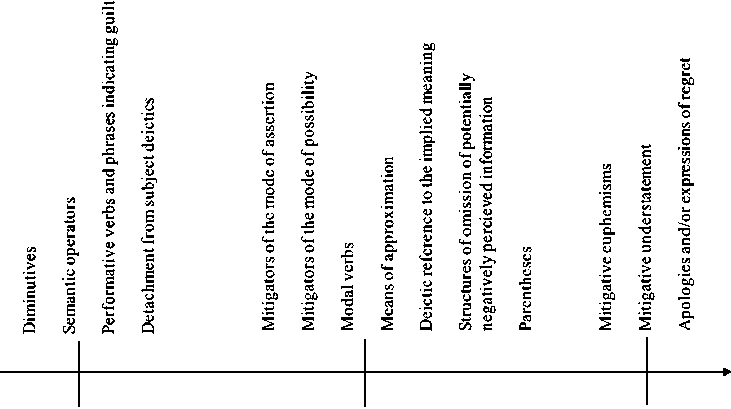
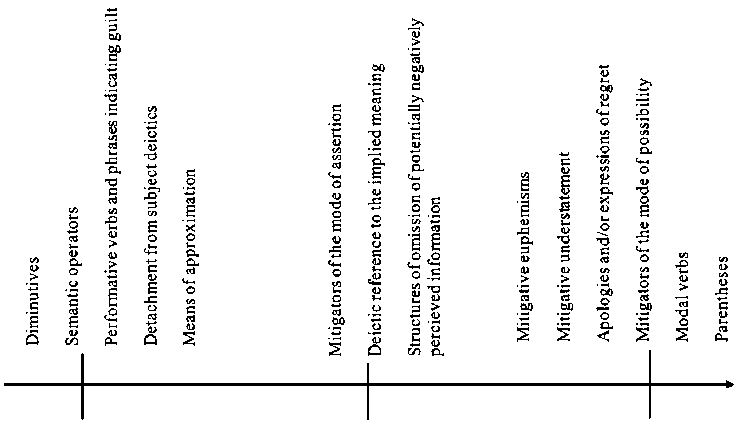
Given that the presence of linguistic means with a contextually mitigating function does not guarantee its implementation in each specific case, it is advisable to introduce a graded scale of these units according to the degree of their typical association with the mitigative function. The proposed scale is based on contextual analysis and includes three levels: from consistently mitigative to predominantly non-mitigative. This distribution is carried out separately for the German (see Fig. 1) and English (see Fig. 2) languages, revealing both universal and specific features of mitigation in political discourses in each language.
By comparing the scales in Fig. 1 and Fig. 2, that reflect the degree of realization of the mitigative function by different linguistic means in German and British political discourses, we can identify significant ethnocultural differences in communicative strategies, tactics, and settings typical of the respective linguocultures.
The data obtained enable positioning mitigative markers for the English and German languages differently across the proposed graded scale. Based on the material under study and the conducted analysis, English political discourse shows a tendency towards the consistently and situationally mitigative markers. This aligns with existing ethnocultural characterization of the English communicative style as indirect, implicit, unobtrusive, emotionally restrained and oriented towards avoiding open confrontation, proposed by researchers, as was mentioned earlier.
German political discourse shows a greater number of situationally mitigative markers. Its communicative style is shaped by cultural dominants as order and prohibition, and is characterized by explicitness, regulatory speech acts. This corresponds with our findings that pragmatic background and specific communicative situations play a decisive role in whether a certain marker or unit is used in mitigative or non-mitigative function.
Conclusion
The study advances the theoretical understanding of political discourse in the focus of cross-cultural communication by revealing how mitigation operates as a strategic communicative category that balances communicative effectiveness – achieving the speaker’s illocutionary goal – and politeness. As the findings suggest, this balance is achieved differently across ethnocultural settings, depending on culturally specific norms of saving the face in a facethreatening act, indirectness, and authority.
There are several key contributions that emerged from this research. The paper introduced a compiled matrix of mitigative markers for the English and German languages, consisting of formal units that can potentially carry mitigative functions. The study also demonstrated that a formal marker cannot be reliably classified as mitigative without a pragmatic analysis of the communicative situation in which it is used. This confirmed that mitigation is context-dependent, and the same linguistic unit may either reduce illocutionary force or serve a different function, thus strengthening the statement instead of mitigating it, depending on several parameters, among which are interpersonal risks, and face-threatening acts. The research proposed an original graded scale that captures different degrees of mitigative force across various linguistic markers and their contextual reliability. This scale moves beyond a binary distinction by arranging mitigative devices along a continuum based on how
Predominantly non-mitigative
Situationally mitigative
Consistently mitigative
Fig. 1. Graded scale of mitigative means of the German language according to their function in the context
Predominantly non-mitigative
Situationally mitigative
Consistently mitigative
Fig. 2. Graded scale of mitigative means of the English language according to their function in the context
consistent is the use of those units in their mitigative function. At the one end of the graded scale context-invariant markers are situated, they are called consistently mitigative as their primary function is mitigation itself regardless of the communicative situation. At the other end we positioned the markers which are rarely used in a mitigative function or never at all in the contexts under study. In the middle of the scale there are context-dependent markers which are categorised as situationally mitigative, because they do not exclusively show mitigative function, though may infrequently. Such graded scale provides a more nuanced tool for cross-linguistic and cross-cultural comparison.
Future research on this topic should explore diachronic shifts in mitigation across various subgenres of political discourse as well as other discourses, and in other lingocultural communities, for instance, a comparison between Eastern and Western languages and cultures. This would help determine whether the observed mitigative patterns are language-specific or universal, and whether the proposed matrix and scale can be generalised to a broader range of communicative situations.
