
Study of the Bioecological and Therapeutic Characteristics of Medicinally Important Species belonging to the Family Brassicaceae Burnett in the Flora of the Nakhchivan Autonomous Republic
Journal: Bulletin of Science and Practice @bulletennauki
Section: Естественные науки
Article in issue: 9 т.12, 2026.
Free access
The bioecological and medicinal properties of medicinally important species belonging to the family Brassicaceae, distributed in the flora of the Nakhchivan Autonomous Republic, have been investigated. During the study, the altitudinal belts, life forms, ecological habitats, and ecological groups of the medicinally valuable species within the family were examined. It was determined that several medicinally important representatives of the family are widely distributed in various phytocenoses of the Nakhchivan Autonomous Republic and are characterized by a rich complex of biologically active compounds. The research has shown that these species are rich in vitamins, flavonoids, glucosinolates, phenolic compounds, essential oils, and other phytochemical substances. These compounds possess antioxidant, anti-inflammatory, antimicrobial, anticancer, and immunomodulatory properties and are widely used in both traditional and scientific medicine.
Short address: https://sciup.org/14139003
IDS: 14139003 | UDC: 581.13 | DOI: 10.33619/2414-2948/130/07
Изучение биоэкологических и лечебных свойств лекарственно ценных видов семейства Brassicaceae Burnett. во флоре Нахчыванской автономной Республики
Исследованы биоэкологические и лечебные свойства лекарственно значимых видов семейства Brassicaceae, распространённых во флоре Нахчыванской Автономной Республики. В ходе исследования были изучены высотные пояса распространения, жизненные формы, экологические условия произрастания и экологические группы лекарственных видов, относящихся к данному семейству. Установлено, что ряд лекарственно ценных представителей семейства широко распространён в различных фитоценозах Нахчыванской Автономной Республики и характеризуется богатым комплексом биологически активных веществ. Результаты исследований показали, что эти виды содержат значительное количество витаминов, флавоноидов, глюкозинолатов, фенольных соединений, эфирных масел и других фитохимических веществ. Данные соединения обладают антиоксидантным, противовоспалительным, антимикробным, антиканцерогенным и иммуномодулирующим действием, благодаря чему широко используются как в народной, так и в научной медицине.
Text of the scientific article Study of the Bioecological and Therapeutic Characteristics of Medicinally Important Species belonging to the Family Brassicaceae Burnett in the Flora of the Nakhchivan Autonomous Republic
Бюллетень науки и практики / Bulletin of Science and Practice
UDC 581.13

Plants have been among the natural resources used by humans for food, economic, and medicinal purposes since ancient times. In the modern era as well, medicinal plants remain a primary source of raw materials for traditional medicine and the pharmaceutical industry, and they continue to maintain their importance. The majority of the world’s population uses plant-derived preparations for the prevention and treatment of various diseases. From this perspective, the study of the bioecological characteristics and medicinal significance of medicinal plants is considered one of the most relevant directions in modern botany and pharmacology. The family Brassicaceae Burnett. (cabbage family) is one of the widely distributed and economically important families of flowering plants. Medicinal plants belonging to this family are rich in biologically active compounds such as glucosinolates, flavonoids, alkaloids, vitamins, phenolic compounds, and essential oils. These substances are responsible for their antibacterial, antioxidant, anti-inflammatory, diuretic, and immunomodulatory effects. Therefore, many species of this family are widely used in both traditional and scientific medicine.
The flora of Azerbaijan, particularly the vegetation cover of the Nakhchivan Autonomous Republic, is distinguished by a high level of biodiversity. The complex relief of the territory, diverse altitudinal zones, continental climatic conditions, and soil variability have contributed to the formation of a rich flora. Numerous genera and species of the family Brassicaceae Burnett. are distributed in the flora of Nakhchivan, a considerable proportion of which possess medicinal properties. The geographical distribution, ecological adaptations, phenological development characteristics, and therapeutic potential of these species are of particular interest in terms of the efficient use of plant resources in the region. In recent years, the increasing demand for natural medicinal raw materials, as well as issues related to biodiversity conservation, have made the comprehensive study of medicinal plants necessary. The investigation of the bioecological characteristics of medicinally important species of the family Brassicaceae Burnett., distributed in the flora of the Nakhchivan Autonomous Republic, is of significant scientific and practical importance for determining their distribution patterns, ecological requirements, and resource potential.At the same time, the study of the medicinal properties of these species expands the possibilities for obtaining new phytopreparations and for the rational use of existing plant resources. The main aim of the research is to investigate the bioecological characteristics, distribution ranges, ecological groups, and medicinal properties of medicinally important species belonging to the family Brassicaceae Burnett., distributed in the flora of the Nakhchivan Autonomous Republic, and to obtain scientifically substantiated data regarding their practical use and conservation.
The family Brassicaceae (cabbage family) includes more than 3,000 species belonging to 350 genera worldwide. In Azerbaijan, it is represented by 248 species distributed across 74 genera, while in the flora of the Nakhchivan Autonomous Republic it is represented by 165 species grouped into 67 genera [2, 10].
The family is represented by medicinally important species belonging to the following genera: Aethionema R.Br., Alliaria Heist. ex Fabr., Alyssum L., Armoracia (Gaertn.) C.A. Mey. & Scherb., Barbarea R.Br. (Campe Dulac), Brassica L., Bunias L., Camelina Crantz, Capsella Medik., Cardamine L., Cardaria Desv., Clypeola L., Conringia Adans., Crambe L., Descurainia Webb & Berth., Draba L., Drabopsis C.Koch, Erophila DC., Erucastrum C.Presl, Erysimum L., Euclidium R.Br., Fibigia Medik., Goldbachia DC., Isatis L., Lepidium L., Matthiola R.Br., Murbeckiella Rothm.(Phrine Bub.), Microthlaspi F.K.Mey., Myagrum L., Nasturtium R.Br., Neslia Desv., Physoptychis Boiss., Raphanus L., Rapistrum Crantz , Rorippa Scop., Sameraria Desv., Sinapis L., Sisymbrium L., Strigosella Boiss. (Malcolmia aict. p.p.) və Thlaspi L., all of which include species of medicinal importance all of which include species of medicinal importance [1, 6].
In the flora of the Nakhchivan Autonomous Republic, the bioecological characteristics of medicinally important species belonging to the family Brassicaceae are presented in the Table below.
Table
BIOECOLOGICAL CHARACTERISTICS Brassicaceae Burnett.
|
Species |
о Kb a4 Altitudinal belt Ecological habitat |
|
Aethionema cardiophyllum Boiss. & Heldr. |
15-25 cm V- S X Mid-mountain belt Dry, gravelly and rocky VI, VI-VII slopes |
|
Aethionema pulchellum Boiss. & Huet. |
15-30 cm V- S X Mid-mountain belt Rocky and gravelly VI slopes |
|
Alliaria petiolata (Bieb.) Cavara & Grande ( A. officinalis Andrz. ex Bieb.) |
20-100 cm B M Up to the mid- Forests, edges of IV-V,VI- mountain belt shrublands, as a weed in VIII parks |
|
Alyssum hirsutum Bieb. |
8-25 cm IV- A X From lowland to the Dry, clayey slopes, VI mid-mountain belt steppes, shrublands |
|
Alyssum persicum Boiss. ( A. muelleri Boiss. & Buhse) |
5-15(25) cm P X Mid-mountain belt Dry, rocky and clayey (IV)V-VI, (rarely reaching slopes, calcareous areas (V)VI-VIII subalpine elevations) |
|
Alyssum Stapfii Vierh.( A. Buschianum Grossh.) |
5-20 cm V, A X Lower and mid- Dry, rocky and gravelly VI mountain belts areas |
|
Alyssum tortuosum Waldst. & Kit. ex Willd. ( A. bracteatum auct.) |
8-25 cm V- P X From lower to upper Gravelly and rocky VIII, VI-IX mountain belts areas, grassy slopes |
|
Alyssum turkestanicum Regel & Schmalh. ( A. desertorum Stapf) |
6-15(20) cm A X Lowland, lower Semi-desert, clayey and (III) IV-V, mountain belt rocky areas, field IV-VI (mostly mid- margins, sandy areas, mountain belt) riverbanks |
|
Armoracia rusticana (Gaertn.) C.A. Mey. & Scherb. |
50-150 cm P M Lowland, mid- Gardens, weedy areas, VI-VII mountain belt shrublands |
|
Barbarea minor C.Koch |
5-25(35) cm P M From the mid- Moist meadows, V-VI (VII), mountain belt to riverbanks VI-VIII (IX) alpine elevations |
|
Brassica campestris L. |
Up to1 m IV- A M From lowland to Weedy areas, vegetable VII, V-VIII subalpine elevations gardens, vineyards |
|
Bunias orientalis L. |
25-80(100) A M From lower Meadows, weedy areas, cm IV-V mountain belt to cultivated fields (VI), VI-VII subalpine elevations |
|
Camelina laxa C.A. Mey. |
20-80 cm A X Lower and mid- Dry slopes, rocky areas, IV-V, VI-VII mountain belts cultivated fields, roadsides |
|
Capsella bursa - pastoris (L.) Medik. |
5-60 cm IV- A Mx From lowland to Roadsides and weedy V(IX), V-VII alpine elevations areas (IX) |
|
Cardamine uliginosa Bieb. ( C. amara L. x C. dentata Schult.) |
20-40(50) P M Mid and upper Rocky slopes and oases cm V- mountain belts (sometimes) VI(VIII), VI- VIII(IX) |
|
Cardaria Boissieri (N. Busch) Soo ( Lepidium |
40-60 cm VI P Xh Lower and mid- Dry slopes, weedy mountain belts areas, cultivated fields, |
|
Species |
Со |
g ч |
tel |
Altitudinal belt |
Ecological habitat |
|
Boisseri N. Busch) |
gardens |
||||
|
Cardaria draba (L.) Desv. ( Lepidium draba L.) |
20-50 cm IV-V, V-VI(VII) |
P |
Xh |
Lowland, foothill, occasionally midmountain belt |
Dry slopes, weedy areas, cultivated fields |
|
Clypeola jonthlaspi L. |
3-25 cm III IV, IV-V(VI) |
A |
X |
From lowland to the mid-mountain belt |
Dry, clayey and rocky areas, shrublands, semidesert |
|
Conringia planisiliqua Fisch. & C.A. Mey. |
20-40 (70) cm V, VI |
A |
X |
Mid-mountain belt |
Dry, rocky and gravelly slopes, as a weed in shrublands and cultivated fields |
|
Crambe juncea Bieb. |
30-70 cm V, VI |
P |
X |
Up to the midmountain belt |
Dry, rocky and gravelly slopes |
|
Crambe orientalis L. ( C. amabilis Butk. & Majlun) |
30-80 cm V (VII), VI-VII |
P |
X |
From the lower to the upper mountain belt |
Dry, rocky and gravelly areas, as a weed in cultivated fields |
|
Descurainia Sophia (L.) Webb. ex Prantl |
15-70 cm VVI, VI-VIII |
A |
Xh |
Up to the midmountain belt |
As a weed in fertile soils, vegetable gardens |
|
Draba nemorosa L. |
8-30 (60) cm (IV)V-VII (IX), VI-VIII (IX) |
A |
M |
From the lower to the upper mountain belt |
Subalpine and alpine meadows, grassy, rocky and stony slopes, between shrublands, cultivated fields |
|
Drabopsis nuda (Belanger) Stapf ( D. verna C. Koch) |
1-10 cm V, V-VI |
A |
X |
Mid-mountain belt |
Dry, rocky slopes |
|
Erophila verna (L.) Bess. |
2-15 (30) cm III-IV, IV-V |
A |
M |
From lowland to the mid-mountain belt |
Steppes, grassy slopes, among rocks, semidesert and weedy areas |
|
Erucastrum armorasioides (Czern. ex Turez.) Cruchet ( Brassica elongata .) Ehrn |
15-50 cm V IX |
B |
X |
Lower and midmountain belts |
Steppes, roadsides, cultivated fields, stony soils, dry, gravelly, clayey, and rocky slopes |
|
Erysimum lilacinum Steinb. |
50 cm V-VI |
B |
Mx |
Mid-mountain belt |
Open woodlands, rocky slopes |
|
Erysimum leucanthemum (Steph.) B.Fedtsch.( E. passgalense Boiss.) |
50-70 cm (IV)V, VI |
B |
X |
Up to the lower mountain belt |
Edges of shrublands, steppe areas |
|
Erysimum pulchellum (Willd.) J.Gay |
15-30 cm VI, VII-VIII |
P |
X |
Mid and upper mountain belts |
Rocky and stony areas |
|
Euclidium syriacum (L.) R. Br. |
5-25 cm IV, V |
A |
X |
Up to the midmountain belt |
Semi-desert, as a roadside weed, fields |
|
Fibigia macrocarpa (Boiss.) Boiss. |
15-35 (40) cm V-VI, VI-VII |
P |
X |
Mid-mountain belt |
Dry, rocky slopes |
|
Goldbachia torulosa DC. |
8-45 cm V (VI), V-VI(VII) |
A |
X |
Lowland, rarely up to the mid-mountain belt |
Dry, stony areas, cultivated fields, weedy areas |
|
Isatis Steveniana Trautv. ( İ. anceps N. Busch) |
30-40 cm V,VI |
Pl |
X |
Mid-mountain belt |
Rocky slopes, screes |
|
Species |
Со |
g ч |
S й tel |
Altitudinal belt |
Ecological habitat |
|
Lepidium draba L. |
16-40(52) cm IV-V, V- VI(VII). |
P |
Mx |
Lowland and lower mountain belt, mostly mid-mountain belt |
As a weed in fields, cultivated lands, gardens, roadsides, mostly in meadows |
|
Lepidium perfoliatum L. |
10-35 cm IV-V, V-VI |
A |
Xh |
Lowland, lower mountain belt, rarely mid-mountain belt |
Dry, clayey and rocky slopes, along rivers as a weed in cultivated fields, gardens, and steppe areas |
|
Lepidium ruderale L. |
10-30 cm IV-VI, V-VII |
A |
X |
Lowland, rarely up to the mid-mountain belt |
Clayey and saline areas, roadside weed habitats |
|
Matthiola Boisseri Grossh. |
15-35 cm IV-V, V-VII |
P |
X |
Mid-mountain belt |
Clayey and rocky slopes |
|
Murbeckiella Huetii (Boiss.) Rothm. |
10-30 cm VI-VII, VIII |
P |
X |
Upper mountain belt |
Rocky outcrops, stony soils, rocky areas |
|
Microthlaspi perfoliatum (L.) F.K. Mey. ( Thlaspi perfoliatum L.) |
5-30 cm IVV, V-VI |
A |
Mx |
From lowland to the mid-mountain belt |
Meadows, shrublands, and waste areas |
|
Myagrum perfoliatum L. |
(10)20-50 cm IV-V, VI(VIII) |
A |
Mx |
From lowland to the mid-mountain belt |
Cultivated fields, mostly weedy areas |
|
Nasturtium officinale R. Br. |
10-60 cm V VII, VII-VIII |
P |
Hd |
Up to the midmountain belt |
Marshes, shores of water bodies |
|
Neslia paniculata (L.) Desv. |
15-80 cm IV-V, V-VI |
A |
X |
From lowland to the mid-mountain belt |
Cultivated fields |
|
Physoptychis caspica (Habl.) V. Boczantzeva [ Ph. gnaphalodes (DC.) Boiss.] |
5-15 sm VI VII, VII-VIII |
P |
X |
Alpine elevation |
Rocky slopes |
|
Raphanus raphanistrum L. |
25-70 cm VIX, VI-IX |
A |
Mx |
Lowland |
Weedy areas |
|
Rapistrum rugosum (L.) All. |
30-100 cm IV-V, V-VI(VII) |
A |
X |
Up to the midmountain belt |
Dry slopes and weedy areas |
|
Rorippa amphibia (L.) Bess. |
40-100 cm (IV) V-VII, VI-VIII |
P |
Hd |
Mid-mountain and subalpine belts |
Slow-flowing rivers, marshes, and stagnant waters |
|
Rorippa austriaca (Crantz) Bess. |
30-90 cm VVI, VI-VII |
P |
M |
Up to the midmountain belt |
Moist areas along riverbanks |
|
Sameraria glastifolia (Fisch. & C.A. Mey.) Boiss. |
15-40 cm IV-V, V-VI |
A |
X |
Lower and midmountain belts |
Dry, rocky, and clayey slopes |
|
Sinapis arvensis L. |
40-100 cm V-VI, VI-VII (VIII) |
A |
Mx |
Mid-mountain belt |
Cultivated fields (mainly cereal crops) and weedy |
|
Sisymbrium altissimum L. |
20-60 cm IV-V,V-VII |
A |
Hm |
Lower mountain belt (rarely in the midmountain belt) |
Slightly saline and weedy areas |
|
Species |
Co |
g 4 |
s й tel |
Altitudinal belt |
Ecological habitat |
|
Sisymbrium Irio L. |
10-60 cm IV-V,V-VII |
B |
Mx |
Lower mountain belt (rarely in the midmountain belt) |
Weedy areas, residential areas, ditches, and roadsides |
|
Sisymbrium Loeselii L. |
20-60 cm IV-VIII (IX),V-IX (X) |
B |
M |
Mid-mountain and subalpine belts |
Meadows, forest clearings, and waste areas |
|
Strigosella intermedia (C.A.Mey.) Botsch. ( Malcolmia taraxafolia Balb.) |
3-25 cm IVV, V-VI |
A |
Xh |
Lowland and lower mountain belt |
Semi-desert, dry, clayey and rocky slopes, saline areas, and cultivated fields |
|
Thlaspi arvense L. |
20-50 cm VI-IX, VIIIX |
A |
Mx |
Mid-mountain and subalpine belts |
Grassy slopes, edges of shrublands, mostly in weedy areas |
Note: A - Annual, B - Biennial, P - Perennial, S - Subshrub, Hm - Halomesophyte, Hd - Hydrophyte, M - Mesophyte, Mx - Mesoxerophyte, Xh - Xerohalophyte, Xerophyte
Based on the data presented in the table, among the medicinally important species of the family, 27 species (50%) belong to the xerophytic ecological group, 10 species (18.51%) to the mesophytic, 9 species (16.66%) to the mesoxerophytic, 4 species (7.40%) to the xeromesophytic, 2 species (3.70%) to the hydrophytic, one species (1.85%) to the xerohalophytic, and one species (1.85%) to the halomesophytic ecological groups. In terms of life forms, 24 species (44.44%) are annuals, 19 species (35.18%) are perennials, 5 species (9.25%) are biennials, 3 species (5.55%) are annual or biennial, 2 species (3.70%) are subshrubs, and one species (1.85%) is biennial or perennial. Among the medicinally important species of the family Brassicaceae Burnett, xerophytic ecological groups and annual life forms are predominant.
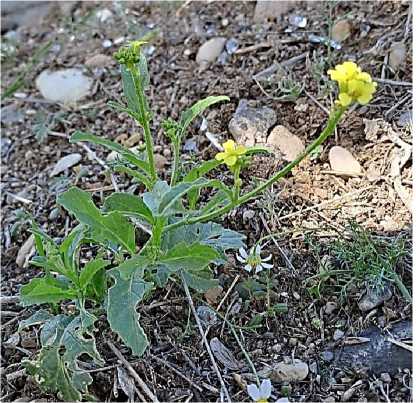
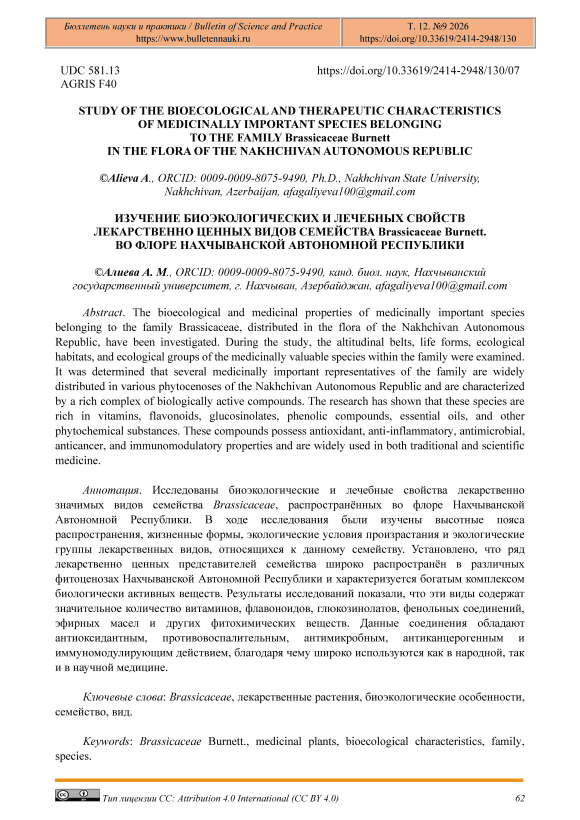
Figure 1. Bunias orientalis L.
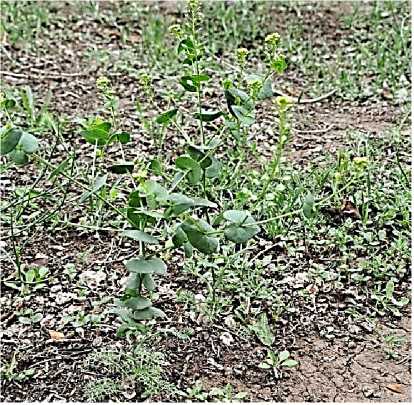
Figure 2. Lepidium perfoliatum L.
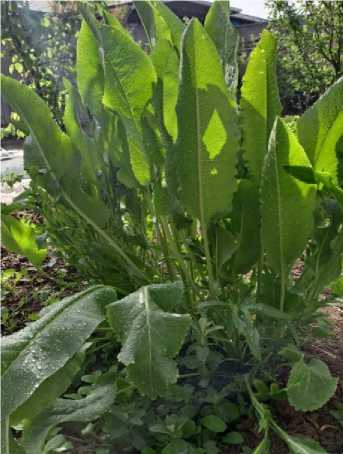
Figure 3. Armoracia rusticana (Gaertn.) C.A. Mey. & Scherb.
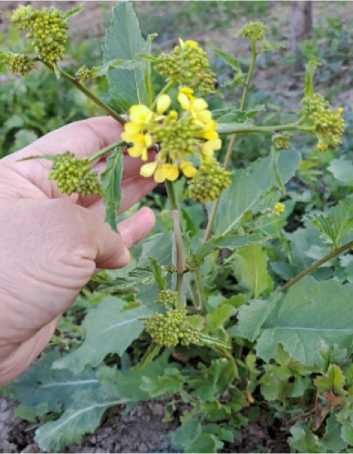
Figure 4. Rapistrum rugosum (L.) All.
As vegetables in the Brassicaceae family contain vitamins, catalase, superoxide dismutase, and peroxidase, they are a prominent source of antioxidant activity. Phytochemicals present in Brassica vegetables help prevent oxidative stress, cancer risk, carcinogenic mutations, and the proliferation of cancer cells. Brassicas are also used as biocontrol agents in the biofumigation process [4, 5, 8].
The beneficial role of the Mediterranean diet in the prevention of chronic diseases, including cardiovascular disease, diabetes, and obesity, is well-recognized. In this context, Brassicaceae are considered important vegetables due to evidence of their health-promoting effects, which are associated with bioactive compounds present in the edible parts of the plants [7].
Nutritious foods are integral to supporting physiological and cognitive functions, facilitating growth and development, and mitigating the risk of chronic conditions [3, 9, 11].
Studies have shown that members of the Brassicaceae family contain compounds that reduce inflammation, regulate estrogen levels and blood sugar, promote weight loss, improve cardiovascular health, and exhibit anti-cancer properties .
Scientists have suggested that cabbage may aid in cancer prevention and provide protection against radiation. Furthermore, a compound called diindolylmethane (DIM) has been shown to be safe for humans and is being investigated as part of cancer treatment protocols. Dr. Eliot Rosen, from the Georgetown Lombardi Comprehensive Cancer Center, has conducted research on the effects of this compound on the human body when exposed to radiation .
