
Study of the Dependence of Electrochemical Synthesis of Sb–Te thin Films on Electrolyte Concentration and Temperature
Journal: Bulletin of Science and Practice @bulletennauki
Section: Естественные науки
Article in issue: 5 т.12, 2026.
Free access
A number of studies have shown that tellurides are optimal semiconductor materials for use in thermoelectrics and in the fabrication of memory devices. In this study, antimony telluride, a widely used tellurium compound, was synthesized via electrochemical deposition from a citric acid-based electrolyte. Antimony telluride co-deposition was performed electrochemically, yielding thin films. The kinetics and formation mechanism of thin and nanostructured antimony telluride layers were studied using an IVIUMSTAT Electrochemical Interface potentiostat. The polarization pattern was analyzed, and it was established that the process occurs under concentration polarization conditions. The polarization pattern was examined using linear and cyclic polarization curves. Electrolytic solutions of varying concentrations were used, and it was found that homogeneous films with a stoichiometric composition and a smooth surface are formed from a solution with a 1:1 component ratio. The effect of electrolyte temperature on the reduction process was also studied. It was shown that as the electrolyte temperature increases, the reduction rate increases and films with different surface morphologies are formed. The most effective films were obtained at a temperature of 350 K. At higher temperatures, deterioration in adhesion and the formation of films with uneven surfaces are observed. The composition of the films obtained at the selected optimal electrolyte concentration was confirmed by X-ray phase analysis. It was found that the atomic ratio of elements in the composition of the obtained films is close to stoichiometric and corresponds to the compound Sb₂Te₃. Images of the film surface structure were obtained using a scanning electron microscope (SEM), confirming the nanostructured nature of the particles forming the film.
Similar articles in the section Chemistry. Crystallography. Mineralogy
Short address: https://sciup.org/14135616
IDS: 14135616 | UDC: 541.653 | DOI: 10.33619/2414-2948/126/01
Изучение зависимости синтеза тонких плёнок Sb–Te, полученных электрохимическим методом, от концентрации электролитного раствора и температуры
По результатам ряда исследований установлено, что теллуриды являются оптимальными полупроводниковыми материалами для использования в качестве термоэлектрических материалов и при изготовлении устройств памяти. В представленной работе синтез тел лурида сурьмы- одного из широко применяемых соединений теллура осуществлён методом электрохимического осаждения из электролита на основе лимонной кислоты. Процесс совместного осаждения теллурида сурьмы проводился электрохимическим методом, в результате были получены тонкие плёнки. Кинетика и механизм образования тонких и наноструктурированных слоёв теллурида сурьмы исследованы с использованием потенциостата IVIUMSTAT Electrochemical Interface. Изучен характер поляризации и установлено, что процесс протекает в условиях концентрационной поляризации. Характер поляризации анализировался с помощью линейных и циклических поляризационных кривых. Использовались электролитические растворы различной концентрации, и установлено, что из раствора с соотношением компонентов 1:1 формируются однородные плёнки со стехиометрическим составом и гладкой поверхностью. Также исследовано влияние температуры электролита на процесс восстановления. Показано, что с увеличением температуры электролита скорость процесса восстановления возрастает и формируются плёнки с различной морфологией поверхности. Наиболее эффективные плёнки были получены при температуре 350 K. При более высоких температурах наблюдается ухудшение адгезии и образование плёнок с неровной поверхностью. Состав плёнок, полученных при выбранной оптимальной концентрации электролита, подтверждён методом рентгенофазового анализа. Установлено, что атомное соотношение элементов в составе полученных плёнок близко к стехиометрическому и соответствует соединению Sb₂Te₃. Изображения структуры поверхности плёнок были получены с помощью сканирующего электронного микроскопа (SEM), что подтвердило наноструктурный характер частиц, формирующих плёнку.
Text of the scientific article Study of the Dependence of Electrochemical Synthesis of Sb–Te thin Films on Electrolyte Concentration and Temperature
Бюллетень науки и практики / Bulletin of Science and Practice
UDC 541.653
In recent years, global demand for sustainable and environmentally friendly energy sources has significantly increased. Considerable attention has been directed toward thermoelectric devices capable of generating electrical energy from municipal waste and biomass sources. The fabrication of thermoelectric systems based on thin and nanoscale films is of great importance; reducing film thickness enhances the manipulation of constituent components and improves conversion efficiency. Compared with conventional thermoelectric materials, thin-film-based devices exhibit reduced thermal losses and greater flexibility in fabrication [1].
Compared to bulk materials, thin-film structures exhibit more pronounced temperature gradients under identical thermal conditions, making them particularly attractive for high-efficiency thermoelectric devices. By reducing film thickness and controlling surface distribution, properties such as thermal conductivity, the Seebeck coefficient, and electrical conductivity can be effectively tuned [2].
Sb₂Te₃ is a narrow bandgap semiconductor with potential applications in thermoelectric energy conversion devices, memory devices, optical data storage media, and as an ohmic contact in CdS/CdTe thin-film solar cells [1-10].
Due to its excellent thermoelectric properties at room temperature, various studies have been conducted on the application of Sb₂Te₃ thin films in thermoelectric devices such as thermal sensors and micro-coolers [1–5].
It is known from the literature that, depending on the synthesis conditions and method, Sb₂Te₃ thin films may exist in different phase states, either crystalline or amorphous. Crystalline phases have been synthesized by laser epitaxy at room temperature [7], by electrochemical reduction deposition at room temperature [11], by electrochemical deposition at 100°C [10, 12], and by metal–organic chemical vapor deposition at 450°C [3].
The amorphous state is obtained at room temperature by evaporation or electrochemical reduction [5, 12].
The thermoelectric properties of Sb 2 Te 3 films, such as the Seebeck coefficient and electrical resistance, vary depending on their phase state [5].
With a higher Seebeck coefficient than the crystalline state [5], the amorphous state of Sb 2 Te 3 films is considered useful for certain applications, such as thin-film sensor devices. Since amorphous Sb 2 Te 3 films transform into the crystalline phase at high temperatures [6-8], it is advisable to increase their thermal stability to prevent thin-film crystallization during sensor processing.
Ge 2 Sb 2 Te 5 thin films are the most widely used materials for phase-change memory, rewritable compact discs, and digital versatile discs. Despite their low crystalline resistance and high melting temperature, they have the drawback of requiring a high reset current [6, 7].
Sb 2 Te 3 films have a low melting temperature and a high crystallization rate. However, amorphous Sb 2 Te 3 has poor thermal stability; therefore, to ensure data retention for phase-change memory applications, it is important to increase its crystallization temperature [6, 7].
For this purpose, the development of new synthesis methods is required. Various studies have been carried out to increase the crystallization temperature of Sb 2 Te 3 films synthesized by different chemical methods [6-8].
However, little work has been done to improve the thermal stability of Sb 2 Te 3 films synthesized electrochemically in electrolyte media. Although various processing methods are used for the preparation of Sb 2 Te 3 thin films, the electrochemical method is more attractive because it is a fast and inexpensive process [11, 12].
In this study, a new electrolyte was selected to obtain Sb 2 Te 3 thin films by electrochemical reduction, and the characteristics of the resulting films were investigated.
Methodology and Experimental part
In the present study, the effects of solution concentration and electrolyte temperature on the synthesis process during the electrochemical synthesis of antimony telluride (Sb2Te3) as the active material were investigated. For the electrochemical reduction of antimony ions, a citric acid solution of antimony oxychloride was used as the electrolyte. First, citric acid (C6H8O7) crystals were dissolved in the required amount of distilled water. For the reduction of tellurite ions, a solution of tellurium dioxide in sodium hydroxide was prepared. The citric acid solution containing antimony ions and the alkaline solution containing tellurite ions were mixed. Sulfuric acid was added to the solution to limit the hydrolysis of antimony ions in the alkaline medium. Hydrazine hydrate was added to accelerate the reduction of tellurite ions. The electrochemical reduction process was carried out at constant potential and constant current. Solutions of different concentrations were prepared for the reduction of each ion, and each solution was electrolyzed at different temperatures. During the reduction process, polarization curves were recorded using a computer-controlled IVIUMSTAT Electrochemical Interface potentiostat, and the kinetics of reduction depending on concentration and temperature were studied. The reduction process was carried out on copper and nickel electrodes. A silver/silver chloride (Ag/AgCl) electrode was used as the reference electrode. Since citric acid is a tricarboxylic acid (C6H8O7), the hydrolysis of antimony ions is sufficiently limited. During electrolysis, the temperature of the electrolyte solution was controlled by a UTU-4 universal ultrathermostat. The electrolyte solutions were prepared with the composition 0.05 mol/L SbOCl + 3 mol/L C6H8O7 + TeO2 + 0.05 mol/L NaOH, and the concentrations of the main components in the electrolyte were varied.
Results and discussion
During the research, it was found that when two or more different ions are co-precipitated, they form compounds with different compositions. Depending on the selected conditions, these can be chemical compounds, solid solutions, or simply a mechanical mixture of the components. It is well known from the literature that the concentration and temperature of the electrolyte solution significantly affect the electrochemical co-precipitation of the components. This was one of the points that drew our attention in our research. During the electrochemical deposition of antimony telluride thin and homogeneous films, the effect of the concentration and the temperature of the electrolyte solution was studied.
First, let’s examine the effect of the electrolyte solution concentration on the reduction process. The reduction of antimony ions was carried out in several electrolyte solutions. To study the kinetics of the electrochemical processes, linear polarization curves were obtained using a potentiostat with the Iviumsoft program (Figure 1). From these polarization curves, it is evident that although changing the concentration does not cause a sharp difference in polarization, there are certain changes in the structure of the deposited films that correspond to these curves. As shown by the polarization curves, the concentration intervals of the components were modified in various proportions, and the surface morphologies of the films corresponding to these curves also differed.
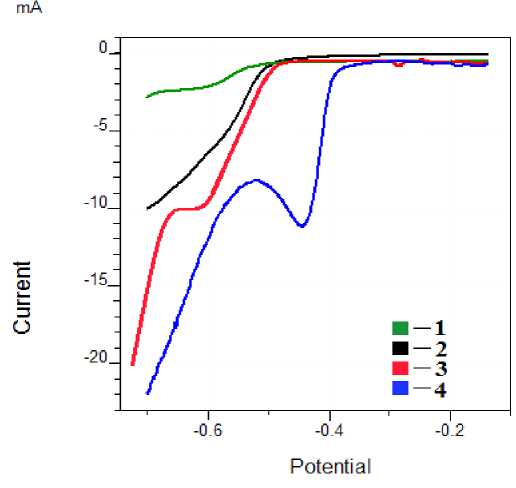
Figure 1. The effect of component concentrations on the co-deposition process of Sb-Te layers obtained by potentiodynamic method. Electrolyte (mol/l): 1 - 0.025 SbOCl +0.075 TeO 2 +3 C 6 H 8 O 7 +0.05NaOH; 2 -0.075 SbOCl + 0.05 TeO 2 + 3 C 6 H 8 O 7 +0.05NaOH; 3 - 0.075 SbOCl + 0.025 TeO 2 + 3 C 6 H 8 O 7 + 0.05 NaOH; 4 - 0.05 SbOCl + 0.05 TeO 2 + 3 C 6 H 8 O 7 + 0.05 NaOH
The films obtained from solutions with lower concentrations of antimony ions and relatively higher concentrations of tellurite ions were observed to have a non-smooth surface. However, the films corresponding to the fourth curve shown in the figure were evenly distributed on the surface and were homogeneous. In these curves, the concentrations of antimony and tellurite ions are equal.
This can be explained by the fact that the reduction of antimony ions on the surface is not stable. It is known from the literature that the reduction of tellurite ions proceeds in a stepwise manner, in two or three stages. This process can be assumed to follow the equations below:
Te+4+2e=Te+2
Te+2 + 2e = Te0
This process occurs at a relatively low electrode potential, E⁰ = +0.55 V. Since the reduction potential of the deposited Te⁰ is E⁰ = +0.42 V, which is slightly lower than the reduction potential of tellurium, but not significantly different, we can conclude that a co-reduction process is taking place. After the reduction processes occurring on the electrode surface, the formation of redox pairs, meaning the oxidation and reduction processes between antimony (Sb) and tellurium (Te), can be assumed. At the same time, a citric acid solution can be considered an optimal medium for the coreduction of antimony and tellurite ions. During co-precipitation, thin and homogeneous films with a smooth surface morphology were obtained from an electrolyte solution containing 0.05 mol/L SbOCl, 0.05 mol/L TeO 2 , 3 mol/L C 6 H 8 O 7 , and 0.05 mol/L NaOH.
The surface morphology of the obtained films was studied, and it was found that the distribution and homogeneity of the films' surfaces varied. The dependence of the quantity ratio of the components in the electrochemically synthesized antimony telluride thin films on concentration was examined and is shown in the table. According to the table, the films obtained from a 0.05:0.05 ion concentration ratio were closer to the stoichiometric composition and met the Sb 2 Te 3 stoichiometric formula. To improve the semiconductor properties of the obtained films, crystallization was required. For this purpose, the films were crystallized in a quartz furnace under an argon atmosphere.
Table
THE COMPOSITION AND QUALITY OF THE OBTAINED Sb-Te
THIN FILMS DEPENDING ON THE ELECTROCHEMICAL DEPOSITION CONDITIONS
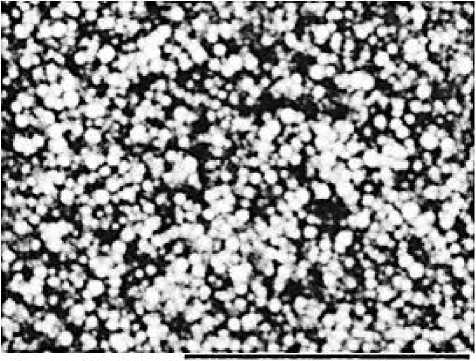
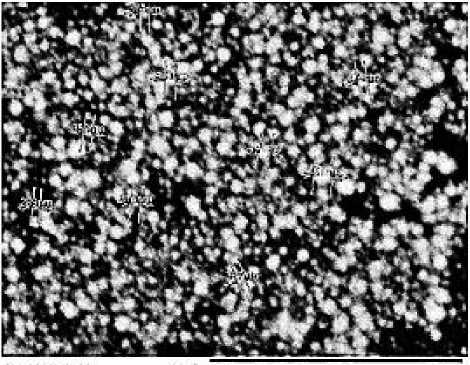
The surface morphology of the films was studied using scanning electron microscopy (SEM), and it was determined that the films were nanostructured (Figure 2). It was found that the films obtained with a 0.05:0.05 ion concentration ratio were evenly distributed over the electrode surface. To improve the films' adhesion, a small amount of gelatin was added to the electrolyte solution.
The effect of the electrolyte solution temperature on the reduction process for obtaining antimony telluride films was also studied. The effect of temperature was investigated at 0.05:0.05 ion concentrations of antimony and tellurium. The electrolyte solution temperature was varied within the range of 298–358 K. To study the kinetics of the reduction process, polarization curves were constructed (Figure 3).
Т. 12. №5 2026
7M3OO0.2383 231711 03 45 HL D0.7 10 urn
ТМЗОООЭДО 2017.12 W 05(49 ML 06.5 10urn
Figure 2. SEM image of the layers obtained on the Ni electrode. The composition of the electrolyte is 0.05 mol/L SbOCl + 0.05 mol/L TeO2 + 3 mol/L C 6 H 8 O 7 + 0.05 mol/L NaOH
TMSDOO 2SB5
3.0 urn
201711'15 03 50 NL 06 7
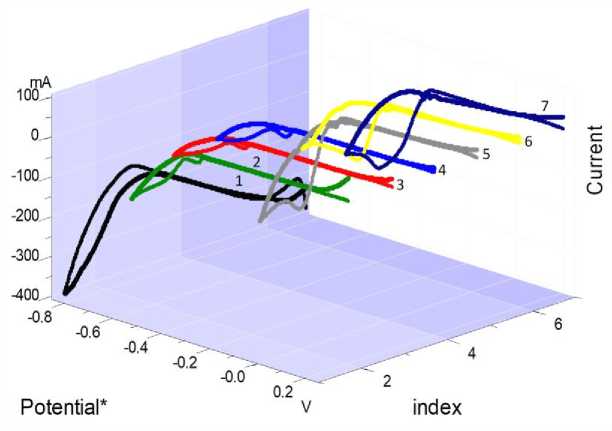
Figure 3. Polarization curves showing the effect of temperature on the co-deposition of Sb-Te layers on a Ni electrode. Electrolyte (mol/L): 0.05 SbOCl + 0.05 TeO 2 + 3 C 6 H 8 O 7 + 0.05 NaOH. Scan rate = 0.02 V/s. 1 - 298 K, 2 - 308 K, 3 - 318 K, 4 - 328 K, 5 - 338 K, 6 - 348 K, 7 - 358 K
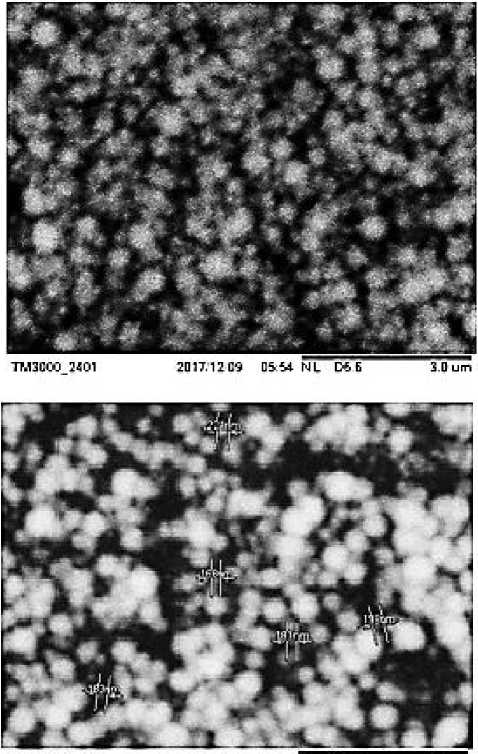
As shown in the figure, at 298 K, the co-precipitation of Sb-Te films occurs at a potential of -0.6 V, while at 358 K, it occurs at -0.36 V. This indicates that increasing the temperature promotes the co-precipitation process, making it easier. The color of the obtained samples changes from silver-gray to black. Higher quality coatings are obtained in the temperature range of 338–348 K. At temperatures above 348 K, the quality of the films deteriorates and they begin to peel off the electrode surface. Experimental results have shown that the films obtained from an electrolyte solution at 348 K are more stable and homogeneous. The composition and homogeneity of the films were confirmed by X-ray structural analysis (Figure 4).
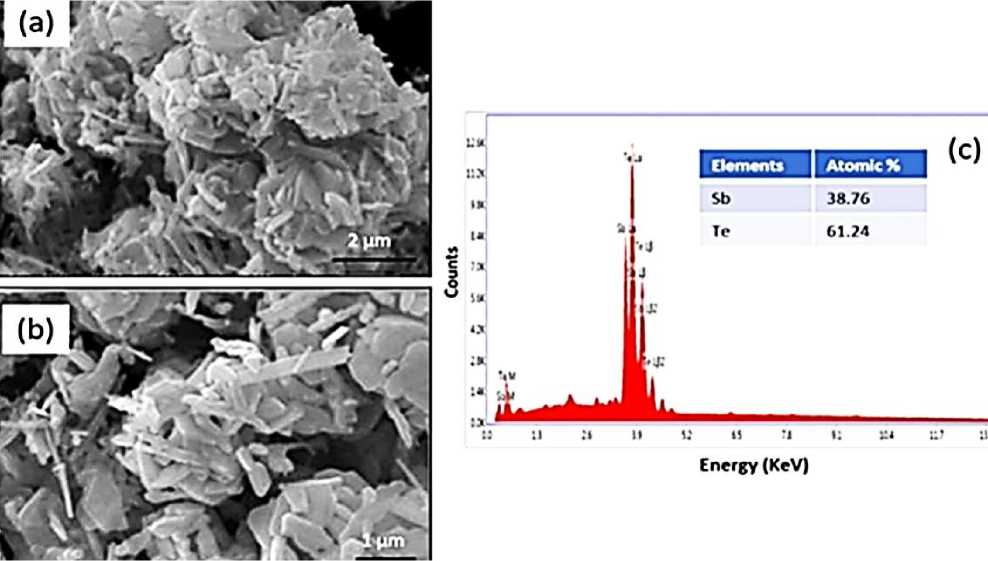
Figure 4. Surface morphology of electrochemically synthesized Sb₂Te₃ thin films: (a) low-magnification surface morphology, (b) high-resolution surface morphology, and (c) X-ray analysis of the elemental composition of the synthesized Sb₂Te₃ nanoparticles. Electrolyte composition: 0.05 mol/L SbOCl + 0.05 mol/L TeO₂ + 3 mol/L C₆H₈O₇ + 0.05 mol/L NaOH; electrolyte solution temperature: 348 K
It was concluded that the antimony telluride semiconductor thin films obtained from an electrolyte containing 0.05 SbOCl, 0.05 TeO 2 , 3 C 6 H 8 O 7 , and 0.05 NaOH at a solution temperature of 308 K are closer to the stoichiometric composition and consist of nano-sized particles. This electrolyte solution can be considered the optimal condition for obtaining Sb 2 Te 3 nanostructures.
