
Study on the evaluation of moral education in chinese universities
Section: Культурология
Article in issue: 1, 2023.
Free access
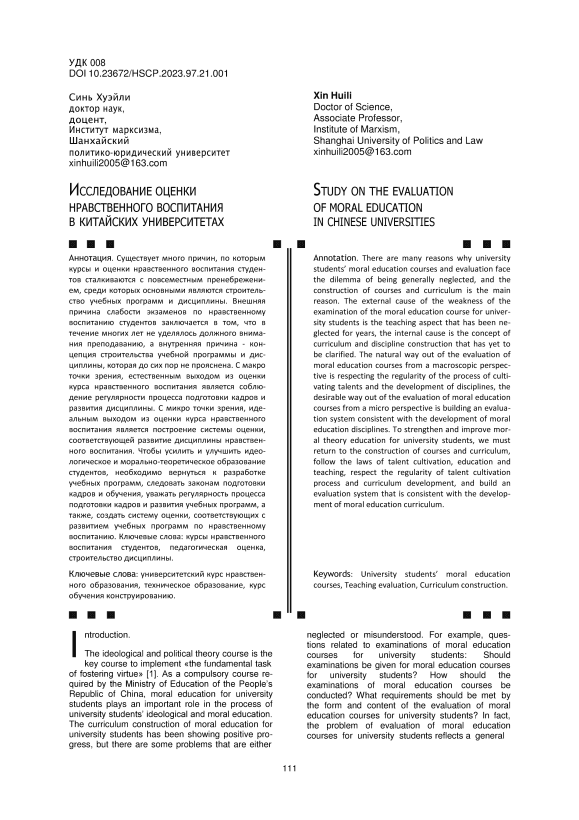
There are many reasons why university students’ moral education courses and evaluation face the dilemma of being generally neglected, and the construction of courses and curriculum is the main reason. The external cause of the weakness of the examination of the moral education course for university students is the teaching aspect that has been neglected for years, the internal cause is the concept of curriculum and discipline construction that has yet to be clarified. The natural way out of the evaluation of moral education courses from a macroscopic perspective is respecting the regularity of the process of cultivating talents and the development of disciplines, the desirable way out of the evaluation of moral education courses from a micro perspective is building an evaluation system consistent with the development of moral education disciplines. To strengthen and improve moral theory education for university students, we must return to the construction of courses and curriculum, follow the laws of talent cultivation, education and teaching, respect the regularity of talent cultivation process and curriculum development, and build an evaluation system that is consistent with the development of moral education curriculum.
Similar articles in the section Civilization. Culture. Progress
Short address: https://sciup.org/14137956
IDS: 14137956 | UDC: 008 | DOI: 10.23672/HSCP.2023.97.21.001
Исследование оценки нравственного воспитания в китайских университетах
Существует много причин, по которым курсы и оценки нравственного воспитания студентов сталкиваются с повсеместным пренебрежением, среди которых основными являются строительство учебных программ и дисциплины. Внешняя причина слабости экзаменов по нравственному воспитанию студентов заключается в том, что в течение многих лет не уделялось должного внимания преподаванию, а внутренняя причина - концепция строительства учебной программы и дисциплины, которая до сих пор не прояснена. С макро точки зрения, естественным выходом из оценки курса нравственного воспитания является соблюдение регулярности процесса подготовки кадров и развития дисциплины. С микро точки зрения, идеальным выходом из оценки курса нравственного воспитания является построение системы оценки, соответствующей развитие дисциплины нравственного воспитания. Чтобы усилить и улучшить идеологическое и морально-теоретическое образование студентов, необходимо вернуться к разработке учебных программ, следовать законам подготовки кадров и обучения, уважать регулярность процесса подготовки кадров и развития учебных программ, а также, создать систему оценки, соответствующих с развитием учебных программ по нравственному воспитанию.
Text of the scientific article Study on the evaluation of moral education in chinese universities
I ntroduction.
The ideological and political theory course is the key course to implement «the fundamental task of fostering virtue» [1]. As a compulsory course required by the Ministry of Education of the People’s Republic of China, moral education for university students plays an important role in the process of university students’ ideological and moral education. The curriculum construction of moral education for university students has been showing positive progress, but there are some problems that are either neglected or misunderstood. For example, questions related to examinations of moral education courses for university students: Should examinations be given for moral education courses for university students? How should the examinations of moral education courses be conducted? What requirements should be met by the form and content of the evaluation of moral education courses for university students? In fact, the problem of evaluation of moral education courses for university students reflects a general and realistic problem in humanities and social science education in China, which needs to be explored, practiced and started to be solved in conjunction with the construction of subjects and courses. On this basis, the curriculum construction of moral education courses for university students and the moral education can achieve due results.
The external cause of the weakness of the evaluation of the moral education course for university students: the teaching aspect that has been neglected for years
Evaluation is a way and method of examining the learning and effectiveness of the course. As the final part of the course teaching, the significance of exams is probably twofold. The first is a measure of the degree of student learning and achievement, and the second is a way and method of feedback on the goals and requirements to be achieved by the teaching content and system.
As long as the course is taught, there must be a certain form and standardized examination or test, otherwise it will not constitute an orderly and complete course teaching system. Therefore, as an important part of the course teaching, the evaluation of moral education course for university students is necessary. In addition to achieving the objective measurement of students’ learning performance, the evaluation also reflects the teaching process, teaching level and teaching effect of the previous period, and is the continuation and summary of teaching activities. Evaluations are not an end but a means. The evaluations help students to master the main content and system of the course or subject and consolidate the ideas, concepts, principles and methods taught in the course so that they can be applied by university students in their life and social activities.
However, the current situation facing the teaching of moral education courses for university students is that evaluations is still a weak link. There is a widespread and long-standing phenomenon of disregard and indifference to the evaluation of moral education courses for university students. The teaching and evaluation of moral education courses for university students are far from receiving sufficient attention, which is indisputably related to the unscientific and unregulated examination of moral education courses, and the fact that a proper social consensus and cultural synergy have not yet been formed. At present, the neglect for the evaluations of moral education courses for university students has affected the teaching of moral education and thus weakened the proper effectiveness of education and teaching. As far as examinations are concerned, moral education courses for university students are still in the iterative repeated stage of «belittling or neglecting – improper learning style – strengthening and improving – weak teaching and examinations».
The internal cause of the weakness of the evaluation of the moral education course for university students: the concept of curriculum and discipline construction that has yet to be clarified
The main reason for the weakness of the evaluation of moral education courses for university students lies in the construction of the moral education discipline itself, which has not yet explored an objective standard that can assess and measure the effectiveness of education and teaching, and has not built a scientific and perfect moral education teaching system.
First, On the objectivity of examinations for moral education courses
In reality, students do not know «how to learn» and «what to learn», and teachers do not know «how to test» and «what to test» in moral education courses. As a result, exams for moral education courses are caught in a dilemma: either they emphasize rote memorization and make students go through the motions, or they are disguised as eliminating the exams, for example, by linking them to students’ actual conduct – and still going through the motions. The teaching of moral education courses and their evaluations are far from being scientific and professionalized, and do not yet provide an objective basis for students to achieve results through hard study, and do not establish an evaluation mechanism for fair study and assessment. Both in terms of evaluation format and content, compared to courses in foreign languages, mathematics, physics and computer science, moral education courses have many inherent difficulties regarding curriculum and discipline development due to their subject specificity and the relative weakness of discipline construction. It seems to be a problem of the content and effect of evaluations of moral education courses, but in essence it is a problem of teaching materials, teaching methods, faculty and teaching level, including relatively weak academic research.
Second, On the disciplinary and theoretical aspects of moral education
«How can a course of moral education, which is more practical in life and society, measure the performance of students through a paper examina-tion?» «How can a score grade based on a written exam indicate the level of a person’s morality?» Some may even ask, «How can the moral level of university students be easily assessed as failing through an examination?» Questions such as these reflect many misunderstandings about the basic nature of moral education courses for university students and their disciplines, that is, the disciplinary and theoretical nature of moral education. It seems to be that: moral education courses are offered to address the actual thoughts and behaviors of university students; leaving the actual behavioral performance of university students, there is no meaning of education teaching and examinations. Or, the examination results of moral education courses should reflect the level of students’ compliance with the law in real life; or, the excellent examination results should indicate the excellent behavioral performance of students, and the failing evaluation results mean the bad moral character of students. Because of all these confusions, for a long time, the questions of the evaluations of moral education courses are simple and the contents are superficial and vague, and they are detached from the proper level of life, moral, legal and value education of university students – rote memorization or perfunctory examination becomes the norm of teaching and evaluation, and the contents of the evaluations are nothing but the popular common knowledge of moral and legal education. In addition, the evaluation norms set by some school teaching administrations lack due respect for the subject and characteristics of moral education, such as stipulating that evaluations must follow an established format, including uniform question types, question sizes and times, as well as setting standard answers, etc. As a matter of fact, this simplistic and administrative way of management has exacerbated the formalism and dogmatism of evaluations of moral education courses for university students, which not only cannot strengthen and improve, but also is weakening the teaching of moral education and its effect.
Third, Questions about human moral qualities, social and moral activities and their structure and principles
The natural way out of the evaluation of moral education courses from a macroscopic perspective: respecting the regularity of the process of cultivating talents and the development of disciplines
The reform and improvement of the teaching and examination system of moral education courses for university students must be based on the premise of respecting the regularity of talent cultivation process and scientific development, return to the construction of moral education disciplines, reconcile the basic nature of moral education disciplines for university students, and improve the quality and teaching level of professional teachers. Moreover, we should make it clear that good or bad grades in the evaluations of moral education courses can only reflect the degree of students’ knowledge and understanding about life, morality, legalism and values, which are the basis for university students to carry out a noble moral life, but cannot be linked or equated with students’ actual character.
First, Moral education course evaluations should reflect the objectivity and regularity of the discipline and academics
For a long time, most universities have unrealistically treated moral education courses on par with social or natural sciences, requiring that evaluations for moral education courses must be developed with standard answers and measured on a percentage scale. This «artificial objectivity» of formal sense has become a force of alienation in the teaching of moral education courses. The values-based nature of the moral education curriculum dictates that neither its teaching nor its evaluations can achieve, or need to pursue, such high-definition resolution. The evaluations of moral education courses, which unify the questions and set the so-called standard answers and use the percentage system as the evaluation standard, make the teaching of the discipline, which is originally based on ideas, logic and principles, metamorphose into a discrete and knowledge base as normative indoctrination education, deviating from the value goal of the moral education discipline and going against the regularity of the discipline construction.
Moral education course is a basic theory course with moral education and legal education as the main lines. Changing the current unsatisfactory state of evaluations in moral education courses should return the evaluation of this course to the discipline and scholarship, which must be based on the premise of disciplinary and academic standards, pedagogical ideas and artistic standards. The content of the evaluation should not be limited to the general knowledge of moral education and legal education, but should reach a higher level of higher education, and require students to face certain obscure and vulgar «common sense» of society, but also have a certain degree of analysis and critical ability.
Second , Moral education course evaluations should give teachers the qualifications and rights to proctor and administer the evaluations
Edward Shils, contemporary American educator, emphasizes «University teachers enjoy various privileges, including university autonomy and academic freedom, for example in terms of appointment and promotion, teaching methods, curriculum, examination arrangements and administration, as well as freedom of scientific research» [5, p. 7]. Strengthening the rights and responsibilities of teachers is a very important aspect in the construction of today’s disciplines and curricula. Evaluation or test is a system designed to measure the level of education, teaching and the effectiveness of student learning. The format of the exams , the content of the questions and the level of student completion are complementary to the level of teaching of the teachers and learning of the students. Therefore, the examination is not only a test of students’ learning condition, but also a test of teachers’ teaching and research level. The higher education and teaching level is inevitably reflected in the form and content of the evaluation questions, and the condition of the examination paper inevitably reflects the degree and level of teaching carried out by teachers and students. Scientific and rational propositions are the key to objectively and fairly measuring student learning outcomes, as well as promoting teaching effectiveness, guiding discipline building and faculty development. Therefore, in the evaluation of moral education courses, teachers who are competent to teach should be allowed to enjoy the qualifications and rights to proctor and administer the examinations while teaching and researching, rather than adopting simple administrative management and regulations.
Third, Moral education course evaluations should reflect the ideological and practical nature of the subject of moral education
The ideological and practical nature of the subject of moral education requires that the evaluation questions should have a certain depth, breadth and difficulty, that there is a difference between correct and incorrect views and methods, and that students should be able to answer the questions in depth and comprehensively, which is difficult to develop standard answers or to differentiate quantitatively by percentages. In the actual teaching and evaluation of moral education courses, it is difficult to truly assess students’ mastery of the content and the level of teaching of moral education. Teaching and evaluations that lack ideology,principles and objectivity are often limited to the content of some rules and boxes, forms and slogans, or just some artificial knowledge memorization and test-taking skills, rather than moral wisdom with ideology, practice and creativity. We found that students who did not take the classroom instruction seriously, or who were tempted to memorize or write «fake» or «lofty» [6, p. 57] content before the exam, were able to pass. This kind of test-taking behavior, which can only focus on «empty knowledge» memorization but not the actual teaching ideas and principles, ignores the development of education and teaching and the cognitive subject of students, which not only promotes the spread of bad learning style, but also fetters the formation of scientific literacy and good moral character of university students, and is not conducive to the cultivation of students’ creativity and practical ability.
The desirable way out of the evaluation of moral education courses from a micro perspective: building an evaluation system consistent with the development of moral education disciplines
The results of written examinations in moral education courses can only make a relative measure, especially the scores calculated by the percentage system, and are not an absolute measure of students’ academic performance because the written examinations themselves are limited by a variety of factors, but they are still by far a relatively objective and fair way of evaluation. What we need to do is to go beyond the traditional administrative management mode of taking tests, deal with the dialectical unity between the ideology, principle and objectivity of the subject and the subjectivity of teaching, establish the most scientific and reasonable evaluation mechanism as possible, and build an evaluation system that is consistent with the development of the subject of moral education. The establishment of the evaluation system for moral education courses is to transform the education and teaching system, which was originally expressed as a normative one, into a more ideological and creative one. In order to increase university students’ interest in learning and enhance the effectiveness, combining with the characteristics of university students’ moral education, we advocate the adoption of open-book examinations for moral education courses and encourage university students to use relevant information to analyze and solve relevant problems, which not only leaves room for students’ independent learning, but also can give full play to their creativity. Of course, open-book examinations do not belittle and exclude subject knowledge and memorization, but rather follow the laws of teaching and learning in higher education, that is, the shift from rote memorization to comprehension and the overarching role of students’ values in them. However, Open-book examinations undoubtedly put forward more stringent requirements for teachers to teach and develop questions, i.e. how to make the educational and teaching system, which was originally presented as normative, transform into a more creative educational and teaching system, further reflect its ideology, principle and academic nature of the discipline, so that the examinations are rulebased, evidence-based, and moderately difficult? If not handled properly, if too much emphasis is placed on the normative aspect, students will either become teacher-oriented, memorizing the teacher’s classroom lecture notes by rote, or become book-oriented, copying from the outline; if too much emphasis is placed on creativity, students will easily leave the classroom teaching completely, based on «fake» or «lofty» content. The evaluation system for moral education courses should be established so that the content of the evaluations is integrated with teachers’ teaching, emphasizing the disciplinary consistency of the types, questions and contents of the evaluations, and changing from a focus on testing conclusions to methods of thought and principles. The current moral education course examination should strengthen education on life, morality, legalism and values from the perspective of cultivating socialist core values, focus on the development of judgment and evaluation questions, and include concepts, principles, principles and norms of moral education in the design of conceptual judgment and content evaluation in order to assess the objectivity of ideological concepts. The content and system should be consistent with the teaching of the textbook and the syllabus, but the scope, depth and difficulty of the evaluation should be increased. Both the content of the book and teachers’ key lectures should be tested; both the concepts, norms and principles should be tested, and how to use the basic norms, principles of judgment analysis and problem solving should be better tested. Of course, the appropriate increase in the difficulty of the evaluation questions is not to propose biased and strange questions, deviating from the proper content and system of curriculum teaching, contrary to the objectives of education and teaching and its regularity. Undoubtedly, under the historical conditions of reform and opening up and renewal of values, this puts higher demands on the discipline and academic level of teachers. Only in this way can the evaluations of moral education courses measure the academic performance of university students in a more objective and fair way, thus helping to improve the ideology and way of thinking of university students and improve their level and ability to analyze and solve problems by applying the principles they have learned.
Conclusion. The establishment of the evaluation system for moral education courses is to enable the transformation of moral education from a normative moral education model to a moral intelligent education model.
