
Surface Plasmon Polaritons Excitation in 2d Gold-Based Nanoresonators of Various Geometries by a Point Source
Journal: Bulletin of South Ural State University. Series: Mathematics. Mechanics. Physics @vestnik-susu-mmph
Section: Физика
Article in issue: 2 т.18, 2026.
Free access
This paper numerically examines the excitation of surface plasmon polaritons (SPPs) in two-dimensional nanoresonators. The SPPs wave field is defined as a 2D array of coupled, recursive digital filters interacting with a point radiation source. Within the discrete model, we analyze SPP distributions in elliptical nanoresonators, which are regions confined on the gold surface at the metal-dielectric interface. The dynamics of metal conduction electrons are taken into account using coupled equations for the electric field and polarization. The composition of the resonant field is determined by a two-dimensional Fourier-Bessel transform. The results show that the excited mode structure and field amplitude depend on the nanoresonator geometry and the position of the center or edge point of the source. We identified the optimal source placement for exciting fundamental or higher-order modes in different geometries. The findings are crucial for designing plasmonic devices with tailored near-field distributions.
Similar articles in the section Optics
Short address: https://sciup.org/147253904
IDS: 147253904 | UDC: 535.016, 535.137 | DOI: 10.14529/mmph260210
Возбуждение поверхностных плазмон-поляритонов точечным источником в двумерных нанорезонаторах на основе золота различной геометрии
В данной работе представлено численное исследование возбуждения поверхностных плазмон-поляритонов (ППП) в двумерных нанорезонаторах. Волновое поле ППП определяется как двумерная сетка связанных рекурсивных цифровых фильтров, взаимодействующих с точечным источником излучения. В рамках дискретной модели проанализировано распределение ППП в эллиптических нанорезонаторах, которые представляют собой области, ограниченные на поверхности золота на границе раздела металл–диэлектрик. Динамика электронов проводимости металла учитывается с помощью связанных уравнений для электрического поля и поляризации. Состав резонансного поля определяется с помощью двумерного преобразования Фурье–Бесселя. Результаты демонстрируют зависимость структуры возбуждаемых мод и амплитуды поля от геометрии нанорезонатора и положения центра или краевой точки источника. Определено оптимальное расположение источника для возбуждения основных мод или мод более высокого порядка в различных геометриях. Полученные результаты имеют решающее значение для разработки плазмонных устройств с индивидуальным распределением ближнего поля.
Text of the scientific article Surface Plasmon Polaritons Excitation in 2d Gold-Based Nanoresonators of Various Geometries by a Point Source
Surface plasmon polaritons are electromagnetic oscillations in the optical frequency range that propagate in a thin layer at the metal-dielectric interface. They emerge as the coupled oscillations of the electromagnetic field in the dielectric and the electron plasma in the metal with a negative real part of dielectric function [1]. Since the first mathematical description by Arnold Sommerfeld in 1899 [2] and the first experimental SPPs observation by Robert Wood in 1902 [3], SPPs have attracted continuous scientific interest. The Maxwell's equation solution for a single interface, submitted by Zenneck and Sommerfeld [4, 5], fully applies to the description of SPPs. Later, Ritchie carried detailed studies of SPPs in thin metal films [6], and in 1968 Kretschmann and Raether introduced a general method for exciting SPPs with visible light using prism coupling [7].
The SPPs ability to strongly localize electromagnetic radiation (in subwavelength scales) opens up wide opportunities’ applications. The structures which provide SPPs propagation are used in highly sensitive biosensors [8], in plasmonic waveguides for high-speed data transfer [9], and in spasers (plas-monic nanolasers) [10]. Despite the advantages, ohmic losses in metals limit SPP propagation and there's occurs the search for new materials and optimized geometries.
In this work, we focus on the SPPs excitation in 2D nanostructures defined at the gold-glass interface on metal surface. We investigate how the resonator geometry and the position of a point excitation source influence the resulting SPP wave field and its mode composition. The discrete model parameters (we employ a model based on coupled digital filters [11–13]) are derived from the SPP dispersion relation for a gold-glass interface at a wavelength of 1,5 μm.
The wave field of surface plasmons in a two-dimensional nanoresonator is modeled by a discrete way, where the wave field is displayed as a coupled recursive digital filter (second-order oscillators) grid. The dynamics of the field is determined by finite difference equations with selected parameters for matching with the physical system, a gold–glass interface at a wavelength of 1,5 μm. While modeling the field in rectangular resonators we used zero‑derivative (Neumann) boundary conditions to simulate
The results demonstrate a dependence between the excited mode structure and SPPs wave field amplitude on the resonator geometry, the center or edge point source position. We have identified optimal source placement for exciting fundamental or higher-order modes in different geometries. These findings are crucial for designing plasmonic devices with customized near-field distributions.
The SPP wave field in a 2D nanoresonator is modeled using a discrete approach, where the continuous field is represented by a coupled recursive digital filter (second-order oscillators) two-dimensional grid. The wave field state at the grid node ( x; y ) at discrete time t is defined by u ( x; y; t +1) . The dynamics are governed by the finite-difference equations [11–13]:
u ( x , y , t + 1 ) = a1 u ( x , y , t ) - a 2 u ( x , y , t - 1 ) + bW ( t,x ± 1, y ± 1 ) + gF ( x , y , t ) , (1)
where the coupling to nearest nodes is
W ( t , x ± 1, y ± 1 ) = u ( x - 1, y , t ) + u ( x + 1, y , t ) + u ( x , y - 1, t ) + u ( x , y + 1, t ) . (2)
Sign g in (1) is the coupling coefficient between the wave field and the point source.
The function F (x, y, t) = 3 (x - x0)(y - y0) z(t) defines the action of the radiation point source lo- cated at (x0,y0) . The source's dynamics modeling as a classical nonlinear oscillator with dissipation, function z(t) is described by a discrete version of the Van der Pol equation [14]:
z ( t + 1 ) = d 1 ( z ) z ( t ) - d 2 ( z ) z ( t - 1 ) + g A u ( x 0 , y 0 , t ) , (3)
where A u ( x 0, y 0, t ) = u ( x 0, y 0, t ) - u ( x 0, y 0, t - 1 ) .
The coefficients a 1, a 2 and b set the relation between physical phase velocity v and attenuation decrement γ and the model:
a 1 = 2 ( 2 v 2 - 1 ) e - 7 , a 2 = e - 2 7 , b = v 2 e 7 . (4)
The nondimensional phase velocity v must be less than 1/√2 for numerical stability.
The model parameters are selected to match the physical system: a gold-glass interface (dielectric constant of glass * 2 = 4). For a wavelength of 2 =1,5 цт in vacuum the frequency is ю ~1015 Hz.
Taking into account the Drude model (metal plasma frequency ω p = 1,39‧1016, η = 1,075‧1014) [15], we calculated the gold dielectric function at this wavelength, * 1 = —190 + 19 i , so I * 1 I =191. From the SPP dispersion relation on a single interface:
£ k SPP =
* 1 * 2
* 1 + * 2
the SPP phase velocity real part is calculated to be Re( v ph ) ≈ 0,5.
The grid step Δ r of digital filters in a discrete model of a two-dimensional wave field in a nanoresonator is 1 nm in order of magnitude, and the characteristic time step Δ t follows from v ph = v (Δ r/ Δ t ) is Δ t ∼Δ r/c∼ 10-18 s [16].
To account the dynamics of conduction electrons, the model is related to the macroscopic polarization P equations obtained from the equation of electrons motion in the plasma layer of a metal. The discretization of the wave equation for the electric field E and the polarization equation leads to the creation of a coupled system:
P [ k + 2 ] + P [ k ] - 2 P [ i + 1 ] P [ k + 2 ] - P [ i + 1 ] e 2 n
-------A?--------+ n----- a --’mE ' k ] ; (6)
E.Ak + 2 ] + E , k ] - 2 E [ k + 1 ]
A t 2
„ r E . + 2., [ k ] + E ,j + 2 [ k ] - 2 EMJ [ k ] - E j., + [ k ] + 2 Eu [ k ]
W* 0 . 2
A r 2
P , , [ k + 2 ] + P , , [ k ] - 2 P , , [ k + 1 ] 1 P + 1, , + 1 [ k ] - Pj + 1 [ k ] - P «J [ k ] + P i, [ k ]
* A t2 - * 0 A r 2
This system (1), (6), (7) forms the complete basis for our numerical simulation. However, for the primary analysis of the mode excitation and field distribution presented in this paper, the basic model (1)–(4) with the parameters obtained above is sufficient, since it reflects the basic dynamics of the waves. The full system is used to verify the correctness of the simplified approach.
Let us consider the SPP excitation taking into account the dynamics of metal conduction electrons in a nanoresonator defined as a limited nanostructure on the metal surface at the metal-dielectric inter- face (Fig. 1). A circle of radius R =16 nm is limited on the metal surface, in which the wave field distributions are considered, and a point source of electromagnetic radiation is located near the interface, exciting SPP.
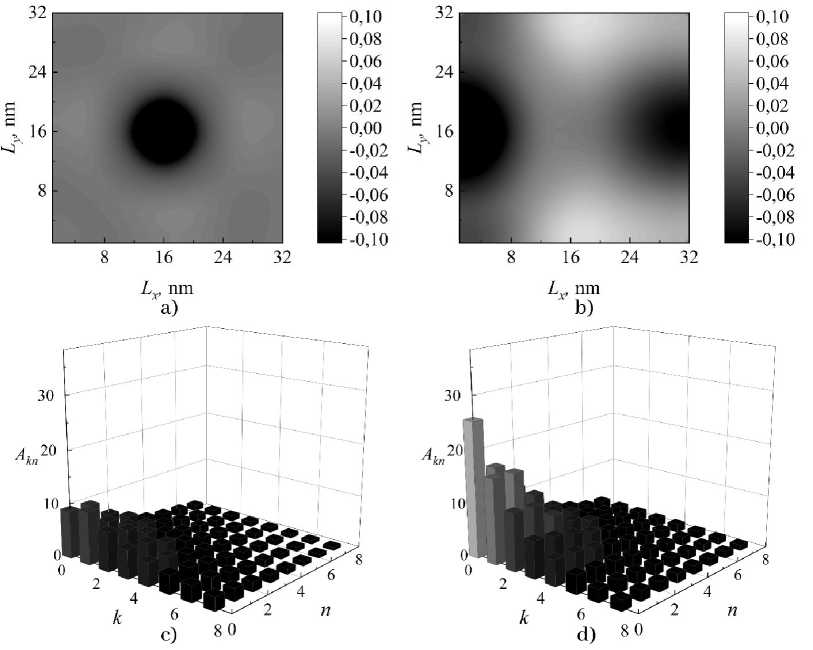
Fig. 2. the wave field in the nanoresonator L x = 32 nm, L y = 32 nm, g = 0,2, point source placed in a ) center, b ) left; the amplitudes of the excited modes, point source placed in c ) center, d ) left
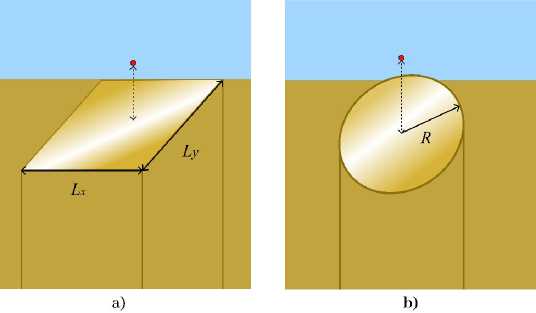
Fig. 1. Nanoresonator scheme of a limited nanostructure on the gold surface at the metal-dielectric interface
First, we consider a rectangular resonator limited on the gold surface with dimensions L x = 32 nm, L y = 32 nm. Fig. 2 shows the steady-state field distribution with the point source located at the center and the left edge. When the position of the point source in the square nanoresonator changes, the wave field is more efficiently excited, and the amplitude of the excited modes increases.
Thus, with a small coupling coefficient of the wave field with a point radiation source, when taking into account the dynamics of electron polarization, a uniform component of the field is observed, and when the oscillator is shifted to the center of the membrane, an increase in the amplitude of the resonant field is observed. With an increase in the coupling coefficient g, the amplitude increases significantly, it can be noted that when the source is located in the center of the structure, the increase is more significant, and with an increase in this coefficient, higher-order modes are excited (Fig. 3).
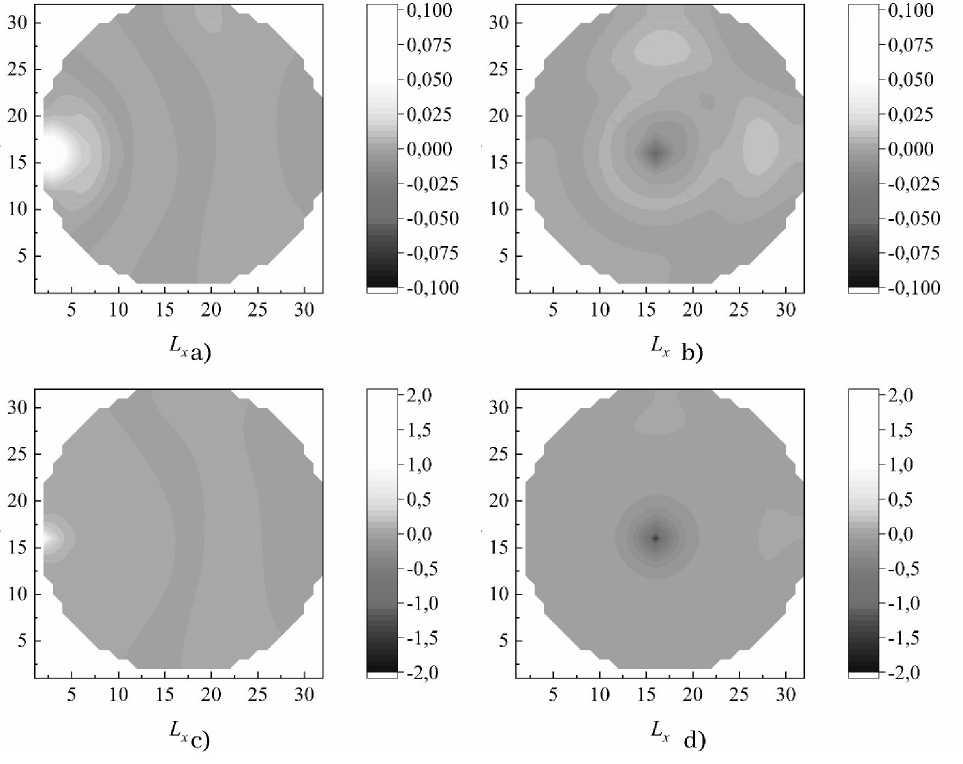
Fig. 3. The wave field in the membrane R = 16 nm, coupling coefficient g = 0,1, point source placed in a) left, b) center; coupling coefficient g = 0,2, c) left; d) center
Let us perform the Fourier–Bessel transformation (in polar coordinates) of the resonant field in a circular nanoresonator and obtain a set of coefficients representing the amplitudes of the excited modes with indices ( m , n ), m – radial components, and n – azimuthal components.
u mn =\ " u ( Г ) J m | r | Sin ( « ^ ) rdr , (8)
0 IR J where Jm (r/R) is a Bessel function of the first kind of order m describing the radial distribution of the field, r = Xx2 + y2 , ф = arcsin (y/r).
The figure shows the amplitudes of the excited modes of the wave field in the structure R = 16 nm, the point radiation source is located in the center of the structure and at its edge. As noted above, with the central location of the source, the amplitude of the excited modes is an order of magnitude greater than the same values with the marginal location of the source. At g = 0,1, zero- and first-order modes predominate, and as this coefficient increases, the number of azimuthally excited modes increases.
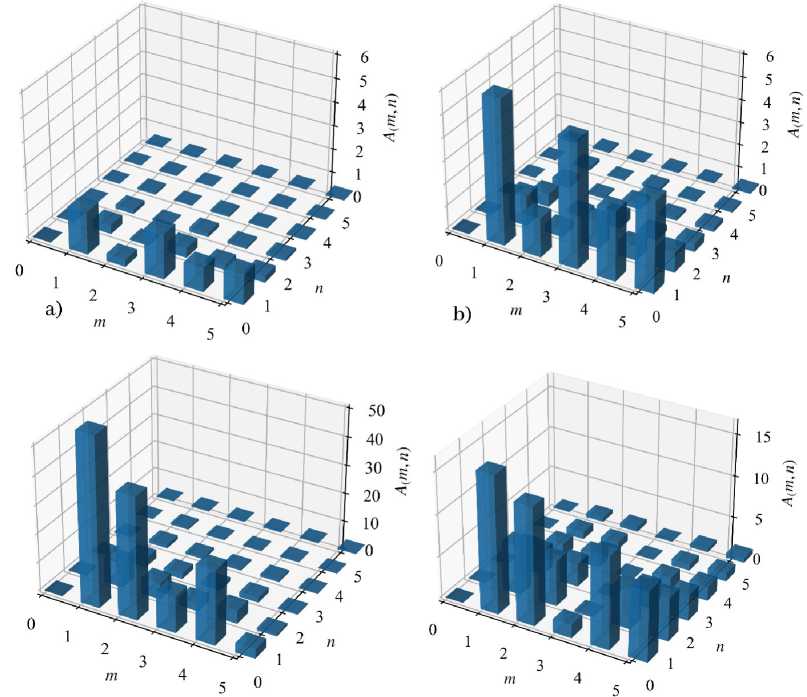
Fig. 4. The excited modes amplitudes with indices (m; n), the wave field in the structure R =16 nm, coupling coefficient g = 0,1, point source placed in a) left, b) center; coupling coefficient g = 0.2, c) left; d) center
In this paper, based on a recursive two-dimensional domain model, the distributions of the wave field of surface plasmon polaritons in metal nanoresonators of various shapes are analyzed, taking into account the purely two-dimensional nature of these surface waves and the dynamics of electrons in the metal plasma layer. A discrete model of a two-dimensional domain is a lattice of coupled second-order recursive filters interacting with a point source of electromagnetic radiation, which is a classical nonlinear oscillator with dissipation (for small nonlinear source parameters in a discrete modification of the Van der Pol equation).
The step of the digital filter grid in the model was adopted in the order of 1 nm, and the characteristic time in the system was adopted.
-
1. When simulating the excitation of SPT in rectangular metal nanoresonators, it is shown that the most advantageous location of a point radiation source for exciting a nanoresonator in a single–mode is the edge of the nanostructure.
-
2. When modeling the excitation of an IFR in ellipsoidal structures with central symmetry, it is shown that the most advantageous location of a point radiation source for exciting a nanoresonator in a single-mode is the central location of the source.
-
3. To identify the mode composition of the resonant field in a circular structure, the Fourier-Bessel transformation was performed, and it was shown that modes with low radial and azimuthal indices predominate in the structure.
The obtained research results can be useful in the design of plasmonic nanoresonators of various geometries. (rectangular, axisymmetric) and other devices that support the propagation of surface plasmon polaritons (waveguides, sensors, etc.), ensuring effective excitation of target modes due to the optimal location of the electromagnetic radiation source.
The research was carried out within the state assignment of Ministry of Science and Higher Education of the Russian Federation (№ 075-00188-26-00).
Bulletin of the South Ural State University Series “Mathematics. Mechanics. Physics” 2026, vol. 18, no. 2, pp. 86–93
