
Taxonomic Composition and Use of species of Hyoscyamus L. in the Nakhchivan Autonomous Republic
Journal: Bulletin of Science and Practice @bulletennauki
Section: Естественные науки
Article in issue: 9 т.12, 2026.
Free access
This article explores the taxonomic spectrum and uses of Hyoscyamus L., a plant genus native to the Nakhchivan Autonomous Republic. In the Nakhchivan Autonomous Republic Hyoscyamus genus is one of the important plant species included in the rich flora of the region. There are 3 species of the genus in Azerbaijan and 3 species in the flora of the Nakhchivan Autonomous Republic. The systematic composition, ecological groups, areal class, altitudinal zone, flowering and fruiting phase of the species included in the genus are listed in the table below. Beyond their medicinal and pharmacological value, these plants also possess toxic properties due to the alkaloids they contain.
Short address: https://sciup.org/14139000
IDS: 14139000 | UDC: 582.949.2:581.4:581.5 | DOI: 10.33619/2414-2948/130/04
Таксономический состав и применение видов Hyoscyamus L. в Нахчыванской автономной Республике
Предоставлена информация о таксономическом спектре и применении Hyoscyamus L., распространенных во флоре Нахчыванской Автономной Республики. В результате проведенных исследований установлено, что в флоре Нахчыванской Автономной Республики встречается 1 вид этого рода. Виды этого рода, помимо преимущественно лекарственного и фармакологического значения, обладают также токсическими свойствами благодаря содержащимся в них алкалоидам.
Text of the scientific article Taxonomic Composition and Use of species of Hyoscyamus L. in the Nakhchivan Autonomous Republic
Бюллетень науки и практики / Bulletin of Science and Practice
The flora of the Nakhchivan Autonomous Republic is rich and diverse due to its geographic location, sharply continental climate, and complex topography. The presence of semi-desert, foothill, and mountain ecosystems in the region has created conditions for the development of various vegetation types. In addition to being an important part of the flora of Azerbaijan, the Nakhchivan Autonomous Republic is also home to a number of rare, medicinal, and endemic plant species.
One of the most common plant groups in the flora of the Nakhchivan Autonomous Republic is represented by the family Solanaceae Juss. Plants belonging to this family are primarily herbaceous, subshrubbery, or shrubby, and many are rich in alkaloid-containing and pharmacologically active substances. A species of the genus Hyoscyamus has been recorded in the flora of the Nakhchivan Autonomous Republic [1].
Research material and methodology
The studies were conducted in various physical-geographical regions of the Nakhchivan Autonomous Republic in 2024–2025. The objects of study were mainly cultivated fields, roadsides, and vacant or ruderal areas. During the identification of plant specimens and the clarification of their taxonomic status, fundamental literature and international taxonomic databases, such as the World Flora Online system, were used .
The collected materials were processed under herbarium conditions, analyzed based on morphological characteristics, and the ecological characteristics of the species within the genus were determined [1].
Discussion and results of the research
In the Nakhchivan Autonomous Republic, the genus Hyoscyamus is one of the important plant groups included in the rich flora of the region. There are 3 species of this genus in Azerbaijan, all of which are present in the flora of the Nakhchivan Autonomous Republic. The systematic composition, ecological groups, areal classes, altitudinal zones, and flowering and fruiting phases of the species included in the genus are listed in the table below.
During the analysis of the species, it was found that 75% belong to the mesoxerophyte ecological group and 25% to the xeromesophyte ecological group.
The analysis of literature sources and the results of field studies show that the species included in the genus represent various geographical elements in terms of areal distribution. These features provide an important scientific basis for determining their distribution patterns and migration routes. According to arealogical assessments, the species recorded in the flora of the Nakhchivan Autonomous Republic are mainly attributed to the Holarctic and Palearctic floristic regions, which indicates their wide geographical distribution potential.
Hyoscyamus L. – It is an annual or perennial herb. The stem is erect, branching, and covered with glandular, sticky hairs. The leaves are alternate, ovate or oblong, with serrated or dissected edges. The flowers are large, yellowish or cream-colored, and distinguished by purple veins. The fruit is a capsule with a lid containing numerous seeds. There are 3 species of the genus in Azerbaijan and 3 species in the Nakhchivan Autonomous Republic.
Hyoscyamus niger L. – It is a biennial herbaceous plant with a height of 30–100 cm. Its stem and leaves are covered with sticky glandular hairs. Its flowers are yellowish and have dark purple veins. It is mainly distributed along roadsides, in cultivated areas, in ruins, and in ruderal areas. It contains the alkaloids hyoscyamine, atropine, and scopolamine. It is used in medicine for the preparation of spasmolytic, sedative, and analgesic drugs. These substances determine the plant's toxic properties in addition to having high pharmacological activity (Figure).
Hyoscyamus pusillus L. – It is an annual herbaceous plant, distinguished by its small size compared to other representatives of the genus. Its height usually varies between 10 and 40 cm. Its flowers are small and yellowish. It is widespread on rocky slopes, in dry steppes, and in areas with sparse vegetation. The plant contains tropane alkaloids. Despite its limited use in folk medicine, it requires caution as it is poisonous.
Hyoscyamus reticulatus L. – It is an annual or biennial herb. The corolla of its flowers has clearly visible, net-like purple veining, which is why the species name is associated with this feature. It is widespread on dry slopes, in rocky and gravelly areas, and in mountainous regions. Like other species, it is rich in alkaloids and has pharmacological significance. Although it is used in folk medicine as a painkiller and sedative, its uncontrolled use is dangerous due to its high toxicity.
In folk medicine, yarrow has been used since ancient times to treat rheumatism, nervous system disorders, bronchial asthma, and various painful conditions. However, due to the plant's high toxicity, its use is considered advisable only under specialist supervision.
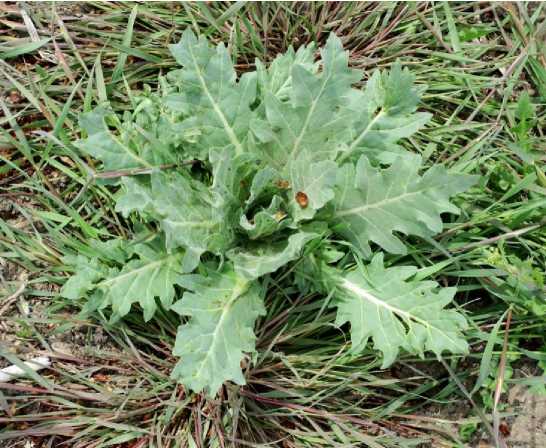
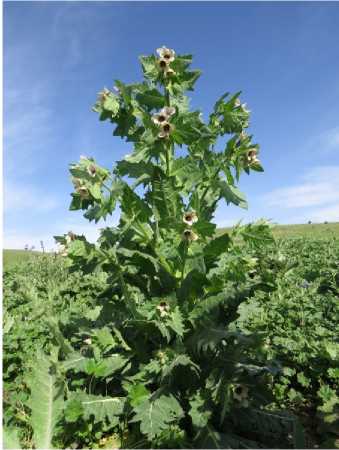
Figure. Hyoscyamus niger L.
Although the flora and vegetation of the Nakhchivan Autonomous Republic, where the research was conducted, are mainly xerophytic in nature, they have formed a favorable environment for the spread of plant species adapted to various ecological conditions. In this regard, representatives of the genus Hyoscyamus L. are also found in various habitats of the region and participate in various phytocenoses together with other plant species. In the studied areas, Hyoscyamus niger L. grows together with various herbs and shrubs, forming plant groups of different levels. In the formation of these groups, species belonging to the families Fabaceae Lindl., Asteraceae Bercht. & J.Presl, Lamiaceae Martinov, and Rosaceae Juss. play an important role [1-5].
The conducted studies have allowed to obtain important information about the taxonomic position, ecological characteristics and directions of use of the genus Hyoscyamus L. in the flora of the Nakhchivan Autonomous Republic. However, the current results do not fully cover the biological, phytochemical and pharmacological properties of the genus. In future studies, it is considered appropriate to assess the reserves of species belonging to the genus, study their biologically active substances and determine the application prospects.
Result
Research determined that the genus Hyoscyamus L. is represented in the flora of the Nakhchivan Autonomous Republic by three species: Hyoscyamus niger L., Hyoscyamus pusillus L., and Hyoscyamus reticulatus L. These species are mainly distributed along roadsides, around agricultural fields, in ruderal areas, and on dry, rocky slopes. The presence of tropane alkaloids increases their pharmacological importance and highlights their potential for medical applications. An ecological analysis shows that they are primarily mesoxerophytic plants adapted to the arid climate of the region. A geographical analysis indicates that the species are mainly associated with Holarctic and Near Asian floristic elements. These studies confirm that the genus Hyoscyamus L. occupies an important place in the region's biodiversity and that further research is scientifically and practically relevant.
