
The Current State of the Flora of Lake Sarysu (Azerbaijan)
Journal: Bulletin of Science and Practice @bulletennauki
Section: Естественные науки
Article in issue: 4 т.12, 2026.
Free access
The present study was conducted during 2022-2024 in the territory of Lake Sarisu, the second largest lake in the Republic of Azerbaijan. During the research, a floristic checklist of the plant species recorded in the study area was compiled. The checklist reflects the taxonomic structure of the flora, life forms, geographical and areal types, ecological groups, and endemism. Herbarium specimens of the identified plant species were prepared, photographs of plants in their natural habitats were taken, and GPS coordinates were recorded. The study revealed one vegetation formation (Phragmiteta australis) and four associations within the vegetation cover of Lake Sarisu: Phragmites australis + Ceratophyllum demersum; Phragmites australis + Typha angustifolia; Phragmites australis + Tamarix ramosissima; and Tamarix ramosissima + Tamarix hohenackeri. The investigation of the current state of flora and vegetation highlights the necessity of assessing the impacts of global ecological problems, including anthropogenic factors, on plant diversity. This issue is of particular relevance for future geobotanical and phytocoenological studies to be conducted in Lake Sarisu and its surrounding areas.
Similar articles in the section General ecology and biodiversity
Short address: https://sciup.org/14135141
IDS: 14135141 | UDC: 574.583 | DOI: 10.33619/2414-2948/125/10
Современное состояние флоры озера Сарысу (Азербайджан)
Исследование проводилось в 2022-2024 гг. на территории озера Сарысу - второго по величине озера Азербайджанской Республики. В ходе исследования был составлен флористический конспект видов, встречающихся в исследуемом районе, в котором отражены таксономическая структура флоры, жизненные формы, географические и ареальные типы, экологические группы, а также уровень эндемизма. Для видов, включённых во флористический конспект, были подготовлены гербарные образцы, выполнена фотофиксация в естественных условиях произрастания и определены GPS-координаты. В результате исследований в растительном покрове озера Сарысу была выявлена одна формация (Phragmiteta australis) и четыре ассоциации: Phragmites australis + Ceratophyllum demersum; Phragmites australis + Typha angustifolia; в прибрежной зоне — Phragmites australis + Tamarix ramosissima; Tamarix ramosissima + Tamarix hohenackeri. Изучение современного состояния видов, встречающихся во флоре и растительности исследуемой территории, подчёркивает необходимость оценки воздействия глобальных экологических проблем, в том числе антропогенных факторов. Это придаёт особую актуальность дальнейшим геоботаническим и фитосоциологическим исследованиям, планируемым на озере Сарысу и в прилегающих к нему территориях.
Text of the scientific article The Current State of the Flora of Lake Sarysu (Azerbaijan)
Бюллетень науки и практики / Bulletin of Science and Practice
UDC 574.583
Lake Sarisu is one of the largest lakes in the Republic of Azerbaijan in terms of surface area and water volume. It is located along the banks of the Kur River within the territories of Imishli, Sabirabad, and Saatli districts and extends for approximately 22 km from northwest to southeast. Notably, Lake Sarisu is one of four interconnected lakes within the study area [7, 11].
The lake is mainly fed by floodwaters of the Kur and Araz rivers, and an increase in its water volume is primarily observed during spring and autumn [9, 19].
Seasonal fluctuations in water level directly influence the surrounding vegetation cover, often leading to the decline of valuable plant species and changes in species composition. Climate variability and anthropogenic pressures further contribute to the degradation of rare, endangered, and threatened plant species in the area. These ongoing changes in the flora and vegetation of Lake Sarisu underline the necessity of conducting regular phytocoenological and geobotanical studies.
The vegetation of the study area is predominantly represented by aquatic and marsh plant communities. During the research, species belonging mainly to the families Poaceae Barnhart, Cyperaceae Juss., Ranunculaceae Juss., Asteraceae Dumort. and Typhaceae Juss. were found to be dominant. Many of these species possess economic value, including food, forage, medicinal, dye, and ornamental properties. Therefore, studying their current ecological condition is of significant scientific and practical importance.
Materials and Methods
The main objective of this study was to assess the current state of the vegetation cover of Lake Sarisu during 2022-2024. A comprehensive floristic checklist of plant species recorded in the study area was compiled, and the bioecological characteristics of selected species were analyzed. Geobotanical research was conducted using generally accepted field methods for vegetation studies [3, 12-14].
Plant species nomenclature and taxonomic classification were standardized according to the APG IV system and the International Plant Names Index (IPNI) and World Flora Online (WFO) [1, 2, 5].
The identification and assessment of endemic, rare, and endangered plant species were based on The Plant World of Azerbaijan and the Red Book of the Republic of Azerbaijan [8, 10, 17, 19].
Collected plant samples were processed as herbarium specimens and identified according to systematic taxa. Modern geobotanical methods were applied during field surveys to classify vegetation units, including formations and associations, based on dominant genera and species [4, 6, 15, 16].
Species abundance and distribution patterns were also recorded following standard phytocoenological approaches.
Results and Discussion
The study area, Lake Sarisu, is located within the territories of Imishli, Sabirabad, and Saatli districts of the Republic of Azerbaijan and extends for approximately 22 km along the Kur River from northwest to southeast. The lake represents one of four interconnected water bodies in the region (Figure).
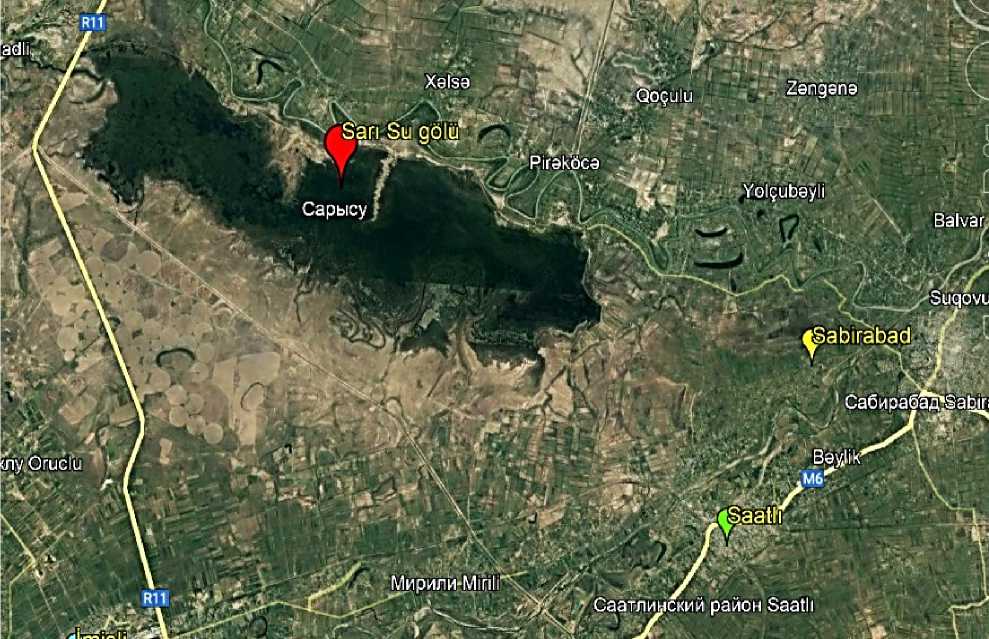
Figure. Lake Sarisu
Geobotanical investigations conducted in the flora and vegetation of Lake Sarisu identified a wide range of annual, perennial, and rhizomatous plant species. Among the recorded taxa were Cyperus fuscus L., C.glaber L., C.longus L., C.rotundus L., C.esculentus L.; Typha angustifolia L., Sparganium erectum L., Juncus subulatus Forssk., J.gerardii Loisel., J.litoralis C.A.Mey., J.acutus L.; Potamogeton crispus L., P.intramongolicus Ma, P.nodosus Poir.; Tamarix ramosissima Ledeb., T.hohenackeri Bunge; Aeluropus littoralis (Gouan) Parl., Tripolium pannonicum (Jacq.) Dobrocz., Lythrum salicaria L., Puccinellia gigantea Grossh., Eleocharis palustris (L.) Roem. & Schult., Mentha aquatica L., and Polygonum aviculare L.
The bioecological characteristics and economic importance of selected plant species were analyzed based on field observations and available literature data [18, 20, 21].
Bioecological Characteristics of Selected Species
Cyperus longus L. is a perennial species with long aromatic rhizomes and an upright, unbranched, light-green stem covered with variegated leaves. The leaves are linear, slightly broadened, and have rough margins. The inflorescence is umbellate, composed of 3-10 spikelets measuring 5-15 mm in length. Flowering occurs from June to September. The fruit is a trigonous nutlet, 1.2-1.5 mm long. The rhizomes possess a bitter taste and aromatic properties and are traditionally used as a spice.
Tripolium pannonicum (Jacq.) Dobrocz. is a biennial plant with linear to slightly fleshy leaves. The inflorescence is a capitulum composed of ligulate female marginal florets, which are blue or pale pink, and tubular bisexual central florets. The achenes are elongated, and the pappus bristles are rough. This species occurs not only in the study area but also in plains, coastal sands, saline soils, and occasionally in agricultural fields.
Potamogeton intramongolicus Ma is a perennial aquatic plant with an upward-branching stem and filamentous, branched rhizomes. The leaves are fully submerged, linear, 2-5 cm long, with acute apices. The inflorescence is spike-like and approximately 5 cm long. Flowering takes place in June, while fruiting occurs from June to July. The crescent-shaped fruits are 3.5-5 mm long. This species is used as forage for livestock and birds and is also applied as green manure in agricultural practice.
Potamogeton nodosus Poir. is a perennial aquatic plant with a long, strongly branched stem. Submerged leaves are linear-lanceolate, thin, and fragile, measuring 10-30 cm in length, while floating leaves are elliptic to lanceolate. The spike-like inflorescences (2-6 cm long) are borne on elongated peduncles. Flowering occurs from June to July, and fruiting from July to August. The nutlet-shaped fruits are 2-2.5 mm long. This species is considered rare and is occasionally used as an ornamental plant.
Polygonum aviculare L. is an annual plant with erect, ascending, or prostrate stems, 15-40 cm long. Leaves are elliptic, oval, or sometimes linear. The inconspicuous flowers are located in the leaf axils, with white or pinkish perianth segments. Flowering continues from May to October. The darkcolored, triangular seeds are 2-3 mm long. This species is a recognized medicinal plant included in pharmacopoeias and is widely used in traditional medicine due to its antioxidant, anti-inflammatory, diuretic, hemostatic, and antimicrobial properties.
Discussion
The vegetation of Lake Sarisu is represented by a single formation, Phragmiteta australis , which includes four associations: Phragmites australis + Ceratophyllum demersum ; Phragmites australis + Typha angustifolia ; Phragmites australis + Tamarix ramosissima ; and Tamarix ramosissima + Tamarix hohenackeri . Field observations indicate a gradual decline in the development dynamics of plant species within the lake ecosystem, primarily due to recent climate warming and increasing anthropogenic pressure.
Currently, Phragmites australis maintains its status as the edificator species of Lake Sarisu. This species is widely distributed across various lakes and wetlands in Azerbaijan and plays a dominant role in forming different plant associations and formations.
The vegetation cover of Lake Sarisu includes true aquatic plants (hydrophytes and hygrophytes) as well as moisture-loving species (hygromesophytes). Among hydrophytes and hygrophytes, Typha angustifolia (2-3 abundance points), Potamogeton pectinatus (2 points), P. crispus (2 points), Sparganium neglectum (1-2 points), and Ceratophyllum demersum (1-2 points) were recorded. In the surrounding areas, dominant species of Azerbaijan such as Tamarix ramosissima and Tamarix hohenackeri (2-4 points) were observed.
Hygromesophytic species forming the background vegetation in moist habitats around the lake include Aeluropus littoralis (2-3 points), Aster tripolium (2 points), Lythrum salicaria (2-3 points), Puccinellia gigantea (2-3 points), Eleocharis palustris (2 points), Mentha aquatica (1-2 points), and Batrachium trichophyllum (2-3 points).
Conclusions
The conducted research demonstrates that Lake Sarisu represents a significant center of aquatic and marsh vegetation diversity within the Republic of Azerbaijan. The floristic analysis carried out during 2022-2024 revealed that the vegetation cover of the lake is dominated by the Phragmiteta australis formation, represented by four well-defined associations. The dominant role of Phragmites australis as an edificator species confirms its key structural and functional importance in shaping the phytocoenotic structure of the lake ecosystem.
The study indicates a gradual decline in the development dynamics of several plant species inhabiting the lake and its surrounding areas. This trend is primarily associated with ongoing climate warming, hydrological fluctuations, and increasing anthropogenic pressure. Seasonal changes in water level significantly affect species composition, leading to the reduction or local disappearance of certain valuable and ecologically sensitive taxa.
The presence of hydrophytes, hygrophytes, and hygromesophytes, represented by annual, perennial, and shrubby life forms, reflects the ecological heterogeneity of the study area. The identification of rare, economically valuable, and medicinal plant species highlights the scientific importance of continuous monitoring and conservation-oriented research in the region.
Practical Significance
The flora and vegetation of Lake Sarisu possess substantial ecological and economic value. Many of the recorded plant species serve as important raw materials for cellulose and fiber production, paper manufacturing, construction materials, fodder resources, and wildlife habitats. The findings of this study emphasize the necessity of implementing regular environmental monitoring programs and developing effective conservation strategies aimed at preserving the floristic diversity and ecological stability of Lake Sarisu and its adjacent territories.
Furthermore, the results obtained can serve as a scientific basis for future geobotanical, phytocoenological, and environmental management studies, as well as for biodiversity conservation planning at the regional level.
