
The impact of tax policy on the state budget in Azerbaijan
Journal: Bulletin of Science and Practice @bulletennauki
Section: Социальные и гуманитарные науки
Article in issue: 11 т.11, 2025.
Free access
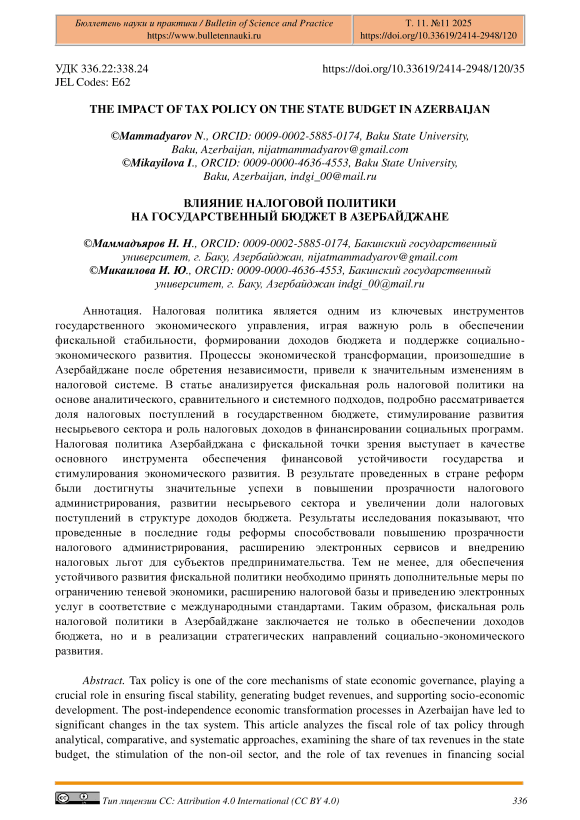
Tax policy is one of the core mechanisms of state economic governance, playing a crucial role in ensuring fiscal stability, generating budget revenues, and supporting socio-economic development. The post-independence economic transformation processes in Azerbaijan have led to significant changes in the tax system. This article analyzes the fiscal role of tax policy through analytical, comparative, and systematic approaches, examining the share of tax revenues in the state budget, the stimulation of the non-oil sector, and the role of tax revenues in financing social programs. The findings indicate that recent reforms have enhanced the transparency of tax administration, expanded electronic services, and introduced tax incentives for business entities. Nevertheless, for sustainable development of fiscal policy, further measures are required to curb the shadow economy, broaden the tax base, and align electronic services with international standards. Consequently, tax policy in Azerbaijan serves not only to ensure fiscal sustainability but also functions as a strategic tool for promoting economic growth and strengthening social welfare. In the modern context, the purpose of fiscal policy extends beyond covering government expenditures; it also aims to stimulate economic growth, create favorable conditions for entrepreneurship, and enhance social well-being. In this regard, the fiscal role of tax policy in Azerbaijan warrants examination both from theoretical and practical perspectives.
Similar articles in the section Public revenue
Short address: https://sciup.org/14135389
IDS: 14135389 | UDC: 336.22:338.24 | DOI: 10.33619/2414-2948/120/35
Влияние налоговой политики на государственный бюджет в Азербайджане
Налоговая политика является одним из ключевых инструментов государственного экономического управления, играя важную роль в обеспечении фискальной стабильности, формировании доходов бюджета и поддержке социально-экономического развития. Процессы экономической трансформации, произошедшие в Азербайджане после обретения независимости, привели к значительным изменениям в налоговой системе. В статье анализируется фискальная роль налоговой политики на основе аналитического, сравнительного и системного подходов, подробно рассматривается доля налоговых поступлений в государственном бюджете, стимулирование развития несырьевого сектора и роль налоговых доходов в финансировании социальных программ. Налоговая политика Азербайджана с фискальной точки зрения выступает в качестве основного инструмента обеспечения финансовой устойчивости государства и стимулирования экономического развития. В результате проведенных в стране реформ были достигнуты значительные успехи в повышении прозрачности налогового администрирования, развитии несырьевого сектора и увеличении доли налоговых поступлений в структуре доходов бюджета. Результаты исследования показывают, что проведенные в последние годы реформы способствовали повышению прозрачности налогового администрирования, расширению электронных сервисов и внедрению налоговых льгот для субъектов предпринимательства. Тем не менее, для обеспечения устойчивого развития фискальной политики необходимо принять дополнительные меры по ограничению теневой экономики, расширению налоговой базы и приведению электронных услуг в соответствие с международными стандартами. Таким образом, фискальная роль налоговой политики в Азербайджане заключается не только в обеспечении доходов бюджета, но и в реализации стратегических направлений социально-экономического развития.
Text of the scientific article The impact of tax policy on the state budget in Azerbaijan
Бюллетень науки и практики / Bulletin of Science and Practice Т. 11. №11 2025
УДК 336.22:338.24
Tax policy is one of the primary instruments of a state’s economic governance, shaping the directions of a country’s socio-economic development. The fiscal function, as a critical component of this policy, plays a significant role in the formation of the state budget, the maintenance of financial stability, and the implementation of social programs. In Azerbaijan, one of the key focuses of economic reforms following independence has been the enhancement of the tax system. At the beginning of the century, the high share of oil revenues deepened the dependence of fiscal policy on the oil sector; however, subsequent diversification measures have enabled tax policy to play an effective role in the non-oil sector as well.
In the contemporary context, the objective of fiscal policy is not limited to covering state expenditures; it also aims to stimulate economic growth, create favorable conditions for entrepreneurial development, and enhance social welfare. In this regard, the fiscal role of tax policy in Azerbaijan requires examination both from theoretical and practical perspectives.
Materials and Methods
The methodological foundation of this study is based on classical and contemporary economic approaches in fiscal theory, public finance, and tax policy. In particular, Keynesian fiscal theory is applied to explain the effects of government expenditures and taxation on economic activity [2].
Additionally, the analysis considers a liberal approach, emphasizing minimal state intervention in the economy and the stimulative function of reduced tax rates [3].
The study utilizes both statistical data (from the State Statistical Committee, Ministry of Economy, and State Tax Service annual reports) and comparative analyses of reports from international organizations (IMF, World Bank, OECD) [6, 7].
The methodological approach encompasses the following stages:
Analytical method — examining the share of tax revenues in GDP and their role in the revenue structure of the state budget;
Comparative method — comparing Azerbaijan’s fiscal policy with that of regional countries;
Historical-methodological approach — tracing the development stages of tax reforms from 1992 to the present;
Systemic approach — assessing the interrelationships between tax policy, economic growth, employment, and social welfare.
Бюллетень науки и практики / Bulletin of Science and Practice Т. 11. №11 2025
Results and Discussion
When evaluating the role of tax revenues in Azerbaijan’s fiscal policy, primary attention is directed towards the structure of budget revenues. In recent decades, in order to reduce dependency on the oil sector, priority measures have included broadening the tax base and promoting entrepreneurial activities in the non-oil sector [1].
-
1. Share of tax revenues in the budget. According to the State Statistical Committee, in recent years approximately 65–70% of budget revenues have been generated through taxes. This highlights the pivotal role of tax inflows as the cornerstone of fiscal policy [5].
-
2. Tax policy reforms. Significant steps have been taken in Azerbaijan to optimize the tax burden, implement electronic tax administration, enhance transparency, and reduce the shadow economy. In particular, the introduction of the “ASAN Service” model and online tax declarations has improved efficiency in fiscal management [2].
-
3. Fiscal stability and the non-oil sector. To decrease reliance on oil revenues, various incentives have been implemented in the non-oil sector, including tax exemptions in agriculture and preferential measures for small and medium-sized enterprises. Such initiatives play a crucial role in ensuring fiscal sustainability [4].
-
4. International comparison. Azerbaijan’s tax policy, unlike that of many post-Soviet countries, simultaneously performs both fiscal and stimulative functions. For example, compared to Georgia, tax incentives in Azerbaijan are more comprehensive; however, relative to Estonia, there remains potential for further development in digital tax administration.
-
5. Social aspects of fiscal policy. Revenues collected through taxes finance education, healthcare, infrastructure, and social protection programs. This underscores the role of fiscal policy as a critical instrument in promoting social equity [5].
Conclusion
From a fiscal perspective, Azerbaijan’s tax policy serves as a key instrument in ensuring the financial stability of the state and stimulating economic growth. The reforms implemented in recent years have led to significant progress in enhancing tax administration transparency, promoting the development of the non-oil sector, and increasing the share of tax revenues within the state budget.
However, for fiscal policy to remain consistently effective, efforts should be strengthened in the following areas:
-
- Expanding the tax base further and fully curbing the shadow economy;
-
- Improving electronic tax services in line with international standards;
-
- Balancing the tax burden to safeguard the interests of entrepreneurs while maintaining the stability of budget revenues;
-
- Integrating fiscal policy more closely with social equity objectives and economic growth targets.
Consequently, the fiscal role of Azerbaijan’s tax policy extends beyond merely securing budget revenues; it is also an indispensable tool for implementing strategic directions in socioeconomic development.
