
The importance of using generative artificial intelligence applications enhancing the teaching efficiency of phisical education and sports teachers at the elementary level
Journal: Sport Mediji i Biznis @journal-smb
Article in issue: 3 vol.11, 2025.
Free access
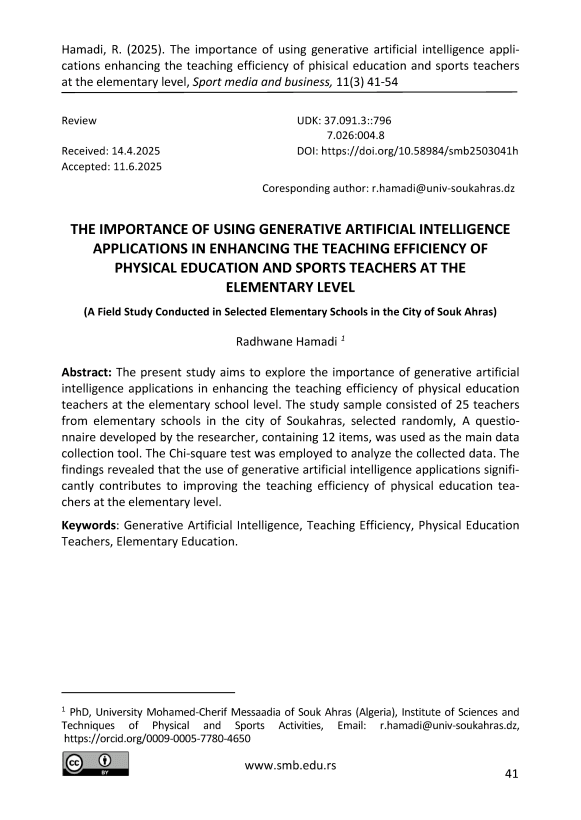
The present study aims to explore the importance of generative artificial intelligence applications in enhancing the teaching efficiency of physical education teachers at the elementary school level. The study sample consisted of 25 teachers from elementary schools in the city of Soukahras, selected randomly, A questionnaire developed by the researcher, containing 12 items, was used as the main data collection tool. The Chi-square test was employed to analyze the collected data. The findings revealed that the use of generative artificial intelligence applications significantly contributes to improving the teaching efficiency of physical education teachers at the elementary level.
Similar articles in the section Organization of instruction

Short address: https://sciup.org/170211428
IDS: 170211428 | UDC: 37.091.3::796; 7.026:004.8 | DOI: 10.58984/smb2503041h
Text of the scientific article The importance of using generative artificial intelligence applications enhancing the teaching efficiency of phisical education and sports teachers at the elementary level
DOI:
Teaching is widely recognized as a key indicator of a nation’s progress and development. The advancement of any country is largely measured by the quality of its teaching and educational systems. According to ( Al-Fatlawi 2003, p.19), teaching occupies a vital position in every society because it is not merely an ordinary profession but a foundational one that prepares qualified individuals for all other professions. She further emphasizes that the teaching profession precedes and underpins all other vocations.
The teaching process fundamentally relies on three essential components: the learner, knowledge, and the teacher. The teacher, in particular, bears the main responsibility for the success and advancement of the educational process. This responsibility requires continuous enhancement of professional competencies and ongoing updates in teaching strategies, tools, and assessment methods in line with current educational developments. Several studies have highlighted the importance of developing teachers’ professional competencies. For instance, ( Abdul Majeed 2015) found that updating teacher competencies directly contributes to raising students’ academic achievement, while (Hamdan 2012) demonstrated that continuous professional training significantly improves teaching performance.
In line with this perspective, (Al-Fatlawi 2010, p.40) asserts that teachers, as specialists in the teaching profession, must possess a deep understanding of relevant concepts, theories, principles, and instructional methodologies, They are responsible for planning and implementing the learning process using methods and strategies that correspond to learners’ cognitive and motor abilities, within the limits of available resources. This view is supported by (Al-Shibli 2016), who emphasized that the effective use of modern teaching methods requires a comprehensive understanding of learners’ individual characteristics and needs.
Teaching remains one of the fundamental pillars by which the progress and development of nations are assessed, as it reflects both the quality of the educational system and the effectiveness of its educational policies, It is not simply a routine occupation but a strategic profession that plays a pivotal role in preparing new generations to assume various responsibilities within society, The teacher stands at the heart of the educational process - transmitting knowledge, guiding learners, and equipping them with the necessary skills to meet the challenges of the modern era. (Al-Fatlawi, 2003, p.19).
The educational process consists of three key elements: the learner, the educational content, and the teacher, who serves as the central pillar ensuring the success of the process. Therefore, the continuous development of teachers’ instructional competencies is imperative. The teaching profession requires constant renewal of knowledge, methods, and assessment strategies to keep pace with rapid changes in education (Al-Fatlawi, 2010, p.40). This ongoing development is essential to maintain educational quality and achieve institutional goals.
In light of the accelerating global technological transformation, artificial intelligence (AI) has emerged as one of the most influential tools capable of reshaping education. ( Almalki , 2021) indicated that generative artificial intelligence (GAI) can assist in customizing educational content, analyzing student performance, and providing immediate feedback - thereby improving instructional efficiency. ( Similarly , Luckin et al , 2016) demonstrated that AI plays a vital role in enhancing data-driven education and optimizing educational decision-making. Generative AI, in particular, is distinguished by its ability to produce tailored learning materials, analyze learners’ progress, and provide accurate, personalized feedback to support teachers in improving their instructional approaches. According to ( Mustafa , 2009), such systems promote intelligent interaction between teacher and learner, enabling more diverse, engaging, and innovative teaching practices.
In the field of physical and sports education, the integration of AI technologies gains particular importance especially at the elementary level, which represents a formative stage for developing pupils’ motor, cognitive, and socio-emotional skills. ( Sassi , 2018) highlighted the crucial role of physical education in the child’s holistic development, while ( Zhou et al , 2020) demonstrated that AI tools can effectively monitor motor performance and provide precise feedback to enhance motor learning. Physical education is not limited to physical training; it is an educational process that aims to improve health, self-confidence, and motor proficiency in alignment with each child’s individual needs (Sassi, 2018). Nevertheless, the integration of modern technologies, including AI, within this field remains relatively limited compared to other disciplines necessitating further research to assess its potential and effectiveness in improving teaching efficiency.
Using generative AI applications to enhance teaching efficiency offers teachers new opportunities to personalize lessons, continuously analyze learners’ progress, and monitor both their motor and psychological development. This contributes to improving the overall quality of physical education and motivates students to engage more actively in learning and sports activities (Hommos , Al-Shaltout, 2008)
Given the significance of the elementary stage as the cornerstone of personality and skill development, it is essential to support physical education and sports teachers with advanced technological tools to improve instructional practices, Generative AI holds great potential for designing adaptive educational programs, analyzing learner behavior, and providing innovative solutions that meet the evolving needs of both teachers and students. Therefore, this research aims to examine the effectiveness of generative AI applications in enhancing teachers’ instructional efficiency and improving the quality of physical education in elementary schools, while also identifying the challenges and barriers to adopting such technologies within Algerian educational institutions.
Research Problem and Research Objectives
The educational process represents the cornerstone of community development and individual capacity building. Effective education cannot be achieved without focusing on the teacher’s role as a central component of this process. With the rapid advancement of technology, particularly in the field of Generative Artificial Intelligence (GAI), new opportunities have emerged to enhance teachers’ instructional efficiency across various disciplines, Despite the promising potential of these technologies, questions remain regarding the extent to which AI applications have been integrated into the field of physical and sports education, especially at the elementary level, where teaching methods must be dynamic, diverse, and performance-oriented.
The core problem lies in understanding the impact of these applications on improving the instructional efficiency of physical and sports education teachers, and in determining how modern technologies can contribute to developing teaching practices while achieving both motor and psychological learning outcomes for students. It is also essential to identify the challenges that hinder the effective adoption of such technologies in elementary schools, given the existing resources and institutional capacities (Hommos , Al-Shaltout, 2008; Sassi, 2018).
Accordingly, the following main research question is posed:
-
- To what extent does the use of generative artificial intelligence applications enhance the teaching efficiency of elementary school teachers?
-
- To identify the importance of using generative artificial intelligence applications by physical and sports education teachers at the elementary level.
The significance of this study lies in its focus on a contemporary and vital issue the integration of generative artificial intelligence in educational and administrative contexts which plays a crucial role in enhancing the quality and effectiveness of education. From this perspective, it becomes necessary to examine this topic analytically, in order to assess the current use of such technologies within Algerian institutes of physical and sports education and to determine their influence on both teaching and administrative processes.
Concepts of Research Variables
Generative Artificial Intelligence refers to the use of AI tools and applications that facilitate access to knowledge, support learning processes, and enhance the efficiency of interaction and communication between teachers and students. This includes assistance in planning, organizing, implementing, and managing classroom-related tasks.
Artificial Intelligence is a technological domain encompassing software capable of performing functions that simulate human cognition such as learning from data, understanding language, and recognizing patterns. Generative Artificial Intelligence, a subfield of AI, specializes in automatically creating new content in response to natural language prompts, including the generation of text, images, graphics, audio, video, and various forms of data.
Teaching refers to a structured set of practices systematically carried out by the teacher within an educational environment, aiming to transfer knowledge, develop skills, and achieve specific learning objectives through planned activities, implementation, monitoring, and evaluation to ensure effective learning outcomes.
According to ( Al-Hayek et al. 2022, p.14), teaching is an organized and interrelated process consisting of deliberate stages carried out by the teacher - beginning with careful planning, followed by implementation, and culminating in evaluation. The ultimate goal of this process is to create an effective learning environment that enables students to achieve predetermined educational outcomes.
Previous Studies:
Study by Noura Mohammed Abdullah Al-Azzam (2020): This study examined the contribution of artificial intelligence to improving administrative performance in human resource management at Tabuk University. It explored the practical impact of AI technologies in enhancing administrative efficiency. The findings indicated that demographic factors such as gender, qualification, and experience did not significantly influence participants’ perceptions of AI’s role in administrative performance.
Study by Mariam Shawqi Abdul Rahman Tarah (2020): This research addressed the use of AI technologies to accelerate the digitalization of education, particularly during crises that necessitate alternative learning solutions. The study emphasized the importance of integrating AI into educational environments to overcome existing and future challenges. Findings revealed that AI positively affects educational quality, highlighting the need for innovative curriculum design and development.
Study by Sidi Ahmed Kebdani and Abdul Kader Baden (2021): The purpose of this study was to clarify the importance of implementing AI in Algerian higher education institutions, particularly to improve educational quality in line with international standards. Results showed that over 81% of participants supported the adoption of AI technologies, considering them an urgent necessity. The study also stressed the need to generalize AI use across both scientific and humanistic disciplines.
Decision by Yarmouk University Deans’ Council (2024): This decision established a regulatory framework for the use of generative AI tools in education and scientific research. It aims to enhance academic performance and ensure the systematic and responsible use of AI, thereby guaranteeing the quality of educational and research outcomes.
Study by Hana Ali Al-Qarni (2024): This study reviewed the relationship between knowledge management and generative artificial intelligence, emphasizing the pivotal role that GAI technologies play in supporting knowledge management processes within educational and research institutions.
Research Methodology and Field Procedures:
Based on the nature of the topic under investigation, the descriptive method was adopted as the methodological framework for this study. This approach is employed to collect information related to the current situation of the study sample, with the aim of obtaining clear answers to the research questions. The descriptive method does not me analysis and interpretation of these data in order to contribute to a deeper understanding of the phenomenon under study. The study was conducted in several elementary schools located in the city of Souk Ahras.
The study involved 25 physical education and sports teachers working at the elementary school level.
The study was carried out during the period extending from January 18, 2025, to February 12, 2025.
The study sample consisted of 25 randomly selected physical education and sports teachers from the primary level.
Table 1. Distribution of the Study Sample According to Qualification and Experience Variables
|
percentage |
number |
category |
variable |
|
32% 68% |
08 17 |
Bachelor's degree Master's degree |
Qualification level |
|
80% 20% |
20 05 |
Less than 5 Years More than 5 Years |
Professional Experience |
Source: Prepared by the researcher based on the study sample data and SPSS v26 outputs.
Data Collection Tool :
Description of the Instrument : To collect the necessary data and information related to the study topic and its various dimensions, the researchers followed systematic steps to ensure that the instrument accurately reflected the reality of the studied phenomenon namely, the importance of using generative artificial intelligence applications to improve the teaching efficiency of physical education and sports teachers at the primary level.
A questionnaire was developed by the researchers after reviewing specialized literature and previous studies relevant to the topic. The questionnaire consisted of nine (9) statements assessing teaching competencies.
Each statement was rated on a four-point Likert scale reflecting the degree of AI application use:
-
1 = I do not use.
-
2 = Low degree.
-
3 = Moderate degree.
-
4 = High degree.
Respondents were instructed to mark (×) in the box corresponding to their level of use.
Scores ranged between 9 (minimum) and 40 (maximum), where higher scores indicate greater proficiency in using generative AI applications and improved teaching competencies.
Psychometric Properties of the Questionnaire :
The validity of the questionnaire was verified by administering it to a pilot group of 08 teachers possessing characteristics similar to those of the main sample. The extreme groups method was used to test discriminant validity, and the results are presented in Table (2).
Table 2. Validity of the Questionnaire Using the Extreme Groups Method .
|
Decision |
sig. level |
Df |
t- value |
SD |
Mean |
N |
category |
|
significant |
0.05 |
6 |
7.24 |
0.45 |
1.66 |
04 |
Lower group |
|
0.39 |
2.51 |
04 |
Upper group |
As shown in Table (2), the computed "t"-value (7.24) is significant at the "0.05" level, indicating statistically significant differences between participants with high and low scores. This confirms that the questionnaire demonstrates acceptable "discriminant validity".
Reliability :
The internal consistency reliability of the questionnaire was calculated using Cron-bach’s Alpha, The results are presented in Table (3).
Table 3: Reliability Coefficient of the Questionnaire
The results shown in Tables (2) and (3) indicate that the questionnaire possesses a
Statistical Analysis Methods:
The collected data were processed and analyzed using the following statistical techniques:
-
- Frequencies and Percentages.
-
- Arithmetic Mean.
-
- Standard Deviation.
-
- Pearson and Spearman Correlation Coefficients.
-
- Chi-Square Test (x2).
Presentation, Analysis, Interpretation, and Discussion of Results:
Answer to the Research Question : Does the use of generative artificial intelligence applications enhance the teaching efficiency of primary education teachers?
To determine the importance of using generative artificial intelligence (AI) applications in improving the teaching efficiency of primary school teachers, the researchers calculated the Chi-square (χ²) values, along with the arithmetic mean, standard deviation, and percentages, Table (04) presents the obtained results.
Table 4. Chi-square (χ²) values, percentages, and levels of significance for each questionnaire item .
|
statistical decision |
DF |
Signifi cance level |
Tabu lated хг |
calcula ted x1 |
Percentage of highest frequency |
Variable |
|
Statistically significant |
3 |
0,05 |
7,81 5 |
49,8 |
75% (High degree) |
1 have scientific knowledge and awareness of some generative Al applications: |
|
Statistically significant |
3 |
0,05 |
7,81 5 |
37 |
%65 (High degree) |
1 have the ability to use generative Al applications: |
|
Statistically significant |
3 |
0,05 |
7,81 5 |
37,4 |
%65 (High degree) |
Generative Al applications help me in lesson planning and preparation: |
|
Statistically significant |
3 |
0,05 |
7,81 5 |
51Д |
77.5% (High degree) |
1 rely on generative Al applications to produce lesson outputs (texts, images, audio, videos, etc.): |
|
Statistically significant |
3 |
0,05 |
7,81 5 |
32,6 |
60.5% (Sometimes) |
1 advise my colleagues to use generative Al applications: |
|
Statistically significant |
3 |
0,05 |
7,81 5 |
38,2 |
67.5% (Sometimes) |
1 rely on generative Al applications during lesson implementation: |
|
Statistically significant |
3 |
0,05 |
7,81 5 |
29,6 |
57.5% (Sometimes) |
1 use generative Al applications in developing learning situations: |
|
Statistically significant |
3 |
0,05 |
7,81 5 |
23,2 |
50% (High degree) |
Generative Al applications help me deal with students' individual differences: |
|
Statistically significant |
3 |
0,05 |
7,81 5 |
49,8 |
72.5% (Medium degree) |
1 rely on generative Al applications in the assessment process: |
The results displayed in Table 4 indicate that all the calculated Chi-square (χ²) values exceed the tabulated value of "7.815" at the "0.05 significance level" with "three degrees of freedom".
This demonstrates that the differences between frequencies are not random but statistically significant, suggesting a consistent trend among participants’ responses toward the questionnaire items.
Interpretation of Results by Variable :
-
1. Knowledge and awareness of generative AI applications (72.5%) : The high percentage indicates that most participants possess substantial awareness and understanding of generative AI technologies, reflecting their growing presence and acceptance within the educational environment.
-
2. Ability to use generative AI applications (65%) : This result reflects participants’ practical competence in using such tools, implying that they have received adequate training or exposure that enables effective utilization.
-
3. Use of AI in lesson planning and preparation (65%) : Generative AI appears to serve as an effective support tool during the planning stages of lessons, fostering creativity and the development of more tailored and efficient instructional materials.
-
4. Reliance on AI for producing lesson outputs (77.5%) : This is the highest percentage observed, indicating a strong dependence on AI tools for creating diverse educational content (texts, visuals, audio, and video), thereby demonstrating their significant practical value in the teaching process.
-
5. Recommending AI applications to colleagues (60.5%) : Although this percentage is slightly lower than previous ones, it remains positive, suggesting that while many teachers advocate for AI adoption, some may still require reassurance or further evidence of its effectiveness.
-
6. Use of AI during lesson implementation (67.5%) : The results reveal notable integration of AI tools in classroom teaching, though potential "technical or organizational barriers" might still limit broader adoption.
-
7. Use of AI in developing learning situations (57.5%) : Less than two-thirds of teachers apply generative AI in this area, which may highlight challenges in aligning these tools with existing instructional strategies or pedagogical models.
-
8. Use of AI in addressing individual differences (50%) : This moderate percentage indicates a fair level of use, suggesting the need for further development of AI tools that more effectively adapt to learners’ diverse needs and abilities.
-
9. Use of AI in assessment (72.5%) : The results suggest that generative AI applications significantly contribute to "enhancing the objectivity and accuracy of assessment practices", thereby improving overall teaching performance and pedagogical outcomes. Would you like me to continue this section with an "academic conclusion and comparison with previous studies" (as a “Discussion of Findings” subsection)? That would make the paper more complete and ready for publication or conference presentation.
General Discussion
The findings of this study reveal a high level of acceptance and significant engagement with generative artificial intelligence (AI) applications across various stages of the educational process namely, lesson preparation, implementation, and assessment. The results further indicate that participants possess advanced technical knowledge and capabilities, reflecting a progressive stage in the integration of generative AI technologies into educational contexts. However, the degree of utilization varies according to educational objectives; areas such as addressing individual differences and developing learning situations still require additional institutional support and targeted professional training.
The present study also confirmed that physical education and sports teachers demonstrate substantial awareness and proficiency in using generative AI applications. A large proportion of participants reported scientific and practical knowledge of these technologies, which aligns with recent studies highlighting the growing integration of AI in education in general and in physical education in particular as an effective tool for enhancing instructional practices and facilitating preparation and evaluation processes (Zhang et al., 2022; Al-Mahmoud, 2021).
Moreover, the study’s findings indicate that generative AI is widely employed in lesson planning, preparation, and the production of diverse educational content such as texts, images, and videos thereby improving teaching efficiency through greater flexibility, creativity, and variety in instructional methods. These results are consistent with the conclusions of Kim and Park (2020), who found that the integration of AI into educational practices reduces teachers’ workload while improving the quality and adaptability of learning materials.
Regarding the use of generative AI during lesson implementation and in developing learning situations, the results were moderate. This may reflect certain technical, logistical, or pedagogical challenges encountered by teachers, particularly within the dynamic and interactive nature of physical education classes. Similar findings were reported by García and López (2019), who emphasized the need for targeted teacher training programs to facilitate the effective incorporation of technology into learning environments that require real-time physical engagement.
Although the percentage of teachers using AI to address individual learner differen-ces was moderate, this finding highlights an opportunity for future research and technological development to create adaptive AI solutions that respond to students’ diverse physical and cognitive needs. This is especially relevant in physical education, where learners vary in motor skills and physical capacity. In this regard, Santos et al. (2021) suggest that adaptive AI systems hold promise for analyzing motor performance and providing personalized, real-time feedback to enhance learning outcomes.
With respect to the use of AI in the assessment process, the findings revealed a strong reliance on generative AI tools, underscoring their growing role in improving evaluation methods by making them more objective, dynamic, and data-driven. This observation is supported by Nguyen et al. (2023), who demonstrated that AI-powered assessment systems can provide detailed performance analytics and tailored recommendations that enhance students’ future achievements.
In light of these findings, it can be concluded that the results of this study are largely consistent with global trends emphasizing the use of AI to enhance teaching efficiency. Nonetheless, they also point to the need for continued training, institutional support, and the systematic integration of AI tools particularly in interactive educational contexts such as physical education lessons at the primary level.
Recommendations Based on the Results:
-
1. Enhance professional training programs focused on the pedagogical use of generative AI tools, particularly in underutilized areas such as personalized learning and classroom management.
-
2. Develop adaptive AI applications that promote individualized instruction and accommodate learners’ physical, cognitive, and emotional differences.
-
3. Encourage the dissemination of AI literacy and foster a culture of collaboration among teachers through professional communities and knowledge-sharing platforms.
-
4. Integrate generative AI tools into educational policies and curricula, ensuring their ethical, effective, and sustainable use in enhancing teaching and learning outcomes.
