
The need to use different types of tasks in foreign language classes at a non-linguistic higher education institution.
Free access
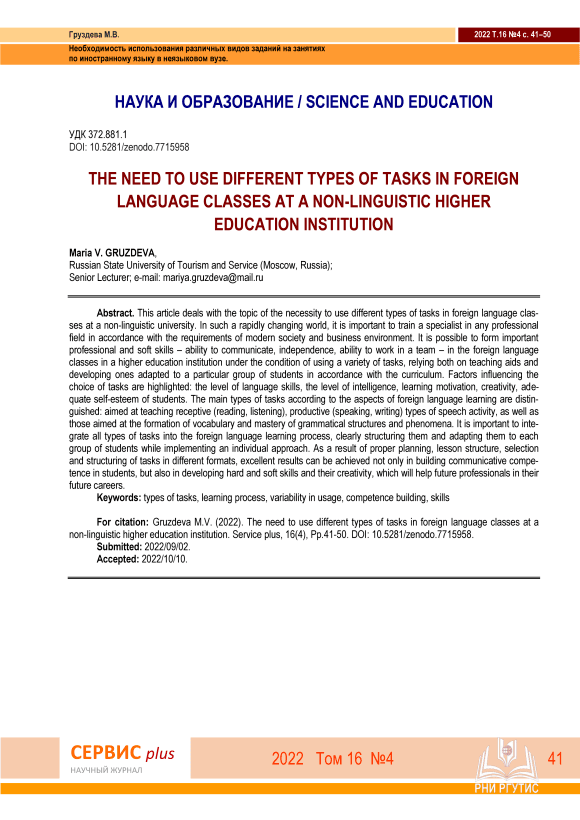
This article deals with the topic of the necessity to use different types of tasks in foreign language classes at a non-linguistic university. In such a rapidly changing world, it is important to train a specialist in any professional field in accordance with the requirements of modern society and business environment. It is possible to form important professional and soft skills - ability to communicate, independence, ability to work in a team - in the foreign language classes in a higher education institution under the condition of using a variety of tasks, relying both on teaching aids and developing ones adapted to a particular group of students in accordance with the curriculum. Factors influencing the choice of tasks are highlighted: the level of language skills, the level of intelligence, learning motivation, creativity, adequate self-esteem of students. The main types of tasks according to the aspects of foreign language learning are distinguished: aimed at teaching receptive (reading, listening), productive (speaking, writing) types of speech activity, as well as those aimed at the formation of vocabulary and mastery of grammatical structures and phenomena. It is important to integrate all types of tasks into the foreign language learning process, clearly structuring them and adapting them to each group of students while implementing an individual approach. As a result of proper planning, lesson structure, selection and structuring of tasks in different formats, excellent results can be achieved not only in building communicative competence in students, but also in developing hard and soft skills and their creativity, which will help future professionals in their future careers.
Similar articles in the section Education
Short address: https://sciup.org/140297220
IDS: 140297220 | UDC: 372.881.1 | DOI: 10.5281/zenodo.7715958
Необходимость использования различных видов заданий на занятиях по иностранному языку в неязыковом вузе
В данной статье рассматривается тема необходимости использования различных видов заданий на занятиях по иностранному языку в неязыковом вузе. В условиях столь быстро меняющегося мира важно подготовить специалиста любой профессиональной сферы в соответствии с требованиями современного общества и бизнес среды. На занятиях по иностранному языку в высшем учебном заведении возможно формировать важные профессиональные и гибкие навыки - способность к коммуникации, самостоятельность, возможность работы в команде при условии использования разнообразных заданий, опираясь как на учебные пособия, так и разрабатывая адаптированные варианты заданий к конкретной группе студентов в соответствии с учебной программой. Отмечаются факторы, влияющие на выбор заданий: уровень языковой подготовки, уровень интеллекта, учебная мотивация, креативность, адекватная самооценка учащихся. Выделяются основные виды заданий в соответствии с аспектами изучения иностранного языка: направленные на обучение рецептивным (чтение, аудирование), продуктивным (говорение, письмо) видам речевой деятельности, а также направленные на формирование лексического запаса и овладение грамматическими структурами и явлениями. Важно интегрировать в процесс обучения иностранному языку все виды заданий, четко структурируя их и адаптируя к каждой группе студентов, осуществляя при этом индивидуальный подход. В результате грамотного планирования, построения занятия, подбора и структурирования заданий в разных форматах можно добиться отличных результатов не только в формировании у студентов коммуникативной компетенции, но и развитии профессиональных и гибких навыков, творческого потенциала, что поможет будущим специалистам в дальнейшей профессиональной деятельности.
References The need to use different types of tasks in foreign language classes at a non-linguistic higher education institution.
- Vygotsky, L.S. (1982-1984). Sobranie sochinenij v 6 t. Tom 3 [Collection of Works in 6 vols. VOL. 3.]. Moscow: Pedagogica. (In Russ.).
- Gruzdeva, M.V., Gazilov, M.G., Loginova, N.Y., & Kostovarova, V.V. (2021). Razvitie tvorcheskogo potenciala studentov v neyazy'kovom vuze na zanyatiyax po inostrannomu yazy'ku [The Development of Creative Potential of Students in Non-linguistic Institutions of Higher Education in Foreign Language Classes]. Service Plus, 15 (4), 66-76. (In Russ.).
- Gruzdeva, M.V., Loginova, N.Y., Chudaykina, G.M., & Kostovarova, V.V. (2020). Formirovanie kommunikativnoj kompetencii studentov v processe obucheniya inostranny'm yazy'kam v neyazy'kovom vuze [The formation of communicative competence of students in the process of teaching foreign languages in a non-linguistic university]. Service plus, 14 (3), 122-124. (In Russ.).
- Zimnyaya, I.A. (2000). Pedagogicheskaya psixologiya: uchebnik dlya vuzov [Pedagogical Psychology: Textbook for Higher Education Institutions]. Moscow: Logos. (In Russ.).
- Ilyin, V.S. (1978). O povy'shenii sistemnosti v pedagogicheskoj podgotovke studentov k rabote v shkole [On enhancing consistency in the pedagogical training of students to work in school]. Sovremenny'e zadachi obshheobrazovatel'noj shkoly' i problemy' podgotovki pedagogicheskix kadrov [Modern tasks of the general education school and the problems of training pedagogical staff]: Collection of scientific works of the APN USSR Research Institute of General Pedagogy. Мoscow: APN USSR Research Institute of General Pedagogy, 24-36. (In Russ.).
- Nikitin, V.A. (1999). Nachalo social'noj pedagogiki: uch.pos. [The Beginning of Social Pedagogy: tutorial]. Moscow: Flinta. (In Russ.).
- Solovova, E.N. (2005). Metodika obucheniya inostranny'm yazy'kam. Bazovy'j kurs lekcij [Methodology of Teaching Foreign Languages. Basic Course of Lectures]. Moscow: Prosveshcheniye. (In Russ.).
- Mahmoodi-Shahrebabaki, M. (2015). On the Understated and Avant-garde Language Teaching Methods and Theories. International Journal of Applied Linguistic Studies, 4 (1), 17-23.
- Willis, J. & Willis, D. (2013). Doing Task-Based Teaching. Oxford: Oxford University Press.
- Edwards C. & Willis J. (2005). Teachers Exploring Tasks in English Language Teaching. London: Palgrave Macmillan.
