
The Role of Artificial Intelligence in the Research of the Flora of the Hakari River Basin (Azerbaijan)
Journal: Bulletin of Science and Practice @bulletennauki
Section: Естественные науки
Article in issue: 2 т.12, 2026.
Free access
In connection with the practical implementation of the “Artificial Intelligence Strategy for 2025-2028”, approved by the Decree of the President of the Republic of Azerbaijan dated March 19, 2025, an International Conference on “Artificial Intelligence for a Better Future” was held in Shusha this year. After the conference, a scientific expedition was organized along the banks of the Hakari River in the Lachin district. This year, at the same time, during the expedition in the Zangilan district, monitoring was carried out on the main plant groups distributed in the Hakari river basin. A critical survey of the flora biodiversity of the Hakari river basin was carried out, the invertarization of species, taxonomic structure were clarified, and bioecological characteristics were studied. It was found that the flora biodiversity of the Hakari river basin consists of 107 species belonging to 32 families and 74 genera. The vegetation of the Hakari river basin consists of 14 formations and 47 associations. Scientifically based data has been collected for the systematic study of plant diversity in the Hakari river basin, identification of rare and endemic species, monitoring of population changes, and protection of biodiversity through artificial intelligence technologies.
Similar articles in the section Threats to the environment
Short address: https://sciup.org/14134421
IDS: 14134421 | UDC: 504.73.05 | DOI: 10.33619/2414-2948/123/09
Роль искусственного интеллекта в исследовании флоры бассейна реки Хакари (Азербайджан)
В связи с реализацией «Стратегии развития искусственного интеллекта на 2025-2028 годы», утвержденной Указом Президента Азербайджанской Республики от 19 марта 2025 г, в Шуше состоялась Международная конференция «Искусственный интеллект для лучшего будущего». После конференции была организована научная экспедиция вдоль берегов реки Хакари в Лачинском районе. Одновременно с экспедицией в Зангиланском районе, был проведен мониторинг основных групп растений, распространенных в бассейне реки Хакари. Проведено исследование биоразнообразия флоры бассейна реки Хакари, инвертизация видов, уточнена таксономическая структура и изучены биоэкологические характеристики. Было установлено, что биоразнообразие флоры бассейна реки Хакари включает 107 видов, принадлежащих к 32 семействам и 74 родам. Растительность бассейна реки Хакари состоит из 14 формаций и 47 ассоциаций. Для систематического изучения разнообразия растений в бассейне реки Хакари, идентификации редких и эндемичных видов, мониторинга изменений численности популяций и защиты биоразнообразия с помощью технологий искусственного интеллекта были собраны научно обоснованные данные.
Text of the scientific article The Role of Artificial Intelligence in the Research of the Flora of the Hakari River Basin (Azerbaijan)
Бюллетень науки и практики / Bulletin of Science and Practice
UDC 504.73.05
The Hakari river basin is a floristically and ecologically rich area located in the southwest of Azerbaijan. This basin creates favorable conditions for the spread of rare and endemic plant species and is of particular importance in terms of biodiversity conservation. In recent years, studying the flora of the region, monitoring population structures and assessing the state of ecosystems have become one of the main priorities of research. The aim of the current study is to systematically study plant diversity in the Hakari river basin, identify rare and endemic species, monitor population changes, and collect scientifically based data for biodiversity conservation through artificial intelligence technologies, and systematize the obtained data for use in the preparation of scientific articles, databases, and ecosystem management strategies. This approach, combining both classical floristic and phytocenotic research methods and artificial intelligence technologies, allows for a more in-depth and accurate study of the ecological state of the Hakari river basin [2].
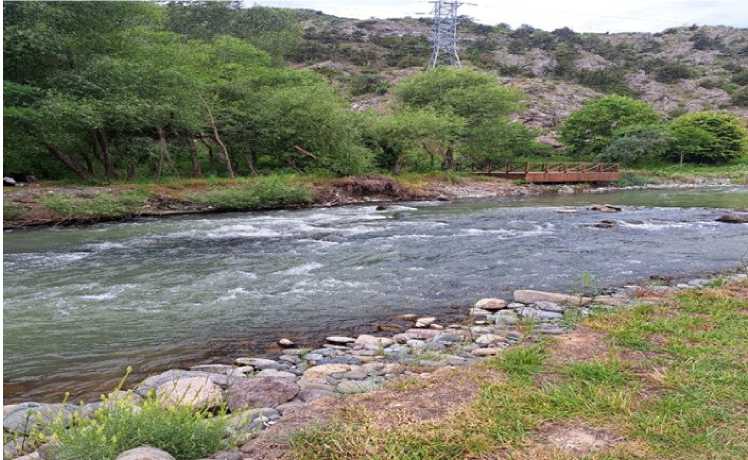
Figure. Hakari River Basin
In connection with the practical implementation of the “Artificial Intelligence Strategy for 2025-2028”, approved by the Decree of the President of the Republic of Azerbaijan dated March 19, 2025, the International Shusha Conference on the topic “Artificial Intelligence for a Better Future” was held this year. After the conference, a scientific expedition was organized along the banks of the Hakari River in the Lachin district. At the same time, monitoring was carried out on the main plant groups distributed in the Hakari River basin during the expedition in the Zangilan district this year.
The Hakari River Basin is a watershed in southwestern Azerbaijan, where the Hakari River, a left tributary of the Araz River, collects water. This basin flows through the Lachin, Gubadli, and Zangilan regions. Its length is 113 km. It begins at an altitude of 2,580 m, 3.5 km east of the Shishtepe peak, south of the Mikhtoken ridge, at the confluence of the Shelva River and Hocazsu Rivers (950 m), and merges with the Araz River in the Zangilan region.
Material methodology of the study
Plant diversity in the Hakari river basin consists of broad-leaved mountain forests, subalpine meadows, semi-desert and steppe areas, shrub and sparse forests. Taking into account the relief features and ecosystem types, 5–10 main observation points are selected along the Hakari river basin, and vegetation monitoring is carried out at each point. The main methods used in determining plants using artificial intelligence are determined and plants are identified based on the shapes of leaves, flowers, seeds and fruits. By analyzing the visual characteristics of plants, their automatic identification and naming are possible. Through modern mobile applications and artificial intelligence-based systems, users can instantly recognize plants by scanning them with a camera. With the help of artificial intelligence, it is possible to monitor the distribution of plants, their location, the natural plant groups where plants living in a certain area interact, and the main components of ecosystems through satellite and drone images. In natural flora, with the help of artificial intelligence, species identification can be carried out by analyzing bioacoustic data such as the rustling of leaves of trees and other plants, the effect of wind, and even the circulation of water. This method is mostly applied in monitoring forest ecosystems[2, 3, 6, 8].
The proclamation of 2024 as the "Year of Solidarity for a Green World" by the Decree of the President of the Republic of Azerbaijan dated December 25, 2023 laid the foundation for the methodology for protecting biodiversity and ecological forecasting of the "Artificial Intelligence Strategy".
Discussion of the work
The territory is very suitable for the preservation of rare relict and endemic species. In general, as a result of monitoring, 30 species of trees, 22 shrubs and 37 herbaceous plant species were recorded in the Hakari river basin. The forests along the Hakari river bank were brutally plundered by the Armenian invaders for about 30 years. Artemisetum semi-deserts and Stipetum steppes are characteristic of the Hakari river basin. Gagea glacialis K. Koch, Tulipa julia K. Koch, Orchis punctulata Steven ex Lindl . , Pyrus salicifolia Pall., Juniperus foetidissima Willd., Paeonia tenuifolia L., Festuca karabaghensis Mussajev, Tulipa karabachensis Grossh., p.p. incl. typo. and others are rare species. Salvia karabachensis Pobed., S. nemoralis L., Astaratia maxima Pall., Centaurea karabachensis Sosn., Taxus baccata L. are the main plant groups of the Haraki River.
Oriental plane ( Platanus orientalis L.), Araz oak ( Q. araxina L.), Red oak ( Quercus rubra L.), Long-leaved oak ( Q. robur K. Koch.), Georgian oak ( Q. iberica Stev . ), ( Fagus orientalis Lipsky), Celtis caucasica Willd, Eastern beech ( C. orientalis L.), Pterostylis mutica R. Br., Iberian maple ( Acer iberica M. Beib.), Araz elm ( Ulmus araxina Takht.), Pyrus salicifolia Pall., juniper form sparse forests. In these forests, xerophytic shrubs Atraphaxis spinosa L., Lonicera iberica M. Bieb., Caucasian small-fruited cherry ( Cerasus microcarpa (C.A. Mey.) Boiss.), Ephedra intermedia Schrenk & C.A. Mey., bush jasmine ( Jasminum fruticans L.), Rhamnus pallasii Fisch. & C.A. Mey. and Paliurus spina-christi Mill. are naturally distributed. Shrubby and sparsely wooded meadows, broad-leaved mountain forests (oak, beech, beech) are widespread along the coast. Pine ( Pinus sylvestris L.), oak ( Q. rubra L.), hornbeam ( Carpinus orientalis Mill . ), linden ( Tilia caucasica Rupr.), maple, willow ( Salix L.), elm, acacia, poplar, juniper, chestnut, Taxus baccata, and pear trees predominate in the forests. For the subalpine zone, dry slopes, mesophilous meadows of steppe and relatively humid slopes, and various herbaceous meadows dominate for the alpine zone. In these areas, there are many medicinal plants are found [1, 4, 5].
Phrygana and xerophyte-type algae have formed in the Hakari River basin [2].
48 species of diatoms have been identified in the Hakari River basin [3].
According to biological characteristics and distribution patterns, the Arctic-Tertiary relicts of the Hakari river basin include Parmelia borreri, P. omphalodes, Bilimbia pulchra, Lecidea elata,
Bacidia muscorum, Lecidea lapicida, Aspicilia alpina, A. pleiocarpa, Hypogimnia vellata, Lecanora badia, Acarosporpa badiofusca, Solorina saccata, S. bispora, Cetraria cuculata, C. nivalis, Thelidium papulare, Caloplaca tetrospora, Stereocolon alpinum, Ochrolechia tetraspora, Rizocarpon alpicola, etc. Species such as Aspicilia, Caloplaca, Placodium, Rhizocarpon, Dermatocarpon, Gyrophora, Lecidea, Acarospora, Verrucaria, etc. are distributed in the Hakari river basin. species of the genera form synucias with species of the moss genera Dicranum, Tortyla, Ambylastegi a, and Pottia .
Considering the rich diversity of the flora of Hakari river, including Zangilan and Lachin, the study of the species composition, areas, phytocenotic characteristics and resources, monitoring the increasing activity of invasive plant species that cause the loss of biodiversity, conducting important field studies to determine their status and the degree of impact on the local flora, and including the results in existing databases — all this should be the main topic of research work to be carried out in the near future. On dry stony slopes, Araz oak (Q. araxina), Celtis caucasica Willd, C. orientalis , P. mutica , Acer iberica , Ulmus arahina , willow-leaf pear ( Pyrus salicifolia ), and juniper form sparse forests. In these forests, xerophytic shrubs Atraphaxis spinosa, Lonicera iberica, small-fruited whiteberry ( Cerasus microcarpa ), Ephedra intermedia Schrenk Et. C. A. Mey., bush jasmine ( Jasminum fruticans ), Rhamnus pallasii, and Paliurus spina — christi are naturally distributed [5, 6].
The flora of the Hakari river basin is of great ecological importance, and this creates conditions for taking special measures to protect biodiversity. The Hakari river basin is a floristically and ecologically rich area located in the southwest of Azerbaijan. Monitoring has shown that 30 species of trees, 22 shrubs, and 37 herbaceous plant species are widespread in the basin. The application of artificial intelligence makes a great contribution to a deeper and faster study of plant diversity, the protection of biodiversity, and the management of ecosystems. The study and protection of the vegetation of the region will help maintain the balance of the ecosystem. With the widespread use of these technologies, flora research can enter a new stage. Through artificial intelligence, it is possible to identify plants in forest and meadow ecosystems, determine their population changes, and determine the distribution areas of rare plant and animal species, and propose measures for their protection. Systematic study of the flora of the Hokari river basin and inclusion of the obtained data in existing databases should be considered a priority direction for both the protection of endemic and relict species and continuous monitoring of biodiversity. These studies will also create a scientific basis for future ecology, phytocenotics and plant protection programs.
