
The Role of Public Reception Offices and Child Helplines in the Protection of Children's Rights: Institutional and Legal Perspectives (Case of the Kyrgyz Republic)
Journal: Bulletin of Science and Practice @bulletennauki
Section: Социальные и гуманитарные науки
Article in issue: 5 т.12, 2026.
Free access
This article examines the institutional and legal role of public reception offices and child helplines in ensuring effective protection of children's rights. These mechanisms serve as accessible channels for reporting violence, abuse, neglect, and other violations affecting minors. The study analyzes their organizational framework, legal foundations, procedural safeguards, and interaction with state authorities within the child protection system of the Kyrgyz Republic. Special attention is given to accessibility, confidentiality, early detection of violence, and referral mechanisms. Based on institutional practice and international child protection standards, the article argues that public reception offices and child helplines function not only as reactive complaint mechanisms but also as preventive instruments that strengthen accountability and improve access to justice for children. The findings highlight the need for further digitalization, improved inter-agency coordination, and legislative refinement to enhance the effectiveness of these child-sensitive protection mechanisms.
Similar articles in the section Home affairs. Internal policy
Short address: https://sciup.org/14135678
IDS: 14135678 | UDC: 323.2 | DOI: 10.33619/2414-2948/126/63
Роль государственных приемных и детских горячих линий в защите прав детей: институциональные и правовые аспекты (на примере Кыргызской Республики)
Рассматривается институциональная и правовая роль государственных приемных пунктов и детских горячих линий в обеспечении эффективной защиты прав детей. Эти механизмы служат доступными каналами для сообщения о насилии, жестоком обращении, пренебрежении и других нарушениях, затрагивающих несовершеннолетних. В исследовании анализируются их организационная структура, правовые основы, процессуальные гарантии и взаимодействие с государственными органами в рамках системы защиты детей Кыргызской Республики. Особое внимание уделяется доступности, конфиденциальности, раннему выявлению насилия и механизмам направления к соответствующим службам. На основе институциональной практики и международных стандартов защиты детей в статье утверждается, что государственные приемные пункты и детские горячие линии функционируют не только как механизмы реагирования на жалобы, но и как превентивные инструменты, укрепляющие подотчетность и улучшающие доступ детей к правосудию. Результаты подчеркивают необходимость дальнейшей цифровизации, улучшения межведомственной координации и совершенствования законодательства для повышения эффективности этих механизмов защиты, учитывающих интересы детей.
Text of the scientific article The Role of Public Reception Offices and Child Helplines in the Protection of Children's Rights: Institutional and Legal Perspectives (Case of the Kyrgyz Republic)
Бюллетень науки и практики / Bulletin of Science and Practice
UDC 323.2.
Ensuring effective protection of children’s rights requires not only substantive legal guarantees but also accessible and child-sensitive mechanisms through which violations can be reported and addressed. Public reception offices and child helplines constitute important institutional tools designed to facilitate access to justice, early detection of abuse, and coordinated response within national child protection systems. In the Kyrgyz Republic, the development of such mechanisms reflects both international obligations and domestic policy efforts aimed at strengthening preventive and responsive measures against violence and neglect. At the international level, the Convention on the Rights of the Child (CRC) establishes the obligation of States Parties to protect children from all forms of violence, abuse, and exploitation [8].
General Comment № 5 emphasizes the necessity of effective implementation mechanisms, including independent monitoring bodies and accessible complaint procedures [10].
Furthermore, General Comment No. 13 underlines that States must ensure the availability of confidential, child-sensitive reporting channels that are safe and accessible [11].
These standards collectively frame child helplines and reception offices not merely as administrative services but as components of the broader system of child rights governance. In the context of the Kyrgyz Republic, national legislation reinforces these international commitments. The Law of the Kyrgyz Republic “On Protection and Safeguarding from Family Violence” establishes a framework for inter-agency cooperation and protection of victims, including minors [3].
Complementing legislative measures, institutional mechanisms such as the Child Helpline 111 operate as direct communication channels for children and their families [1-5].
These services aim to provide immediate psychological support, legal guidance, and referral to competent authorities. Empirical assessments indicate that violence against children remains a significant concern in Kyrgyzstan, with many cases remaining underreported due to social stigma, fear, and limited awareness of available support mechanisms [7].
In this regard, public reception offices and hotlines play a critical role in lowering reporting barriers and enabling early intervention. UNICEF’s country reports emphasize that strengthening complaint mechanisms enhances institutional accountability and contributes to systemic prevention strategies [4].
The Ombudsman of the Kyrgyz Republic also highlights the importance of accessible reporting channels in annual reports on children’s rights, noting that a substantial proportion of complaints relate to domestic violence, neglect, and violations within educational institutions [5].
Such data demonstrate the practical relevance of helplines and public reception services as instruments for both reactive intervention and preventive oversight. Despite their importance, challenges persist. Limited regional coverage, insufficient digital integration, and resource constraints may hinder the full realization of these mechanisms’ potential. International experience suggests that sustainable effectiveness requires legal clarity, institutional independence, inter-agency coordination, and continuous public awareness campaigns [9].
Against this background, the present article aims to examine the legal and institutional role of public reception offices and child helplines in the protection of children’s rights in the Kyrgyz Republic. The study analyzes their normative basis, procedural functioning, and practical contribution to violence prevention and access to justice. By situating national practice within the framework of international child protection standards, the research seeks to assess the effectiveness of existing mechanisms and to identify directions for further institutional and legislative improvement. The present study employs a qualitative legal and institutional analysis to examine the role of public reception offices and child helplines in the protection of children’s rights in the Kyrgyz Republic. The methodological framework integrates doctrinal legal research, comparative analysis, and elements of institutional assessment in order to evaluate both normative foundations and practical functioning of complaint mechanisms. The core methodological approach is the formal-legal (doctrinal) method, which was used to analyze international and national legal instruments regulating child protection mechanisms. Primary sources include the Convention on the Rights of the Child, General Comment № 5 on general measures of implementation, and General Comment № 13 on the right of the child to freedom from all forms of violence [6-9].
These documents establish normative requirements for accessible, confidential, and childsensitive reporting mechanisms. At the national level, the Law of the Kyrgyz Republic “On Protection and Safeguarding from Family Violence” was examined to determine the legal status of inter-agency cooperation and procedural guarantees for victims, including minors. Doctrinal interpretation allowed the identification of legal principles governing complaint mechanisms, including accessibility, confidentiality, non-discrimination, and accountability. A comparative standards-based approach was applied to assess the alignment of national practice with international child protection requirements. Reports and analytical materials from UNICEF Kyrgyzstan were used to evaluate how institutional mechanisms such as Child Helpline 111 correspond to international recommendations on early detection and prevention of violence [7].
Additionally, materials from Child Helpline International (n.d.) were consulted to contextualize the Kyrgyz helpline within the broader global network of child-focused support systems. This comparative perspective enabled assessment of structural features such as anonymity guarantees, referral procedures, and data monitoring practices [1].
An institutional analysis was conducted using publicly available reports from the Ombudsman of the Kyrgyz Republic (n.d.) and information from the Ministry of Labor, Social Security and Migration (2020) regarding the operational activities of Child Helpline 111 [6].
This method focused on evaluating: procedural stages of complaint reception and processing; referral mechanisms to law enforcement and social services; inter-agency coordination practices; preventive and awareness-raising functions. The study also relies on secondary statistical and policy data from UNICEF Kyrgyzstan (2023), which provide contextual information on underreporting, risk factors, and systemic barriers in child protection [7].
The research is grounded in a child-rights-based approach, which conceptualizes access to complaint mechanisms as a component of the broader right to protection and access to. The analytical framework integrates: the principle of the best interests of the child; the requirement of effective remedies; prevention-oriented governance models emphasized in General Comment № 13 [8, 9].
By combining doctrinal, comparative, and institutional methods, the study ensures a comprehensive assessment of both normative design and practical implementation of public reception offices and child helplines in the Kyrgyz Republic. This multi-method approach enhances the reliability of conclusions regarding institutional effectiveness and provides a foundation for evidencebased recommendations for strengthening child protection mechanisms. The findings demonstrate that public reception offices and child helplines in the Kyrgyz Republic function as essential access-to-justice mechanisms within the broader child protection system. Their effectiveness, however, varies depending on institutional coordination, accessibility, and procedural safeguards. Institutional data indicate that Child Helpline 111 functions as a nationwide, toll-free mechanism designed to provide immediate psychological, informational, and referral assistance to children and their families [4].
The hotline operates as an entry-level protection channel, ensuring that children can seek help without financial barriers or procedural complexity. From a structural perspective, accessibility operates along three dimensions: 1. Geographical accessibility — the hotline is available nationwide, including rural areas, thereby partially compensating for the limited physical presence of specialized child protection offices in remote regions; 2. Procedural accessibility — calls may be anonymous, reducing fear of retaliation or stigma; 3. Psychological accessibility — trained operators provide initial counseling, creating a safe environment for disclosure. UNICEF Kyrgyzstan (2023) emphasizes that underreporting of child abuse remains a systemic challenge. Cultural stigma, fear of family repercussions, distrust toward authorities, and lack of awareness about available services contribute to the hidden nature of violence. Confidential and anonymous helplines directly address these barriers by lowering the threshold for disclosure [7].
The model of Child Helpline 111 aligns with Article 19 of the Convention on the Rights of the Child, which obliges States to protect children from all forms of violence [8].
Furthermore, General Comment № 13 requires accessible, child-sensitive complaint mechanisms that guarantee confidentiality and protection from retaliation [9].
Importantly, helplines not only serve as reactive instruments but also function as early detection tools. Initial consultations may reveal risk factors even before severe harm occurs. This preventive potential positions helplines within the broader child protection governance system rather than merely as crisis-response services.
Table 1
FUNCTIONAL CHARACTERISTICS OF CHILD HELPLINES IN KYRGYZSTAN
|
Indicator |
Observed Practice |
Legal/Policy Basis |
International Standard Alignment |
|
Toll-free access |
Nationwide hotline (111) |
Ministry of Labor (2020) |
CRC Art. 19 |
|
Confidentiality |
Anonymous consultations |
Internal procedural safeguards |
General Comment № 13 |
|
Referral system |
Cooperation with police and social services |
Family Violence Law (2017) |
Inter-agency model (UNICEF, 2023) |
|
Psychological support |
Immediate crisis counseling |
Social protection mandate |
Best interests principle (CRC Art. 3) |
|
Early risk detection |
Identification of latent abuse |
Institutional practice |
Prevention-oriented model |
Analysis of publicly available reports from the Ombudsman of the Kyrgyz Republic (n.d.) and UNICEF Kyrgyzstan (2023) indicates that the majority of complaints fall into several recurring categories. These patterns reveal both structural vulnerabilities within families and systemic weaknesses in child protection mechanisms [5, 6].
Domestic violence constitutes the most frequently reported category. Cases often involve physical abuse, psychological coercion, or exposure to violence between parents. The prevalence of such complaints underscores the relevance of the Law of the Kyrgyz Republic “On Protection and Safeguarding from Family Violence”, which mandates coordinated action among law enforcement, social services, and educational institutions. The institutional response pathway typically includes: Referral to law enforcement authorities (OVD); Issuance of protective orders; Involvement of social protection services; Follow-up monitoring [3].
Neglect cases involve failure to provide adequate supervision, education, or healthcare. These complaints frequently highlight socio-economic vulnerability as an underlying factor. Referral mechanisms generally involve social protection authorities and guardianship bodies. Bullying cases, particularly psychological and emotional harassment, represent an emerging category in reporting trends. These cases may involve procedural violations, restricted access to one parent, or failure to prioritize the child’s best interests. Judicial review combined with Ombudsman oversight ensures compliance with child rights principles.
Бюллетень науки и практики / Bulletin of Science and Practice Т. 12. №5 2026 Table 2 TYPICAL CATEGORIES OF COMPLAINTS Category Nature of Violation Legal Framework Institutional Response Pathway Domestic violence Physical/psychological abuse Law on Family Violence (2017) Police + Social services + Monitoring School bullying Emotional harm/harassment Education regulations School administration + Psychologists Neglect Failure of guardianship duties Child protection legislation Social protection authorities Custody disputes Procedural violations Family law provisions Judicial review + Ombudsman monitoring
The predominance of domestic violence cases suggests that family environments remain the primary locus of risk. However, the increasing visibility of school-related complaints indicates improved awareness and utilization of reporting mechanisms. The reporting trends demonstrate that helplines and reception offices perform three interrelated functions: Complaint intake mechanism; Referral coordination node; Data-generation source for policy improvement. By documenting recurrent patterns of violations, helplines contribute to evidence-based policymaking and institutional reform. Their analytical role complements their immediate protective function. The findings confirm that public reception offices and Child Helpline 111 function primarily as initial contact and screening mechanisms, rather than adjudicative bodies. Their institutional role is to receive information, conduct preliminary assessments, provide immediate psychological support, and ensure that cases are directed to competent authorities. According to operational materials of the Ministry of Labor, Social Security and Migration (2020), once a complaint is received, hotline specialists perform an initial classification based on urgency, severity, and risk indicators. Cases involving immediate danger are prioritized and referred without delay to law enforcement authorities. Less urgent cases are directed toward social services, educational institutions, or guardianship bodies [1, 4].
This model corresponds to the implementation framework articulated in General Comment № 5 of the Committee on the Rights of the Child, which emphasizes that effective child protection systems require coordinated institutional structures rather than isolated interventions [10]. The helpline therefore operates within a multi-level governance structure, ensuring that different sectors assume responsibility according to their legal mandates. The referral mechanism typically follows several procedural stages: 1. Intake and documentation — recording essential information while maintaining confidentiality; 2. Preliminary risk assessment — identifying indicators of physical harm, psychological distress, neglect, or legal violation; 3. Institutional referral — transferring the case to relevant authorities based on legal classification; 4. Inter-agency communication — ensuring that referral is acknowledged and acted upon; 5. Follow-up monitoring — verifying whether protective measures have been implemented. Importantly, the helpline retains a monitoring role even after referral. Although it does not substitute investigative or judicial authorities, it may track whether the referred institution has responded appropriately. This ensures a minimum level of accountability within the child protection chain. From a governance perspective, this structure transforms helplines into coordination nodes within the national protection system rather than passive information centers.
The referral-based model ensures functional specialization. However, its effectiveness depends on: Speed of institutional response; Clarity of jurisdictional boundaries; Data-sharing capacity between agencies; Accountability mechanisms. Where coordination is weak, referrals may lead to procedural delays or fragmented intervention. UNICEF Kyrgyzstan (2023) highlights the importance of integrated case-management systems to strengthen inter-agency cooperation [7].
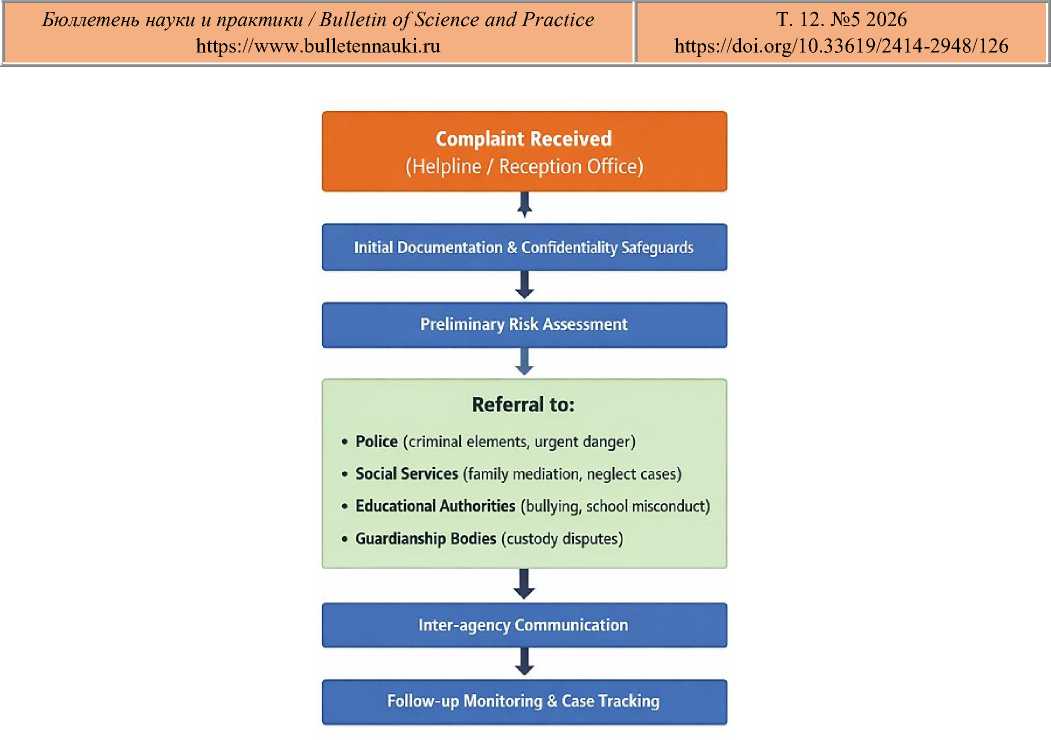
Figure 1. Institutional Referral Flow
While the referral mechanism addresses individual cases, public reception offices and child helplines also perform a broader preventive and awareness-raising function. UNICEF Kyrgyzstan (n.d.) emphasizes that effective child protection systems must combine reactive and preventive elements. Public visibility of reporting mechanisms reduces silence around violence and promotes societal intolerance toward abuse [1].
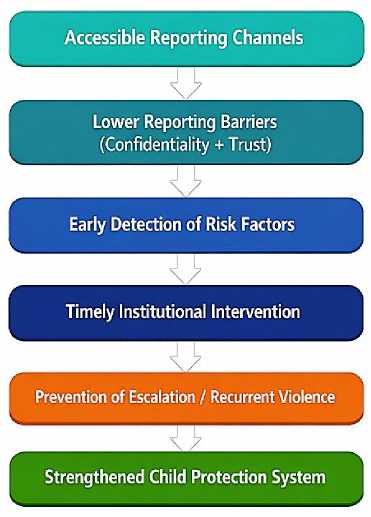
Figure 2. Preventive Impact Model
Monitoring reports of the Ombudsman of the Kyrgyz Republic indicate that increased awareness of hotline services correlates with higher reporting rates, particularly in cases of psychological violence and school bullying. This suggests that accessibility does not merely reflect demand but actively shapes detection rates. The preventive function operates along three levels: 1. Individual level — children and families receive guidance before harm escalates; 2. Institutional level — data from helplines identifies systemic vulnerabilities; 3. Societal level — public campaigns normalize reporting and reduce stigma. Public reception offices also contribute to legal education through outreach events, cooperation with schools, and dissemination of informational materials. This expands their role beyond complaint processing into the domain of child-rights advocacy.
The preventive model aligns with General Comment № 13, which stresses that States must implement proactive strategies to prevent violence before it occurs [9].
By enabling early disclosure, helplines transform isolated incidents into actionable institutional knowledge. Furthermore, preventive visibility strengthens institutional accountability. When children and families are aware of accessible reporting channels, authorities face increased expectations for transparency and responsiveness. The institutional referral mechanism and preventive function are interdependent. The referral structure ensures procedural response, while the preventive dimension enhances early detection and systemic awareness. Together, they position public reception offices and child helplines as: Access-to-justice facilitators; Coordination hubs; Early warning systems; Accountability instruments within child rights governance. Although institutional mechanisms such as Child Helpline 111 and public reception offices have strengthened access to child protection services, the findings reveal several structural weaknesses that limit their overall effectiveness and preventive capacity. One of the most significant challenges is the disparity between urban and rural regions. While the hotline operates nationwide, physical public reception offices and specialized child protection units are concentrated in major cities. Rural communities may lack direct institutional presence, leading to: Reduced awareness of available complaint mechanisms; Limited access to follow-up support services; Logistical delays in case verification and intervention. UNICEF Kyrgyzstan (2023) highlights regional inequality as a recurring concern in national child protection assessments. Without local-level institutional capacity, referral-based systems may fail to translate reporting into effective protection [7].
Although complaints are received and referred, inter-agency communication often relies on traditional administrative procedures. The absence of interoperable digital systems between helplines, law enforcement, social protection bodies, and educational authorities results in: Fragmented information exchange; Duplication of documentation; Delays in confirmation of protective measures; Limited data analytics for policy improvement. Digital integration is critical for transforming complaint systems into coordinated case-management frameworks [7].
Currently, there is no centralized national database enabling cross-sector case tracking. As a result: Cases may be transferred without systematic follow-up; Statistical aggregation may be incomplete; Institutional learning from repeated patterns of abuse remains limited. The lack of unified tracking undermines both preventive governance and evidence-based policymaking. Effective casemanagement systems are essential for implementing the coordinated institutional model required under General Comment № 5 [10].
Public reception offices and the Ombudsman issue recommendations rather than binding decisions. Although this preserves institutional independence, it also creates reliance on voluntary compliance by executive authorities. Consequences include: Inconsistent enforcement of protective measures; Variability in institutional responsiveness; Potential erosion of public trust when recommendations are not implemented.
Бюллетень науки и практики / Bulletin of Science and Practice Т. 12. №5 2026 IDENTIFIED GAPS AND SYSTEMIC RISKS Table 3 Structural Issue Practical Consequence Systemic Impact Risk Level Regional disparities Limited rural accessibility Unequal protection coverage High Lack of digital integration Delayed case tracking Fragmented coordination Moderate Resource constraints Reduced follow-up capacity Weakened monitoring High Informal coordination Inconsistent response quality Procedural variability Moderate Non-binding recommendations Voluntary compliance Accountability gaps Moderate–High
These structural limitations weaken the preventive potential of complaint mechanisms. While helplines effectively lower reporting barriers, insufficient integration and monitoring capacity may reduce the long-term impact of institutional intervention. The findings suggest that complaint mechanisms are stronger at intake and referral stages than at systemic follow-up and preventive transformation. To fully realize their preventive function, mechanisms must be supported by: Integrated digital infrastructure; Strengthened regional capacity; Standardized inter-agency protocols; Enhanced monitoring authority. The results confirm that public reception offices and child helplines are indispensable components of the child protection framework in the Kyrgyz Republic. They enhance visibility of violations, facilitate early detection, and strengthen institutional accountability.
However, their long-term effectiveness depends on structural modernization, digital integration, and expansion of preventive governance mechanisms. Strengthening these dimensions would enable complaint systems to evolve from reactive support services into fully integrated pillars of child rights protection and violence prevention. The results of the study confirm that public reception offices and child helplines play a structurally significant role within the child protection framework of the Kyrgyz Republic. However, their institutional potential remains partially underutilized due to systemic coordination gaps and digital limitations.
The findings demonstrate that child helplines effectively reduce reporting barriers by offering confidential, toll-free, and child-sensitive communication channels. This aligns with Article 19 of the Convention on the Rights of the Child and with the implementation requirements articulated in General Comment №13, which emphasize the need for safe and accessible reporting mechanisms [4, 7].
From a governance perspective, helplines serve as “entry nodes” in the child protection system, facilitating early disclosure of abuse and connecting children with competent authorities. This reinforces the interpretation of complaint mechanisms as integral components of access to justice for minors. However, accessibility alone does not guarantee effective protection. The discussion suggests that accessibility must be combined with institutional responsiveness and enforceability in order to generate sustainable protective outcomes. The empirical findings indicate that current institutional practice is more strongly oriented toward reactive case processing than toward preventive risk mitigation. While helplines facilitate rapid referral in crisis situations, preventive analytics — such as systematic trend monitoring and early risk mapping — remain underdeveloped. UNICEF Kyrgyzstan (2023) underscores the importance of prevention-oriented governance in child protection systems. Effective prevention requires integration of complaint data into policy design, targeted awareness campaigns, and regional outreach strategies. The absence of unified case-tracking systems limits the ability to transform individual complaints into structural prevention measures [7].
Thus, the institutional model appears functionally sound at the micro-level (individual case intervention) but requires strengthening at the macro-level (systemic prevention and policy feedback). The referral-based structure reflects the coordinated institutional framework recommended in General Comment №5. Nevertheless, practical implementation reveals dependence on inter-agency communication quality and voluntary compliance with recommendations. The discussion highlights a structural paradox: helplines initiate protection procedures but lack binding authority. While this preserves institutional neutrality, it may weaken enforcement consistency. Strengthening formalized inter-agency protocols and digital case integration would improve accountability and reduce procedural fragmentation. Comparative international practice demonstrates that integrated child protection information systems significantly enhance institutional efficiency and transparency. Therefore, digital modernization should be regarded not merely as a technical upgrade but as a structural reform instrument. The increase in reported school-based and psychological violence cases suggests growing awareness and trust in complaint mechanisms. Public visibility of reporting channels contributes to normalization of disclosure and reduction of stigma. However, sustained trust depends on demonstrable outcomes. If children and families perceive those complaints do not lead to tangible protective measures, confidence in the system may decline. Institutional transparency, feedback mechanisms, and public reporting on resolved cases can strengthen trust and encourage continued engagement. The discussion confirms that the long-term effectiveness of public reception offices and helplines depends on: Regional equalization of access; Integrated digital case management; Formalized coordination protocols; Strengthened preventive analytics; Enhanced institutional authority in monitoring compliance. These measures would transform complaint mechanisms from reactive communication platforms into fully integrated governance tools within the national child protection architecture. The study confirms that public reception offices and child helplines constitute essential institutional mechanisms within the child protection system of the Kyrgyz Republic. By providing confidential, accessible, and child-sensitive communication channels, these mechanisms significantly reduce reporting barriers and enhance children’s access to protection and justice. Their operation aligns with international obligations under the Convention on the Rights of the Child and the implementation standards articulated in General Comments № 5 and № 13 of the Committee on the Rights of the Child [2, 8, 9].
The findings demonstrate that helplines function effectively as entry points and referral nodes within a coordinated institutional framework. They facilitate early detection of domestic and schoolbased violence, connect victims to competent authorities, and contribute to institutional accountability. However, their effectiveness remains closely dependent on inter-agency coordination, regional accessibility, and the responsiveness of enforcement bodies. At the same time, the analysis reveals that the preventive potential of complaint mechanisms is not fully realized. Structural gaps — such as limited digital integration, absence of unified case-tracking systems, and uneven regional access — constrain the transformation of individual complaints into systemic prevention strategies. Strengthening digital infrastructure and establishing interoperable case-management systems would significantly enhance monitoring capacity, transparency, and policy feedback loops. The practical significance of this research lies in its identification of institutional modernization priorities. To improve the organizational and legal model of child protection mechanisms, it is recommended to: Develop a unified digital case-management platform connecting helplines, law enforcement, social services, and educational institutions; Expand regional outreach and ensure equal access to public reception services in rural areas; Formalize inter-agency coordination protocols to reduce procedural fragmentation; Strengthen preventive analytics by integrating complaint data into national child protection strategies; Enhance public awareness campaigns to promote trust and encourage early reporting. Future research should focus on empirical impact evaluation of referral outcomes, comparative analysis with regional best practices, and assessment of digital governance solutions in child protection systems. Overall, the study concludes that public reception offices and child helplines represent critical pillars of child rights protection in the Kyrgyz Republic. With targeted institutional strengthening and digital modernization, they can evolve into fully integrated, prevention-oriented instruments within a sustainable and accountable child protection framework.
Sources:
-
1. Child Helpline International. (n.d.). Kyrgyzstan – Child Helpline 111. https://clc.li/bBVOw2 . Government of the Kyrgyz Republic. (n.d.). Hotlines and family support services. https://bishkek.gov.kg
-
3. Ministry of Justice of the Kyrgyz Republic. (2017). Law of the Kyrgyz Republic No. 63 “On Protection and Safeguarding from Family Violence”. https://clc.li/OcpfQ
-
4. Ministry of Labor, Social Security and Migration of the Kyrgyz Republic. (2020). Center “Child Helpline 111” activities and training initiatives. https://mlsp.gov.kg
-
5. Ombudsman of the Kyrgyz Republic. (n.d.). Reports on children’s rights protection. https://ombudsman.kg
-
6. UNICEF Kyrgyzstan. (n.d.). Child protection in Kyrgyzstan. https://clc.li/xTCJx
-
7. UNICEF Kyrgyzstan. (2023). Situation analysis of children in Kyrgyzstan. https://clc.li/DcMZk
-
8. United Nations. (1989). Convention on the Rights of the Child. https://clc.li/OYjTN
-
9. United Nations Committee on the Rights of the Child. (2011). General Comment No. 13: The right of the child to freedom from all forms of violence. https://www.ohchr.org
-
10. United Nations Committee on the Rights of the Child. (2003). General Comment No. 5: General measures of implementation of the Convention on the Rights of the Child. https://www.ohchr.org
Поступила в редакцию 06.03.2026 г.
15.03.2026 г.
